
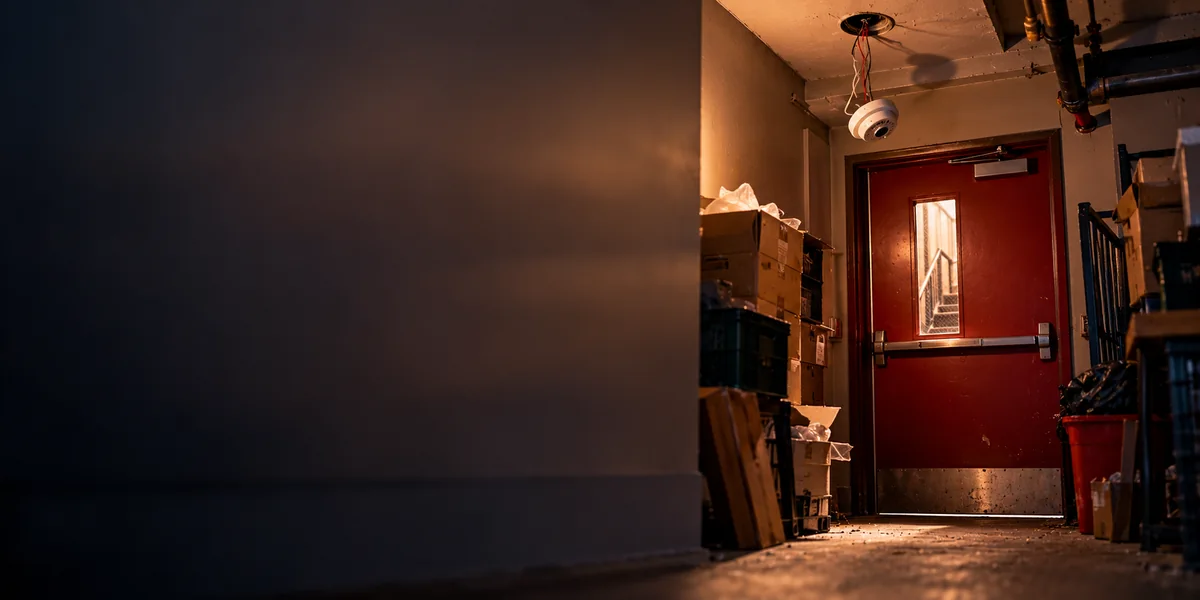
The Short Answer
Yes, you can sue your landlord for an unremedied fire hazard, and you do not have to wait for an actual fire to take legal action.
Landlords have a non-negotiable legal duty under municipal fire safety codes and the Implied Warranty of Habitability to protect tenants from preventable fire hazards. If your landlord ignores severe fire code violations, your legal rights follow two distinct paths:
Path 1: Pre-Fire Emergency Relief & Rent Abatement
If your building has missing smoke alarms, blocked fire escapes, or dangerous wiring, you can call the municipal Fire Marshal for an emergency inspection. You can sue in Small Claims Court for a 15% to 50%+ retroactive rent refund, force emergency repairs through a court order, or terminate your lease immediately without penalties under the Constructive Eviction doctrine.
Path 2: Post-Fire Commercial Liability Lawsuit
If a fire breaks out because your landlord ignored prior warnings or failed to maintain fire systems, you can sue their commercial liability insurance. You can claim 100% full replacement value for all lost personal property, emergency hotel bills, medical care for burns or smoke inhalation, and compensation for severe emotional distress.
What You Need to Know
- A Fire Marshal Citation Proves Negligence Per Se: An official Notice of Violation from your city Fire Prevention Bureau proves that the landlord violated a public safety statute. In court, this establishes negligence automatically and bars the landlord from claiming ignorance.
- You Never Have to Wait for a Fire to Sue: Missing smoke detectors, dead carbon monoxide alarms, and padlocked fire doors violate the warranty of habitability immediately. You can file for emergency court injunctions, rent escrow, or retroactive rent refunds today.
- Blocked Fire Escapes and Wedged Doors Are Serious Offenses: Chaining exterior exit doors, allowing trash or bikes to block hallways, or removing self-closing hinges exposes landlords to escalating daily fines, stop-work orders, and misdemeanor charges.
- Constructive Eviction Lets You Break Your Lease Penalty-Free: When a landlord ignores critical fire code notices for 24 to 72 hours, the apartment is legally uninhabitable. You can vacate, return your keys, cancel future rent obligations, and demand your full deposit back.
- Commercial Landlord Insurance Pays Full Replacement Value: While basic renter policies often depreciate your goods, a liability lawsuit against your landlord's commercial insurance demands brand-new replacement costs, alternative housing, and pain and suffering damages.
The 5 Most Common Apartment Fire Code Violations
Residential fire safety laws protect human life. Unlike cosmetic problems like peeling wallpaper or squeaky floorboards, building fire hazards create an immediate threat of catastrophic injury or death. Municipalities across the United States enforce strict standards derived from the National Fire Protection Association (NFPA) and the International Fire Code (IFC).
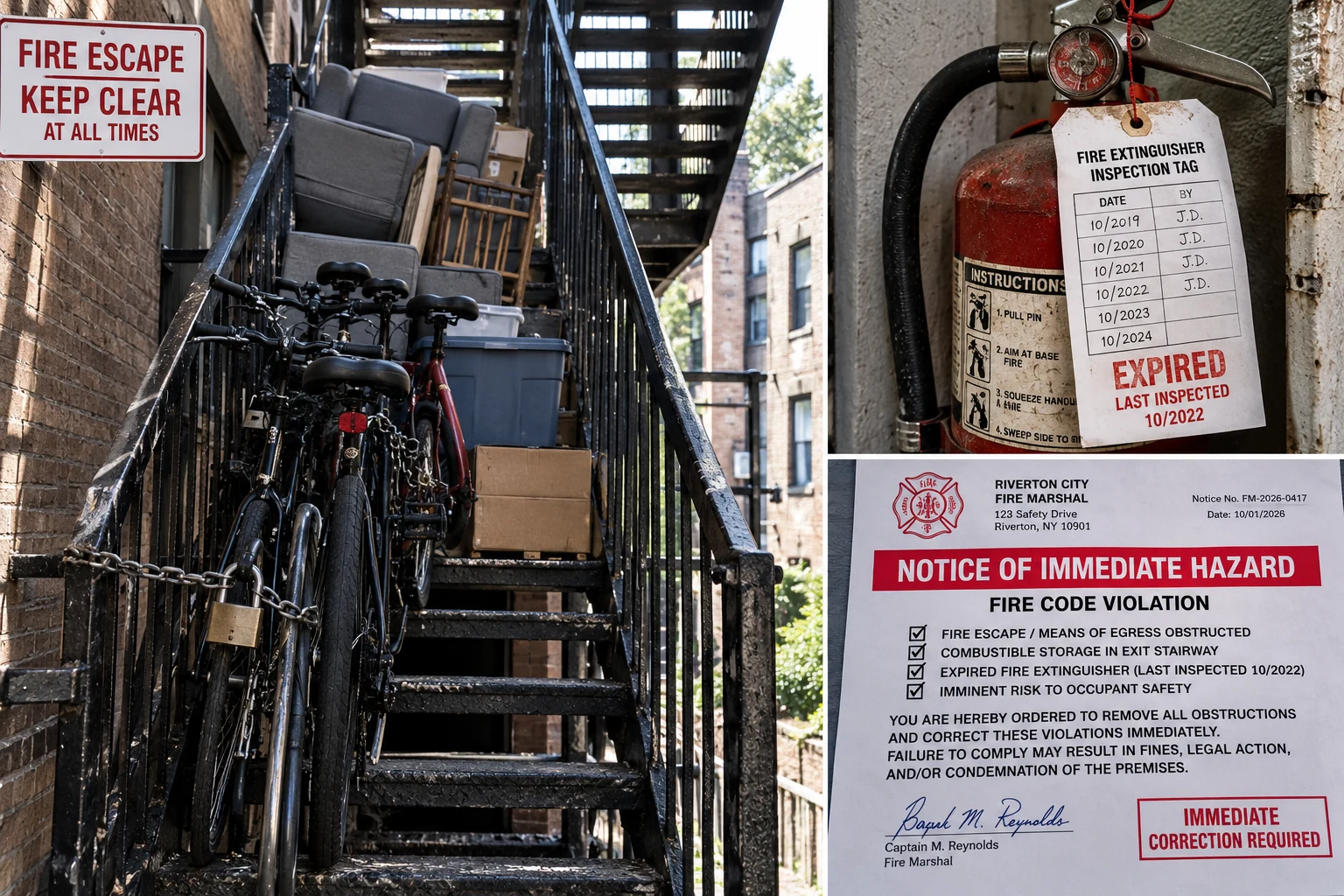
When landlords cut maintenance corners, fail to inspect alarms, or block egress routes, they violate the Implied Warranty of Habitability as a matter of law. The table below details the five most frequent fire code violations found in apartment buildings, the binding legal standards, and the evidence required to prove your claim in court:
| Fire Code Violation | Governing Safety Standard | Tenant Evidence Required | Landlord Legal Duty |
|---|---|---|---|
| 1. Missing or Dead Smoke & CO Detectors | NFPA 72 & Local Housing Codes | Photos of bare ceiling mounting brackets, video showing test button silence, written maintenance requests. | Install working 10-year sealed battery or hardwired alarms inside every bedroom and in immediately adjacent hallways. |
| 2. Blocked Fire Escapes & Padlocked Exits | IFC § 1031 (Means of Egress) & NFPA 101 | Photographs of padlocked gates, storage clutter blocking exit corridors, or rusted drop-ladders that fail to release. | Maintain 100% unobstructed exit access 24/7; security window bars must have interior tool-free quick-release levers. |
| 3. Wedged Open or Broken Self-Closing Fire Doors | IFC § 703 & NFPA 80 (Fire Door Assemblies) | Video showing corridor fire door remaining open or latch failing to catch; photos of wooden wedges or kickstands. | Keep stairwell and corridor fire doors fully operational and self-closing to stop deadly smoke migration between floors. |
| 4. Sparking Panels, Overloaded Circuits & Bad Wiring | IPMC § 604 & National Electrical Code (NFPA 70) | Photos of scorched breaker boxes, melted outlet plates, thermal imaging showing hot circuits, electrician inspection receipts. | Provide adequate electrical capacity, replace obsolete knob-and-tube or aluminum wiring, and eliminate arcing hazards. |
| 5. Faulty Heating Flues & Unvented Space Heaters | NFPA 54 & IPMC § 603 (Mechanical Equipment) | Gas utility Red-Tag citation, carbon monoxide detector readings, photos of cracked furnace heat exchangers. | Maintain licensed central heating systems; never force tenants to rely on hazardous portable kerosene or electric space heaters. |
If any of these conditions exist in your building, you are not merely dealing with a repair inconvenience. You are living in a documented fire trap that triggers emergency legal rights under state habitability statutes.
For broader procedures on calculating statutory damages and taking a property owner to Small Claims Court, review our central guide on suing your landlord.
How Calling the Fire Marshal Fast-Tracks Landlord Action
Many tenants make the mistake of calling standard city code enforcement when they spot dangerous fire hazards. Municipal building code inspectors often take several weeks to schedule a visit, and their violation notices typically give landlords 30 days to resolve problems.
The municipal Fire Marshal operates under completely different emergency authority. Your local Fire Department\'s Fire Prevention Bureau has an immediate life-safety mandate. When a tenant calls reporting blocked fire escapes, missing smoke detectors in a multi-unit complex, or sparking breaker boxes, Fire Marshals frequently respond within 24 to 48 hours.
The Power of a Fire Marshal Inspection Report
Fire Marshals carry quasi-police powers that standard building inspectors lack:
- Same-Day Criminal Citations: In many jurisdictions, padlocked fire doors and disabled exit routes result in immediate misdemeanor citations and daily fines against the property owner.
- Emergency Condemnation Orders: If an apartment building lacks operational smoke alarms and exit access, the Fire Marshal can declare the property an imminent life hazard and order emergency repairs under threat of red-tagging the building.
- Automatic Proof of Negligence Per Se: In civil court or Small Claims hearings, a written Fire Marshal Notice of Violation proves statutory violation as a matter of law. You do not have to prove that the landlord was careless; the government citation confirms the violation conclusively.
Step-by-Step Protocol to File a Fire Safety Complaint
- Gather Clear Visual Evidence: Take high-resolution photographs and videos of the hazard. If smoke detectors are missing, photograph the bare ceiling junction. If a fire escape is blocked, capture the entire exit corridor showing the obstruction.
- Call Your Local Fire Prevention Bureau: Do not dial 911 unless an active fire or gas smell is present. Search online for your city\'s non-emergency Fire Marshal or "Fire Prevention Bureau Inspection Division."
- Request a Physical Site Inspection: State clearly: "I am a tenant reporting an imminent life-safety code violation regarding blocked fire exits and missing smoke detection systems."
-
Obtain the Written Incident Report: Ask the inspecting officer for the case or inspection number. Submit a public records request or visit the fire prevention office to pick up a certified copy of the Notice of Violation.
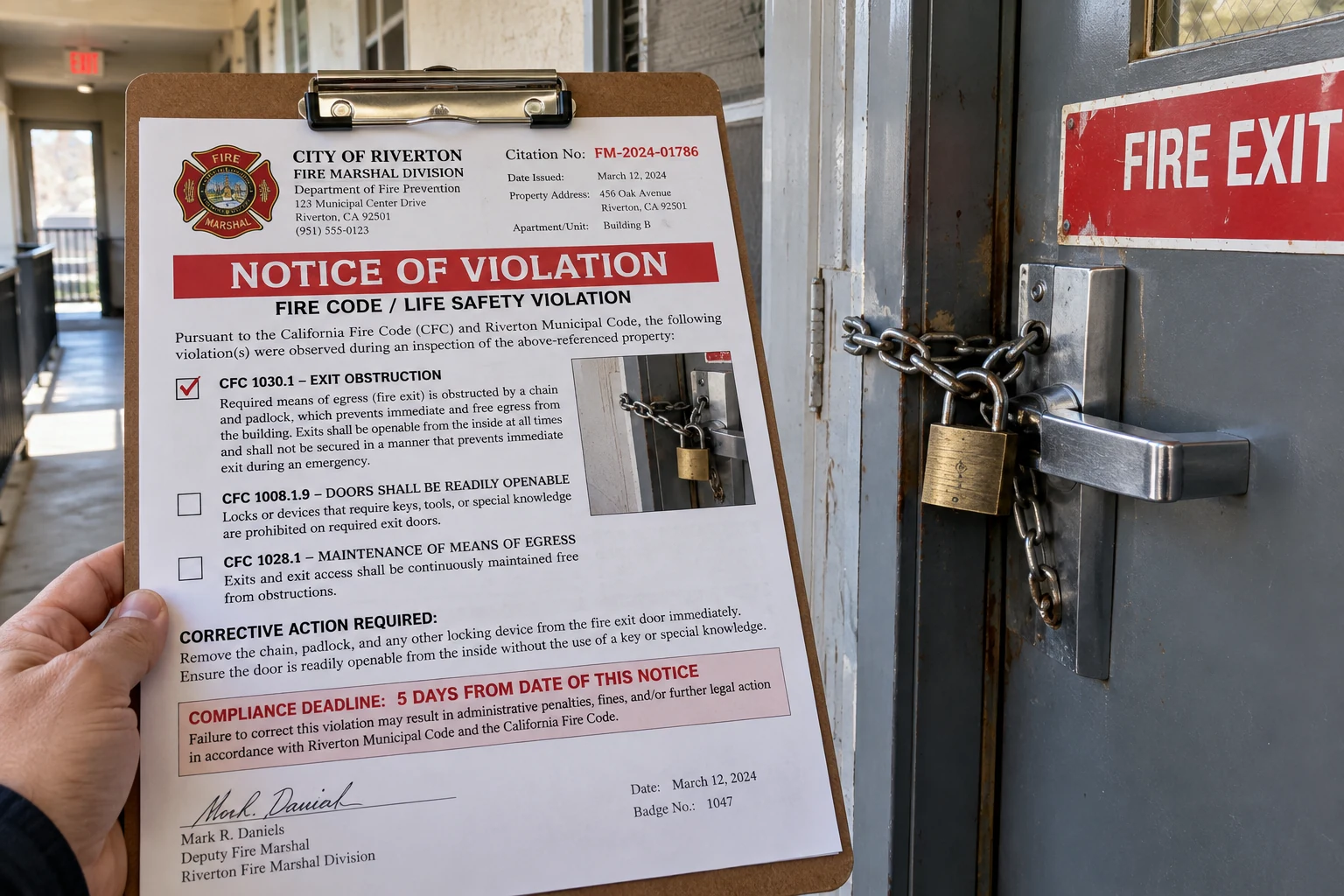
Fire Marshal Notice of Violation: A formal municipal citation documenting padlocked fire exits or missing alarms conclusively establishes negligence per se in court.
If a Fire Already Happened: Origin & Cause Reports and Suing Commercial Insurance
If an actual fire has already damaged your apartment or building, your legal posture changes dramatically. You are no longer pursuing preventative rent abatement; you are building a commercial tort lawsuit against the landlord and their property liability insurance provider.
Following any apartment fire, the municipal Fire Investigation Unit (FIU) conducts an official Origin and Cause Investigation under NFPA 921 standards. Fire investigators dissect electrical outlets, inspect heating appliances, and analyze burn patterns to identify exactly where and why the fire originated.
| Landlord Counter-Defense | Tenant Evidence to Disprove It | Legal Impact on Insurance Payout |
|---|---|---|
| "The tenant started the fire with an unapproved space heater or candle." | Official Fire Marshal Origin & Cause report tracing ignition to building wiring; written maintenance requests showing central heat was broken. | Establishes landlord negligence for failing to provide functional heat, forcing foreseeable tenant countermeasures. |
| "The tenant took down their own smoke alarms." | Move-in inspection checklist showing alarms were never provided; pre-fire certified letters demanding installation. | Destroys landlord claim of tenant interference; confirms violation of state smoke alarm statutes upon lease signing. |
| "The tenant should rely solely on their own renter's insurance." | Commercial General Liability (CGL) claim filing; insurance subrogation records. | Renter\'s insurance only pays depreciated value. The landlord\'s insurer is liable for 100% replacement value, hotels, and pain and suffering. |
Recoverable Damages in an Apartment Fire Lawsuit
When landlord negligence causes an apartment fire or accelerates fire spread due to missing barriers, you can recover comprehensive economic and non-economic damages:
- Full Personal Property Replacement: The actual cost to replace your furniture, electronics, clothing, and household goods at brand-new retail prices.
- Emergency Hotel & Long-Term Relocation: Every night of hotel lodging, short-term furnished apartment rent, moving van rentals, and storage unit fees incurred while you search for permanent housing.
- Medical Treatment & Ongoing Therapy: Hospital emergency room invoices, pulmonary treatments for smoke inhalation, burn surgeries, and psychological therapy for post-traumatic stress.
- Pain, Suffering & Emotional Distress: Substantial non-economic recovery for the terror of escaping a burning building and losing cherished personal possessions.
How to Break Your Lease for Severe Fire Hazards Without Penalties
Tenants often feel trapped in dangerous buildings because their lease contains aggressive early termination penalty clauses—such as demanding two months of rent to break the contract.
Under the established legal doctrine of Constructive Eviction, a landlord who fails to provide a fire-safe home forfeits the right to enforce the lease agreement. The law recognizes that you cannot be forced to risk your life sleeping in a residential unit that violates core fire safety codes.
The 4 Essential Rules of Constructive Eviction
- The Condition Must Pose a Critical Life Hazard: Blocked fire escapes, missing smoke detectors, unpermitted wiring, or red-tagged appliances satisfy this threshold immediately.
- You Must Deliver Formal Written Notice: You must send formal notice detailing the life-safety emergency. Text messages are often challenged; use Certified Mail with return receipt or the official management portal.
- The Landlord Must Fail to Cure Within Statutory Windows: For acute life-safety emergencies, the cure window is typically 24 to 72 hours, not the standard 30 days applied to minor cosmetic repairs.
- You Must Actually Surrender the Premises: You cannot claim constructive eviction while continuing to occupy the apartment. You must vacate the premises, remove your possessions, and hand back all keys.
Recovering Your Security Deposit and Protecting Your Credit
When executing a constructive eviction for fire hazards, attach a copy of the Fire Marshal\'s inspection report or photographic evidence directly to your termination letter. State explicitly that possession is being surrendered due to constructive eviction and demand the return of your full security deposit within your state\'s statutory window (typically 14 to 30 days).
If the landlord attempts to report an early termination penalty to credit bureaus, submit your Fire Marshal Notice of Violation and termination letter directly to Experian, TransUnion, and Equifax to dispute and permanently remove the unauthorized trade-line.
Formal Demand Letter Generator: Pre-Fire & Post-Fire Notices
Sending a legally binding demand letter creates the paper trail required to win in court. Select the appropriate notice below based on whether you are forcing urgent safety repairs or demanding compensation following a fire:
How Much Can You Sue for Regarding Fire Code Violations?
When taking legal action against a landlord in Small Claims Court or Civil District Court, financial recovery is based on documented economic losses, statutory damages, and premises liability standards:
| Recovery Category | Calculation Standard | Statutory Authority & Limits |
|---|---|---|
| 1. Mandatory Rent Withholding / Escrow | Deposit of monthly rent into a court-supervised escrow account until certified fire code citations are fully abated by licensed contractors. | Municipal housing court escrow statutes. |
| 2. Judicial Injunction & Per-Day Civil Fines | Court orders compelling immediate clearance of blocked fire escapes, installation of hardwired smoke detectors, and daily statutory fines for contempt. | International Fire Code (IFC) & NFPA 1. |
| 3. Penalty-Free Lease Termination | Immediate judicial cancellation of the lease agreement with complete return of the security deposit due to hazardous living conditions. | Warranty of Habitability. |
Small Claims Filing Limits: Most property damage and minor habitability disputes are resolved efficiently in Small Claims Court without hiring a lawyer. Maximum claim thresholds vary by jurisdiction: for example, $12,500 in California (California Courts Self-Help), $10,000 in New York City (NY Courts Small Claims), and $20,000 in Texas (Texas Judicial Branch). If catastrophic fire, severe burn injuries, or toxic asphyxiation damages exceed small claims ceilings, claims proceed through standard Civil District Court.
Frequently Asked Questions
Can I sue my landlord if there was no fire, but there are severe fire hazards? +
Yes. You do not need to wait for a fire to take legal action. Maintaining active fire hazards—such as missing smoke alarms, blocked fire escapes, or illegal electrical wiring—violates municipal fire codes and the Implied Warranty of Habitability. Tenants can sue in Small Claims Court for retroactive rent abatement (a 15% to 50%+ refund of rent paid while living in danger), obtain an emergency court injunction forcing immediate repairs, or legally break their lease without penalty.
What should I do if my landlord padlocks or blocks our building's fire escape? +
Photograph the obstruction immediately and call your local Fire Marshal or Fire Prevention Bureau rather than standard code enforcement. Padlocked fire escapes, blocked hallways, and bolted emergency doors are critical life-safety emergencies. Fire Marshals have the legal authority to issue same-day emergency abatement orders and assess daily criminal fines against the property owner until the exit path is completely cleared.
Can I break my lease immediately if the apartment has no working smoke detectors? +
Yes, under the doctrine of Constructive Eviction. State laws and building codes require working smoke alarms outside sleeping areas. Send an urgent written notice demanding installation within 24 to 72 hours. If your landlord fails to provide operational detectors within this emergency window, the apartment is legally uninhabitable. You can vacate immediately, surrender your keys, avoid future lease rent, and demand your full security deposit.
Who pays for my hotel if a fire hazard or fire makes my apartment unlivable? +
If the city red-tags your building or an emergency Fire Marshal order forces you out due to landlord negligence, the landlord is legally liable for your temporary lodging costs. While your renter's insurance "Loss of Use" coverage can pay immediate hotel bills upfront, your insurer will subrogate against the landlord's commercial property liability insurance to recover every dollar.
What is a Fire Marshal "Notice of Violation" and how does it prove my lawsuit? +
A Fire Marshal Notice of Violation is an official government inspection citation documenting specific fire safety code breaches on the property. In a civil lawsuit or Small Claims hearing, this official report establishes "Negligence Per Se"—meaning the landlord is considered negligent as a matter of law because they violated a life-safety statute, eliminating their ability to argue that the building was reasonably safe.
SueLegal is an independent educational legal publisher, not a law firm or lawyer referral service. The information provided in this guide is for general informational and educational purposes only and does not constitute formal legal advice. Residential landlord-tenant laws, repair notice periods, and statutory remedies vary significantly across state and municipal jurisdictions. If you are facing eviction, severe uninhabitable conditions, or complex litigation, consult a licensed attorney in your jurisdiction or contact your local legal aid organization. For more details on our standards, read our Editorial Policy and Legal Research Methodology.