
What You Should Know
- Normal Wear and Tear Cannot Be Deducted: Faded paint, carpet wear along walking paths, minor baseboard scuffs, and small nail holes are ordinary residential depreciation that landlords must absorb by law.
- Landlords Must Furnish Itemized Receipts: In states like California, New York, Texas, and Florida, landlords who deduct more than statutory thresholds (e.g., $125 in CA) must attach actual third-party contractor invoices, material receipts, or hourly labor breakdowns.
- Missing the Statutory Clock Forfeits All Deductions: If your landlord fails to mail the deposit or accounting within your state's statutory deadline (e.g., 21 days in CA, 14 days in NY, 30 days in TX), judicial precedent (e.g., Granberry v. Islay Investments) holds that the landlord completely forfeits the right to withhold any funds.
- Bad Faith Triggers Double or Treble Damages: Intentionally inflating cleaning estimates or withholding funds in retaliation allows tenants to claim statutory penalty multipliers of up to triple the withheld amount in small claims court.
- Demand Letters Establish Written Bad Faith: Sending a formal 10-day demand letter citing state deposit codes before filing proves to the judge that the landlord had clear notice and refused to comply willingly.
If your former landlord told you that routine turnover painting, steam carpet cleaning, or small picture nail holes come out of your security deposit, they are counting on your ignorance of the law. Under statutory property acts across all 50 states, a security deposit is not a post-tenancy renovation slush fund—it remains the legal property of the tenant held in strict fiduciary trust.
Too often, corporate property managers and individual landlords treat security deposits as an automatic parting fee, fabricating inflated $400 cleaning charges or withholding the entire balance without providing mandatory contractor invoices. When a landlord misses your state's statutory return deadline (typically 14 to 30 days) or deducts for normal residential wear and tear, state law does not just require a refund—it subjects the landlord to statutory bad-faith penalties of double or triple (2x to 3x) the deposit.
For a complete procedural roadmap to small claims filing limits, trial preparation, and subpoena rules, visit our central pillar guide on suing your landlord.
The Legal Framework: Security Deposits Are Fiduciary Trust Funds
Under common law and modern landlord-tenant acts, landlords do not "own" security deposits. The deposit is tenant money temporarily held in escrow to guarantee lease performance (such as unpaid rent or structural tenant destruction). Consequently, the law imposes strict fiduciary duties on landlords:
Core Landlord Legal Duties Under State Law
- Rigid Return Deadlines: Landlords must deliver the deposit balance and an itemized accounting within strict calendar windows (e.g., 14 days in NY, 21 days in CA, 30 days in TX).
- Mandatory Third-Party Receipts: In jurisdictions like California (Civ. Code § 1950.5(g)), any deduction over $125 requires copies of actual invoices, receipts, and hourly contractor timecards. Self-generated estimates are legally insufficient.
- Zero Deductions for Normal Wear and Tear: Landlords are legally prohibited from charging tenants for ordinary deterioration resulting from everyday human habitation.
- Written Forfeiture Sanctions: A landlord who fails to provide timely itemized accounting forfeits the summary right to retain any portion of the deposit funds.
Forensic Audit: Normal Wear & Tear vs. Unlawful Landlord Deductions
The most frequent battlefield in small claims court is distinguishing between "Normal Wear and Tear" (which the landlord must absorb as a cost of doing business) and "Tenant Damage" (abnormal neglect or intentional destruction). Use the forensic audit table below to determine whether your landlord's deductions are legally permissible:
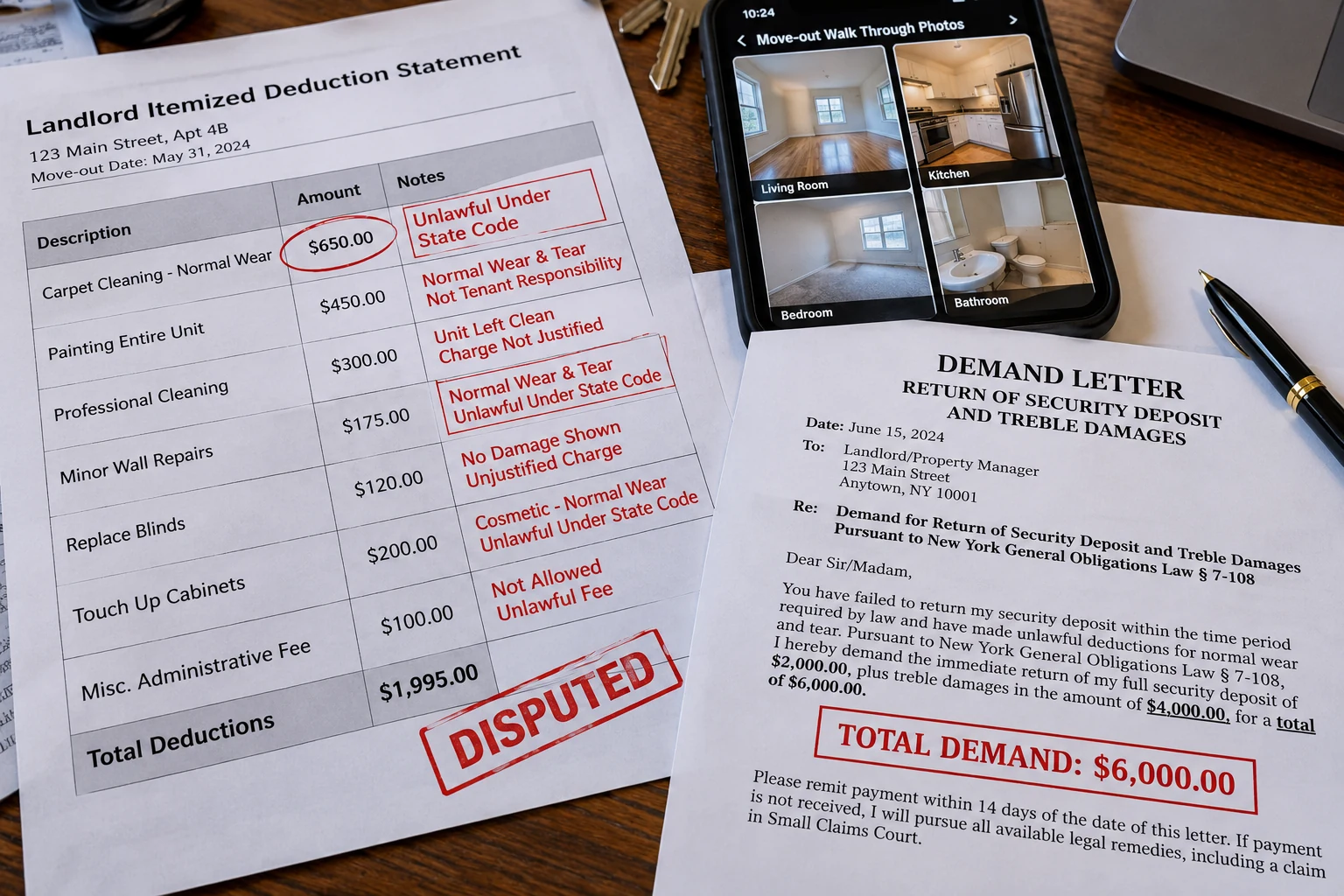
| Item / Deduction Category | What Landlords Claim (Normal Wear & Tear) | What the Law Dictates & Court Precedent |
|---|---|---|
| Wall Paint & Nail Holes | Deducting $350–$600 to repaint an entire living room due to small picture nail holes or faded sunlight spots. | 100% Landlord Responsibility. Small pin holes from hanging artwork, sun-faded walls, and minor corner scuffs are textbook normal wear and tear. Paint has a statutory useful life (typically 2–3 years); landlords cannot charge for repainting after a multi-year tenancy. Learn how to challenge these charges in our dedicated guide on suing your landlord for painting charges. |
| Carpet Wear & Cleaning | Deducting $250–$500 for "professional steam cleaning" or routine traffic lane matting between doors. | Unlawful Automatic Deduction. Landlords cannot charge for routine turnover carpet cleaning unless specified pet urine stains or burns exist. Under IRS guidelines (Publication 527) and common rental accounting standards, residential carpet has a 5-year useful life. While small claims judges apply local wear-and-tear rules, 5+ year old carpet has minimal depreciated value absent intentional destruction. |
| Broom-Clean Standard | Charging $400 for deep-cleaning oven interior, ceiling fans, or behind the refrigerator when the unit was left vacuumed and tidy. | Broom-Clean Requirement Met. Tenants are only required to leave the apartment in "broom-clean" condition, not surgical sterility. Deep sanitation between tenancies is an owner overhead expense. |
| Minor Hardware & Blinds | Deducting $150 for dusty mini-blinds, loose cabinet hinges, or sliding door track stickiness. | Ordinary Mechanical Wear. Inexpensive vinyl mini-blinds degrade under UV sunlight. Loose cabinet handles and door hardware represent normal structural usage that cannot be docked. |
| Missing Invoices & Estimates | Providing a vague line item: "Repairs & Maintenance: $850" with no contractor invoices or receipts attached. | Complete Statutory Violation. In states like CA, NY, and WA, deduction lists without third-party proof are void. Courts routinely award 100% restitution of receiptless amounts. |
State-by-State Statutory Deadlines & Bad-Faith Penalty Multipliers
State legislatures recognize that landlords hold asymmetrical financial leverage after a tenant moves out. To prevent property owners from holding tenant funds hostage, state statutes enforce strict statutory calendars and severe penalty multipliers:
| State | Return Deadline | Governing Statute | Statutory Bad-Faith Penalty & Remedies |
|---|---|---|---|
| California | 21 Days | Cal. Civ. Code § 1950.5 | Full refund + Up to 2x statutory bad-faith damages + Invoices mandatory for deductions over $125. |
| New York | 14 Days | NY Gen. Oblig. Law § 7-108 | Strict forfeiture of right to retain any deposit + Up to 2x punitive damages + Mandatory move-out inspection offer. |
| Texas | 30 Days | Tex. Prop. Code § 92.109 | Presumption of bad faith if missed + $100 statutory penalty + 3x treble damages + Mandatory attorney fees. |
| Florida | 15–30 Days | Fla. Stat. § 83.49 | 15 days if full refund; 30 days to claim deductions via Certified Mail. Missing 30-day notice forfeits all deduction rights. |
| Washington | 30 Days | Wash. Rev. Code § 59.18.280 | Full deposit refund + Up to 2x double damages + Court costs and reasonable attorney fees. |
| Massachusetts | 30 Days | Mass. Gen. Laws c. 186 § 15B | Automatic 3x treble damages + 5% annual interest + Mandatory attorney fees for any statutory non-compliance. |
| Illinois / Chicago | 30–45 Days | 765 ILCS 710/1 & Chicago RLTO § 5-12-080 | Chicago Municipal Code awards double the full deposit amount plus attorney fees for improper withholding. |
Judicial Precedent: Strict Forfeiture for Failing to Provide Timely Accounting
Tenants often fear that even if the landlord missed the statutory return deadline, the landlord can simply show up in Small Claims Court with photos and claim damages retroactively. Judicial precedent roundly rejects this landlord maneuver.
Landmark Case Precedent: Granberry v. Islay Investments (1995) 9 Cal.4th 738
In Granberry v. Islay Investments, the California Supreme Court ruled that security deposit accounting statutes establish strict consumer protections. A landlord who fails to provide an itemized disposition within the statutory window forfeits the summary right to retain deposit funds.
While the landlord may attempt an independent lawsuit for proven damages, they cannot unilaterally offset funds from the deposit. If the landlord acted in bad faith, courts routinely award the full deposit plus double or treble damages without allowing the landlord to raise unproven counterclaims.
Legal Significance: Gives tenants total leverage. When the statutory clock expires without accounting, the tenant possesses an immediate, enforceable claim for statutory penalties.
Step-by-Step Security Deposit Recovery Protocol
-
1
Step 1: Deliver Written Forwarding Address
In states like Texas, Florida, and Ohio, the statutory return clock does not begin until the tenant delivers a written forwarding address. Send it via Certified Mail with tracking or official tenant portal upon surrendering keys.
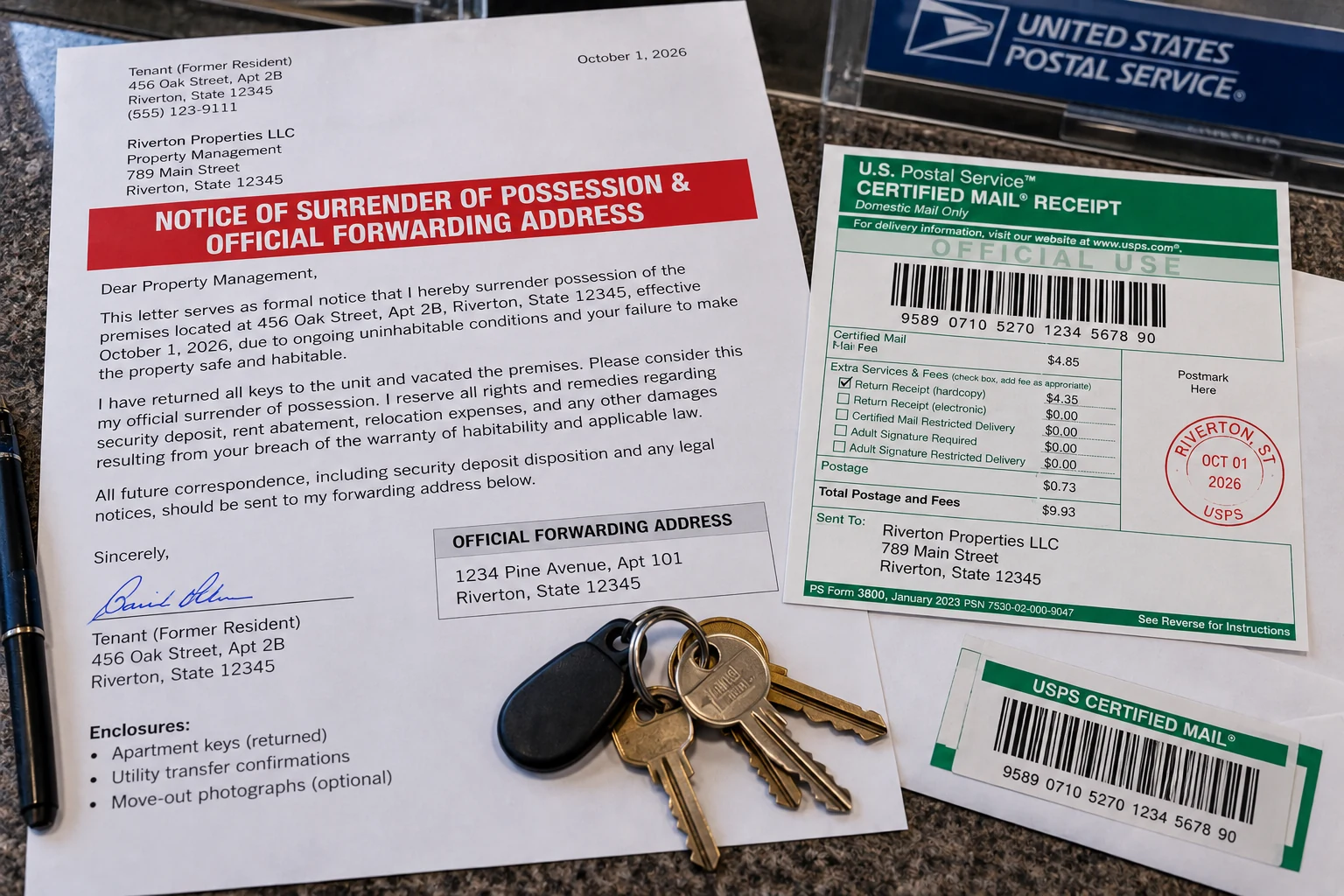
Step 1 Forwarding Address: Delivering a written forwarding address with tracking begins the landlord's mandatory statutory return clock. -
2
Step 2: Preserve Move-Out Inspection Photos and Video
Collect your move-out walk-through video, timestamped photos of every room, and your original move-in inspection sheet. If the landlord failed to conduct a joint walk-through inspection after your written request, note that violation.
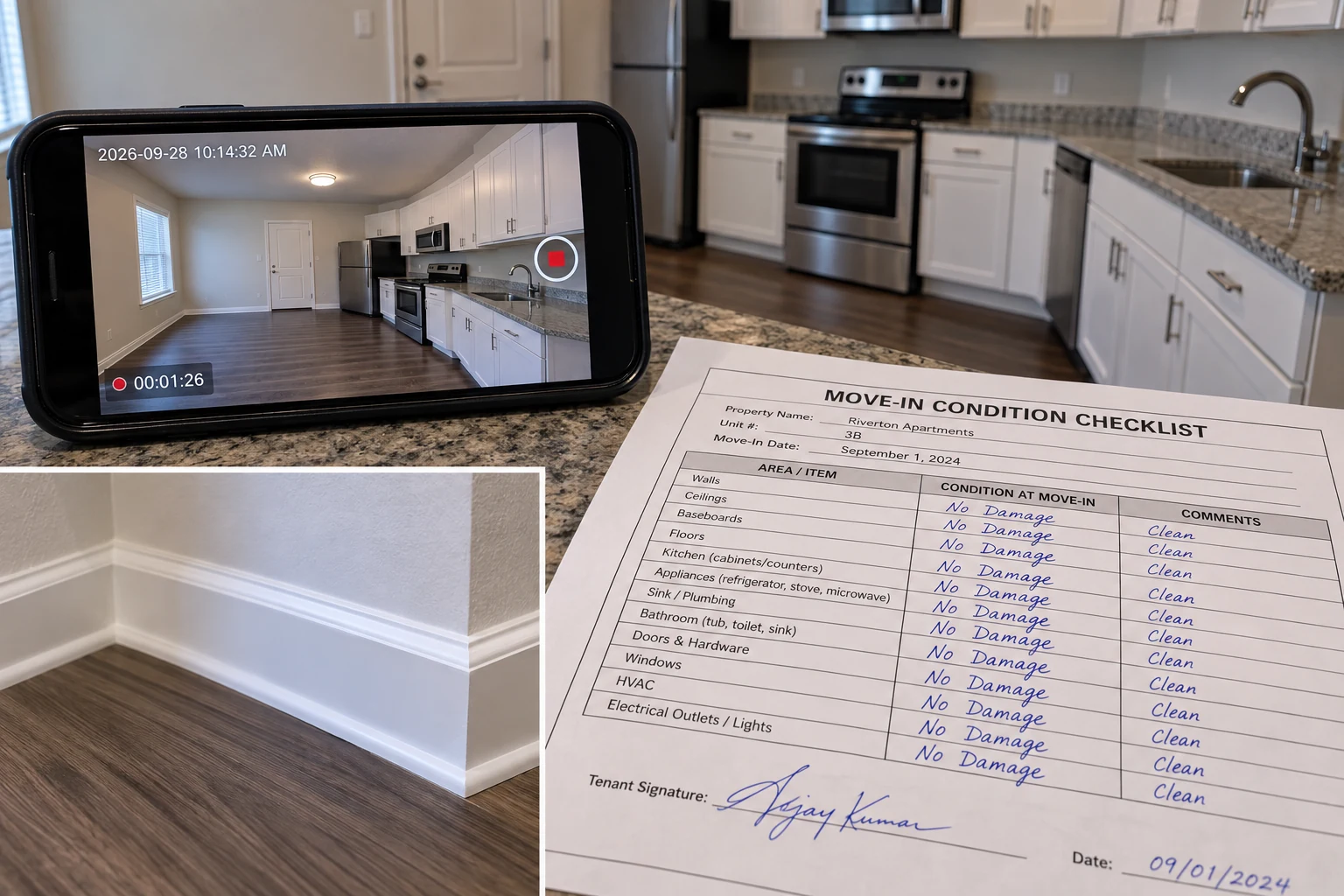
Step 2 Move-Out Video: A continuous move-out walkthrough video paired with original check-in sheets disproves fictitious repair charges. -
3
Step 3: Calendar the Statutory Return Clock
Track day 14 (NY), day 21 (CA), or day 30 (TX, WA, MA). If the deadline passes without receiving either your full refund check or an itemized accounting with contractor receipts, the landlord is in default.
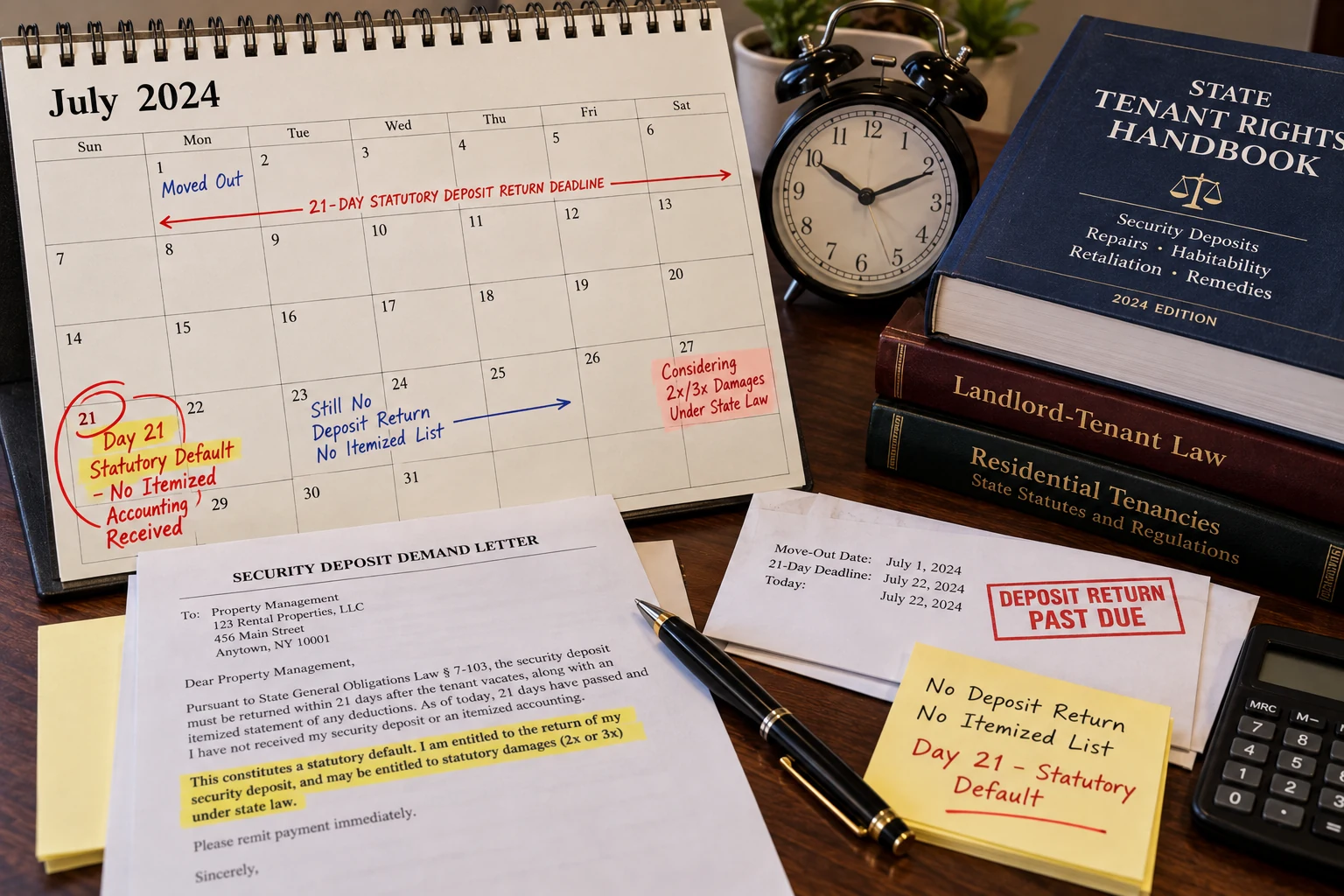
Step 3 Statutory Deadlines: Missing the statutory 14, 21, or 30-day deadline generally forfeits the landlord's right to withhold any deductions. -
4
Step 4: Send a Formal 10-Day Statutory Demand Letter
Use our interactive tool below to generate an airtight Demand Letter citing specific state code sections and bad-faith penalty multipliers. Send via USPS Certified Mail with Return Receipt Requested.
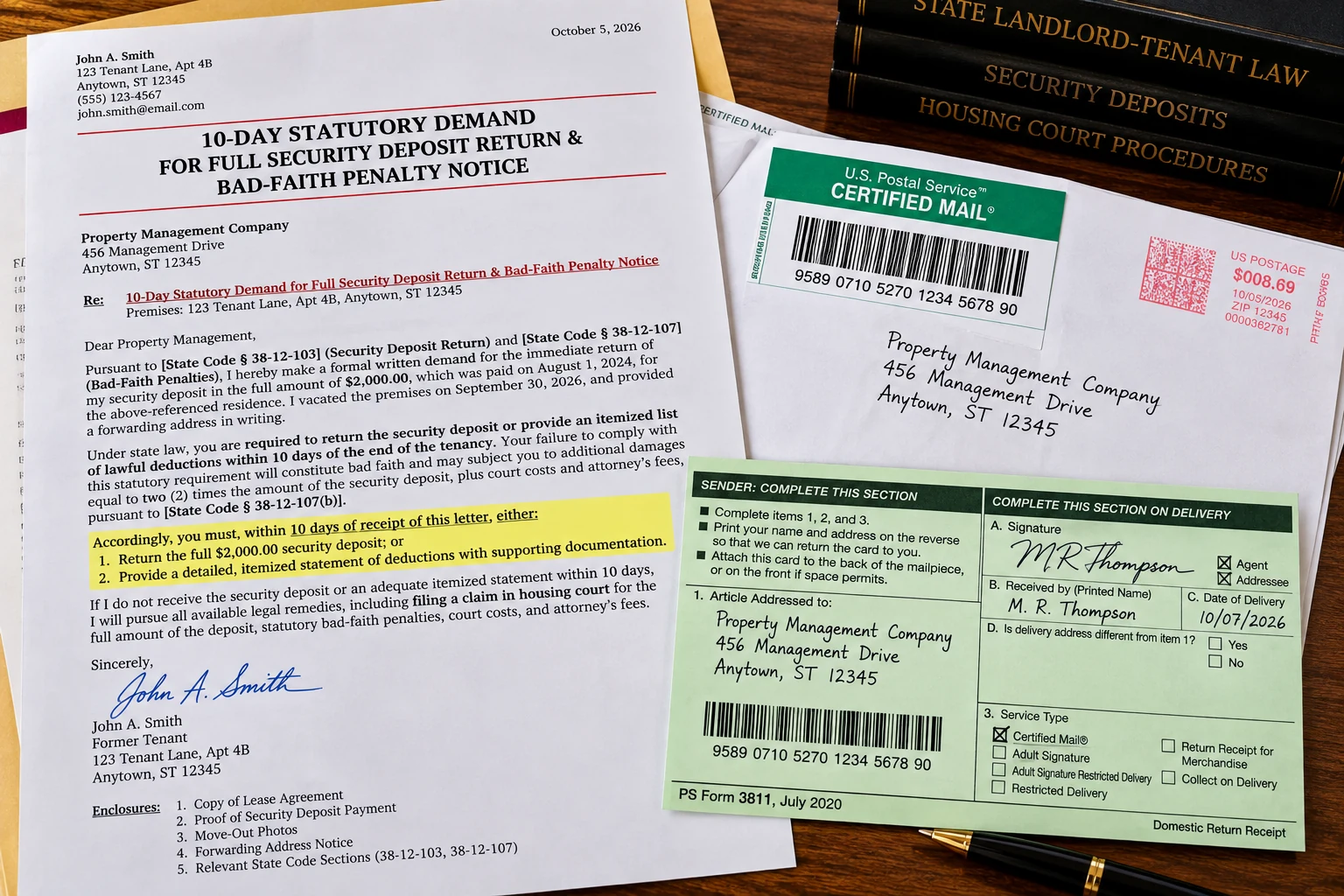
Step 4 Certified Demand: A formal 10-day demand letter citing bad-faith statutory penalty multipliers triggers immediate landlord settlements. -
5
Step 5: File in Small Claims Court for Full Deposit + Multiplier Damages
Small Claims Court requires no lawyer. File your statement of claim seeking your principal refund, statutory double or treble damages, and court filing fees. Landlords settle over 70% of claims before trial.
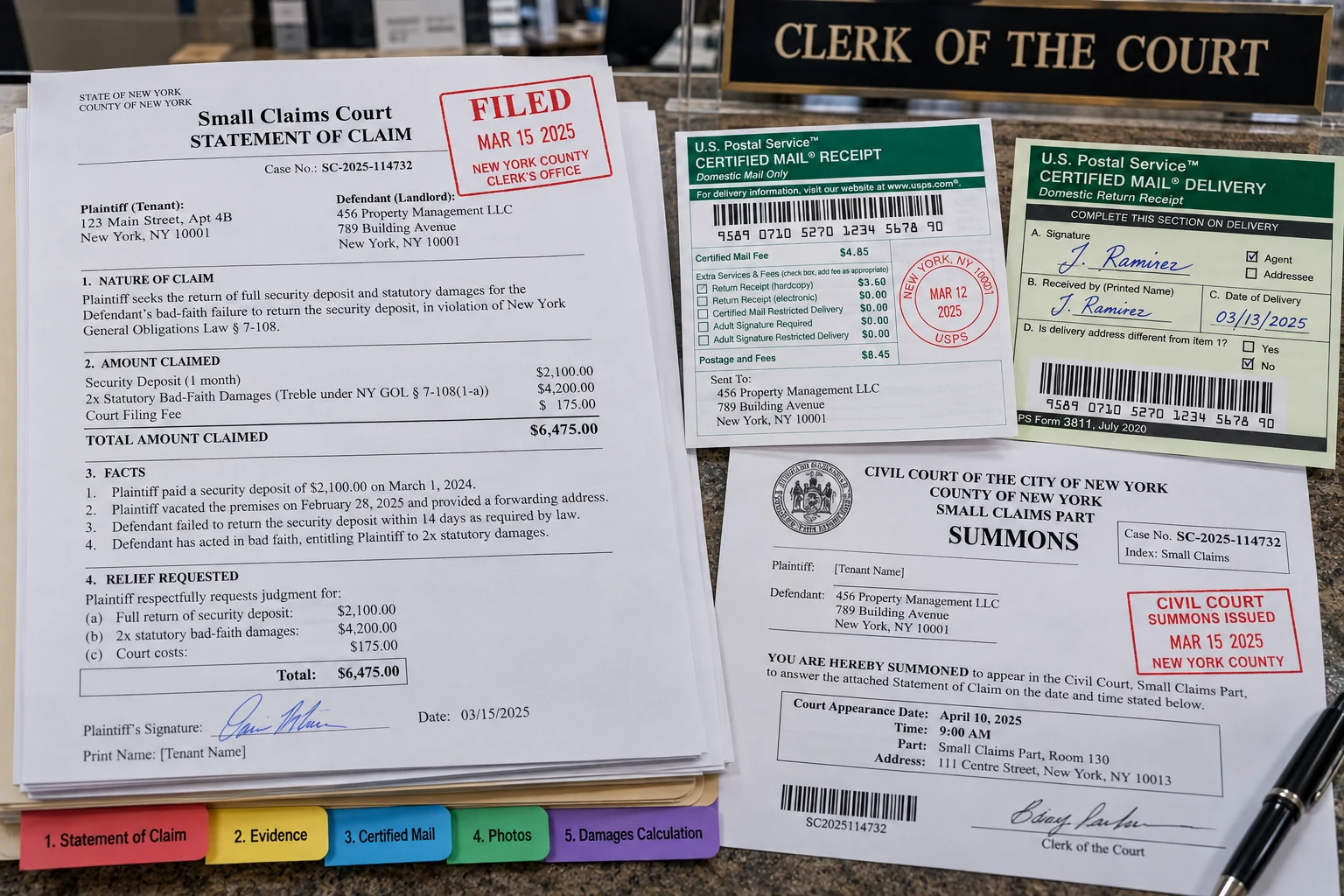
Step 5 Small Claims Action: File for your full deposit plus statutory multipliers (up to 3x) in Small Claims Court without needing an attorney.
Ready-to-Send Security Deposit Demand & Bad Faith Penalty Letters
Before filing in Small Claims Court, state law and judicial procedure require delivering a formal written demand. A certified demand letter removes any excuse of "accidental oversight" and provides judges with undeniable proof of bad faith:
FORMAL DEMAND FOR RETURN OF SECURITY DEPOSIT & NOTICE OF STATUTORY BAD FAITH PENALTIES

Date: [Insert Current Date]
Sent Via: USPS Certified Mail (Tracking #: [Insert Tracking #]) & Email

TO:
Landlord / Property Management: [Landlord / Company Name]
Address: [Landlord Address]
City, State, ZIP: [City, State, ZIP]

FROM:
Former Tenant(s): [Your Full Name(s)]
Rental Property Address: [Former Rental Address, Unit #]
Forwarding Address: [Your New Address, City, State, ZIP]
Phone: [Your Phone Number] | Email: [Your Email]

RE: FINAL 10-DAY DEMAND FOR FULL SECURITY DEPOSIT RETURN (STATUTORY DEADLINE VIOLATION)

Dear [Landlord / Property Manager Name],

This letter serves as formal legal demand for the immediate, full return of my residential security deposit in the amount of $[Insert Full Deposit Amount, e.g., $2,000.00] regarding my tenancy at the property referenced above.

I surrendered possession and returned all keys to you on [Insert Move-Out Date], and previously provided my written forwarding address. Under governing state law (including [Insert Applicable State Code: e.g., Cal. Civ. Code § 1950.5(g) / NY Gen. Oblig. Law § 7-108 / Tex. Prop. Code § 92.109]), you were legally required to mail my full security deposit or an itemized accounting with supporting contractor receipts within [Insert State Days: e.g., 21 / 14 / 30] calendar days.

As of today, [Insert Current Date], [Insert Number of Days] days have elapsed since my tenancy ended. You have failed to deliver either my deposit funds or an itemized accounting.

Under established state statutory law and judicial precedent (including Granberry v. Islay Investments):
1. By failing to provide timely accounting within the statutory window, you have completely forfeited any legal right to withhold or deduct from my security deposit funds.
2. Your ongoing retention of my deposit without statutory justification constitutes bad-faith retention under state law, entitling me to statutory penalty damages of [Insert Statutory Multiplier: e.g., double damages / triple treble damages / statutory fine].

DEMAND FOR PAYMENT:
Please remit a cashier's check or money order for the full deposit amount of $[Insert Full Deposit Amount] made payable to [Your Name] and delivered to my forwarding address listed above within TEN (10) BUSINESS DAYS of your receipt of this notice.

If I do not receive payment in full by [Insert Expiration Date - 10 Days from Today], I will immediately file a formal statement of claim in Small Claims Court seeking:
1. Full restitution of my $[Insert Full Deposit Amount] security deposit;
2. Statutory bad-faith penalty damages of $[Insert Calculated Penalty: e.g., $2,000.00 to $4,000.00];
3. Full reimbursement of court filing fees and process server expenses;
4. Pre-judgment statutory interest as authorized by state law.

I trust you will resolve this matter promptly without compelling formal litigation.

Sincerely,

________________________________________
[Your Signature]
[Your Printed Full Name]
How Much Can You Recover in a Security Deposit Lawsuit?
When taking legal action in Small Claims Court or Housing Court, financial recovery is calculated using established statutory remedies, documented out-of-pocket expenses, and rent reduction standards:
| Recovery Category | Calculation Standard | Statutory Authority & Limits |
|---|---|---|
| 1. 100% Principal Deposit Return | Full judicial refund of improperly retained deposit funds when landlord missed statutory 14–30 day itemization deadlines. | State security deposit return statutes. |
| 2. Statutory Bad-Faith Multipliers | Two to three times the deposit amount (treble damages) awarded for intentional or bad-faith retention of tenant funds. | Cal. Civ. Code § 1950.5; NY Gen. Oblig. § 7-108; Tex. Prop. Code § 92.109. |
| 3. Mandatory Legal Fees & Costs | Full statutory recovery of court filing fees, service costs, and attorney fees for prevailing tenants. | Statutory fee-shifting provisions. |
Small Claims Filing Limits: Most tenants resolve these matters pro se (without a lawyer) in Small Claims Court. Maximum claim limits vary by state: for example, $12,500 in California (California Courts Self-Help), $10,000 in New York City (NY Courts Small Claims), and $20,000 in Texas (Texas Judicial Branch). If damages exceed local small claims thresholds, lawsuits proceed to standard Civil Court.
Frequently Asked Questions
Generally no. Small nail holes from pictures, minor scuff marks, and ordinary fading caused by sunlight are legally categorized as normal wear and tear. A landlord can only deduct for painting if you painted the walls an unapproved non-neutral color or caused major gouges in the drywall. For detailed useful life depreciation rules and small claims strategies, see our complete guide on disputing landlord painting charges.
In almost all states (including California, New York, Texas, and Washington), missing the statutory calendar deadline forfeits the landlord's legal right to retain any portion of the deposit. Furthermore, willful retention past the deadline subjects the landlord to statutory bad-faith penalties of 2x to 3x the deposit amount.
Yes. In jurisdictions such as California (Civ. Code § 1950.5(g)) and New York, landlords who withhold more than minor statutory thresholds ($125 in CA) must attach copies of actual third-party contractor invoices, material receipts, or hourly labor breakdowns. A generic estimate or self-written invoice without proof is legally invalid.
No. Security deposit disputes are specifically designed for Small Claims Court, where filing fees are low ($30 to $100) and attorneys are either optional or prohibited (such as in California and Michigan). You represent yourself, present your move-out photos and demand letter, and judges render decisions promptly.
SueLegal is an independent educational legal publisher, not a law firm or lawyer referral service. The information provided in this guide is for general informational and educational purposes only and does not constitute formal legal advice. Residential landlord-tenant laws, repair notice periods, and statutory remedies vary significantly across state and municipal jurisdictions. If you are facing eviction, severe uninhabitable conditions, or complex litigation, consult a licensed attorney in your jurisdiction or contact your local legal aid organization. For more details on our standards, read our Editorial Policy and Legal Research Methodology.