
Yes, you can sue your landlord for leaving you with no heat.
Working heat during cold weather is a mandatory legal right in almost every U.S. state and city—most housing codes require your landlord's heating system to keep your rooms at least 68°F (20°C) during the day. Because lack of heat in winter is an emergency health hazard, your landlord typically has only 24 to 72 hours after you report it to restore heat. If they fail to fix it, you can sue in Small Claims or Housing Court to recover:
- A 50% to 100% Daily Rent Refund for every day your apartment was below the legal minimum temperature.
- Emergency Hotel or Airbnb Bills if freezing temperatures forced you or your family to sleep elsewhere.
- Space Heater Costs & Your Electric Bill Spike (if running plug-in heaters jacked up your monthly electric bill).
- Extra Daily Cash Penalties ($100+/day or up to 3x Rent) if the landlord shut off the heat on purpose or failed to pay the building's gas/oil bill.
What You Need to Know
- Handing You Two Cheap Space Heaters Does NOT Fix the Law Violation: Under national housing codes (like the International Property Maintenance Code and NYC/Chicago/Boston rules), portable plug-in space heaters cannot be used as a permanent substitute for central heat—and if running them spikes your electric bill by $200, your landlord owes you that money back.
- Know the "68°F Rule" in Your City: In most U.S. cities and states, if the indoor temperature in your living room or bedroom drops below 68°F during the day (or 62°F–66°F overnight), your apartment is legally considered "without heat"—even if the radiators feel slightly warm.
- You Only Have to Wait 24 to 72 Hours in Winter (Not 30 Days): In cold weather, a broken furnace or boiler is a life-safety emergency. If your landlord ignores you past your state's 24-to-72-hour emergency window, call 311 or your local Code Enforcement / Health Inspector immediately.
- Take "Center-of-the-Room" Thermometer Photos: Don't just photograph a broken wall thermostat. Place a $10 digital thermometer on a table in the middle of the room (at least 3 feet off the floor and away from windows) and photograph it next to your phone screen showing the date, time, and outside weather.
- Send One Quick Text to Protect Yourself From Burst Pipe Blame: If indoor temperatures drop near freezing, text your landlord immediately warning that the pipes could freeze. That written record stops the landlord from blaming you if a pipe freezes and floods the apartment.
Minimum Legal Apartment Temperatures & "Heating Season" Dates by City & State
In almost every American municipality, residential landlords are strictly governed by designated heating seasons and minimum legal indoor temperatures. A landlord cannot defend themselves by claiming the radiators are lukewarm or that the basement boiler is running. The law judges habitability exclusively by the thermometer reading inside your private living rooms.
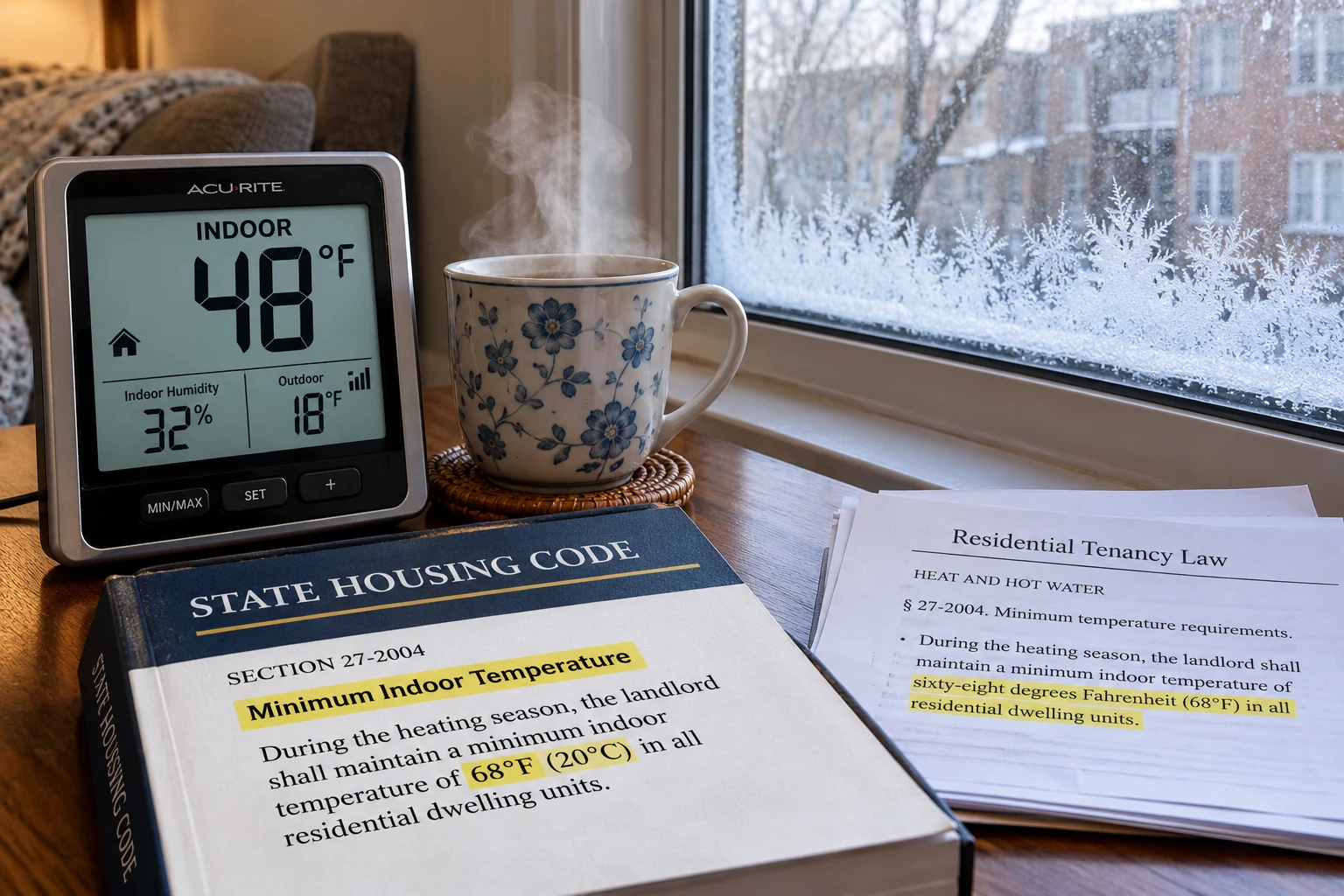
If your apartment drops below the mandated thresholds during the heating season, your landlord is in immediate violation of local housing codes. Review the exact statutory temperature caps and cure windows for major metropolitan jurisdictions below:
| City / State | Heating Season Dates | Minimum Legal Daytime Temp | Minimum Legal Nighttime Temp | Emergency Repair Deadline |
|---|---|---|---|---|
| New York City & NY State | Oct 1 – May 31 | 68°F (6 AM–10 PM when outside is below 55°F) | 62°F (10 PM–6 AM, regardless of outside temp) | 24 Hours (Class C immediately hazardous code violation; fines of $250–$500/day) |
| Chicago, Illinois | Sept 15 – June 1 | 68°F (8:30 AM–10:30 PM) | 66°F (10:30 PM–8:30 AM) | 24 to 72 Hours (Under Chicago RLTO § 5-12-110, tenants can procure hotel rooms or withhold rent) |
| Massachusetts (Statewide) | Sept 16 – June 14 | 68°F (7 AM–11 PM) | 64°F (11 PM–7 AM) | 24 Hours (State Sanitary Code mandates emergency repair; maximum indoor heat cannot exceed 78°F) |
| California (Statewide) | Year-Round Requirement | 68°F (Measured 3 feet above floor in all living rooms) | 68°F | 24 to 72 Hours in freezing conditions (Cal. Civ. Code § 1941.1 & Health & Safety Code § 17920.3) |
| Philadelphia & Pennsylvania | Oct 1 – April 30 (plus any cold May/Sept days) | 68°F | 68°F | 24 to 72 Hours (Philadelphia L&I classifies lack of winter heat as an imminent safety hazard) |
| Washington State (Seattle) | Sept 1 – June 30 | 68°F (Daytime) | 58°F–65°F (Nighttime) | 24 Hours (Under RCW 59.18.070, landlord must begin emergency heating repairs within 24 hours) |
| CO, MN, MI, OH, DC & IPMC Cities | Oct 1 – May 1 (or whenever outside is below 60°F) | 68°F (Standard International Property Maintenance Code § 602.3) | 65°F–68°F | 24 to 72 Hours for emergency winter heating failures |
| Texas & Florida | Whenever Cold Weather Hits | Working heating system capable of 68°F (FL § 83.51; Dallas/Houston codes require 68°F) | 68°F | 24 to 72 Hours during winter freezes (7 days statutory notice limit under Tex. Prop. Code § 92.056) |
When the temperature falls below these statutory limits, your apartment transitions into an unlivable condition under the Warranty of Habitability. Landlords cannot claim they were unaware if you provided prompt written notice.
To learn how small claims courts evaluate habitability damages and rent abatements, read our central guide on suing your landlord.
The "Space Heater & Electric Bill" Trap (Why Portable Heaters Don't Let Your Landlord Off the Hook)
When an apartment furnace or building boiler malfunctions on a freezing weekend, property managers frequently attempt to cut corners. Rather than paying emergency weekend rates to licensed HVAC technicians, landlords often drop off two inexpensive ceramic space heaters and instruct tenants to wait until the following week.
While space heaters provide temporary emergency comfort, relying on them as an ongoing heating solution is unlawful for three specific reasons:
1. International Building & Fire Code Bans
Under the International Property Maintenance Code (IPMC § 602.3) and municipal fire codes across New York, Chicago, Boston, and Seattle, portable plug-in space heaters cannot serve as a primary heating source. Plug-in heaters warm only a few square feet in a single room, leave bathrooms and kitchens unheated, and draw excessive wattage that can overheat older wiring or trip circuit breakers.
2. The Electric Utility Bill Spike
If your rental agreement includes heat through central building boilers, or if your apartment is heated by cost-effective natural gas, running multiple 1,500-watt electric space heaters creates substantial financial harm. Running two portable heaters continuously for two weeks can add $150 to $350 or more to your monthly electric bill.
3. Forcing Your Landlord to Reimburse the Utility Surge
Courts recognize that heating expenses caused by landlord neglect are recoverable consequential damages. You do not have to absorb the power company\'s bill. To collect full compensation in Small Claims Court or via a formal rent demand:
- Download utility billing statements from the previous month and the corresponding winter month from the previous year.
- Calculate the specific surge in kilowatt-hour (kWh) usage and dollar charges directly attributable to running the space heaters.
- Submit the utility bills alongside purchase receipts for heaters or extra blankets as itemized out-of-pocket damages.
Judges routinely award 100% reimbursement for space heater purchases and utility bill increases on top of pro-rated rent refunds (see our guide to landlord repair refusal lawsuits).
What If the Landlord Controls the Thermostat (Or Forgot to Pay the Gas Bill)?
Heating disputes often involve deliberate landlord interference rather than simple mechanical breakdown. When a landlord restricts heating access or cuts off fuel, the legal stakes escalate dramatically.
Scenario A: The Landlord Controls or Locks the Thermostat
In multi-unit properties or subdivided houses, landlords often house the central thermostat inside a locked plastic enclosure or in a restricted basement. Landlords may set the dial to 60°F to save on heating bills, arguing that the system is operational.
In court, the setting on the landlord\'s thermostat is completely irrelevant. The legal standard is measured strictly inside your private living space. If your bedroom or living room fails to reach the mandatory 68°F daytime minimum, the landlord is violating the law, regardless of what the locked thermostat displays.
Scenario B: Utility Shutoffs and Unpaid Fuel Bills (Constructive Eviction)
If your lease specifies that heat, heating oil, or natural gas is included in rent, but the utility provider shuts off service because the landlord failed to pay the commercial bill, the law views this as an unlawful eviction tactic.
Similarly, if a landlord turns off heating valves or disconnects electrical lines during a dispute, they commit an illegal utility shutoff. State statutes impose harsh statutory penalties on landlords who engage in utility cutoffs:
- California (Civ. Code § 789.3): Penalties of up to $100 per day for every day the utility remains terminated, plus actual damages and mandatory attorney fees.
- Texas (Prop. Code § 92.008): An automatic penalty of one month\'s rent plus $1,000, along with moving costs, lodging expenses, and attorney fees.
- Florida (Stat. § 83.67): Statutory damages equal to 3 months\' rent or actual damages, whichever is greater, plus court costs.
- Massachusetts & Illinois: Treble damages (3 times monthly rent) or automatic statutory fines for interfering with essential utilities.
For additional details on illegal landlord lockouts, review our analysis on uninhabitable apartment lawsuits.
How to Document a Freezing Apartment So You Win in 5 Minutes in Court
Judges and hearing officers review dozens of housing disputes each week. Tenants who arrive with vague claims that their apartment "felt freezing" often face skepticism. You can establish undisputed proof of a heating violation in five minutes by following four disciplined evidence steps:
1. Buy an Inexpensive Digital Thermometer and Apply the "3-Foot Rule"
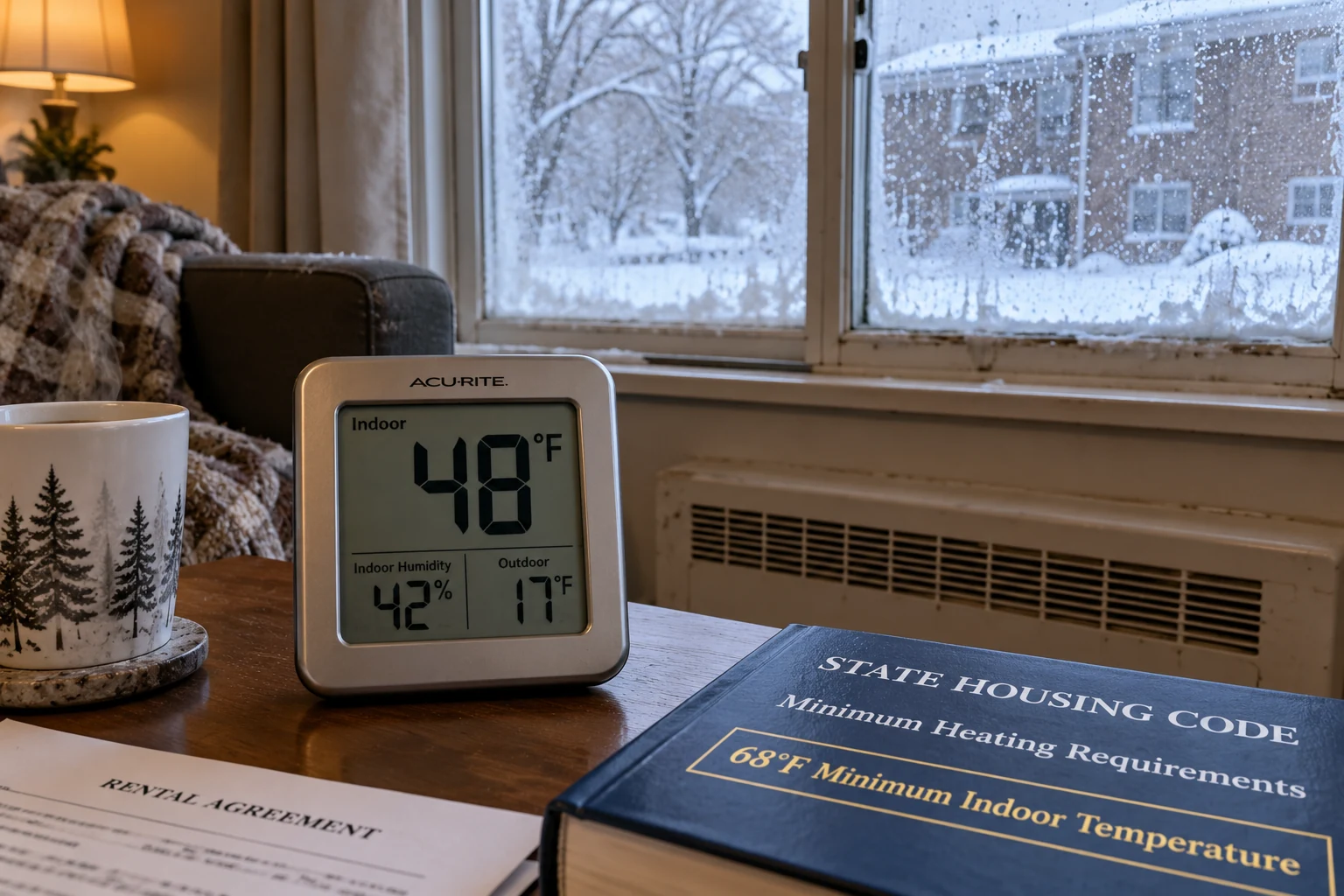
Municipal code enforcement inspectors follow standardized measurement protocols. They measure air temperature at least 3 feet above the floor and at least 3 feet away from exterior walls or drafty windows in the center of the room. Place your digital thermometer on a desk or dining table in the middle of your living room or bedroom. This prevents the landlord from claiming you placed the sensor on a cold windowsill.
2. Take Daily Timestamped Photos Morning, Afternoon, and Night
Photograph the digital thermometer display three times each day: at 7:30 AM (morning heating window), 2:00 PM (peak daytime window), and 11:00 PM (nighttime heating window). Hold a second device (smartphone, tablet, or watch) directly next to the thermometer in the same frame showing the date, exact time, and local outdoor weather forecast. This creates an unshakeable visual record of persistent code violations.
3. Send the "Frozen Pipe Protection" Notification Immediately
If outdoor temperatures drop below freezing (32°F / 0°C), send a written text or email to your landlord immediately. Use this precise language:
If a water pipe bursts subsequently, this communication proves you exercised ordinary care and insulates you completely from liability for water damage.
4. Contact 311 or Municipal Code Enforcement Before Checking Into a Hotel
When a landlord misses the 24-to-72-hour emergency repair window, contact your city's 311 agency, housing inspection bureau, or local board of health. Municipal inspectors prioritize lack-of-heat complaints during winter months. An official municipal citation documenting an indoor temperature below 68°F establishes absolute legal fault and makes reimbursement for hotel bills and rent refunds practically automatic in court.
311 / Code Enforcement Emergency Phone Script
Read this word-for-word so dispatchers categorize your ticket as an Immediate Life-Safety EmergencyReady-to-Send Emergency No-Heat, Hotel & Rent Refund Demand Letter
Before initiating legal action in Small Claims Court or filing a formal housing complaint, serve your landlord with an unequivocal written demand. Deliver this letter via Certified Mail with Return Receipt Requested, as well as by email and resident maintenance portal.
Select the appropriate template below, copy the text to your clipboard or download the text file, insert your specifics, and retain a copy for your legal binder.
How Much Can I Sue My Landlord for No Heat?
When pursuing a legal claim against your landlord in Small Claims Court or Housing Court, financial recovery is determined by statutory damages categories, proven out-of-pocket losses, and rent reduction formulas:
| Recovery Category | Calculation Standard | Statutory Authority & Limits |
|---|---|---|
| 1. 100% Daily Rent Abatement | Full refund of daily rent for every day indoor temperatures fell below statutory minimums (e.g. 68°F day / 62°F night). | Implied Warranty of Habitability; Municipal Housing Maintenance Codes. |
| 2. Emergency Hotel & Space Heater Bills | 100% reimbursement for reasonable hotel lodging and utility surcharges from space heater usage. | Consequential out-of-pocket contract damages. |
| 3. Statutory Shutoff Penalties | If the landlord intentionally shut off heating fuel or gas, statutory damages apply ($100/day up to 3x monthly rent). | E.g., Cal. Civ. Code § 789.3; Fla. Stat. § 83.67. |
Small Claims Filing Limits: Most tenants resolve these disputes without hiring an attorney in Small Claims Court. Maximum claim limits vary by state: for example, $12,500 in California (California Courts Self-Help), $10,000 in New York City (NY Courts Small Claims), and $20,000 in Texas (Texas Judicial Branch). If your total damages exceed small claims thresholds, you may file in standard civil district court.
Frequently Asked Questions About Landlord Heating Laws
How long can a landlord legally leave you without heat in the winter?
In cold weather, lack of heat is an emergency health hazard—most states and cities require landlords to start fixing the heating system within 24 to 72 hours of receiving your complaint, not the 14 or 30 days allowed for routine repairs.
Does my landlord have to pay for a hotel if the heat goes out?
If indoor temperatures drop to unsafe levels in winter and the landlord fails to restore heat within the 24-to-72-hour emergency window, many state laws and municipal codes—like Chicago's RLTO, Massachusetts, California, and New York—allow you to check into a reasonable hotel or motel and deduct or sue for the hotel cost plus a 100% rent refund for the days you couldn't sleep at home.
Do plug-in space heaters count as working heat from my landlord?
No—under the International Property Maintenance Code and almost all major city housing codes, portable plug-in space heaters are only a temporary 24-to-48-hour emergency measure and cannot be used as a substitute for a working permanent heating system. Furthermore, if running space heaters drives up your electric bill, the landlord owes you for the extra electricity.
Can I use my gas oven or stove burners to heat my apartment when the furnace breaks?
Never use a gas oven or stove to heat your apartment. Gas ovens are not vented for room heating and quickly fill an apartment with invisible, deadly carbon monoxide (CO) gas. Instead, document the freezing temperature, check into a safe place or use an auto-shutoff electric oil/ceramic heater temporarily, and bill the landlord.
Can I withhold rent or hire my own HVAC technician if my landlord won't fix the heat?
Many states allow Emergency Repair and Deduct—letting you call a licensed heating technician after the landlord ignores a 24-to-72-hour written notice and subtract the repair bill from your rent—or allow paying rent into a court escrow account. However, the safest zero-risk option in all 50 states is to call a free 311 city inspector and sue in Small Claims Court for a 50%–100% rent refund and your hotel/heater receipts.
SueLegal is an independent educational legal publisher, not a law firm or lawyer referral service. The information provided in this guide is for general informational and educational purposes only and does not constitute formal legal advice. Residential landlord-tenant laws, repair notice periods, and statutory remedies vary significantly across state and municipal jurisdictions. If you are facing eviction, severe uninhabitable conditions, or complex litigation, consult a licensed attorney in your jurisdiction or contact your local legal aid organization. For more details on our standards, read our Editorial Policy and Legal Research Methodology.