

Yes, you can sue your landlord for an illegal eviction—even if you were behind on rent or didn't have a written lease.
In all 50 states, only a Sheriff, Marshal, or Constable with a judge's court order can legally evict a tenant. If your landlord changed your locks, put your belongings on the street, shut off your utilities, or used a fake "owner move-in" lie to force you out, they broke the law. You can get an emergency court order to get back inside today, OR move elsewhere and sue your landlord to recover:
- Massive State Statutory Penalties ($2,500 to $50,000+): Including Triple (3x) Damages on all your losses (in New York, New Jersey, and CA rent-control cities), 3 Months' Rent (in Florida and Massachusetts), 2 Months' Rent (in Illinois/Chicago, Arizona, Oregon, and Connecticut), 1 Month's Rent + $1,000 (in Texas), or $100 per day (statewide in California and Washington).
- 100% of Your Actual Losses: Full reimbursement for hotel rooms, ruined or stolen furniture/clothes, locksmith bills, moving trucks, lost wages (if your work laptop or uniform was locked inside), 100% of your security deposit, and the monthly rent difference if your new apartment costs more.
- Fraudulent "Owner Move-In" Settlements ($25,000 to $250,000+): If your landlord lied about moving a relative into your rent-protected unit and re-rented it at a higher price, tenant lawyers regularly win six-figure settlements with 100% of your lawyer fees paid by the landlord.
Important Things to Know
- Owing Back Rent NEVER Makes a Lockout Legal: Even if you are 3 months behind on rent or your lease expired last month, a landlord who changes your locks without a Sheriff and a court order is committing an illegal eviction—and your statutory lawsuit against them can completely wipe out the back rent you owed!
- You Do NOT Need a Written Lease to Be Protected: If you rent a basement, a single bedroom, or a house on a verbal agreement and have lived there for 30+ days (or paid rent), you are a legal tenant. Your landlord cannot call you a "guest" and throw your bags on the porch.
- Call the Police & Cite Criminal Lockout Laws Tonight: In states like New York (
RPAPL § 768), California (Penal Code § 418), Illinois (735 ILCS 5/9-301), New Jersey, and Massachusetts, an illegal lockout is an arrestable misdemeanor crime. Show the police a piece of mail, utility bill, or Venmo rent receipt with your address on it so they order the landlord to open the door immediately. - Even in Texas, a Landlord MUST Give You a Key Within 2 Hours (Without Paying Rent!): Texas landlords often think they can change locks for late rent. Under
Tex. Prop. Code § 92.0081, a residential landlord must leave a notice on the door and must hand you a new key within 2 hours of your request—even if you pay $0 of the overdue rent! - Watch Zillow After an "Owner Move-In" Eviction: If your landlord forced you out claiming they, their child, or their parent needed to live in your apartment, check Zillow, Apartments.com, and Airbnb 60 days later. If they re-listed it for higher rent, screenshot the listing—you may have a $50,000 to $250,000+ wrongful eviction lawsuit.
What Counts as an Illegal Eviction? (The 3 Types & What Each Is Worth)
In all 50 states, residential landlords are strictly barred from evicting tenants on their own authority. Regardless of whether a lease has expired, rent is delinquent, or unauthorized occupants are present, the property owner cannot take unilateral action to dispossess a renter.
Only a designated law enforcement officer—such as a County Sheriff, Marshal, or Constable—executing a valid judicial Writ of Possession after a contested eviction trial can legally remove a tenant or their belongings. When a landlord circumvents the judicial system, they commit an unlawful eviction.
Courts recognize three distinct types of illegal evictions, each carrying substantial financial liability:
| Type of Illegal Eviction | How Landlords Commit It | Why It Is Strictly Unlawful | Typical Court Payout Range |
|---|---|---|---|
| 1. Physical "Self-Help" Lockout | Changing deadbolts while you are away, removing exterior doors, padlocking gates, deactivating key fobs, or placing furniture on the sidewalk. | Violates state forcible entry and detainer statutes. Only an authorized sheriff executing a court writ can legally lockout an occupant. | $5,000 to $50,000+ (1x–3x rent statutory fines, 3x treble damages on all losses, ruined property, hotel bills, and 100% legal fees). |
| 2. Fraudulent "Owner Move-In" (OMI) or Renoviction | Landlord in a rent-controlled or Just-Cause area claims a relative is moving in, then re-rents the unit on Zillow or Airbnb 60 days later at higher rent. | Violates municipal rent stabilization and just-cause eviction codes. Owners must reside in the unit continuously for 12 to 36 months. | $25,000 to $250,000+ (Triple damages on the multi-year rent differential, emotional distress, moving allowances, and full fee shifting). |
| 3. Fake Eviction Notices & Procedural Tricks | Taping a homemade "24-Hour Notice to Vacate" to the door, claiming a building sale requires immediate exit, or falsely claiming court papers were served ("Sewer Service"). | A landlord's written notice is merely a preliminary warning, not an order of dispossession. Obtaining default judgments through false service is fraud. | Eviction Dismissed + $2,000 to $15,000 (Vacatur of default judgment, restoration of tenancy, statutory harassment sanctions, and attorney fees). |
When landlords resort to self-help tactics like lockouts or illegal utility shutoffs, their legal standing collapses. In many jurisdictions, lockouts occur right after a tenant asks for urgent repairs or reports code violations—triggering substantial claims for retaliation and statutory damages that exceed any back rent originally disputed.
Before changing the deadbolts completely, rogue landlords often escalate their behavior by trespassing into the residence without statutory notice. If your landlord crossed boundaries before locking you out, learn about your rights when your landlord is entering without permission.
Locked Out Right Now? Follow This "First 2 Hours" Playbook to Get Back Inside Tonight
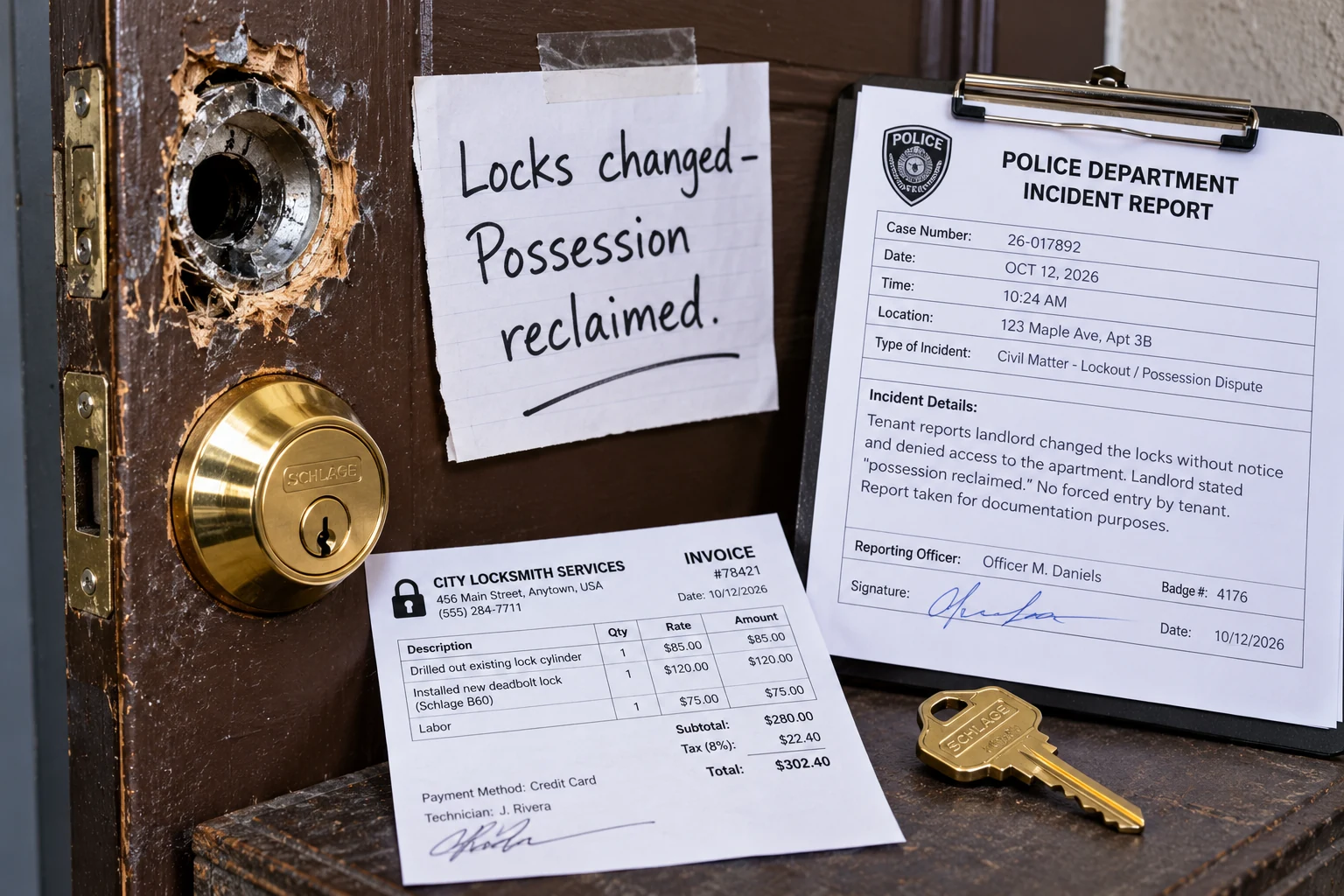
Arriving at your home to find changed locks, missing doors, or personal belongings piled on the porch requires immediate, systematic action. You do not have to spend the night without your bed, clothing, or essential prescriptions.
Follow this emergency protocol to establish legal proof and secure re-entry tonight:
The 3-Step Emergency Lockout Playbook
Record a 30-second continuous video displaying your key failing to turn in the lock or showing removed doors. Send an immediate text message and email to the landlord: "Changing locks without a court Writ of Possession and a Sheriff is an illegal self-help eviction carrying mandatory statutory fines. If you do not provide a working key within 30 minutes, I will contact local police, hire a locksmith at your expense, and file an emergency Writ of Re-Entry tomorrow morning."
If responding officers suggest that the dispute is purely a "civil matter," provide immediate documentation of residence (a digital lease PDF, recent utility statement, driver's license, or Venmo rent transfer). State clearly: "Officer, there is no Sheriff's eviction notice posted on this door. Under state law [such as NY RPAPL § 768, California Penal Code § 418, Illinois 735 ILCS 5/9-301, or Mass. Gen. Laws c. 186 § 14], extrajudicial tenant lockout is an arrestable misdemeanor offense." Officers will frequently require the landlord to unlock the premises immediately.
If the property owner refuses to grant access, arrive at the local municipal housing court or Justice of the Peace office at 8:30 AM. Request an emergency Ex Parte Petition for Writ of Re-Entry / Order to Show Cause. A judge reviews your sworn statement on the same day and orders law enforcement officers to restore your possession and cite the landlord.
If you are also confronting targeted intimidation or threats, review our legal guidance on suing your landlord for harassment to combine your civil claims.
50-State Illegal Eviction & Lockout Penalty Lookup Table
State legislatures have established strict statutory penalties to punish landlords who bypass the courts. In several states, courts are required to apply mandatory treble damages to all losses suffered by the ousted tenant.
Review this state statutory table to confirm the legal penalties, criminal classifications, and governing statutes in your jurisdiction:
| State / Jurisdiction | Statutory Lockout Penalty You Win | Criminal Status for Landlord | Exact State Law to Cite |
|---|---|---|---|
| New York (NYC & Statewide) | Mandatory Triple (3x) Damages on ALL actual losses (hotel, moving, ruined property, rent differential) + $1,000 to $10,000 civil fine per lockout. | Class A Misdemeanor Crime (Arrestable under RPAPL § 768). |
NY RPAPL § 853 & § 768 |
| California (Statewide & Major Cities) | $100 Per Day (minimum $250) + actual damages + $2,000 harassment fine + lawyer fees. 3x Treble Damages in SF, LA, Oakland, Berkeley, and Santa Monica. | Misdemeanor Crime (Cal. Penal Code § 418). |
Cal. Civ. Code § 789.3 & § 1940.2 |
| Texas | 1 Month's Rent + $1,000 Fine + all actual damages (hotel, ruined belongings, moving) + attorney fees. | Contempt of Justice Court Writ of Re-Entry. | Tex. Prop. Code § 92.0081 & § 92.009 |
| Florida | 3 Months' Rent (or actual damages, whichever is higher) PER lockout violation + mandatory attorney fee shifting. | Strict Civil Injunction & Statutory Penalty. | Fla. Stat. § 83.67 |
| Massachusetts | 3 Months' Rent (or actual damages, whichever is greater) + 100% legal fees. | Criminal misdemeanor (Fines or up to 6 months in jail). | Mass. Gen. Laws c. 186, § 14 & § 15F |
| New Jersey | Mandatory Triple (3x) Damages + legal fees + immediate police restoration of possession. | Disorderly Persons Offense (Mandatory police assistance under N.J.S.A. 2C:33-11.1). |
N.J.S.A. 2A:39-8 |
| Illinois (Chicago & Statewide) | 2 Months' Rent OR 2x Actual Damages + mandatory attorney fees and emergency restoration. | Class A Misdemeanor (735 ILCS 5/9-301). |
Chicago RLTO § 5-12-160 & 735 ILCS 5/9-301 |
| AZ, OR, CT, VA, KY & URLTA | 2 Months' Rent OR 2x Actual Damages (3x in Connecticut under C.G.S. § 47a-46; up to 4 months in VA). | Unlawful Ouster Injunction & Contempt. | A.R.S. § 33-1367, ORS 90.375, C.G.S. § 47a-46 |
Notice that in almost every state listed above, attorney fee-shifting is mandatory. When you prevail in court against a landlord who executed an extrajudicial lockout, the landlord must pay all of your attorney fees in addition to your cash penalties.
Belongings on the Curb, Lost Wages & Rent Differential
When a property owner removes personal items from an apartment without judicial supervision, their civil liability increases dramatically. Outside the court eviction process, seizing or exposing a tenant's belongings constitutes common-law conversion and trespass to chattels.
Three distinct categories of economic damages routinely multiply wrongful eviction payouts:
Rule 1: Discarding Items on the Lawn or Curbside (Full Replacement Value)
Even following a lawful court-ordered eviction, state statutes obligate landlords to store abandoned property safely for 7 to 30 days. Placing furniture, electronics, clothing, or heirlooms on the sidewalk where they are exposed to rain or theft makes the landlord liable for 100% of their fair market replacement cost. Itemize every missing or damaged item with photos and receipts.
Rule 2: Lost Wages When Work Equipment Is Trapped Inside
If you work remotely and your computer, trade tools, professional licenses, or vehicle keys were locked inside, document every missed shift or cancelled client invoice. Housing judges hold landlords responsible for all lost wages that result directly from an intentional extrajudicial lockout.
Rule 3: Rent Differential Damages When Replacement Housing Costs More
If an illegal lockout forces you to find a new residence, you are entitled to the monthly price difference if comparable market housing costs more. For example, if your prior rent was $1,700 and your replacement unit costs $2,100, the landlord owes the $400 monthly difference ($4,800 over 12 months). In treble damage states like New York and New Jersey, that $4,800 loss triples automatically to $14,400.
If the landlord also unlawfully withholds your security deposit, review our companion guide on suing your landlord for withholding your security deposit to add double or triple deposit penalties to your lawsuit.
The Fake Owner Move-In & Renoviction Scam: How to Win $50,000+
In jurisdictions governed by rent stabilization or Just-Cause eviction statutes—including California under the Tenant Protection Act (AB 1482), New York, New Jersey, Oregon, Washington, and Washington D.C.—landlords cannot terminate a lease simply to raise the rent to prevailing market rates.
To evade these statutory caps, dishonest property owners frequently exploit statutory exemptions: the Owner Move-In (OMI) or relative move-in provision, or the capital improvement "renoviction."
The landlord serves formal notice asserting that they or an immediate family member will occupy the residence as their primary home. After the tenant relocates, the owner never moves in, instead re-listing the residence on rental portals or Airbnb for a higher price.
How to Catch a Fraudulent Owner Move-In in 3 Steps
- Establish Real Estate Alerts on Your Prior Address: Configure active listing notifications on Zillow, Redfin, Craigslist, and Apartments.com on the day of departure. If the unit appears for lease, archive digital screenshots displaying the asking rent and date immediately.
- Verify Actual Occupancy After 60 Days: Check utility records, speak with remaining building neighbors, or observe the premises to determine whether the landlord or their designated family member actually took possession.
- Examine Short-Term Rental Portals: Search Airbnb and VRBO for your building's street address. Landlords converting rent-stabilized apartments into unlicensed vacation rentals create direct evidence of bad-faith eviction.
When a tenant demonstrates that an Owner Move-In notice was served in bad faith, municipal ordinances in cities like San Francisco, Los Angeles, Oakland, and Seattle authorize statutory triple damages based on the difference between the tenant's prior stabilized rent and current market rent over several years. Settlements regularly exceed $50,000 to $200,000.
For a broader evaluation of tenant rights against wrongful management conduct, explore our pillar guide at Can I Sue My Landlord? Complete Guide to Tenant Lawsuits.
Ready-to-Send Illegal Eviction Demand Letters
Delivering a formal written legal demand establishes an undeniable record of the landlord's unlawful exclusion. Property managers and their insurance carriers recognize that forcible entry and detainer statutes impose strict liability and mandatory attorney fee awards.
Select the tab matching your situation, customize the highlighted brackets, and copy the demand notice directly to your clipboard:
How Much Can You Recover for an Unlawful Lockout or Eviction?
When taking your landlord to Small Claims Court or Housing Court, financial recovery is determined by statutory damages categories, proven out-of-pocket losses, and rent reduction formulas:
| Recovery Category | Calculation Standard | Statutory Authority & Limits |
|---|---|---|
| 1. Statutory Treble Damages / Multipliers | Many states award automatic statutory damages (e.g., 2x to 3x monthly rent, or $100–$250 per day) for self-help lockouts without court process. | E.g., Cal. Civ. Code § 789.3; NY Real Prop. Actions § 853; Tex. Prop. Code § 92.0081. |
| 2. Stolen, Discarded or Damaged Possessions | Fair market value for furniture, electronics, clothing, or pets removed from the apartment or left outside in the rain. | Tort conversion damages. |
| 3. Emergency Hotel & Re-entry Costs | Cost of locksmith services, emergency lodging, storage fees, and immediate judicial writ of restoration. | Emergency judicial restoration remedies. |
Small Claims Filing Limits: Most tenants resolve these disputes without hiring an attorney in Small Claims Court. Maximum claim limits vary by state: for example, $12,500 in California (California Courts Self-Help), $10,000 in New York City (NY Courts Small Claims), and $20,000 in Texas (Texas Judicial Branch). If your total damages exceed small claims thresholds, you may file in standard civil district court.
Frequently Asked Questions
No. In 49 states, changing a residential tenant's locks over unpaid rent is 100% illegal under any circumstance. Even in Texas—the only state with a narrow statutory lockout procedure under Tex. Prop. Code § 92.0081—the landlord must provide advance written notice, post a 24-hour contact number on the exterior door, and must hand you a new key within 2 hours of your request whether you pay the delinquent rent or not. Refusing to supply a key constitutes an unlawful lockout entitling you to 1 month's rent + $1,000, actual damages, and attorney fees.
Yes. You possess the exact same anti-lockout legal protections as a tenant holding a multi-year written lease. Once you move into a residential dwelling with permission and either pay rent or occupy the premises for 30 or more days, you establish lawful tenancy as a tenant-at-will or month-to-month tenant. A homeowner renting out an accessory bedroom or basement cannot change locks or remove belongings without going through formal judicial court eviction proceedings.
If your lease is active and no Sheriff's notice of execution has been completed, you retain the lawful right of possession. In many jurisdictions, calling a licensed 24-hour locksmith, displaying proof of residence (driver's license or utility bill), and retaining the receipt to sue the landlord is a recognized remedy. However, requesting police assistance and securing an emergency court Writ of Re-Entry is significantly safer than breaking structural windows or doors, which can cause misunderstandings or physical altercations.
If you learned of an eviction judgment only upon the Sheriff's arrival because the process server failed to serve you—a fraudulent practice termed "Sewer Service"—go to the courthouse clerk immediately and file an Emergency Order to Show Cause to Vacate Default Judgment and Restore Possession. Present evidence that you were never served; housing judges routinely freeze evictions, vacate default orders, and restore tenants to possession.
Almost never. Because wrongful eviction and illegal lockout statutes across the nation—including California, New York, Texas, Florida, Illinois, Massachusetts, New Jersey, and Washington—mandate statutory attorney fee-shifting, tenant-rights attorneys frequently accept strong lockout claims on pure contingency ($0 upfront). When you win, the landlord is court-ordered to pay your attorney's bill.
SueLegal is an independent educational legal publisher, not a law firm or lawyer referral service. The information provided in this guide is for general informational and educational purposes only and does not constitute formal legal advice. Residential landlord-tenant laws, repair notice periods, and statutory remedies vary significantly across state and municipal jurisdictions. If you are facing eviction, severe uninhabitable conditions, or complex litigation, consult a licensed attorney in your jurisdiction or contact your local legal aid organization. For more details on our standards, read our Editorial Policy and Legal Research Methodology.