
The Short Answer
Yes, you can sue your landlord for mold.
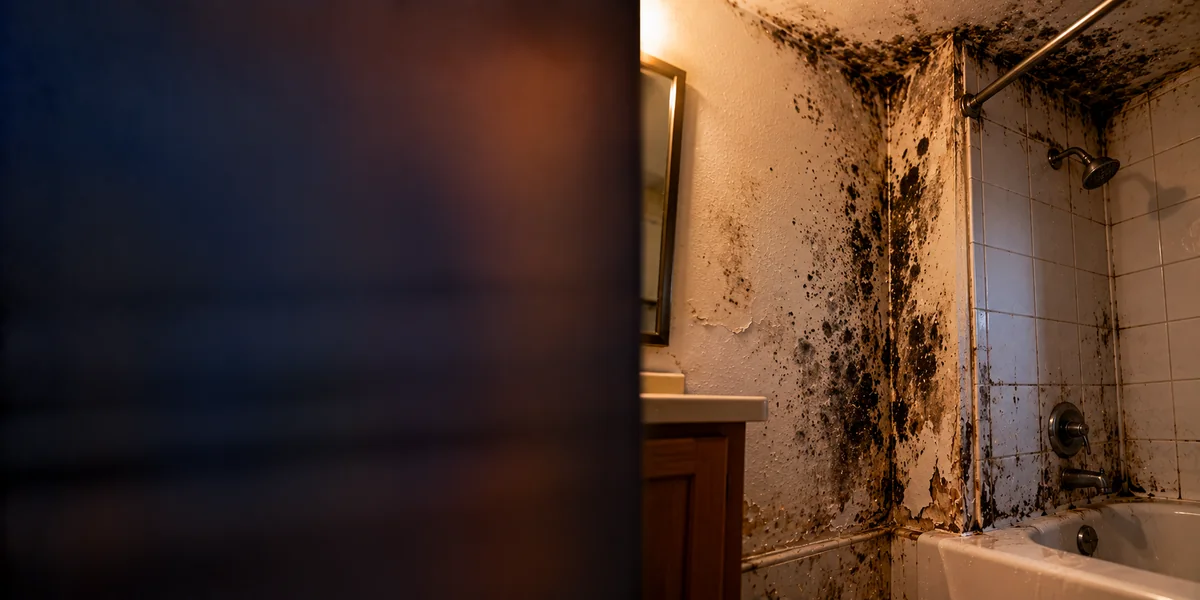
Landlords are legally required to fix roof leaks, plumbing leaks, and damp walls that cause mold to grow. If you reported mold or a water leak in writing and your landlord ignored it—or just painted over it without fixing the leak—you have two ways to sue:
- Small Claims Court ($2,500 to $12,500 — No Lawyer or Medical Proof Needed): You can sue for a partial rent refund, ruined mattresses, couches, and clothes, air purifiers, mold testing, and moving or hotel costs simply by proving the mold made your home unlivable and damaged your stuff.
- Personal Injury Lawsuit ($25,000 to $500,000+ With a Lawyer): If toxic mold caused documented health problems—such as severe asthma attacks, chronic sinus infections, nerve symptoms, or hospitalizations—you can sue for medical bills, lost wages, and pain and suffering.
What Tenants Should Know
- Spraying Bleach or Painting Over Mold Is Illegal: If your landlord sends a handyman to wipe mold with bleach and roll white paint ("Kilz") over wet drywall, they have not fixed the problem. Drywall with deep mold must be cut out and replaced after the water leak is fixed.
- You Don't Need Hospital Bills to Win Money in Small Claims Court: Many renters think they can only sue if a doctor proves mold made them sick. Even without medical bills, you can win thousands of dollars in Small Claims Court for rent refunds and ruined clothes, shoes, couches, and beds.
- Don't Waste Money on a $15 Hardware Store Petri Dish Test: Judges throw out cheap DIY Petri dish kits because mold spores exist in all air everywhere. Instead, call your city Code Enforcement / Health Inspector for a free official violation report, or hire a licensed inspector to run an Air Spore Trap test comparing indoor air to outdoor air.
- The EPA 48-Hour Water Rule Is Your Best Friend: According to the U.S. Environmental Protection Agency (EPA), wet drywall and carpet begin growing mold within 24 to 48 hours. If your landlord left a pipe leak, flood, or roof leak wet for more than 2 days, their delay directly caused the mold.
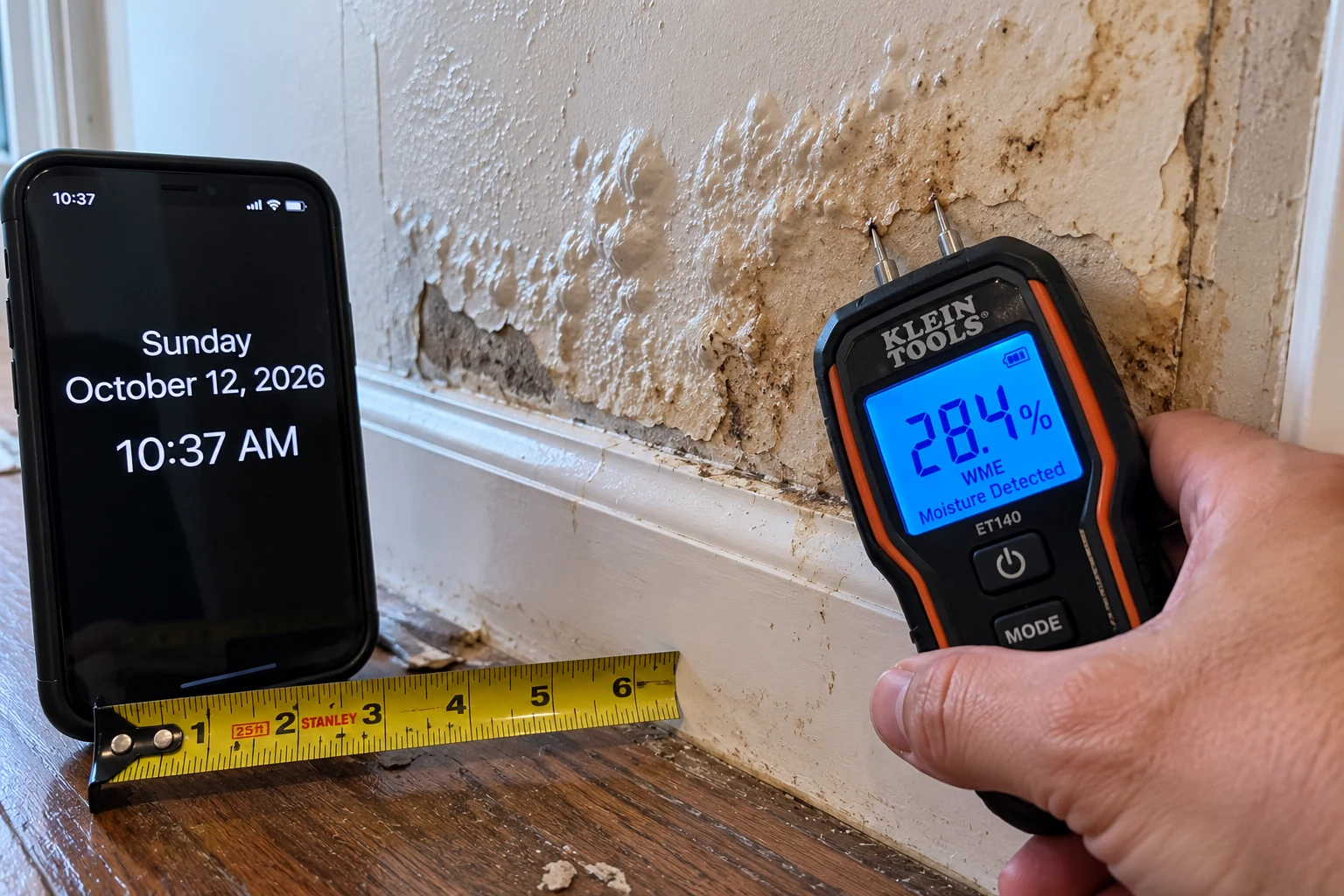
- Beat the "Bathroom Fan" Excuse With a $20 Moisture Meter: Landlords almost always claim you caused the mold by taking hot showers and not opening windows. Buying a $20 digital moisture meter at the hardware store and photographing a reading over 17% moisture inside a wall or ceiling proves a hidden pipe or roof leak is to blame.
Can You Sue Your Landlord for Mold or Black Mold?
Yes, you can sue your landlord for mold or toxic black mold. Under state law, every residential lease carries an automatic, non-negotiable guarantee called the Warranty of Habitability. State law requires every landlord to keep rental homes dry, safe, and free of dangerous mold caused by leaks or dampness—and a lease clause claiming the landlord "isn't responsible for mold" cannot override state law.
When taking legal action against a landlord for mold, it is critical to understand Causation (proving what caused what). There are two separate things to prove:
- Proving the Building Leak Caused the Mold (Property & Rent Track): This is straightforward to prove in Small Claims Court. You only need to show that a roof leak, pipe leak, or rising dampness created mold that damaged your belongings or made rooms unusable. You do not need a doctor's note to win a rent refund (rent abatement) or money for ruined clothes and furniture.
- Proving the Mold Caused a Specific Medical Illness (Personal Injury Track): If you suffered severe asthma attacks, chronic sinusitis, or neurological symptoms, you can pursue a high-value personal injury claim, which requires medical records from a physician linking your illness to mold exposure.
If the mold makes your home unsafe to breathe in and management refuses to fix it, you also have the legal right to claim Constructive Eviction—breaking your lease and moving out without paying early termination fees while recovering your security deposit and moving costs.
To see how housing courts evaluate landlord negligence across all habitability disputes, refer to our central guide on suing your landlord.
Why the Landlord's "Bleach & Paint" Trick Is Illegal (And How to Prove It)
One of the most common shortcuts dishonest landlords take is sending a handyman with a spray bottle of Clorox bleach and a roller of white stain-blocking paint ("Kilz"). They paint over the black stains and claim the issue is resolved. In a court of law, this cover-up tactic directly establishes landlord liability:
Why Bleach and Primer Cannot Cure Mold in Drywall
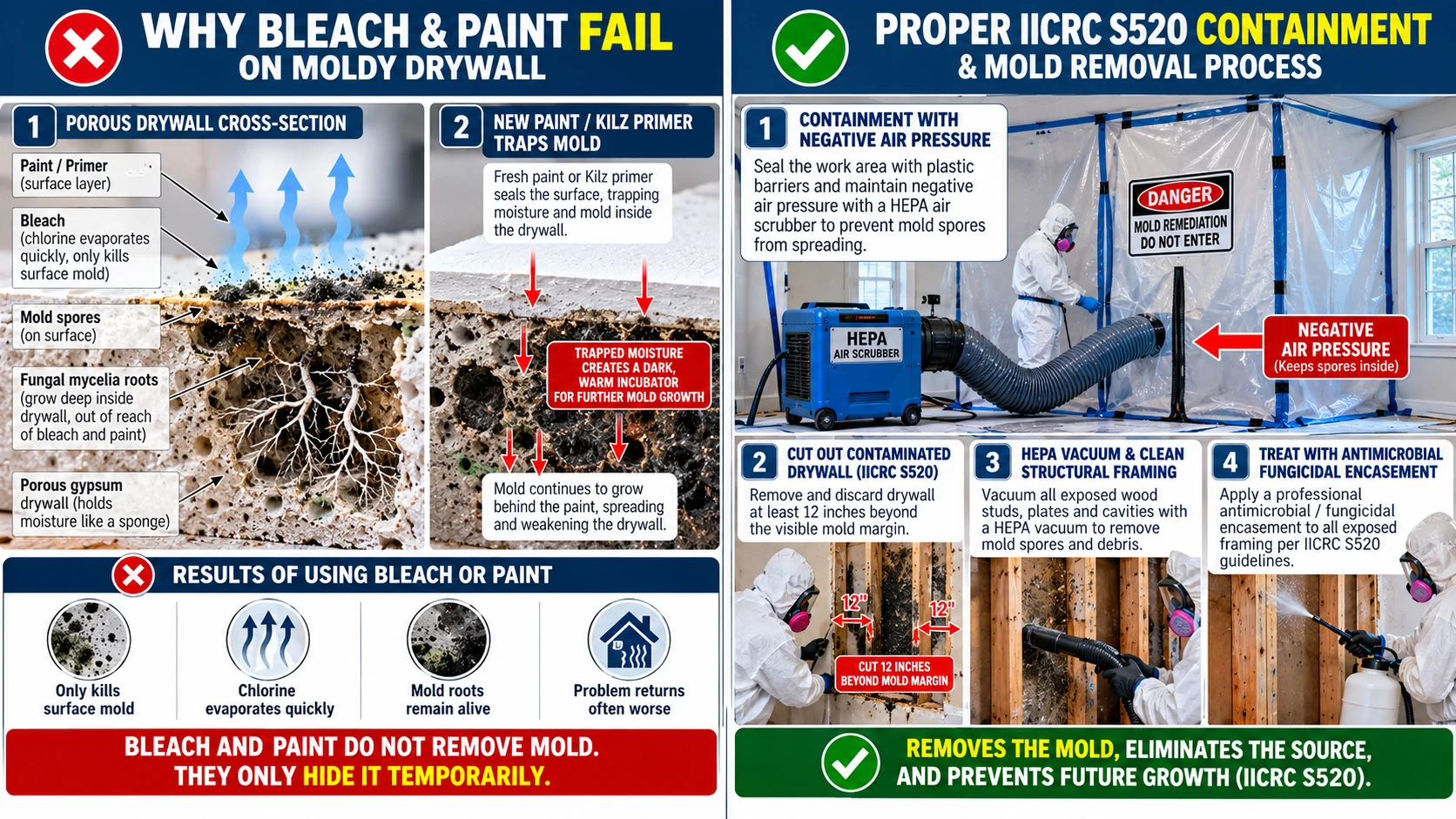
- Why Bleach Fails on Porous Drywall and Wood: Chlorine bleach only disinfects non-porous surfaces like glazed tile, porcelain, or glass. On porous drywall, baseboards, and wood studs, the chlorine chemical evaporates rapidly on the surface. The 90% water component in the bleach soaks deep into the gypsum core, actively feeding the microscopic mold roots (mycelia) and causing the mold to bloom back thicker within 2 to 3 weeks.
- The "Kilz Paint" Cover-Up Violates National Standards: Rolling stain-blocking paint over wet drywall traps active moisture inside the wall cavity, creating a dark, warm incubator for toxic molds like Stachybotrys and Aspergillus. Under EPA guidelines and the IICRC S520 Standard for Professional Mold Remediation, any porous building material with active mold exceeding 10 square feet must be sealed off under negative air pressure, cut out, and physically discarded—never wiped down or painted over.
- How to Document the Cover-Up for a Judge: Take a clear photo of the mold patch before the maintenance crew arrives. Take a second photo immediately after they roll the fresh white paint. Then, wait 10 to 20 days and take a third dated photo when dark stains, bubbles, or peeling paint bleed back through. Presenting those three dated photos side-by-side proves that management performed an incompetent, cosmetic cover-up.
Judicial Precedent: The Implied Warranty of Habitability
Landlords cannot shield themselves behind lease waivers or argue that cosmetic handyman repairs fulfill their duty to provide safe housing.
In the landmark housing decision Green v. Superior Court (10 Cal. 3d 616), the California Supreme Court formally recognized the implied warranty of habitability in modern residential tenancies. The court held that a residential lease is a contract for a livable shelter, and that when substantial code violations or moisture defects exist, the tenant's obligation to pay full rent is suspended.
This ruling established persuasive precedent across the country: property owners must maintain structural envelopes and plumbing systems in a safe condition. When a landlord conceals active mold with paint rather than fixing the underlying water leak, the tenant has full legal standing to recover retroactive rent abatements and property damages under our guide to breach of the warranty of habitability.
Which Mold Tests Actually Hold Up in Court? (Don't Buy a $15 Petri Dish!)
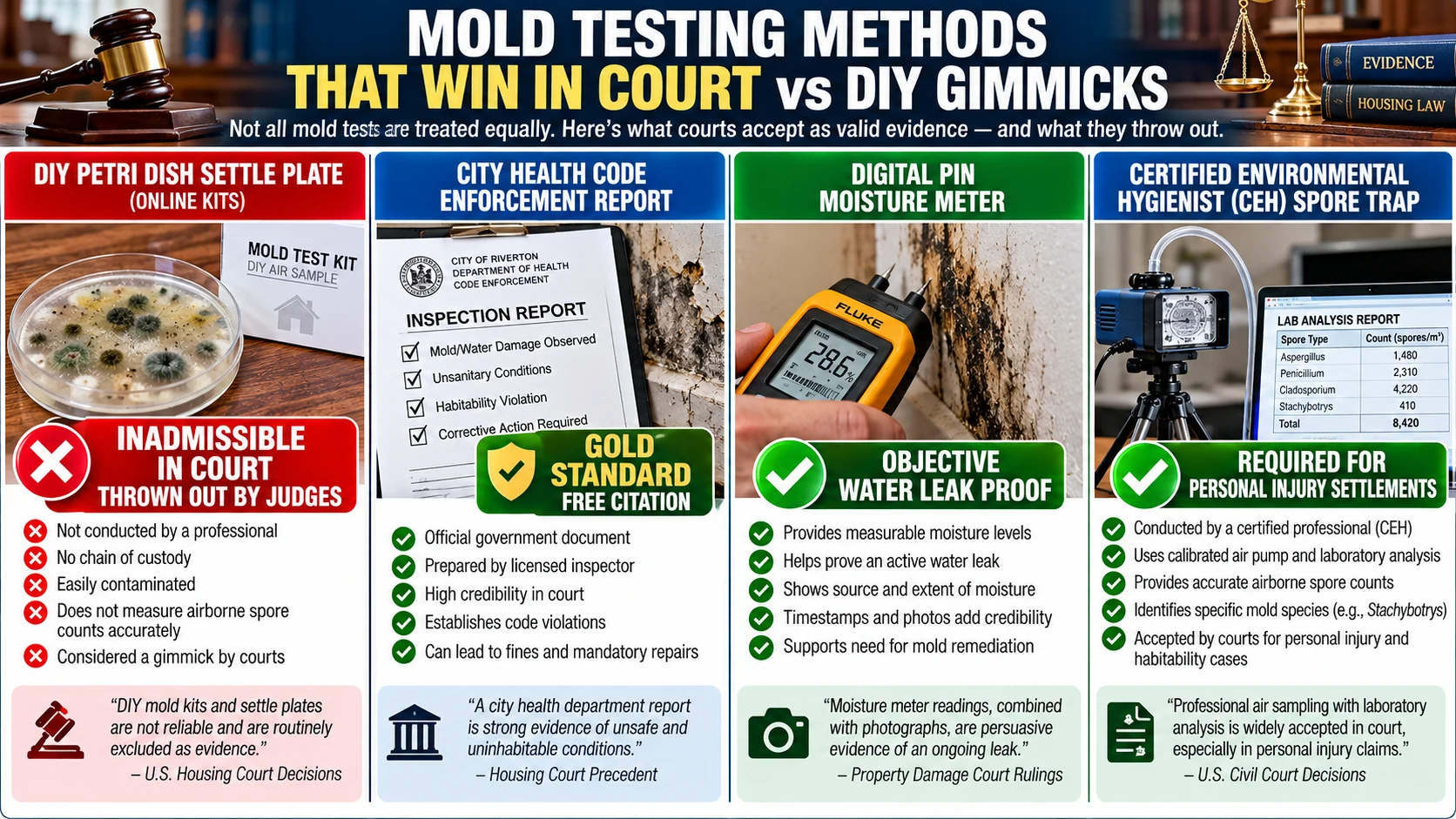
Many tenants waste money on do-it-yourself mold testing kits that have zero legal value. Understanding which tests judges accept is essential to building an airtight case:
| Testing Method | Typical Cost | Will a Judge Accept It? | When You Should Use It |
|---|---|---|---|
| $15 Store-Bought DIY Petri Dish ("Settle Plate") | $10 – $35 | NO (Thrown Out in Court) | Never. Natural harmless mold spores float in all indoor and outdoor air everywhere. Every open Petri dish will grow mold. Defense attorneys easily convince judges that DIY settle plates have no scientific validity. |
| City Code Enforcement / Health Department Inspection | FREE | YES (Gold Standard for Small Claims) | Always do this first. A municipal inspector examines the unit for active leaks, dampness, peeling paint, and visible mold, and issues an official government violation citation ordering the landlord to make structural repairs. |
| $20 Digital Pin Moisture Meter (Photos of Reading) | $18 – $30 | YES (Great Supporting Proof) | Press the two metal pins into the stained drywall or baseboard and take a photo showing a reading above 17%–20% moisture. This proves an active water leak inside the wall and destroys the "tenant shower humidity" excuse. |
| Licensed Mold Inspector (Air Spore Trap + Surface Swab) | $300 – $650 | YES (Required for Large Lawsuits) | A certified environmental hygienist compares an indoor calibrated air sample against an outdoor baseline sample. Proves that elevated toxic spores (like Stachybotrys or Aspergillus) are concentrated indoors. You can sue the landlord to reimburse this fee! |
| Medical Mycotoxin / Allergy Blood & Urine Testing | Insurance Copay | YES (For Health Injury Claims) | Ordered by an allergist, pulmonologist, or environmental physician to prove that your immune system is reacting directly to the specific mold species identified inside the apartment. |
How to Defeat the Landlord's #1 Excuse ("You Didn't Open the Window or Run the Fan")
Whenever mold appears in a bathroom or bedroom, landlords almost reflexively blame the tenant: "You took too many hot showers, didn't run the exhaust fan, or kept the windows closed." Here is how to prove the mold is 100% structural:
Clear Signs of Landlord Structural Moisture
- Mold Inside AC Ducts or HVAC Closets: Mold growing on air conditioning supply registers, drip pans, or inside the air handler blows toxic spores through the entire apartment. Maintaining and sanitizing central HVAC ductwork is exclusively the landlord's legal responsibility.
- Bubbling, Blistering, or Spongy Drywall: When paint bubbles, peels, or feels soft and damp when pressed with a finger, moisture is pushing from behind the wall—proving a hidden leaking pipe, shower pan failure, or exterior wall breach.
- Mold Along the Bottom 6 Inches of Baseboards or Ceiling Corners: Black mold creeping up along baseboards indicates rising dampness or subfloor plumbing leaks. Mold across ceiling corners proves roof leaks, broken gutter flashing, or an overflowing upstairs tub.
- Broken or Missing Bathroom Ventilation: If the bathroom lacks an operable exterior window and the mechanical exhaust fan is broken—or merely vents humid air into the closed ceiling cavity without an exterior duct—the landlord has violated local building ventilation codes.
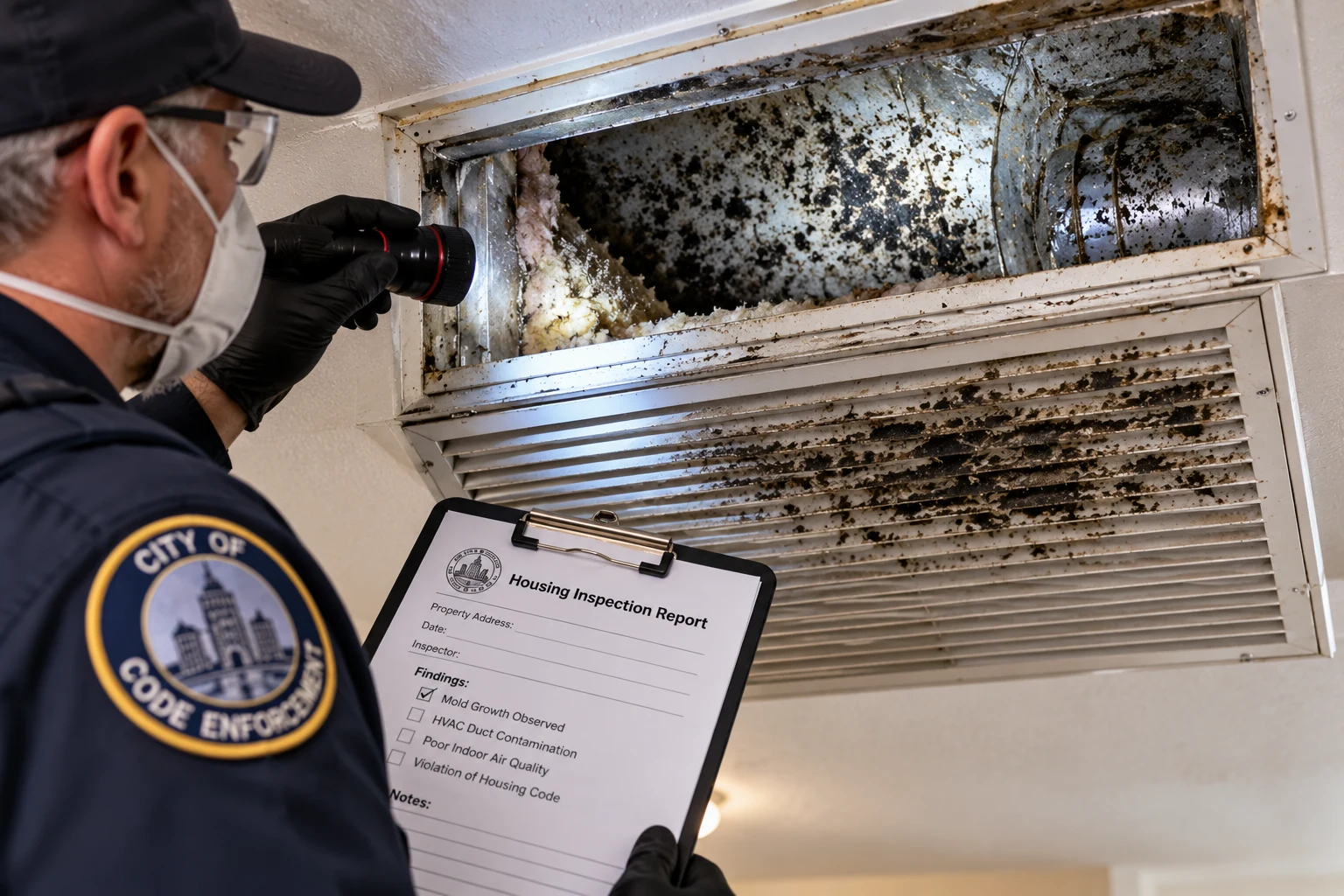
- The EPA 48-Hour Water Rule: Under U.S. Environmental Protection Agency (EPA) remediation guidelines, wet building materials must be completely dried within 24 to 48 hours to prevent mold colonies from establishing. If you reported a water leak and your landlord left the drywall or carpet damp for more than two days, the landlord's unreasonable delay directly caused the mold.
- Clean the Shower Before Calling the City Inspector: Wipe away any ordinary pink soap scum or minor surface mildew from your bathtub caulk and shower curtain first. That way, when the landlord or inspector walks in, they cannot photograph your bathtub to claim you have poor housekeeping habits. Keep the focus entirely on the water-damaged walls and ceilings.
If your landlord continues to dismiss structural dampness, review our guide to suing a landlord for refusing to make repairs.
Small Claims Court vs. Hiring a Toxic Mold Lawyer (The Honest Truth)
Many tenants are surprised to find that personal injury lawyers turn down mold cases that seem obvious. Understanding the economics of mold litigation helps you choose the right legal path:
| Legal Path | Why Choose This Option | Financial Expectations |
|---|---|---|
| Small Claims Court (Represent Yourself) |
|
Awards typically range from $3,000 to $12,500 for partial rent refunds, ruined personal property, and testing reimbursement. |
| Contingency Toxic Mold Lawyer |
|
Attorneys work on contingency ($0 upfront). Settlements and jury verdicts typically range from $35,000 to $300,000+. |
State-Specific Mold Laws & Repair Deadlines
State property codes and municipal health regulations impose strict timelines on property owners to remediate active moisture:
| State / City | Specific Mold Law or Rule | Landlord's Deadline to Fix | Small Claims Court Limit |
|---|---|---|---|
| California | Toxic Mold Protection Act & SB 655: Visible mold is officially classified as a substandard building condition. Landlords must provide the CDPH Mold Booklet to new tenants. | 30 Days max (much faster—24 to 72 hours—for active pipe leaks or acute toxic mold). | $12,500 |
| New York (NYC) | Local Law 55 (Asthma-Free Housing Act): Landlords of 3+ unit buildings must inspect annually and hire certified mold assessors and remediators for mold exceeding 10 sq. ft. | 7 to 30 Days depending on violation severity (Class B hazardous vs. Class C immediately hazardous). | $10,000 (City Court) |
| Texas | Texas Occupations Code Chapter 1958 and 25 TAC § 295.301-295.338: Requires landlords to remedy conditions that materially affect physical health and safety. Mold remediation over 25 sq. ft. requires licensed contractors. | 7 Days (statutory presumption of reasonable time after certified written notice). | $20,000 (Justice Court) |
| Florida | Fla. Stat. § 83.51 & § 83.56: Tenants can deliver a formal 7-Day Notice to Cure. If the landlord fails to remediate, the tenant can withhold rent or terminate the lease. | 7 Days after receipt of formal written notice. | $8,000 |
| Virginia, Maryland, Washington & Illinois | Mandatory written mold disclosure at move-in (VA, WA) and strict sanitary codes requiring moisture containment. | 5 to 14 Days (Virginia requires remediation to begin within 5 business days for health hazards). | $5,000 to $10,000 |
Ready-to-Send Mold Remediation & Rent Refund Demand Letter
Before filing a lawsuit in Small Claims Court, you should send one final formal demand letter. This document establishes legal notice, rejects superficial bleach or paint attempts, and gives your landlord a firm deadline to complete professional remediation and reimburse your losses:
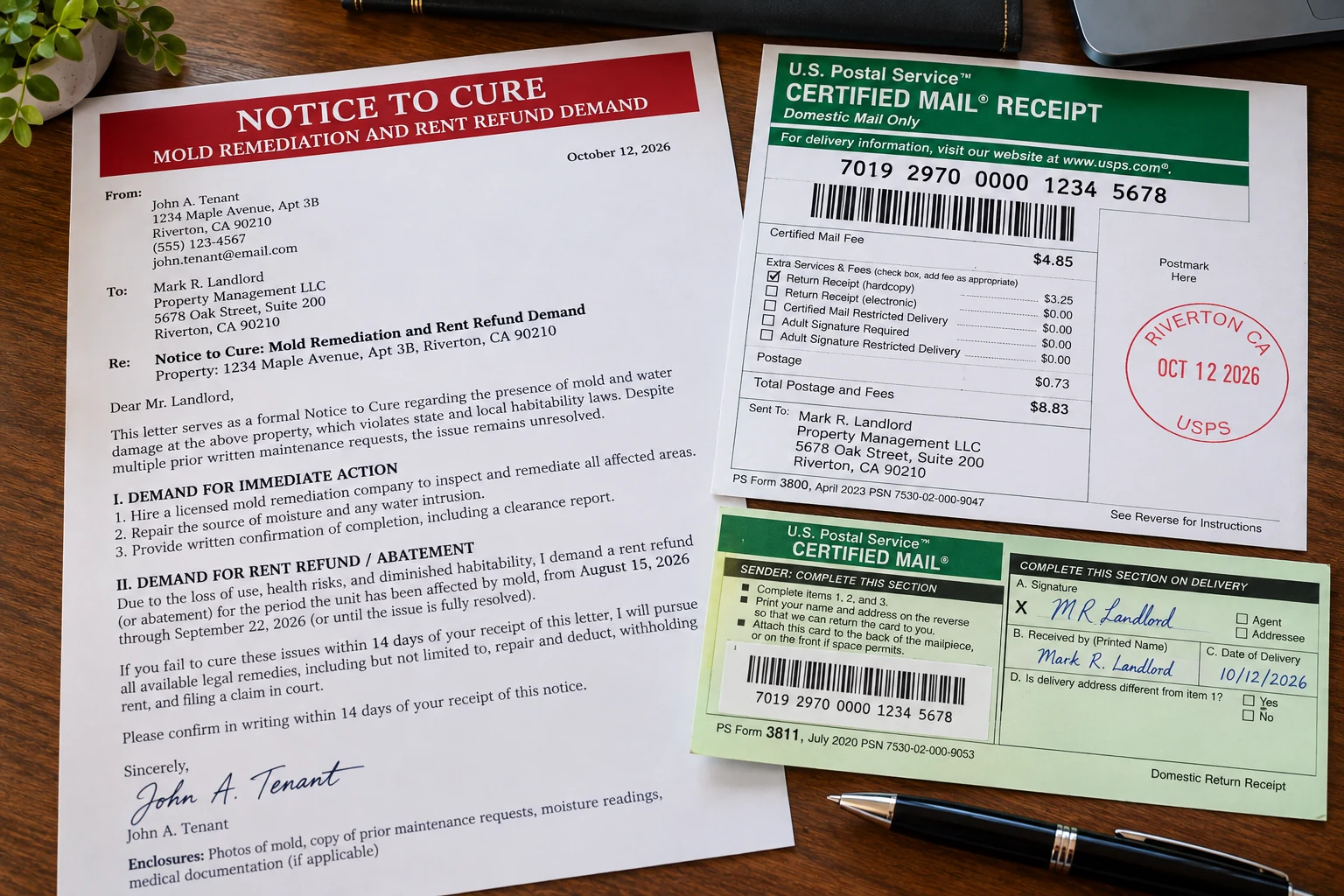
VIA CERTIFIED MAIL WITH RETURN RECEIPT REQUESTED
AND VIA ELECTRONIC DELIVERY (EMAIL / TENANT PORTAL)

Date: [TODAY'S DATE, e.g. October 15, 2026]

To: [LANDLORD OR PROPERTY MANAGEMENT COMPANY NAME]
Address: [OFFICIAL LEASE NOTICE ADDRESS]
City, State, Zip: [CITY, STATE, ZIP]

From: [YOUR FULL NAME]
Rental Address: [YOUR APARTMENT NUMBER AND STREET ADDRESS]
Phone Number: [YOUR PHONE NUMBER]
Email: [YOUR EMAIL ADDRESS]

SUBJECT: FORMAL NOTICE OF ACTIVE WATER INTRUSION AND TOXIC MOLD CONTAMINATION — FINAL DEMAND FOR STRUCTURAL REMEDIATION AND REIMBURSEMENT

Dear [LANDLORD OR PROPERTY MANAGER NAME],

This letter serves as formal written notice under state landlord-tenant statutes and the implied warranty of habitability that my rental home is suffering from active water intrusion and resulting mold contamination.

1. LOCATION AND SOURCE OF WATER INTRUSION:
Active moisture and visible mold growth were first observed on [DATE ISSUE STARTED] and reported to your office on [DATE OF FIRST REPORT] via [EMAIL / PORTAL TICKET / TEXT].

The underlying moisture source is located at:
- [DESCRIBE SOURCE: e.g., Leaking plumbing pipe beneath kitchen sink / Ceiling water leak from upstairs bathroom / Leaking window frame / AC unit condensation pan].

Visible mold and strong musty odors are currently impacting the following living areas:
- [DESCRIBE AREAS: e.g., Master bedroom drywall, closet ceiling, and baseboards].

2. INADEQUACY OF PRIOR ATTEMPTS:
[CHOOSE APPLICABLE OPTION:]
- To date, management has failed to inspect or dispatch qualified repair personnel to remedy the active leak or remediate the mold.
- The previous attempt to wipe the surface with bleach or paint over the water stain on [DATE] was legally and technically inadequate. Under EPA guidelines and IICRC S520 standards, painting or bleaching porous drywall does not eliminate active fungal mycelia, and the mold has actively bled back through the wall.

3. REQUIRED CORRECTIVE ACTIONS AND DEADLINE:
Under state property maintenance codes and habitability statutes, you are legally required to provide a dry, safe, and mold-free home. I hereby demand that you complete the following corrective actions within [NUMBER: FIVE (5) TO SEVEN (7)] BUSINESS DAYS of receipt of this notice:
1. Permanently repair the water leak at its source to halt all ongoing moisture intrusion.
2. Retain a qualified remediation contractor to safely contain the work area, remove all water-damaged and mold-contaminated porous drywall, insulation, and carpet, and treat the wall cavity with EPA-registered antimicrobial agents.
3. Reimburse me in the amount of $[TOTAL AMOUNT, e.g. $1,800] for ruined porous personal belongings (mattress, upholstered furniture, clothing), air purifiers, and independent mold testing fees (itemized receipts attached).
4. Provide a retroactive rent refund of $[AMOUNT, e.g. $2,200] representing the diminished rental value of the property during the [NUMBER] months of ongoing contamination.

4. NOTICE OF LEGAL ACTION:
If professional remediation is not scheduled and confirmed in writing within the deadline above, I will immediately pursue all statutory remedies without further notice, including:
- Requesting an urgent municipal inspection from the City Department of Health and Code Enforcement.
- Exercising statutory Repair-and-Deduct or Rent Escrow remedies as authorized by law.
- Initiating legal proceedings in Small Claims Court for rent abatement, property damage, and statutory court costs.
- Declaring constructive eviction, terminating the tenancy without penalty, and holding you liable for all relocation and moving expenses.

Please contact me in writing immediately at [YOUR EMAIL ADDRESS] to confirm inspection and repair dates.

Sincerely,

_________________________________________
[YOUR SIGNATURE]

[YOUR PRINTED NAME]
Tenant at [YOUR APARTMENT NUMBER]
How to Send This Letter So It Counts in Court:
- Fill in the brackets: Replace all bracketed placeholder text with your real dates, unit number, leak location, and itemized property losses.
- Send an email copy immediately: Email or upload the letter through your tenant portal so your landlord has immediate timestamped notice.
- Mail via USPS Certified Mail: Go to your local post office and send the letter via Certified Mail with Return Receipt Requested. Keep the green signed return receipt as primary proof for the judge.
How Much Can You Recover in a Landlord Mold Lawsuit?
When taking your landlord to Small Claims Court or Housing Court, financial recovery is determined by statutory damages categories, proven out-of-pocket losses, and rent reduction formulas:
| Recovery Category | Calculation Standard | Statutory Authority & Limits |
|---|---|---|
| 1. Retroactive Rent Abatement | Full or partial refund of rent paid while living with active toxic mold after landlord received written notice of water intrusion. | Cal. Health & Safety Code § 17920.3; NY Real Prop. Law § 235-b. |
| 2. Contaminated Soft Goods Replacement | Fair market value for mattresses, clothing, and upholstered furniture that absorbed toxic mycotoxins or active fungal spores. | EPA mold cleanup criteria; property tort damages. |
| 3. Medical & Certified Testing Reimbursement | Invoices for certified mold assessor spore testing, allergist visits, inhaler prescriptions, and hotel lodging during remediation. | Consequential out-of-pocket health expenses. |
Small Claims Filing Limits: Most tenants resolve these disputes without hiring an attorney in Small Claims Court. Maximum claim limits vary by state: for example, $12,500 in California (California Courts Self-Help), $10,000 in New York City (NY Courts Small Claims), and $20,000 in Texas (Texas Judicial Branch). If your total damages exceed small claims thresholds, you may file in standard civil district court.
Frequently Asked Questions
Yes. Every state gives you a legal time window called a Statute of Limitations to file a lawsuit after vacating. In most states, you have 2 to 3 years for personal injury and health claims, and 3 to 4 years for property damage and breach of contract. Under the legal "discovery rule," the countdown clock typically begins on the date you reasonably discovered that your health symptoms were caused by toxic mold exposure in your former home.
Standard renters insurance policies almost universally exclude mold damage resulting from ongoing building leaks, roof seepage, or landlord maintenance neglect. Renters insurance typically only covers mold if it stems directly from a sudden and accidental covered peril, such as a burst pipe. However, an insurance denial letter serves as powerful evidence in Small Claims Court to hold your landlord legally responsible for replacing all ruined porous belongings.
Yes, under the doctrine of Constructive Eviction, you can break your lease without early termination fees if severe mold makes the apartment unlivable. However, you should never stop paying rent unilaterally into your personal checking account. To protect yourself from an eviction lawsuit, issue a formal written notice with a strict cure deadline, obtain an official City Code Enforcement or Health Department inspection report, and deposit rent into a court-supervised escrow account if authorized by state law.
In Small Claims Court for rent refunds and ruined property, you do not need to prove the presence of Stachybotrys chartarum (toxic black mold). Any extensive mold growth resulting from landlord water intrusion breaches the implied warranty of habitability regardless of species. Proving a specific toxic mold species and mycotoxin levels is primarily necessary in large personal injury lawsuits where medical causation must be established to recover substantial health damages.
Yes. If you notified your landlord in writing about water leaks or suspected mold, management refused to investigate or denied the problem, and you subsequently paid $300 to $650 for an independent certified environmental hygienist whose air spore trap test confirmed elevated indoor mold, judges routinely order the landlord to reimburse the testing fee as a necessary mitigation cost.
SueLegal is an independent educational legal publisher, not a law firm or lawyer referral service. The information provided in this guide is for general informational and educational purposes only and does not constitute formal legal advice. Residential landlord-tenant laws, repair notice periods, and statutory remedies vary significantly across state and municipal jurisdictions. If you are facing eviction, severe uninhabitable conditions, or complex litigation, consult a licensed attorney in your jurisdiction or contact your local legal aid organization. For more details on our standards, read our Editorial Policy and Legal Research Methodology.