

Yes, you can sue your landlord for breaching the Warranty of Habitability.
In 49 states and Washington, D.C., every residential lease automatically includes the Implied Warranty of Habitability—a law requiring your landlord to keep heat, hot water, plumbing, electricity, roofs, locks, and pest control in safe working order. If your landlord fails to fix a serious living problem after you notify them in writing, you can use this law in two ways:
- Sue for a Retroactive Rent Refund & Damages (Offensive Lawsuit in Small Claims Court): Even if you paid your full rent on time every month, you can sue your landlord to get back 25% to 100% of the rent you paid during the months the home had unfixed violations—plus out-of-pocket costs, ruined belongings, and daily discomfort damages.
- Defend Yourself Against an Eviction (Defensive Shield in Housing Court): If you withheld rent because your home had no heat, leaks, mold, or pests, and your landlord filed to evict you, raising "Breach of the Implied Warranty of Habitability" forces the judge to reduce or wipe out the rent you owe and stop the eviction.
Your Key Rights & Responsibilities
- "As-Is" Lease Clauses and "Fixer-Upper" Rent Discounts Are Illegal: A landlord cannot escape the Warranty of Habitability by writing "Tenant accepts apartment as-is" in the lease—or even by offering you cheaper rent in exchange for living without heat, hot water, or a leak-free roof.
- You Can Win Both a Rent Refund AND "Discomfort & Annoyance" Money: In many states (like California, New York, Massachusetts, and Oregon), you don't just win back a percentage of your rent—judges can also award extra money ($20 to $100+ per day) for the stress, lost sleep, and inconvenience of living in a broken apartment.
- Context Determines What Counts as a Legal Breach: A broken toilet in a one-bathroom apartment is an immediate 100% habitability violation, while a broken second toilet in a two-bathroom apartment is a smaller (~20%) violation. A broken heater in January is an emergency breach; in July, it is a routine repair.
- Even a "$50 Furnace Part" Can Trigger a $5,000 Lawsuit: Courts judge a habitability breach by how the problem affects your life, not how cheap the part is. If a $50 thermostat breaks and leaves your family freezing for 3 weeks, the landlord is guilty of a major habitability breach.
- You Must Prove 4 Simple Things in Court: (1) A serious health or safety defect existed, (2) You didn't break it yourself, (3) You told the landlord in writing (or a city inspector cited them), and (4) The landlord failed to fix it within a reasonable time.
What Counts as a Breach of the Warranty of Habitability? (Major Breach vs. Minor Repair)
The Implied Warranty of Habitability does not require your apartment to be flawless or luxurious. It requires the rental home to be safe, sanitary, and fit for human living under local building and health codes. When evaluating habitability, courts draw a strict line between serious violations that endanger health and minor inconveniences that merely annoy you.
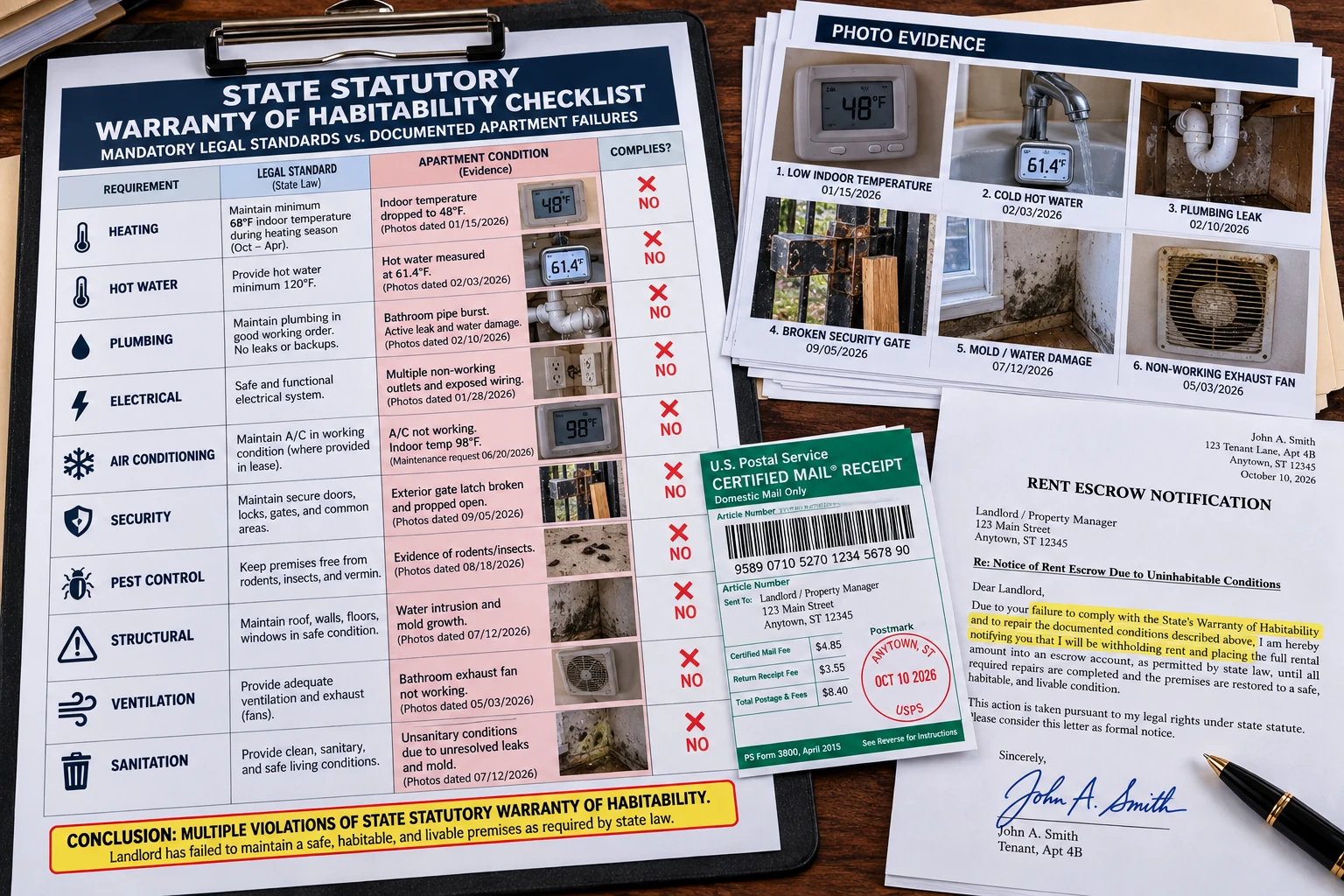
Context determines whether a defect crosses the legal line. For example, a broken toilet in a one-bathroom apartment leaves you with no sanitation, creating an immediate emergency breach. The same broken toilet in a home with two working bathrooms is an ordinary maintenance inconvenience. Similarly, a broken heater in sub-freezing January weather is an acute code violation, while a broken heater in mild July weather is a routine repair.
| Housing System | Counts as a Major Habitability Breach (You Can Sue!) | Counts as a Minor Repair Only (Not a Habitability Breach) |
|---|---|---|
| Heat & Temperature | Furnace fails during winter, or indoor temperature drops below 65°F–68°F required by city heating ordinances (see suing for no heat). | Heater malfunctions during warm summer months, or one bedroom is 2 degrees cooler than the living room. |
| Hot & Cold Water | Complete loss of running water, or water heater fails to supply at least 110°F–120°F water for over 24 to 48 hours (see suing for no hot water). | Kitchen faucet takes 45 seconds to heat up, low pressure in one sink aerator, or a slow drip. |
| Toilets & Plumbing | Sole toilet in unit fails to flush, raw sewage backs up through drains, or waste pipes burst into living spaces (see suing for sewage backup). | One toilet runs intermittently in a two-bathroom unit where the master bathroom functions properly. |
| Roof & Wall Leaks | Active rain intrusion through ceiling, soaked drywall risking collapse, or unaddressed moisture spawning toxic spores (see suing for mold and water damage claims). | Dry water stains on ceiling plaster left over from an old, resolved plumbing leak from the previous year. |
| Locks & Security | Exterior entry door deadbolt broken, ground-floor windows unable to lock, or building security gates broken in high-crime zones. | A small tear in a 3rd-floor window insect screen when the glass window itself latches and locks securely. |
| Pests & Vermin | Active infestation of rats, mice, bed bugs, or German cockroaches inside walls, cupboards, or bedrooms (see pest infestation lawsuits). | Occasional outdoor garden ants near patio sliding doors or harmless spiders in an unfinished basement. |
| Trash & Common Areas | Piles of rotting garbage in common courtyards due to unpaid dumpster service, rotted exterior stair treads, or pitch-black interior fire stairs. | Hallway runner carpet appears worn or scuffed, or lobby walls need cosmetic repainting. |
If your situation matches any of the conditions in the middle column, your landlord is in direct breach of the lease and state housing statutes. You have immediate legal remedies to compel repairs and recover compensation.
For full step-by-step guidance on filing against residential landlords in small claims court, read our master guide on suing your landlord.
Using the Law as a "Sword" vs. a "Shield" (2 Ways to Win in Court)
Renters often believe the Warranty of Habitability can only be used after withholding rent. In reality, state tenant statutes allow you to deploy the doctrine in two completely different legal postures: offensively as a "Sword" or defensively as a "Shield."
Way #1: As a "Sword" (Pay Your Rent, Then Sue in Small Claims Court)
This is the cleanest, lowest-risk strategy for residential tenants. You continue paying your full contract rent on the first of every month, completely eliminating any risk of an eviction notice or negative credit reporting. Meanwhile, you document every written maintenance request, photo, and municipal inspection report.
Once you move out—or even while your lease is active—you file a claim in Small Claims Court suing the landlord for retroactive rent abatement. Judges respect tenants who acted in good faith by paying their rent. Because the landlord accepted full payment for a defective property, courts routinely award 25% to 75% of your total rent back in cash, plus your verified out-of-pocket expenses.
Way #2: As a "Shield" (Your #1 Defense Against an Eviction)
Under landmark legal precedents—including Javins v. First National Realty Corp. and Green v. Superior Court—a residential lease is a mutual contract. Your obligation to pay rent is legally dependent on the landlord fulfilling their duty to provide habitable housing.
If you withheld rent following your state's statutory notice and escrow rules, and the landlord attempts to evict you for non-payment, you raise "Breach of the Implied Warranty of Habitability" as an affirmative defense on your court Answer. During trial, the judge reviews evidence of the defects. If the court finds the apartment was 40% uninhabitable, it reduces the landlord's rent demand by 40%. Once you pay the remaining adjusted balance from your escrow account, the eviction is dismissed and you retain legal possession of your home.
For more details on handling severe living hazards, review our comprehensive guides on uninhabitable apartment lawsuits and fighting illegal landlord evictions.
How Judges Calculate Your Payout (The 3 Official Court Formulas)
When you present a habitability claim in court, judges do not pick random numbers. They rely on three recognized judicial formulas to calculate your monetary recovery. Understanding these formulas allows you to structure your demand letter and court testimony with mathematical precision.
1. The "Percentage-of-Use Reduction" Method (Used in 80% of Cases)
This is the standard formula in small claims and housing courts nationwide. The court estimates what portion of the home's functional value, safety, or square footage was compromised by the landlord's failure to repair.
Monthly Contract Rent × Percentage Loss of Use × Number of Months Defect Existed = Rent Abatement
For example, if your monthly rent is $2,200 and a ceiling leak made your secondary bedroom and bathroom completely unusable for 4 months (representing a 35% loss of living utility), your rent abatement award is: $2,200 × 0.35 × 4 = $3,080.
2. The "Fair Market Value Difference" Method
Courts apply this formula primarily in rent-stabilized properties or situations where the tenant held a favorable below-market lease. Instead of applying a flat percentage to your contract rent, the court measures the gap between the apartment's open-market value in good condition versus its impaired value in its defective state.
(Market Value as Warranted − Actual Market Value in Defective Condition) × Months = Rent Abatement
If comparable clean units in your neighborhood rent for $2,400 per month, but an expert or housing inspector establishes your pest-ridden apartment was only worth $1,100 per month on the open market, the monthly abatement is $1,300, regardless of the rent stated on your lease agreement.
3. Additional "Discomfort, Annoyance & Out-of-Pocket" Damages
A habitability lawsuit is not limited strictly to rent reimbursement. Tenants are legally entitled to recover consequential economic damages and general damages:
- 100% Out-of-Pocket Expenses: Receipts for space heaters, portable air filters, hotel accommodations, laundromat costs, spoiled groceries from a dead refrigerator, and replacement furniture (see our guide to suing for property damage).
- Tort Damages for Annoyance and Discomfort: In states such as California, New York, Massachusetts, and Oregon, appellate courts hold that tenants may recover separate damages for mental anguish, discomfort, and inconvenience resulting from habitability breaches. Courts commonly award $25 to $100 per day for enduring severe cold, vermin bites, or hauling water buckets.
Why "As-Is" Clauses & "Handyman Rent Discounts" Are 100% Illegal
When confronted with housing code violations, landlords frequently attempt to point to fine-print lease clauses or verbal side agreements. In residential tenancy law, these defenses almost universally fail in court.
Excuse #1: "Look at Paragraph 18—You Signed an 'As-Is' Lease!"
In 49 states and the District of Columbia, the Implied Warranty of Habitability is a mandatory public policy doctrine that cannot be waived. Just as an employer cannot ask employees to sign away their rights to minimum wage or workplace safety rules, a landlord cannot contract out of local building and health codes.
Any lease provision stating that the tenant accepts the premises "as-is," assumes responsibility for structural repairs, or agrees not to hold the landlord liable for code defects is legally void and unenforceable. Judges routinely strike these clauses down and admonish landlords for including them.
Excuse #2: "I Gave You $300 Off the Rent Because You Knew the Roof Leaked!"
Landlords often argue that lower rent reflects substandard conditions. State appellate courts have repeatedly ruled that housing codes establish an absolute floor for human living conditions. A landlord cannot rent an unsafe property simply because they reduced the rent price.
The only limited exception recognized under the Uniform Residential Landlord and Tenant Act (URLTA § 2.104) requires an entirely separate, voluntary written agreement supported by genuine consideration where a single-family home tenant agrees to perform specified repairs. This exception never applies to shared structural systems, multi-unit apartment complexes, or core utility infrastructure.
If your landlord continues to delay repairs after written notification, consult our guides on landlord repair refusal and holding landlords accountable for unsafe living conditions.
Ready-to-Send Breach of Warranty of Habitability Notice & Refund Demand
Before filing a lawsuit in Small Claims Court or formally withholding rent into an escrow account, you must establish an unassailable paper trail. Send a formal demand letter via Certified Mail with Return Receipt Requested, as well as via email or your landlord's official resident portal.
Select the template below that aligns with your legal track, click "Copy Letter to Clipboard," fill in the bracketed information, and retain a copy for your court exhibit binder.
How Much Compensation Can You Recover for Habitability Breaches?
When taking your landlord to Small Claims Court or Housing Court, financial recovery is determined by statutory damages categories, proven out-of-pocket losses, and rent reduction formulas:
| Recovery Category | Calculation Standard | Statutory Authority & Limits |
|---|---|---|
| 1. Percentage-Reduction Rent Abatement | Judges reduce rent by the percentage of impairment (e.g., 20% to 100%) for every day conditions violated housing codes. | 49-state habitability jurisprudence (Green v. Superior Court). |
| 2. Repair & Deduct Reimbursement | Full credit for certified contractor invoices paid to restore vital services after statutory notice. | State repair-and-deduct codes (capped at 1-2 months' rent). |
| 3. Statutory Multiplier Penalties | Civil penalties awarded where landlords deliberately collected rent despite knowing of uncorrected health orders. | E.g., Cal. Civ. Code § 1942.4. |
Small Claims Filing Limits: Most tenants resolve these disputes without hiring an attorney in Small Claims Court. Maximum claim limits vary by state: for example, $12,500 in California (California Courts Self-Help), $10,000 in New York City (NY Courts Small Claims), and $20,000 in Texas (Texas Judicial Branch). If your total damages exceed small claims thresholds, you may file in standard civil district court.
Frequently Asked Questions About the Warranty of Habitability
Does every state have the Implied Warranty of Habitability?
49 states and Washington, D.C. recognize the Implied Warranty of Habitability by state statute or landmark judicial precedent. Arkansas was historically the only state without a broad implied warranty, though Arkansas passed baseline statutory habitability requirements in 2021 requiring working roofs, hot/cold running water, electricity, sewage, and heating/cooling systems for modern residential leases.
Can I sue for breach of the warranty of habitability if I never withheld rent?
Yes. Paying your rent on time and then suing your landlord in Small Claims Court for a retroactive rent refund is actually the safest way to enforce the Warranty of Habitability. Because you have paid all rent due, the landlord cannot threaten you with a non-payment eviction while your lawsuit is pending, and judges view paying tenants with high credibility.
Does the Implied Warranty of Habitability cover broken air conditioning, washers, or dishwashers?
It depends on local law and lease terms. In hot Sunbelt states and municipalities such as Arizona, Nevada, and parts of Texas, air conditioning is classified as an essential habitability service during summer months. For secondary appliances like dishwashers, washing machines, or garbage disposals, even if they are not covered under basic health codes, if the unit was leased with them in place, the landlord is legally obligated to repair them under Breach of Express Lease Contract.
How long do I have to sue my landlord for breaching the warranty of habitability?
Because the Warranty of Habitability is an inherent component of your residential lease agreement, most states apply their Written Contract Statute of Limitations, which typically ranges from 3 to 6 years from the date of the breach. This means you can still file a lawsuit against a former landlord for a retroactive rent refund even after moving out, provided you saved your photographs, written repair requests, and payment records.
Can I win attorney's fees if I hire a lawyer to sue for breach of habitability?
In many states—including California, New York, Florida, Washington, Oregon, and jurisdictions following the Uniform Residential Landlord and Tenant Act—if your lease contains an attorney's fees clause or state law provides statutory fee-shifting, a tenant who prevails in a habitability lawsuit can be awarded reasonable attorney's fees paid by the landlord on top of their rent refund.
SueLegal is an independent educational legal publisher, not a law firm or lawyer referral service. The information provided in this guide is for general informational and educational purposes only and does not constitute formal legal advice. Residential landlord-tenant laws, repair notice periods, and statutory remedies vary significantly across state and municipal jurisdictions. If you are facing eviction, severe uninhabitable conditions, or complex litigation, consult a licensed attorney in your jurisdiction or contact your local legal aid organization. For more details on our standards, read our Editorial Policy and Legal Research Methodology.