
The Main Points
- Key Condition: Habitability defects must be substantial, or landlord conduct must be outrageous or retaliatory under California tort law.
- Typical Deadline: 2 years from the injury date for personal injury and emotional distress; 3 years for statutory violations.
- Cost Range: $30 to $75 for Small Claims Court filing; no attorneys permitted in Small Claims hearings.
- Best Next Step: Request a formal local code enforcement inspection and send written notice under California Civil Code § 1942.
When Can California Tenants Sue for More Than Just a Rent Refund?
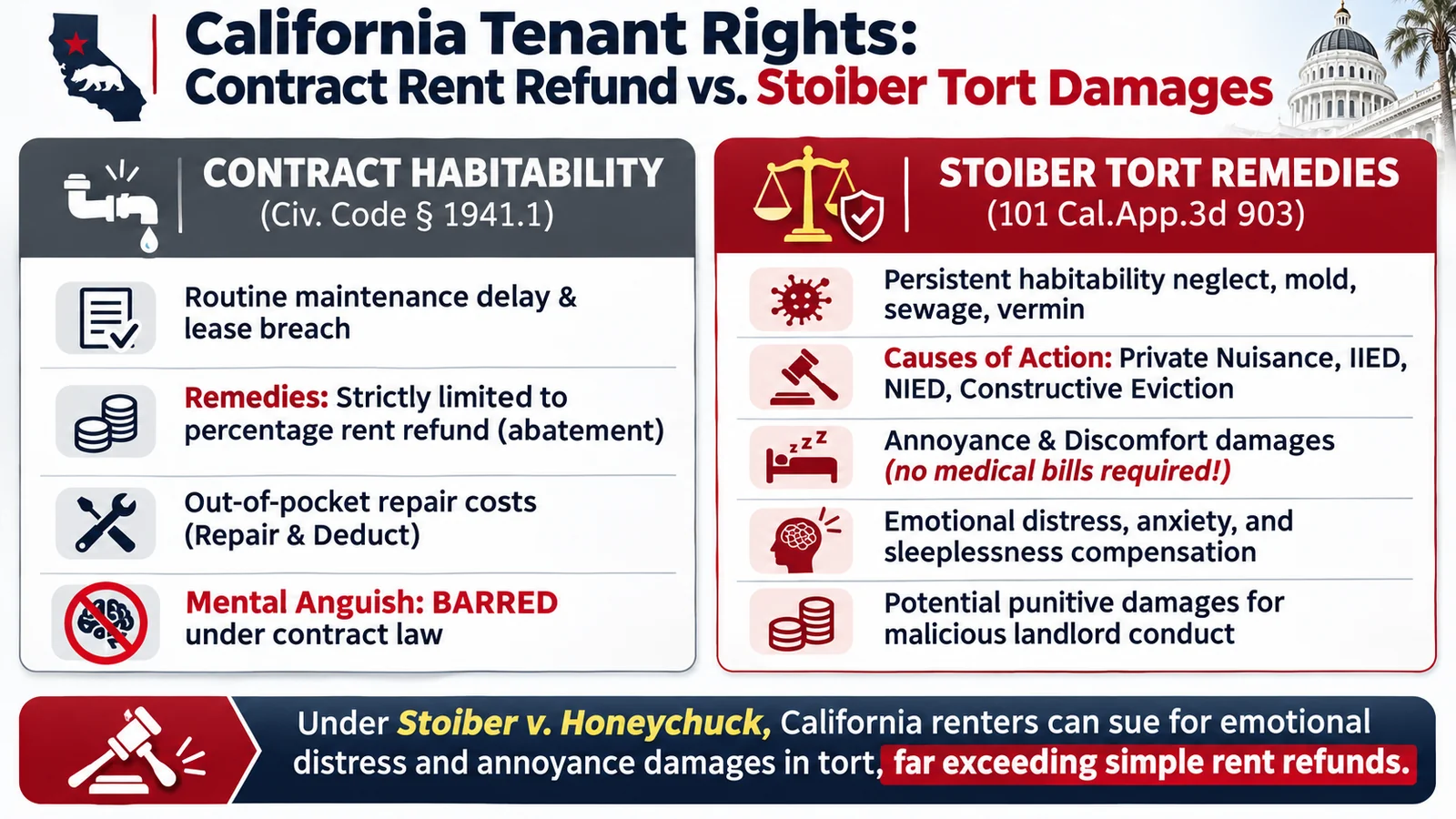
For decades across the United States, landlords defended tenant lawsuits by arguing that a lease is strictly a contract, limiting remedies to rent refunds. California shattered this limitation in the landmark Fifth District Court of Appeal decision Stoiber v. Honeychuck (101 Cal. App. 3d 903) 101 Cal. App. 3d 903.
In Stoiber, the court held that a landlord's failure to maintain habitable premises gives rise not only to breach of contract claims, but also to distinct common-law tort actions. If you are wondering, "Can I sue my landlord for emotional distress?", California allows tenants to assert claims for:
- Tortious Breach of the Implied Warranty of Habitability: Allowing general damages for personal suffering, anxiety, and frustration caused by substandard housing.
- Private Nuisance: Compensating tenants for substantial interference with the comfortable enjoyment of life or property under California Civil Code § 3479.
- Intentional Infliction of Emotional Distress (IIED): When a landlord intentionally maintains squalid conditions or ignores complaints with reckless disregard of tenant well-being.
- Negligent Infliction of Emotional Distress (NIED): Recovering for mental distress flowing from a landlord's negligent property maintenance.
Furthermore, when a landlord's conduct is proven to be malicious, fraudulent, or oppressive, California Civil Code § 3294 permits judges and juries to award substantial punitive damages designed to punish slumlords.
Annoyance & Discomfort Damages: Getting Compensated Without Doctor Bills
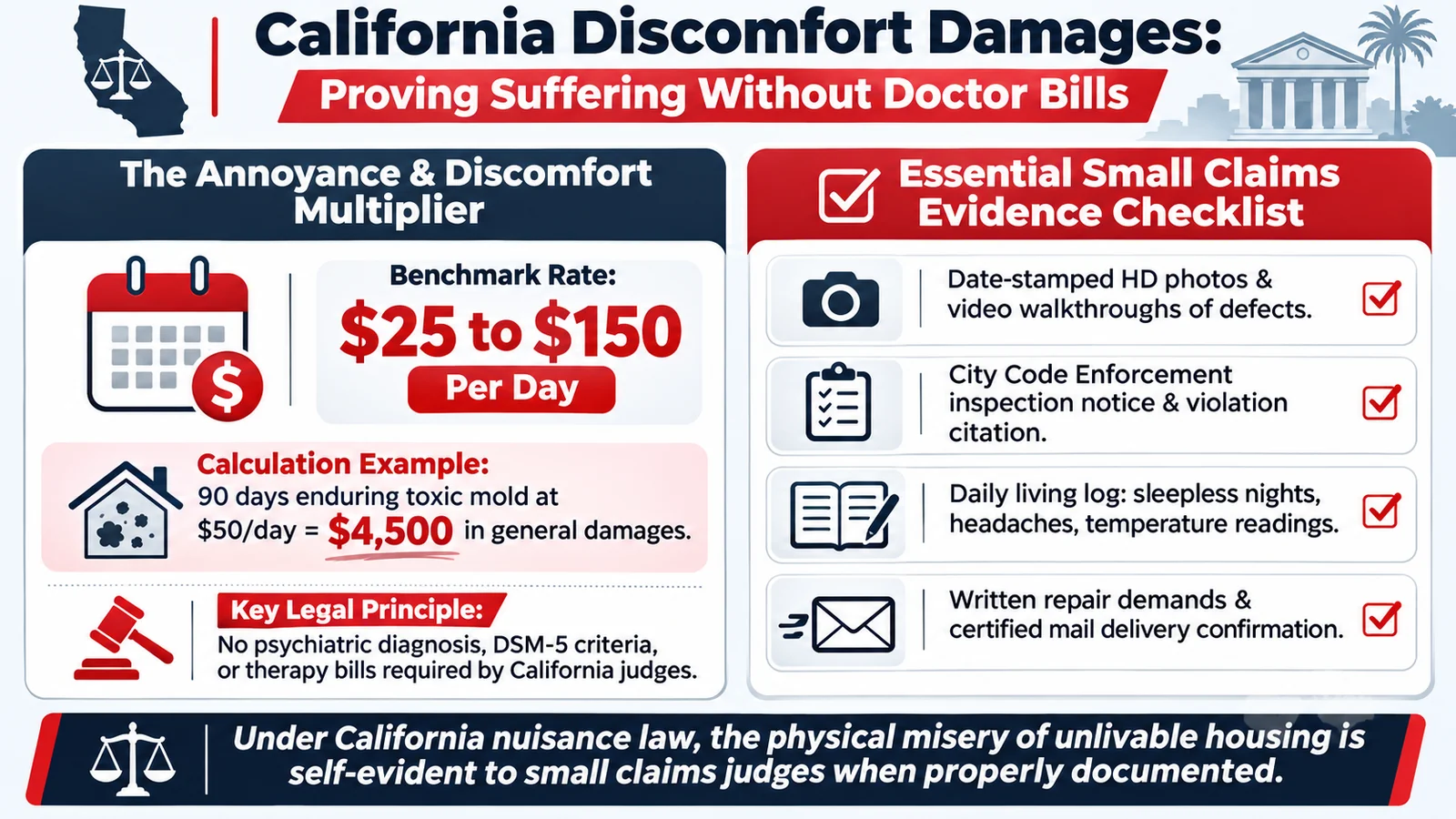
One of the most persistent misconceptions among tenants is that winning an emotional distress claim requires tens of thousands of dollars in medical or psychiatric treatment records. In California, this is definitively not the law.
Under California nuisance jurisprudence and decisions such as Harlan v. Melendez, tenants can recover non-economic damages specifically classified as "annoyance and discomfort". California civil jury instructions (CACI No. 3905A) explicitly authorize compensation for physical discomfort, inconvenience, irritation, and mental tranquility disruption caused by defective housing.
A tenant forced to endure cockroach infestations crawling over kitchen counters, constant sewer odors, water leaks dripping onto furniture, or persistent dampness can testify directly regarding how those conditions disrupted their daily life, sleep patterns, and mental peace. Judges in California Small Claims Court regularly assign daily dollar values (e.g., $25 to $75 per day) for annoyance and discomfort on top of rent reductions, providing meaningful non-economic recoveries without requiring expensive medical expert witnesses.
Ignoring City Repair Notices: $5,000 Penalties for Unfixed Violations
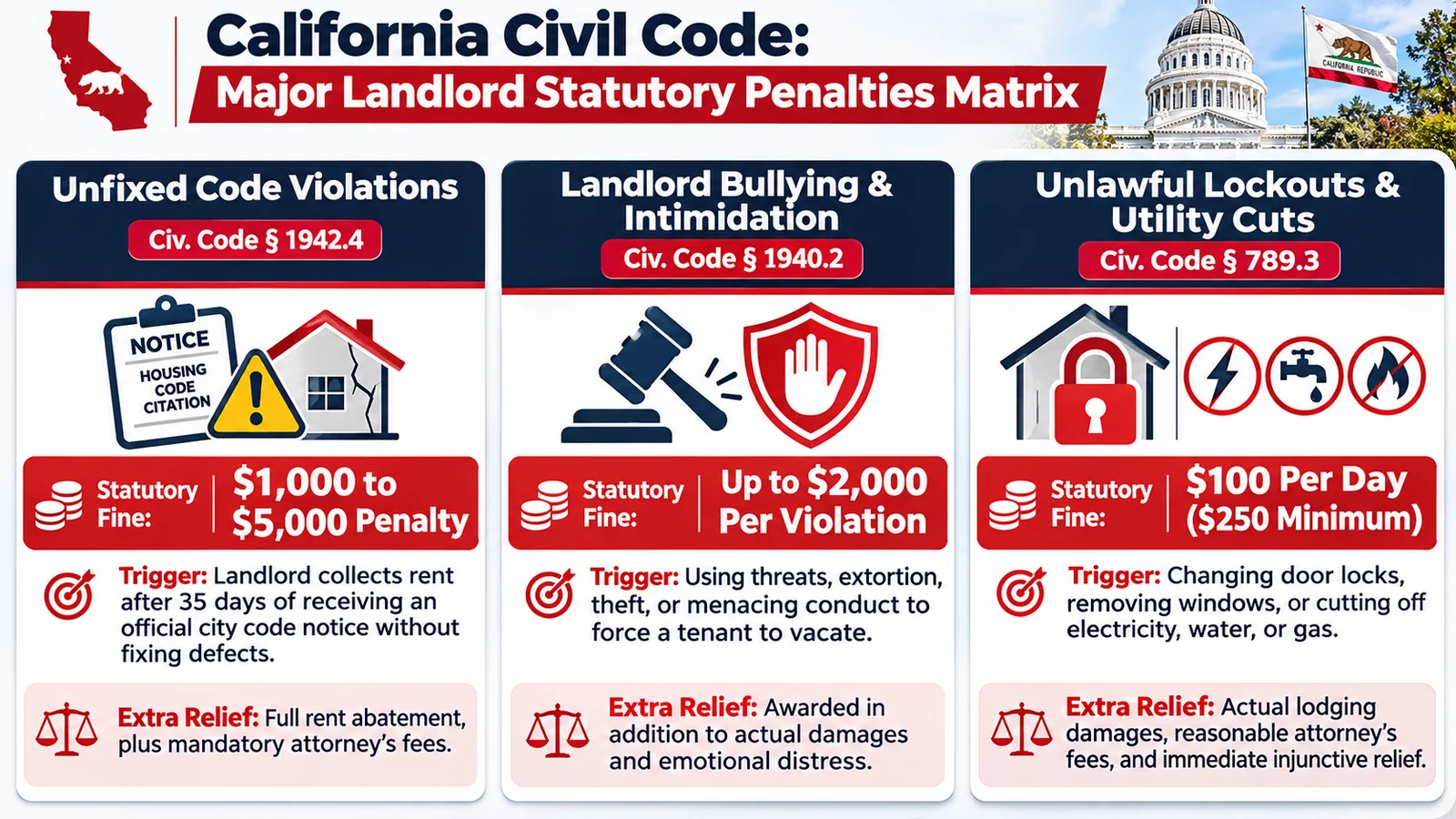
California provides a lethal statutory weapon against stubborn landlords: California Civil Code § 1942.4. This statute establishes severe financial liability when an owner fails to remedy documented housing code violations.
To trigger liability under § 1942.4, four statutory conditions must be established:
- The dwelling substantially lacks any of the affirmative standard characteristics of habitability listed in Civil Code § 1941.1 (such as effective waterproofing, plumbing, gas, heating, electrical lighting, clean premises, or adequate trash receptacles).
- A public officer or code enforcement inspector inspected the premises and served written notice of the substandard condition to the landlord.
- The hazardous conditions remained unabated for more than 35 days after the notice was served, without good cause for delay.
- The landlord demanded, collected, or attempted to collect rent for the period after the 35 days elapsed.
| California Remedy Category | Governing California Statute | Potential Monetary Recovery |
|---|---|---|
| Habitability Code Violation Penalty | Cal. Civ. Code § 1942.4 | $100 to $5,000 Statutory Fine + Actual Damages + Attorney Fees |
| Unlawful Utility Shutoff / Lockout | Cal. Civ. Code § 789.3 | $100/Day (Min $250) + Actual Losses + Mandatory Attorney Fees |
| Landlord Harassment & Intimidation | Cal. Civ. Code § 1940.2 | Up to $2,000 Civil Penalty Per Violation |
| Bad-Faith Deposit Retention | Cal. Civ. Code § 1950.5 | Full Deposit Return + Statutory Damages Up to 2x Withheld Sum |
Under § 1942.4, the court is authorized to award the tenant actual damages, reasonable attorney's fees, and statutory damages between $100 and $5,000. When combined with general discomfort damages, Section 1942.4 creates substantial exposure for non-compliant landlords.
Landlord Bullying & Illegal Lockouts: $100-per-Day Penalties
California strictly prohibits self-help evictions and landlord bullying through specific statutory protections designed to curb bad-faith property management practices.
Under California Civil Code § 1940.2, a landlord cannot use force, willful threats, or menacing conduct that interferes with a tenant's quiet enjoyment, nor can they commit substantial theft or extortion. Landlords who violate § 1940.2 face a civil penalty of up to $2,000 for each violation. In cities with local rent stabilization ordinances—such as the Los Angeles Tenant Anti-Harassment Ordinance (TAHO) or San Francisco Administrative Code Chapter 37.10B—tenants can sue for landlord harassment with treble damages and attorney fees.
If a landlord resorts to an illegal lockout, cuts off electricity, water, gas, or removes doors or windows, Civil Code § 789.3 triggers severe penalties. The landlord is liable for actual tenant losses, mandatory reasonable attorney fees, and a statutory penalty of $100 per day that the violation persists (with a mandatory statutory minimum of $250). If conditions become so severe that you are forced to abandon your home, California recognizes this as an actionable constructive eviction.
Real Court Example: How an Alameda Tenant Won in Small Claims
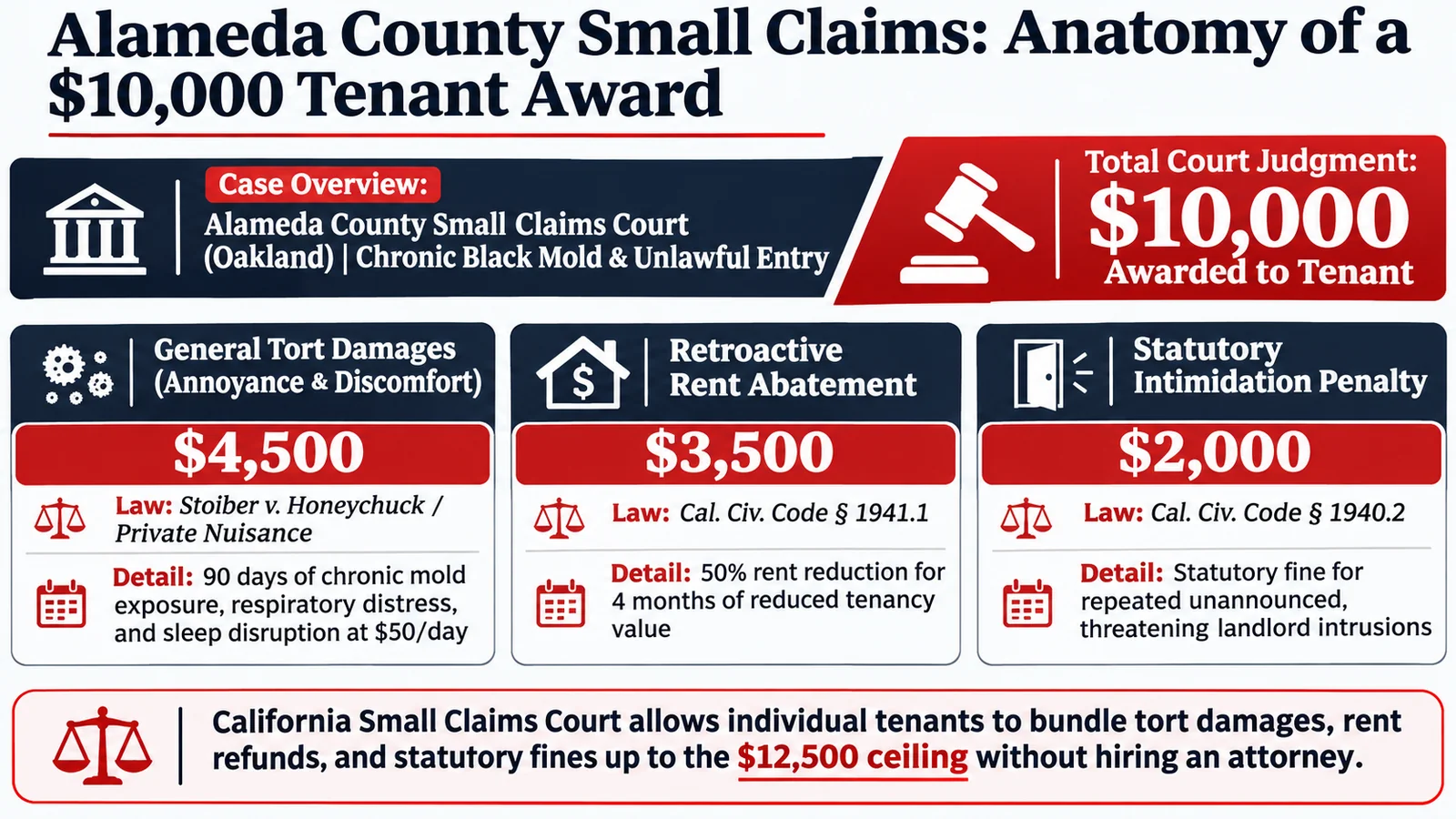
To see how California judges apply these rules in practice, consider an illustrative composite case from the Alameda County Superior Court (Oakland Small Claims Division):
Alameda County Small Claims Habitability & Nuisance Trial
The Background: A tenant in Oakland paying $2,200/month endured chronic roof leaks and black mold growth inside the bedroom for four months. Despite repeated written notifications, the landlord sent unannounced handymen who entered without 24 hours notice and merely painted over wet drywall without fixing the exterior roof. The Oakland Code Enforcement Division inspected and issued a Notice of Violation giving the owner 30 days to abate the hazard. The landlord ignored the citation and served a retaliatory 60-day notice to terminate tenancy.
The Small Claims Claim: The tenant filed a pro se lawsuit for $12,500 (the maximum statutory limit) alleging breach of warranty of habitability under Stoiber, private nuisance, and statutory violations under Cal. Civ. Code § 1942.4 and § 1940.2. Evidence included Oakland Code Enforcement inspection reports, moisture meter readings, photos of ruined mattress and clothes, and documented dates of unannounced entries violating tenant privacy.
The Court's Ruling: The Small Claims Judge Pro Tem ruled entirely in favor of the tenant, awarding:
- $3,520 in retroactive rent abatement (40% reduction of $2,200/month rent across 4 months).
- $3,000 statutory damages under Civil Code § 1942.4 (failure to abate code violations within 35 days).
- $2,000 statutory penalty under Civil Code § 1940.2 (landlord intimidation and retaliatory termination notice).
- $2,400 in general damages for "Annoyance and Discomfort" under Harlan v. Melendez ($20/day across 120 days).
- $1,200 in damaged personal property (bedding and ruined furniture).
- Total Award: $12,120, plus $75 in court costs, and an injunction quashing the retaliatory notice to vacate.
This case highlights why California tenants have a unique advantage: you do not need medical bills to recover for the emotional annoyance and disruption caused by uninhabitable living conditions.
Taking Your Landlord to Small Claims: The $12,500 Maximum
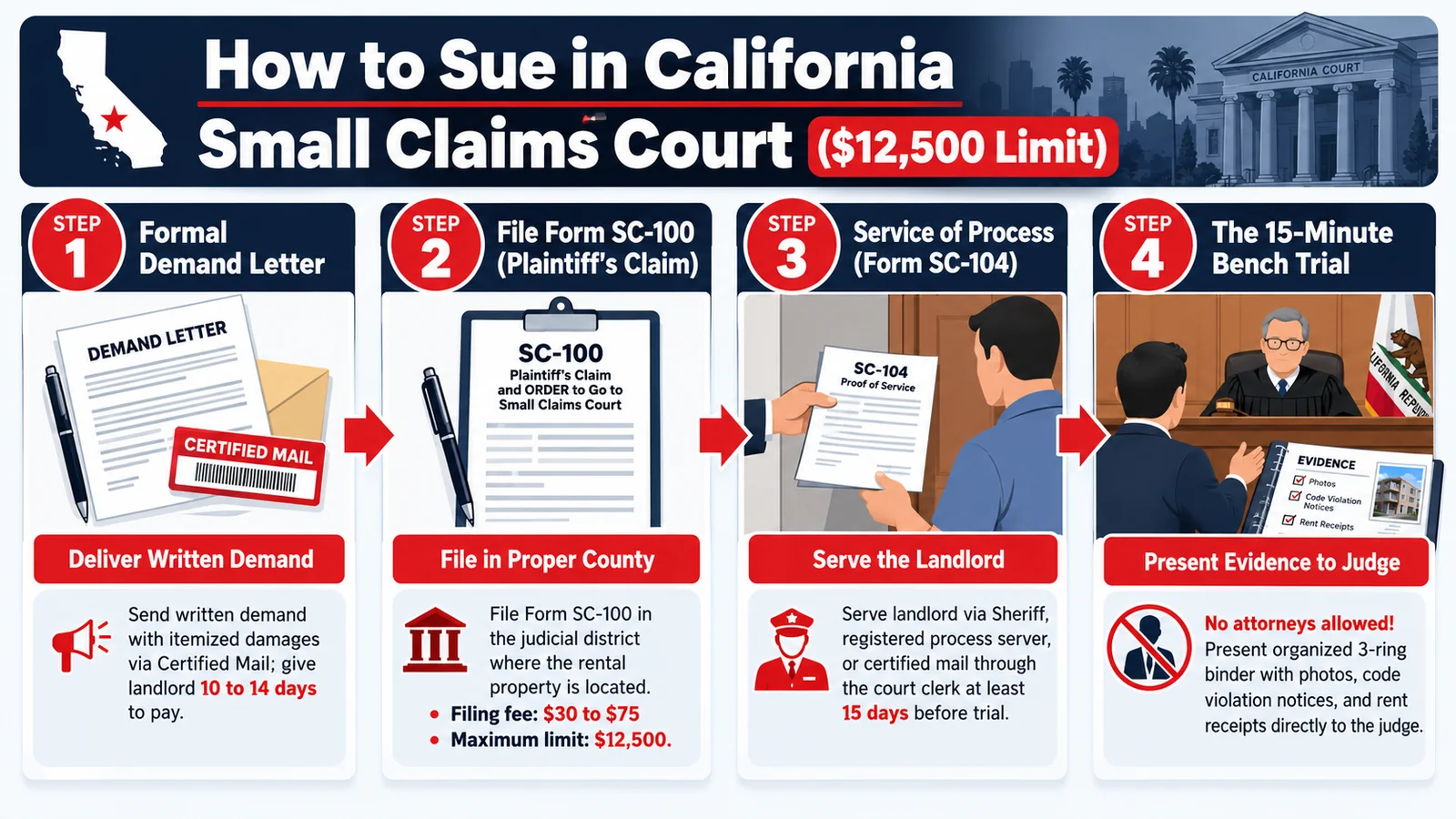
In California, natural persons can sue for up to $12,500 in Small Claims Court (Code of Civil Procedure § 116.221). For corporations or LLCs, the limit remains $5,000, but as an individual tenant suing your landlord, the $12,500 ceiling provides an efficient, low-cost legal forum.
Key procedural benefits of California Small Claims Court include:
- No Lawyers Allowed at Trial: Under CCP § 116.530, neither party can be represented by an attorney during the small claims hearing. This eliminates the landlord's advantage of retaining expensive legal counsel to overwhelm an unrepresented tenant.
- Expedited Hearing Dates: Small claims hearings are typically scheduled within 30 to 70 days of filing.
- Affordable Filing Fees: Filing fees range from $30 (for claims up to $1,500) to $75 (for claims from $5,001 to $12,500). Fee waivers (Form FW-001) are readily available for qualifying low-income tenants.
- Right of Appeal: If the tenant loses, there is no right of appeal; however, if the landlord loses, they can appeal to the Superior Court for a trial de novo (where attorneys are permitted).
How to Prove Your Day-to-Day Struggles to a Judge
To maximize your recovery for annoyance and discomfort in a California court, your evidence must tell a clear chronological story of daily disruption:
- Maintain a Contemporaneous Misery Log: Record daily temperature readings, foul odors, insect sightings, water leaks, and sleep disruptions with exact dates and timestamps.
- Government Inspection Reports: Request an inspection from your local city or county Code Enforcement, Housing Authority, or Department of Public Health. A formal Notice of Substandard Housing issued by a government inspector serves as near-conclusive proof of habitability breaches.
- Visual Evidence Binder: Print high-resolution, color photographs and date-stamped video clips showing the severe conditions. Create three bound copies of your exhibit packet: one for the judge, one for the defendant, and one for your own reference.
- Notice of Unauthorized Entries: Document every instance where a landlord or contractor entered your private space without statutory 24-hour written notice. In California, unlawful landlord entry directly violates Civil Code § 1954 and reinforces harassment claims.
Sample California Tenant Demand Letter (Ready to Use)
In California, delivering a certified pre-suit demand letter eliminates any landlord defense of unawareness and triggers statutory bad-faith penalties under California Civil Code §§ 1942.4 and 789.3, while laying the evidentiary foundation for tort damages under Stoiber v. Honeychuck.
Frequently Asked Questions: California Tenant Rights
SueLegal is an independent educational legal publisher, not a law firm or lawyer referral service. The information provided in this guide is for general informational and educational purposes only and does not constitute formal legal advice. Residential landlord-tenant laws, repair notice periods, and statutory remedies vary significantly across state and municipal jurisdictions. If you are facing eviction, severe uninhabitable conditions, or complex litigation, consult a licensed attorney in your jurisdiction or contact your local legal aid organization. For more details on our standards, read our Editorial Policy and Legal Research Methodology.