

Your Key Rights & Responsibilities
- Key Condition: Requires proof of serious and prolonged disturbance of mental tranquility affecting daily living.
- Typical Deadline: Varies by province: 1 year in Ontario (RTA s. 29(2)); 2 years in BC and Alberta.
- Cost Range: $50 to $100 for provincial tribunal application fees; small claims civil court fees vary by province.
- Best Next Step: Identify your specific provincial tenancy dispute tribunal and compile an incident chronological log.
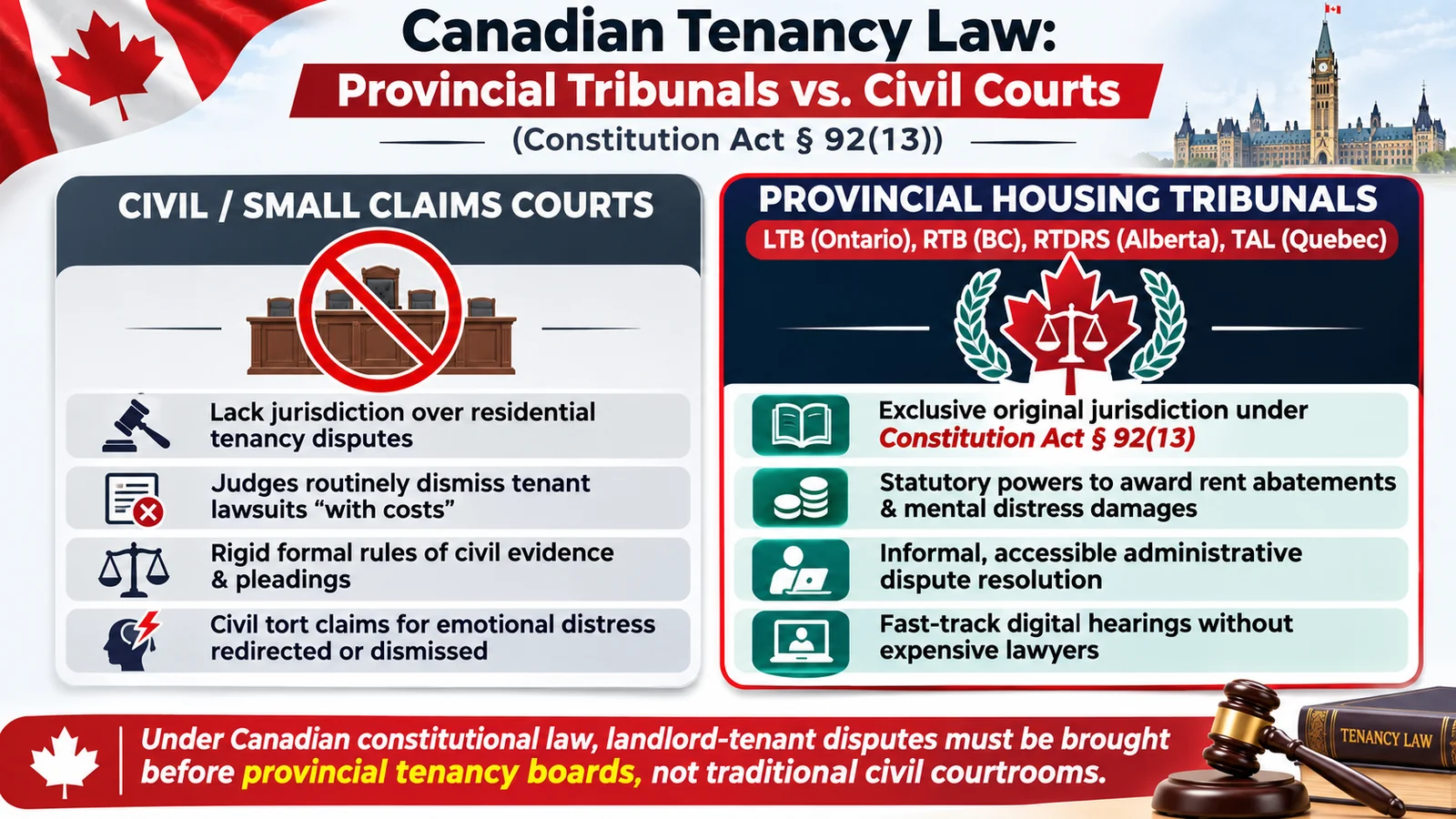
Where to File in Canada: Housing Tribunals vs. Small Claims Court
To understand how to pursue a legal claim against a landlord in Canada, one must first understand the Canadian constitutional structure. Under Section 92(13) of the Constitution Act, 1867, legislative authority over "Property and Civil Rights in the Province" is granted exclusively to the provincial legislatures.
Consequently, the Parliament of Canada does not enact residential tenancy legislation, nor does the federal government maintain housing courts. Each province and territory has enacted its own comprehensive statutory regime governing residential leases, evictions, repair obligations, and dispute resolution mechanisms.
For example, Ontario handles tenancy disputes through its dedicated tribunal system (see our in-depth provincial guide on suing a landlord for emotional distress in Ontario), whereas British Columbia, Alberta, and Quebec each maintain distinct administrative bodies with unique procedures and evidentiary thresholds. As detailed in our comprehensive Guide to landlord emotional distress claims, your remedies depend entirely on the province in which the property is located.
Proving Mental Distress Without an Official Psychiatric Diagnosis
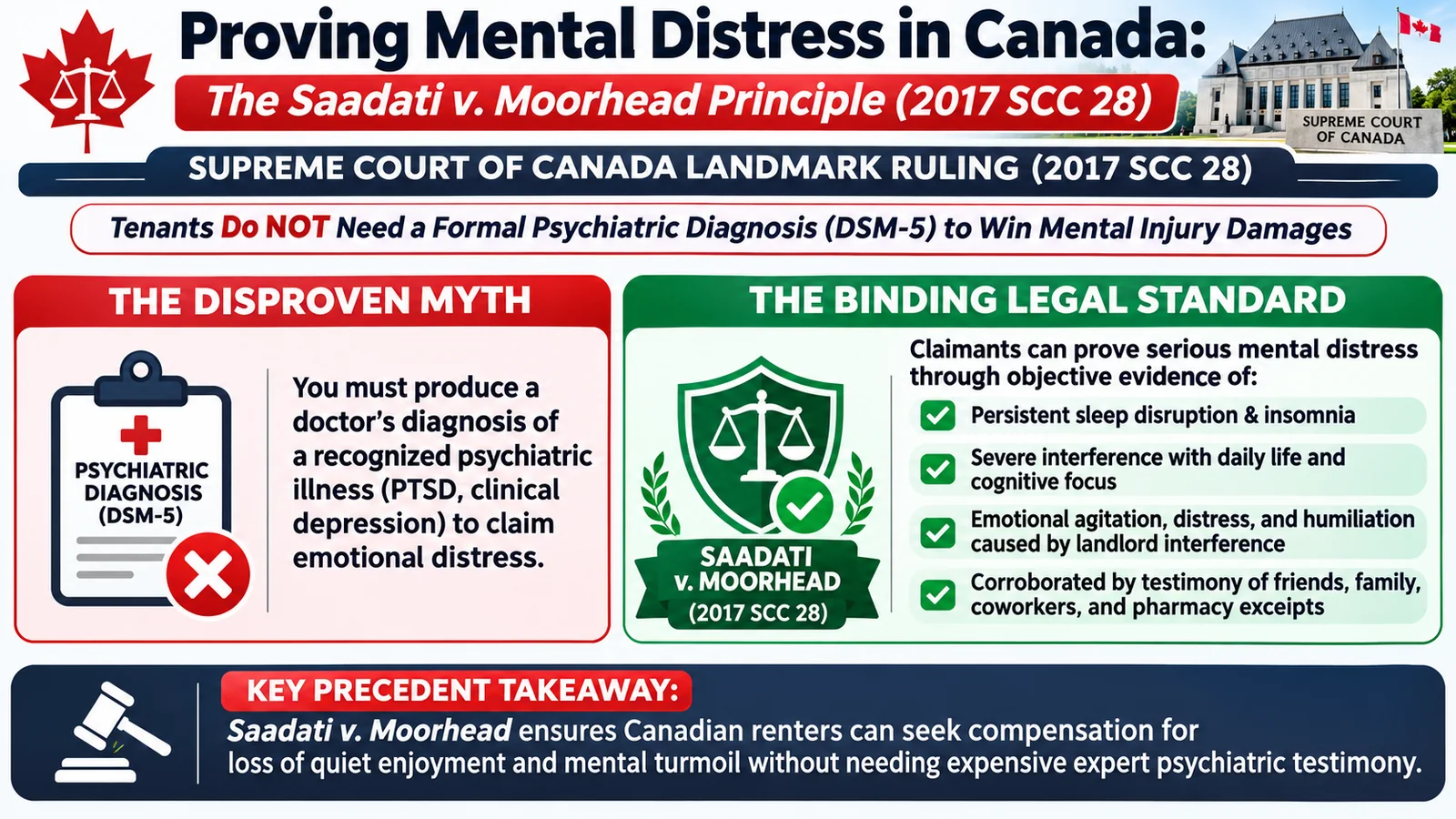
The governing authority across all Canadian common-law provinces regarding claims for mental distress is the unanimous Supreme Court of Canada decision Saadati v. Moorhead (2017 SCC 28).
Prior to Saadati, Canadian defendants frequently argued that a plaintiff could not recover damages for emotional suffering or mental anguish without presenting expert medical evidence proving a recognizable psychiatric illness (such as clinical depression or DSM-diagnosed PTSD). In a landmark opinion written by Justice Russell Brown, the Supreme Court completely abolished this rule.
The Supreme Court held that requiring a claimant to prove a medically recognized psychiatric illness creates an unfair, medically obsolete barrier that stigmatizes mental injury. Instead, Canadian courts and tribunals must determine whether the plaintiff has demonstrated a serious and prolonged mental disturbance that impairs cognitive or emotional function, established through credible witness testimony, personal logs, workplace disruption, and circumstantial evidence.
Provincial housing tribunals across Canada routinely cite Saadati when awarding general damages for mental distress, recognizing that severe living conditions—such as toxic mould, bedbug infestations, or continuous landlord intimidation—produce actionable mental harm even without formal psychiatrist reports.
How Rental Boards Handle Distress Claims Across Each Province
In most Canadian provinces, residential tenancy legislation contains an ouster clause granting exclusive original jurisdiction to administrative bodies. Attempting to bypass these tribunals by filing in provincial Small Claims Court will result in immediate dismissal for lack of jurisdiction.
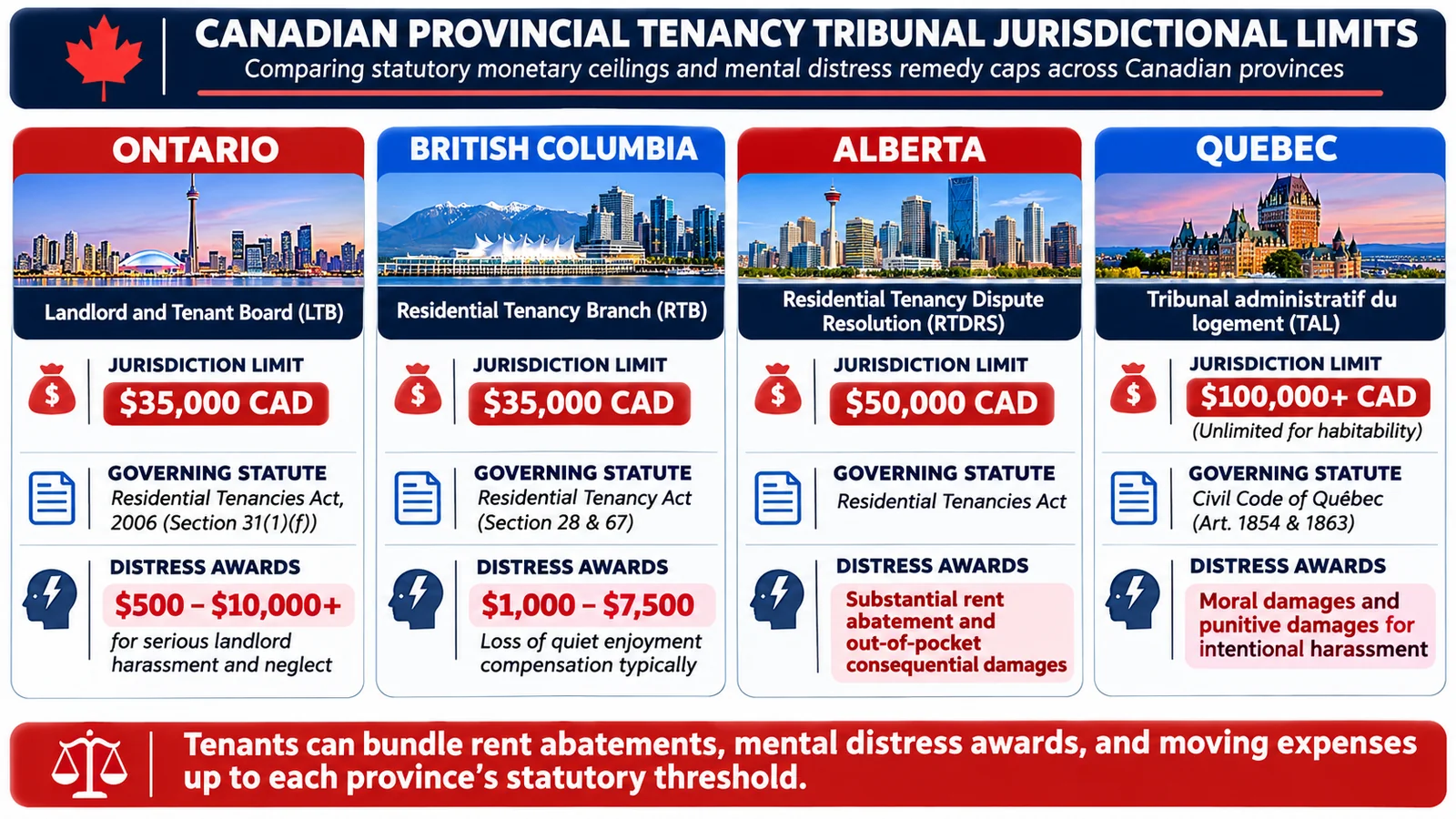
| Province | Primary Governing Body | Monetary Ceiling | Mental Distress Remedy Available |
|---|---|---|---|
| Ontario | Landlord and Tenant Board (LTB) | $35,000 CAD | General damages under RTA s. 31(1)(f) (Onyskiw) |
| British Columbia | Residential Tenancy Branch (RTB) | $35,000 CAD | Compensation for loss of quiet enjoyment (s. 28/67) |
| Alberta | RTDRS & Alberta Court of Justice | $50,000 CAD | Damages for breach of covenant for quiet possession |
| Quebec | Tribunal administratif du logement (TAL) | $100,000 CAD | Moral damages (dommages moraux, CCQ art. 1607/1611) |
Superior Court litigation is reserved exclusively for claims that exceed the administrative monetary cap, or where independent human rights violations are pursued through provincial human rights tribunals (such as the Ontario Human Rights Tribunal or BC Human Rights Tribunal) for discriminatory harassment.
Real Dispute Example: How a BC Tenant Won Rent Abatement
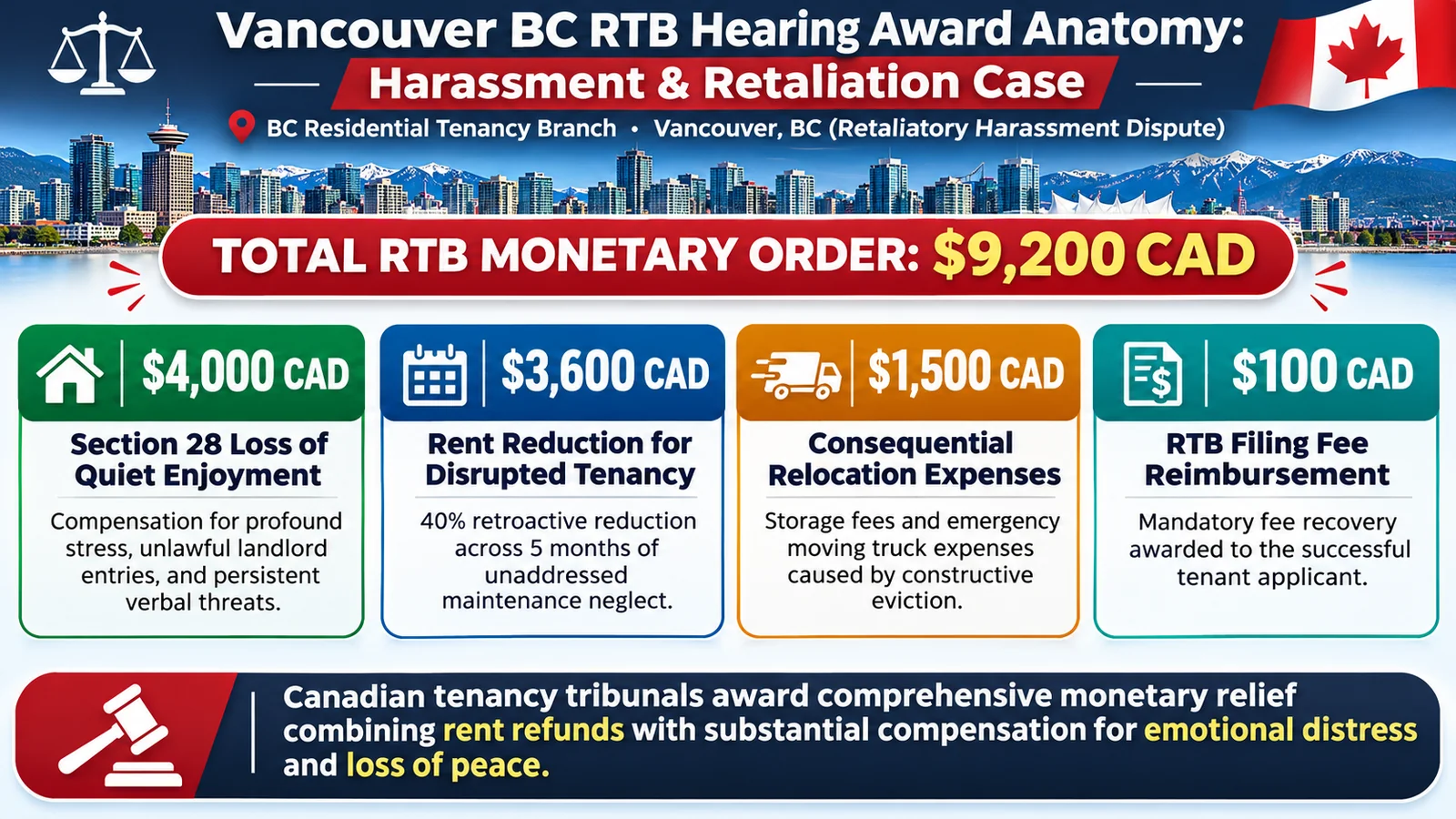
To illustrate how provincial tribunals apply non-economic remedies outside Ontario, consider this representative composite decision from Vancouver (British Columbia Residential Tenancy Branch):
BC RTB Dispute Resolution Proceeding Summary
The Dispute: A Vancouver tenant paying $2,400/month in a condominium unit faced constant intrusive surveillance, noise disruptions, and repeated text threats from an upstairs landlord who lived on-site. When the tenant raised maintenance concerns regarding water ingress around the windows, the landlord served a Two Month Notice to End Tenancy for Landlord's Use in bad faith and cut off the building's shared laundry facilities.
The Filing: The tenant applied through the RTB Dispute Access site under Section 28 (protection of quiet enjoyment), Section 67 (director's orders for compensation), and Section 49 (disputing bad-faith eviction notice). Evidence included text message logs showing late-night threats, decibel meter recordings of banging from above, date-stamped surveillance video of the landlord loitering near the tenant's door, and a letter from the tenant's employer documenting fatigue and reduced work performance.
The Arbitrator's Decision: Citing Saadati v. Moorhead and RTB Policy Guideline 6 (Entitlement to Quiet Enjoyment), the Arbitrator cancelled the eviction notice and awarded:
- $3,600 in compensation for substantial loss of quiet enjoyment and harassment ($600/month over 6 months).
- $1,200 retroactive rent reduction for termination of laundry facilities under Section 27.
- $500 in compensation for water ingress inconvenience.
- $100 filing fee reimbursement.
- Total Money Award: $5,400 CAD, to be deducted from future monthly rent payments.
This ruling confirms that across Canadian jurisdictions, tribunals award substantial monetary compensation for mental stress and harassment without requiring the tenant to produce psychiatrist bills.
Gathering Everyday Proof That Hearing Officers Take Seriously
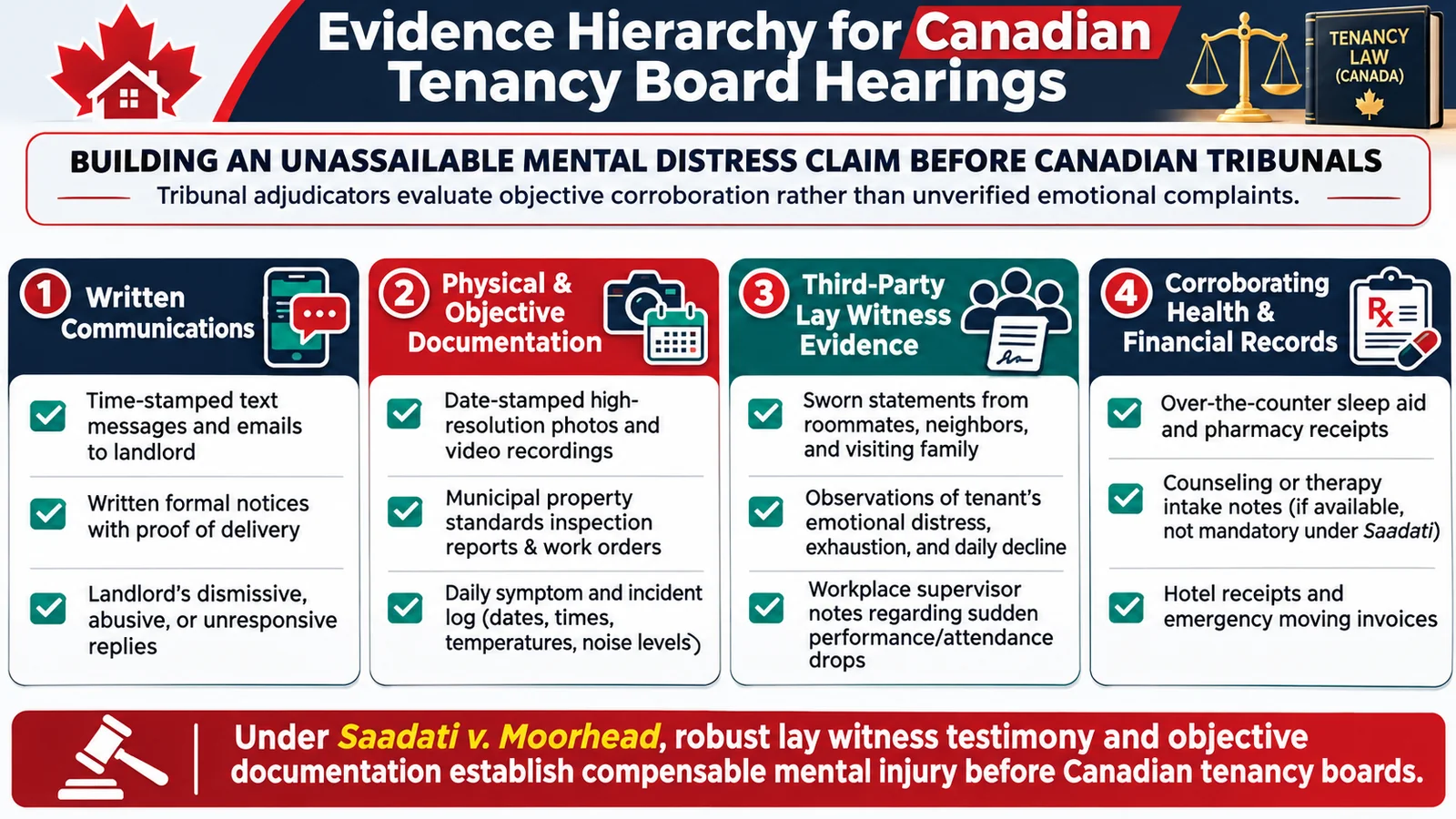
To succeed in claiming compensation for mental distress or loss of quiet enjoyment before a Canadian administrative tribunal, tenants should construct an objective evidentiary foundation under the principles of Saadati:
- Contemporaneous Incident Journals: Record every interaction, unannounced entry, or repair failure with precise dates, times, and direct quotations. Tribunals give high weight to notes written immediately after an incident.
- Witness Affidavits and Third-Party Testimony: Obtain written witness statements from roommates, neighbors, or visitors who observed the physical conditions or witnessed aggressive landlord interactions. In instances of landlord harassment, independent bystander testimony establishes credibility.
- Municipal Inspection Reports: File complaints with municipal bylaw officers or property standards inspectors (such as Municipal Licensing & Standards in Toronto, or City of Vancouver Property Use inspectors). Official notices of violation eliminate landlord claims that conditions were normal.
- Demonstrable Life Impairments: Present records demonstrating how the distress altered daily living—such as employer notes verifying missed work, pharmacy receipts for over-the-counter sleep aids, or evidence of having to sleep elsewhere to escape noise or pests. Challenging unauthorized intrusions under landlord entry violations further reinforces interference with quiet enjoyment.
Step-by-Step Guide to Filing an Official Tenancy Board Dispute
Unlike civil court litigation that takes years, Canadian tenancy tribunals operate on expedited administrative dispute resolution models:
- Digital Portals: Applications are submitted online (Tribunals Ontario Portal, BC RTB Dispute Access, Alberta RTDRS e-Filing). Filing fees range from $50 to $100 CAD, with fee waivers available for low-income tenants.
- Evidence Disclosure Timelines: Evidence must be served on the other party within strict deadlines (e.g., at least 7 days before an LTB hearing, or 14 days before an RTB dispute hearing). Failure to serve evidence leads to automatic exclusion.
- Virtual Hearings: Most Canadian tenancy hearings are conducted by video conference (Zoom or Microsoft Teams) or teleconference, where an Adjudicator or Arbitrator examines witnesses under affirmation and renders a written binding decision.
Sample Formal Notice to Landlord (Ready to Use)
Across Canada, residential tenancy disputes are governed by provincial administrative tribunals. Sending this formal notice creates an authoritative evidentiary record of willful landlord breach and mental distress under the Supreme Court of Canada precedent Saadati v. Moorhead.
Frequently Asked Questions: Canadian Tenant Rights
SueLegal is an independent educational legal publisher, not a law firm or lawyer referral service. The information provided in this guide is for general informational and educational purposes only and does not constitute formal legal advice. Residential landlord-tenant laws, repair notice periods, and statutory remedies vary significantly across state and municipal jurisdictions. If you are facing eviction, severe uninhabitable conditions, or complex litigation, consult a licensed attorney in your jurisdiction or contact your local legal aid organization. For more details on our standards, read our Editorial Policy and Legal Research Methodology.