

Before You Take Action
- Key Condition: Negligence claims require physical injury; intentional claims require atrocious conduct beyond all decency.
- Typical Deadline: Strict 2 years under HB 837 (Fla. Stat. § 95.11(4)(a)) for general negligence; 4 years for intentional torts.
- Cost Range: $55 to $300 for Florida Small Claims or County Court filing and sheriff service fees.
- Best Next Step: Deliver a formal 7-Day Notice of Noncompliance under Fla. Stat. § 83.56 via Certified Mail.
Why Careless Landlord Mistakes Usually Do Not Qualify for Emotional Damages
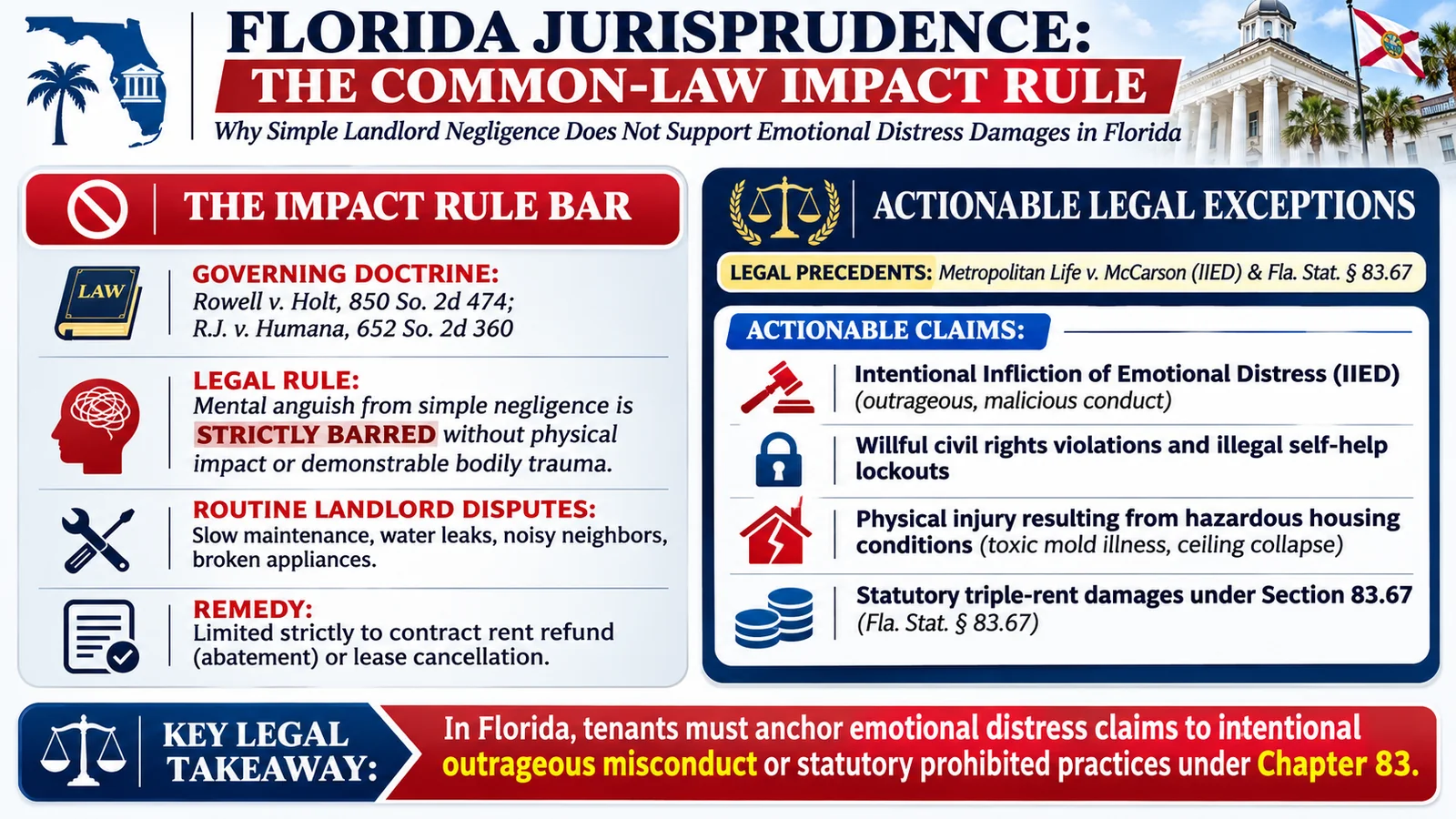
Florida is one of the few jurisdictions that strictly preserves the traditional common-law "Impact Rule." In landmark decisions such as Rowell v. Holt (850 So. 2d 474) and R.J. v. Humana of Florida, Inc. (652 So. 2d 360), the Florida Supreme Court reaffirmed that a plaintiff cannot maintain an action for negligent infliction of emotional distress (NIED) unless the emotional distress stems from an actual physical impact sustained by the claimant.
In residential housing disputes, this means that if a landlord negligently fails to fix plumbing leaks, delays air conditioning repairs, or allows mold to grow, a tenant cannot sue for anxiety, frustration, or mental distress alone. Unless toxic mold causes diagnosed bodily injury or physical illness, Florida courts will grant summary judgment dismissing any negligence claim seeking damages purely for emotional suffering.
When evaluating whether to sue your landlord for emotional distress in Florida, tenants must look beyond negligence and pursue claims grounded in intentional torts or specific statutory violations.
The Outrageous Conduct Exception: When Landlords Cross the Line
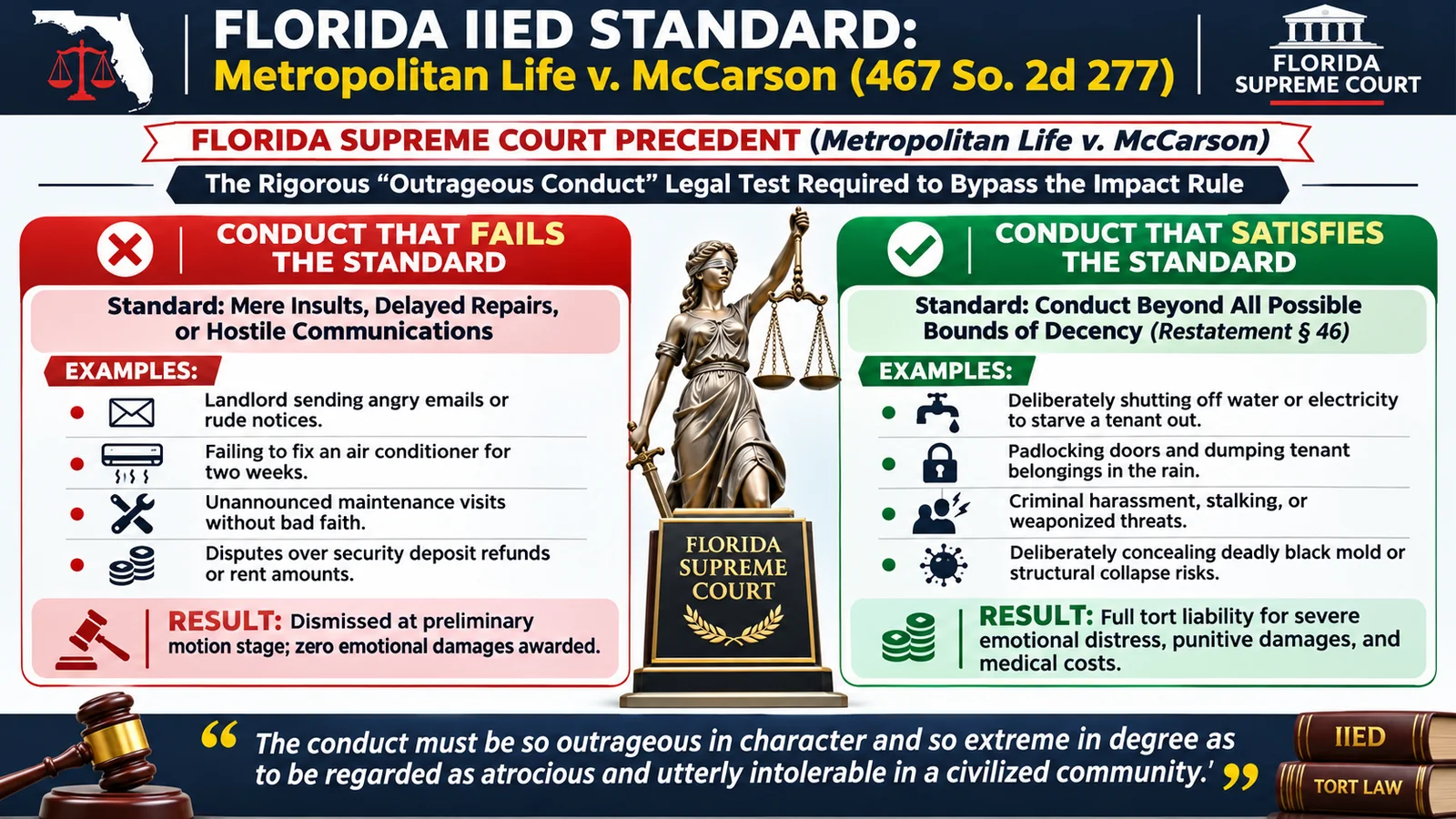
The primary common-law exception to the Impact Rule in Florida is the tort of Intentional Infliction of Emotional Distress (IIED). In Metropolitan Life Insurance Co. v. McCarson (467 So. 2d 277), the Florida Supreme Court adopted Section 46 of the Restatement (Second) of Torts, confirming that the Impact Rule does not apply to intentional, outrageous conduct.
To prevail on an IIED claim against a Florida landlord without physical impact, a tenant must prove four elements:
- The landlord acted intentionally or recklessly.
- The landlord's conduct was extreme and outrageous—described by Florida courts as conduct "so outrageous in character, and so extreme in degree, as to go beyond all possible bounds of decency, and to be regarded as atrocious, and utterly intolerable in a civilized community."
- The conduct directly caused severe emotional distress.
- The emotional distress was severe.
Florida appellate decisions establish that ordinary rudeness, aggressive eviction threats, and standard maintenance delays do not meet the outrageousness threshold. However, intentional acts such as entering a tenant's bedroom without consent late at night, cutting off power to a medically vulnerable tenant, or engaging in continuous stalking satisfy the standard.
Three Months' Rent Penalty: What Happens If Your Landlord Changes the Locks
Rather than fighting the uphill battle of proving an IIED claim, Florida tenants have access to one of the most effective statutory penalty laws in the country: Florida Statute § 83.67 (Prohibited Practices).
Under § 83.67, a landlord—whether directly or indirectly—is strictly prohibited from:
- Terminating or interrupting utility services (water, heat, light, electricity, gas, elevator, or refrigeration).
- Preventing the tenant from gaining reasonable access to the dwelling by changing locks, using bootlocks, or padlocking.
- Removing outside doors, locks, roof, walls, or windows of the unit.
- Removing personal property from the unit without judicial process.
| Violation Type | Governing Statute | Mandatory Statutory Remedy |
|---|---|---|
| Self-Help Lockout / Key Change | Fla. Stat. § 83.67(2) | 3 Months' Rent or Actual Damages (Whichever is Greater) + Legal Fees |
| Utility Disconnection | Fla. Stat. § 83.67(1) | 3 Months' Rent or Actual Damages + Mandatory Attorney's Fees |
| Removal of Doors / Windows | Fla. Stat. § 83.67(3) | 3 Months' Rent or Actual Damages + Mandatory Attorney's Fees |
| Unlawful Retaliation | Fla. Stat. § 83.64 | Complete Defense to Eviction + Damages for landlord harassment |
Under § 83.67(6), a landlord who commits any prohibited practice is liable to the tenant for actual and consequential damages or three months' rent, whichever is greater, and court costs including reasonable attorney's fees. When landlords attempt an unlawful self-help eviction, this three-month penalty provides automatic monetary compensation.
The 7-Day Warning Notice: Protecting Your Rights Before Withholding Rent
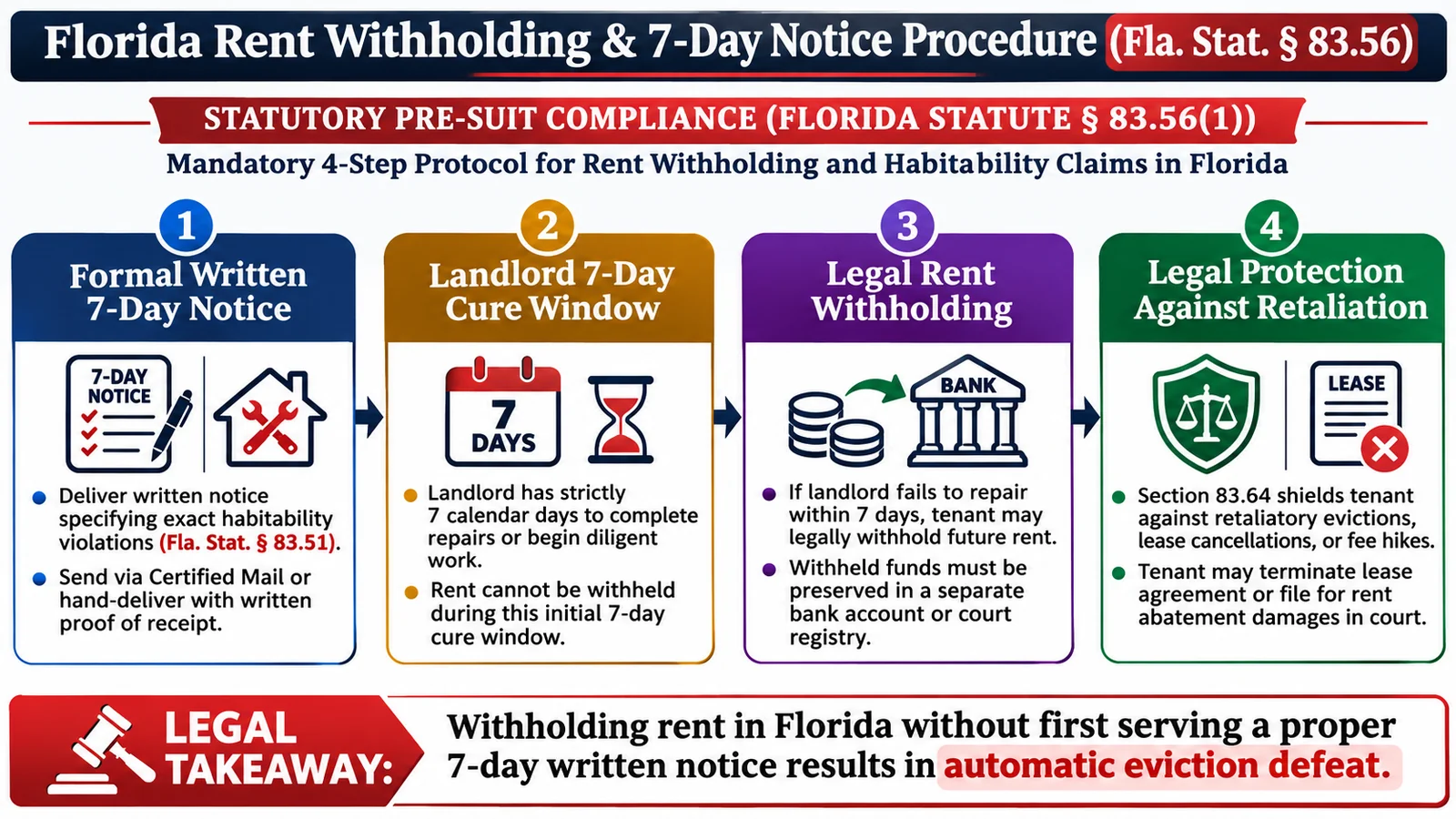
Under Florida Statute § 83.56(1), if a landlord fails to maintain the premises in compliance with the implied warranty of habitability (Fla. Stat. § 83.51), the tenant must deliver a formal written 7-Day Notice of Noncompliance.
The notice must specify the noncompliance and state that the tenant intends to withhold rent or terminate the lease if the repairs are not completed within seven days. If a tenant withholds rent without serving this statutory 7-day notice, the landlord can immediately serve a 3-Day Notice to Pay or Vacate and file an eviction action in county court.
Deadlines Matter: The 2-Year Time Window to Take Legal Action
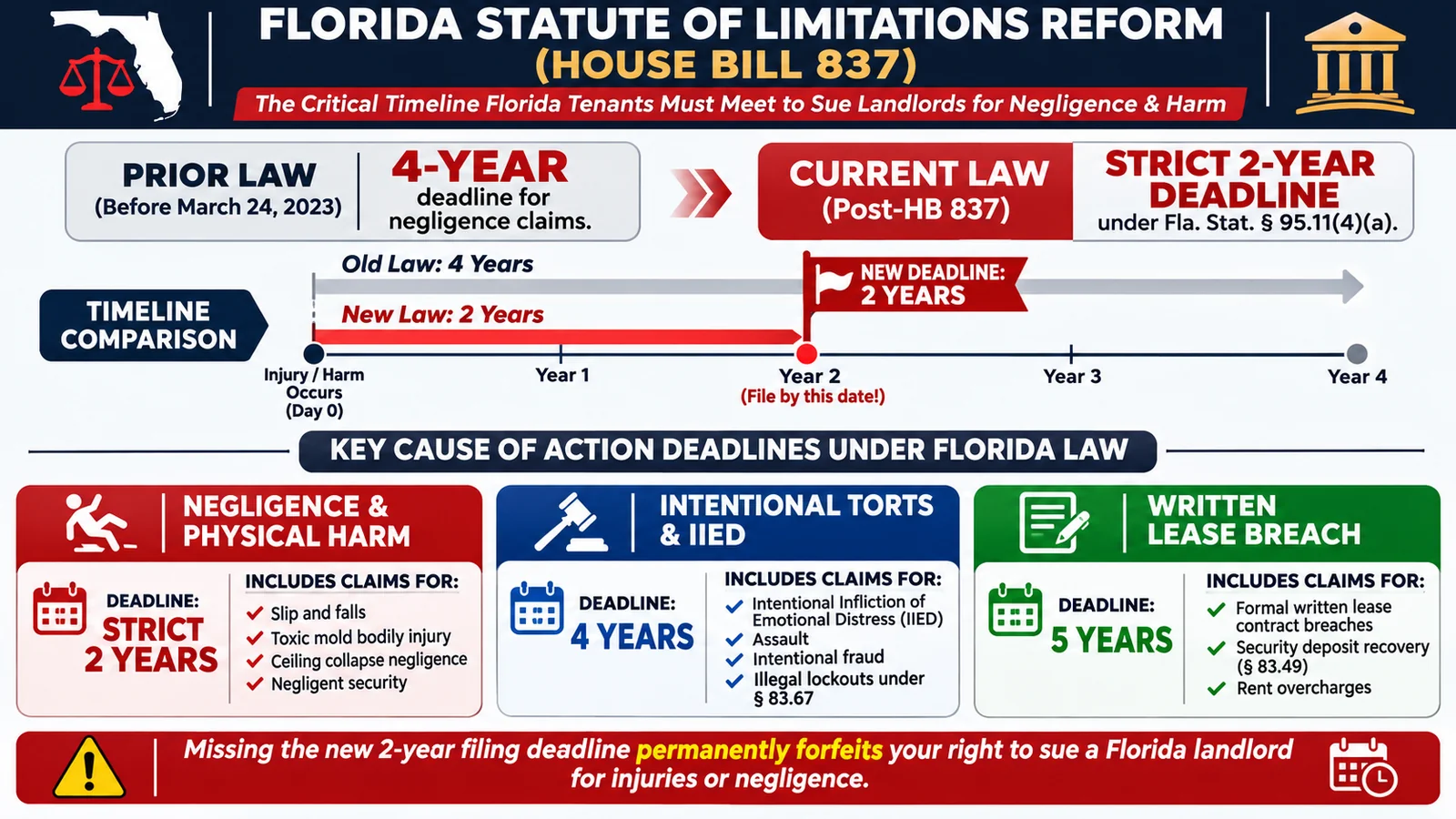
Tenants must be aware of Florida's major tort reform legislation enacted under House Bill 837 (2023). HB 837 amended Florida Statute § 95.11(4)(a), cutting the statute of limitations for general negligence and personal injury claims from four years down to two years.
If your claim involves physical injury resulting from habitability failures (such as toxic mold illness, structural collapse, or broken stairs), you have only two years from the date of injury to file a lawsuit in Florida courts.
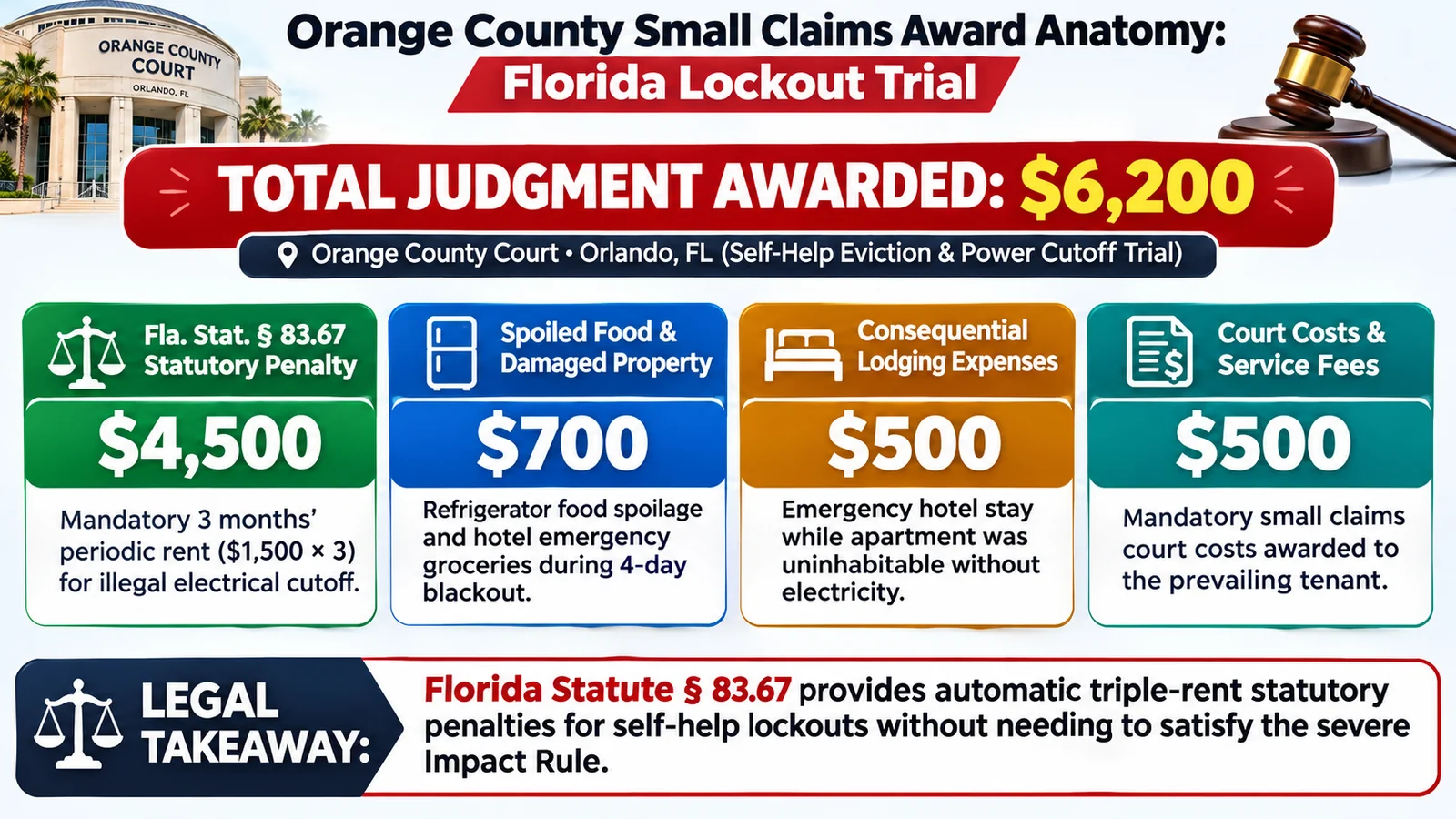
Real Court Example: How an Orlando Tenant Recovered $6,200
To understand how Florida judges apply § 83.67, consider this representative composite case from Orlando (Orange County Court, Small Claims Division):
Orange County Small Claims Dispute Summary
The Dispute: An Orlando tenant paying $1,600/month experienced an air conditioning failure during an August heatwave. The tenant served a proper 7-day statutory notice under Fla. Stat. § 83.56. In anger, the landlord entered the property without consent, shut off the main water valve, and padlocked the exterior electrical breaker panel, stating the utilities would remain off until the tenant dropped maintenance complaints.
The Small Claims Lawsuit: The tenant filed a lawsuit for $8,000 (the maximum small claims jurisdiction) in Orange County Court alleging statutory violations of Fla. Stat. § 83.67(1) (utility termination) and § 83.67(2) (access denial). Evidence included photos of padlocked breaker panels, text message admissions from the landlord, the certified 7-day notice, and hotel bills for 6 nights.
The Court's Final Judgment: The county court judge ruled in favor of the tenant, awarding:
- $4,800 under Fla. Stat. § 83.67(6) (three months' rent statutory penalty: 3 x $1,600).
- $1,250 in actual damages (hotel lodging, food spoilage, bottled water).
- $1,600 in return of the full security deposit under Fla. Stat. § 83.49.
- $300 in court filing and service fees.
- Total Money Judgment: $7,950, plus an order immediately restoring all utilities.
This case proves that Florida Statute § 83.67 delivers clear financial remedies for abusive landlord tactics without needing to overcome the common-law Impact Rule.
Florida Small Claims Court: The $8,000 Dollar Limit and Mediation
In Florida, Small Claims Court is governed by the Florida Small Claims Rules, handling claims up to $8,000 (excluding costs, interest, and attorney's fees). Claims above $8,000 and up to $50,000 are heard in County Court, while claims exceeding $50,000 are heard in Circuit Court.
Under Florida Small Claims Rule 7.090, all parties must attend a mandatory Pre-Trial Conference, where a certified court mediator attempts to facilitate a settlement before trial. Documenting unauthorized entries under landlord illegal entry rules provides strong leverage during mediation.
Sample Florida 7-Day Demand Letter (Ready to Use)
In Florida, serving a formal written 7-Day Notice of Noncompliance is a mandatory legal prerequisite under Florida Statute § 83.56(1) before withholding rent, and puts landlords on notice of automatic three-month rent penalties under § 83.67.
Frequently Asked Questions: Florida Tenant Rights
SueLegal is an independent educational legal publisher, not a law firm or lawyer referral service. The information provided in this guide is for general informational and educational purposes only and does not constitute formal legal advice. Residential landlord-tenant laws, repair notice periods, and statutory remedies vary significantly across state and municipal jurisdictions. If you are facing eviction, severe uninhabitable conditions, or complex litigation, consult a licensed attorney in your jurisdiction or contact your local legal aid organization. For more details on our standards, read our Editorial Policy and Legal Research Methodology.