

At a Glance
- Key Condition: Conduct must be extreme and outrageous, evaluated through the landlord's position of authority under McGrath.
- Typical Deadline: 2 years for personal injury and intentional torts (735 ILCS 5/13-202); 5 years for property damage.
- Cost Range: $90 to $175 for Illinois Circuit Court Small Claims filing and sheriff service fees.
- Best Next Step: Deliver a written 14-day repair notice under CRLTO § 5-12-110 or statewide statutory provisions.
When Landlord Bullying and Harassment Crosses the Legal Line
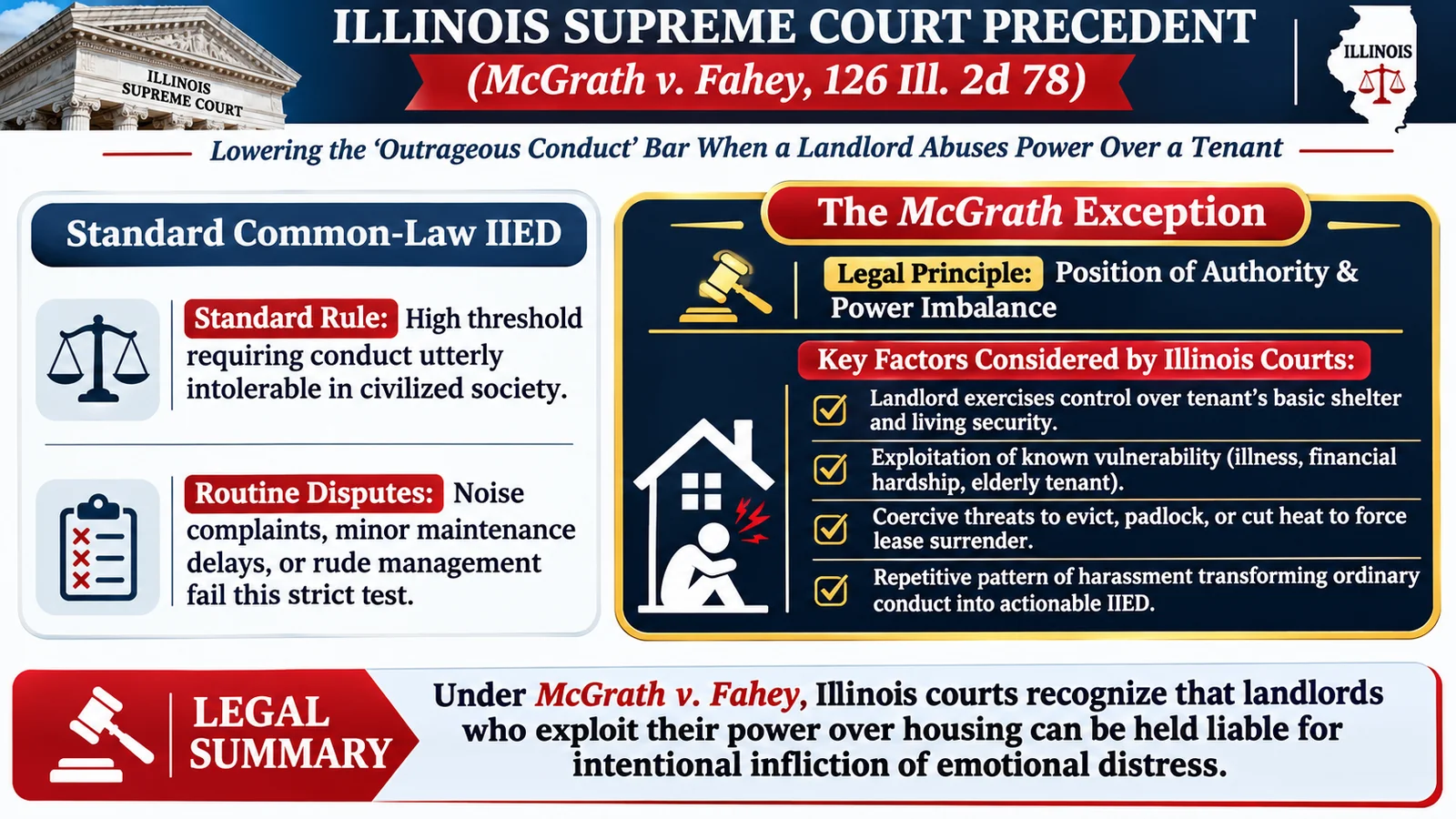
Under Illinois common law, establishing Intentional Infliction of Emotional Distress (IIED) generally requires proving conduct so outrageous in character as to go beyond all possible bounds of decency (Public Finance Corp. v. Davis, 66 Ill. 2d 85). However, when exploring Legal options for emotional distress caused by a landlord, Illinois tenants benefit from a pivotal judicial exception.
In the landmark decision McGrath v. Fahey (126 Ill. 2d 78), the Illinois Supreme Court ruled that the extreme and outrageous character of conduct may arise directly from an abuse by the defendant of a position of power, influence, or authority over the plaintiff.
The court explicitly recognized that the landlord-tenant relationship is inherently unequal. When a landlord uses their leverage—such as threatening eviction, shutting off heat in winter, entering without notice, or fabricating lease violations—to coerce a tenant or force them out, Illinois courts treat that conduct as an actionable abuse of power that satisfies the IIED standard.
Chicago Renters: Getting Double Rent Back Plus Legal Fees
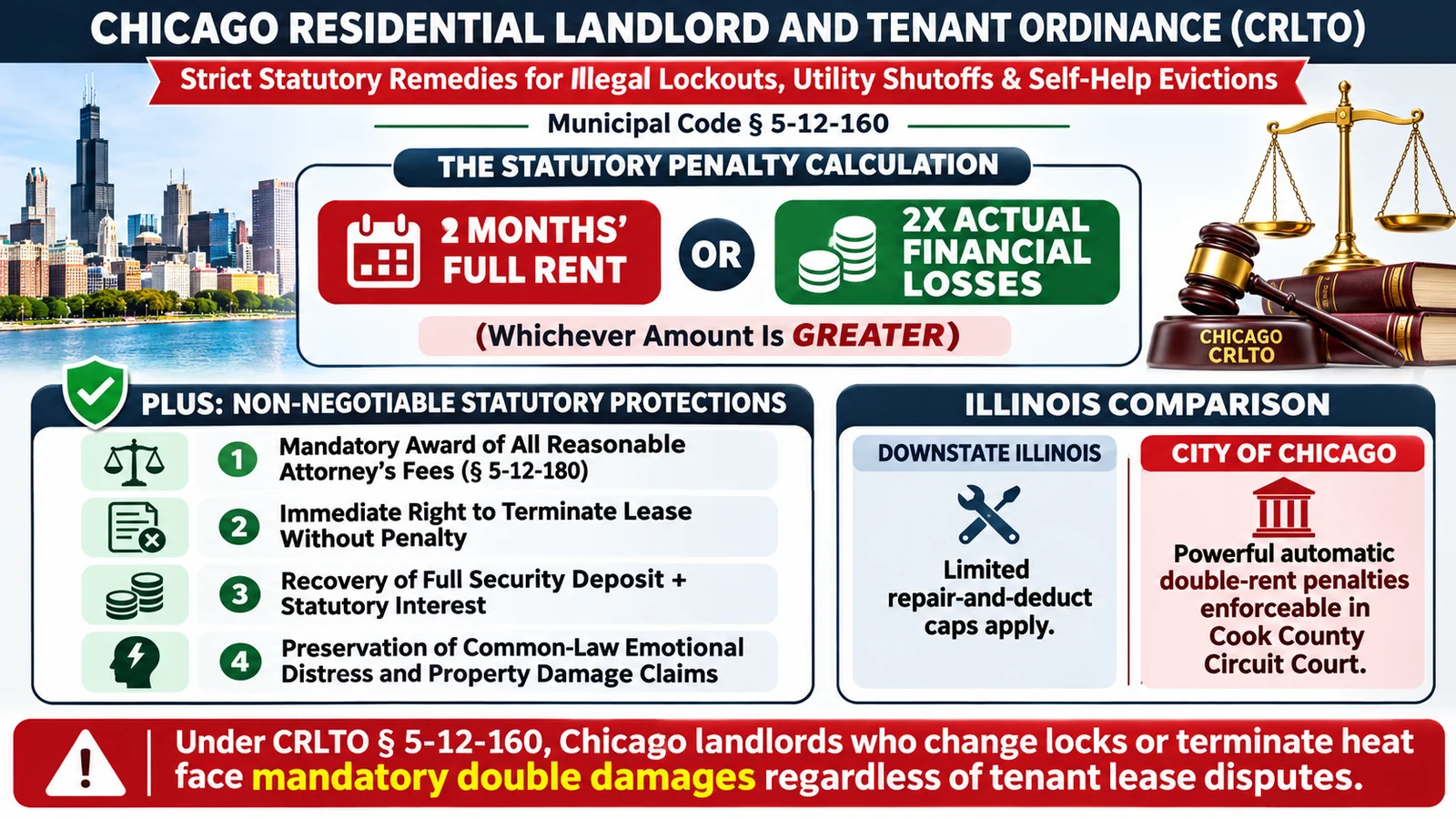
For tenants living within the City of Chicago, the Chicago Residential Landlord and Tenant Ordinance (CRLTO) (Municipal Code Title 5, Chapter 12) provides some of the most potent tenant protections in North America.
The CRLTO applies to nearly all rental units in Chicago (except owner-occupied buildings of six units or fewer). Key statutory remedies under the CRLTO include:
- Unlawful Lockouts (§ 5-12-160): Landlords cannot block entry, change locks, or cut off utilities. Violations entitle the tenant to recover possession or terminate the lease, plus an amount equal to two months' rent or twice actual damages sustained, whichever is greater, and mandatory attorney fees. Challenging lockouts under unlawful self-help eviction triggers immediate liability.
- Failure to Maintain Habitability (§ 5-12-110): If a landlord fails to maintain the premises in compliance with the municipal housing code under the implied warranty of habitability, the tenant can withhold rent, terminate the lease, or sue for damages.
- Prohibition of Retaliation (§ 5-12-150): Landlords cannot increase rent, decrease services, or threaten eviction within one year of a tenant exercising legal rights or reporting code violations, with statutory penalties of two months' rent. Tenants subjected to intimidation can also review remedies for landlord harassment.
- Mandatory Attorney's Fees (§ 5-12-180): The prevailing tenant is statutorily entitled to recover all court costs and reasonable attorney's fees, ensuring private attorneys routinely represent Chicago tenants without upfront fees.
Freezing Apartments & Winter Heat Rules: $1,000 Daily City Fines
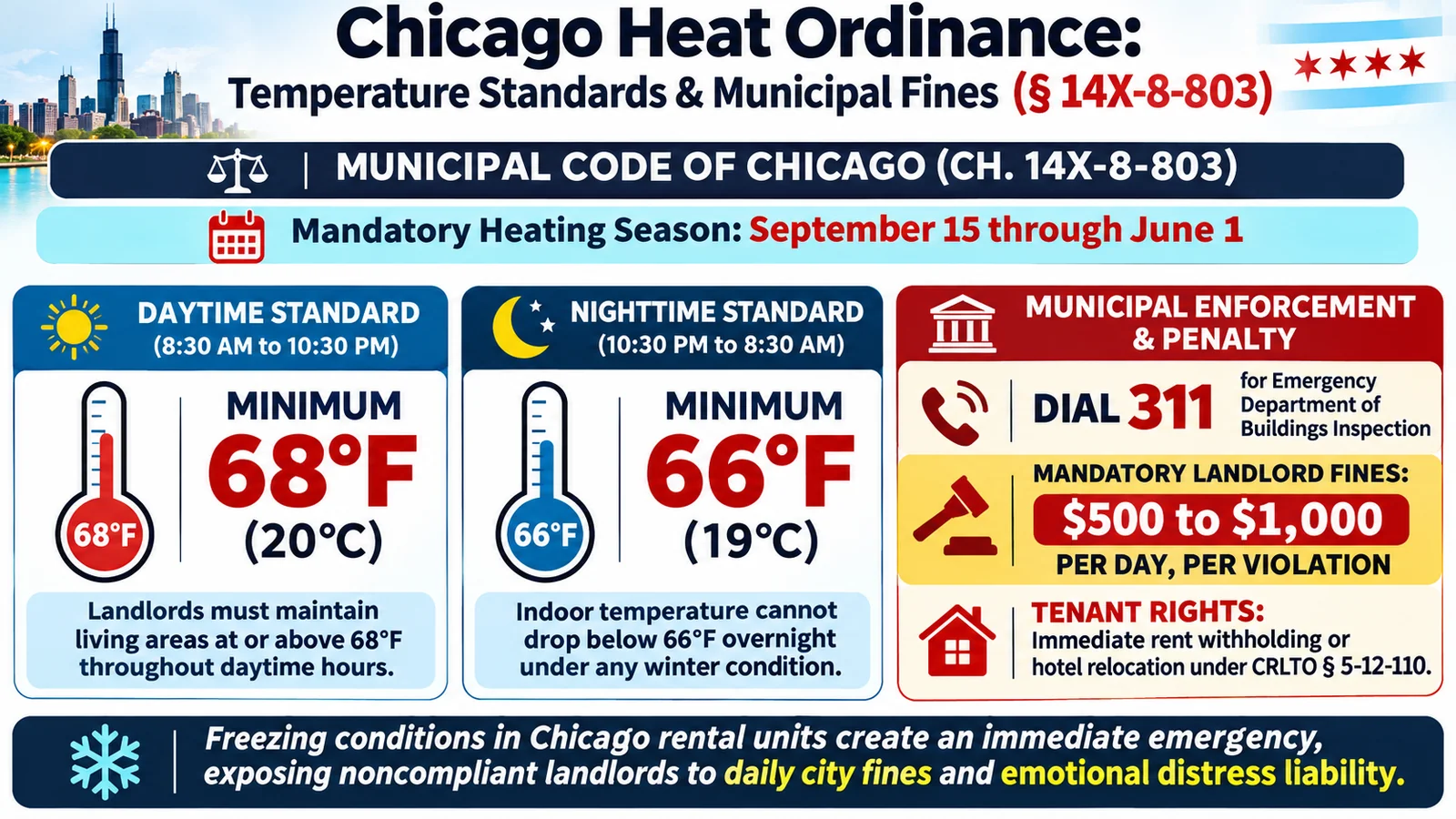
During harsh Illinois winters, heating failures represent immediate life-safety emergencies. Under the Chicago Heat Ordinance (Municipal Code § 14X-8-803), landlords must maintain minimum indoor temperatures from September 15 to June 1:
| Time Period | Mandatory Minimum Indoor Temperature | Landlord Noncompliance Fine |
|---|---|---|
| Daytime (8:30 AM to 10:30 PM) | At least 68°F (20°C) | $500 to $1,000 Per Day Per Violation |
| Nighttime (10:30 PM to 8:30 AM) | At least 66°F (19°C) | $500 to $1,000 Per Day Per Violation |
When an owner fails to supply heat, tenants can dial 311 for emergency Department of Buildings inspections. The city can initiate emergency circuit court proceedings to appoint a receiver or fine the landlord up to $1,000 per day.
Outside Chicago: The 14-Day Written Notice Rule for Essential Repairs
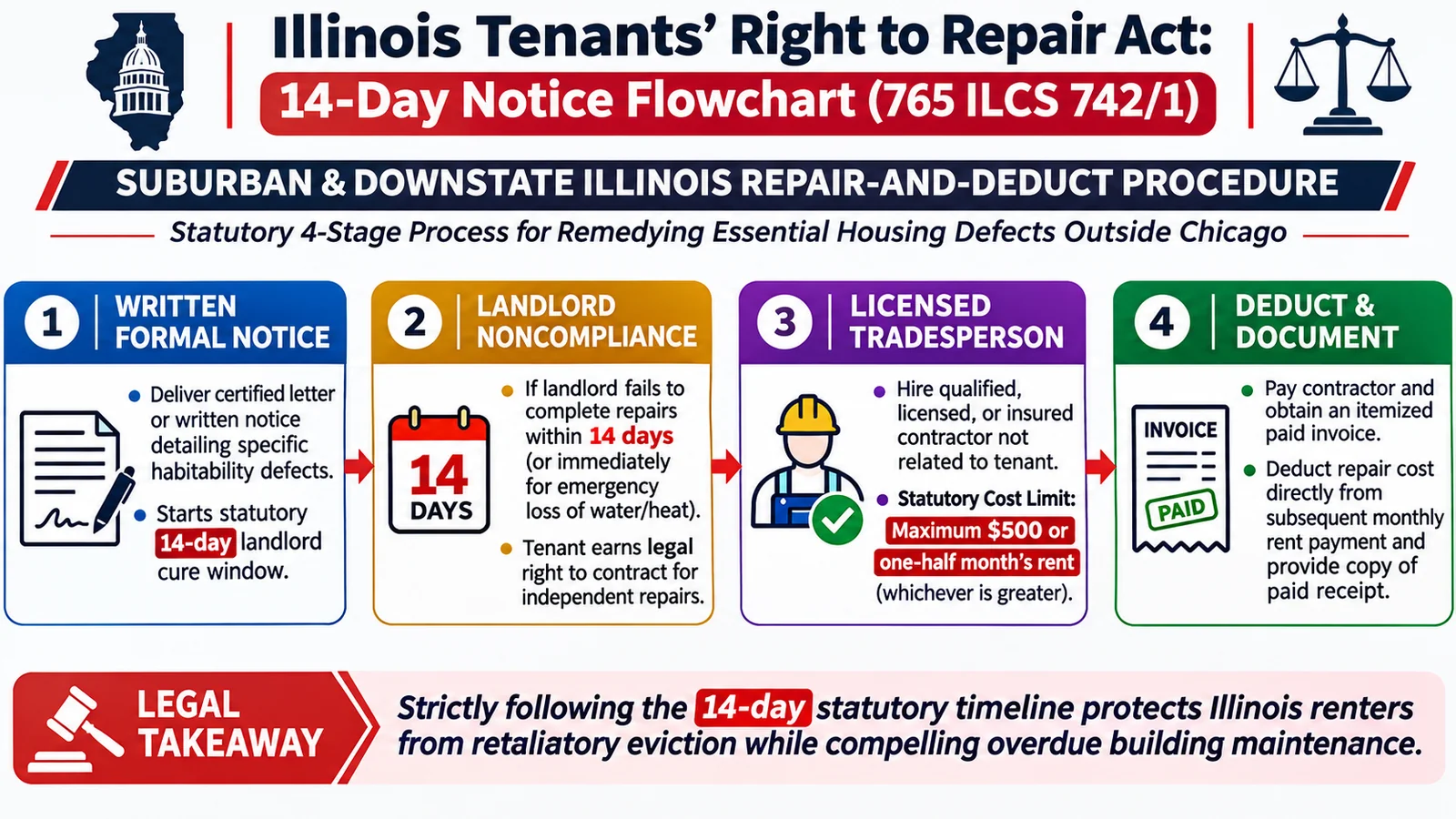
Outside the City of Chicago, tenant rights are governed by the Illinois Residential Tenants' Right to Repair Act (765 ILCS 742/1 et seq.) and the common-law implied warranty of habitability established in Jack Spring, Inc. v. Little (50 Ill. 2d 351).
Under 765 ILCS 742/5, if a landlord fails to maintain habitability, the tenant must deliver written notice via Certified Mail or registered mail specifying the required repairs. The landlord has 14 days to complete the repair. If the landlord fails to act, the tenant can hire a licensed tradesperson to make the repair and deduct the actual cost from rent, up to $500 or one-half of the monthly rent, whichever is greater.
Real Court Example: How a Chicago Tenant Won After Heat Was Cut Off
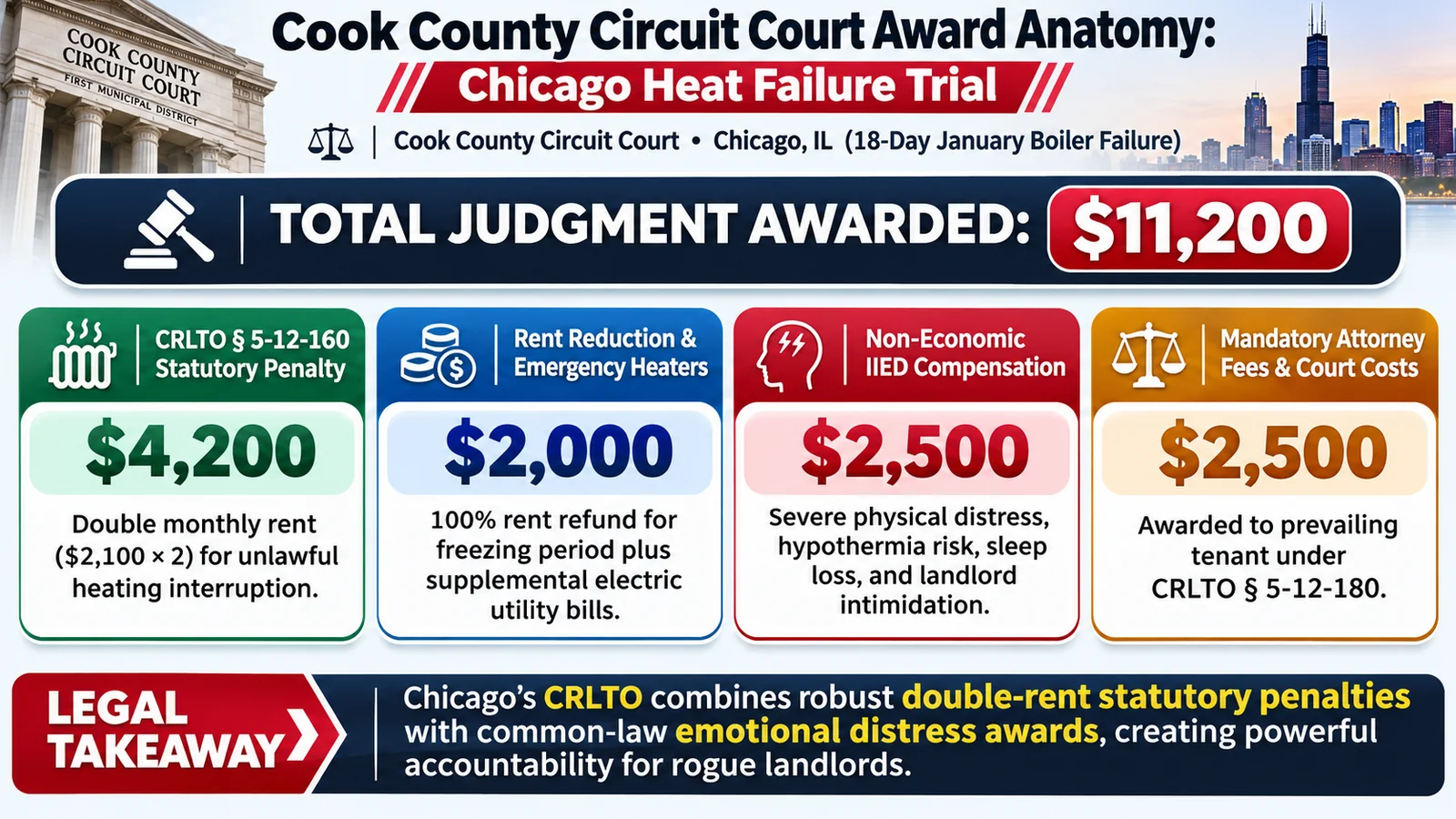
To illustrate how Illinois courts apply the CRLTO and McGrath doctrines, consider this representative composite case from Chicago (Cook County Circuit Court, First Municipal District):
Cook County Circuit Court Hearing Summary
The Dispute: A Logan Square tenant paying $1,750/month experienced radiator failure in January during sub-zero temperatures. Indoor temperatures dropped to 52°F. Despite multiple calls and written requests, the landlord failed to repair the boiler for three weeks, telling the tenant to "buy space heaters or move out." When the tenant deducted the cost of space heaters from rent, the landlord padlocked the basement laundry and served a 5-day eviction notice.
The Lawsuit: The tenant retained legal counsel and filed a multi-count lawsuit in Cook County Circuit Court alleging CRLTO § 5-12-110 (failure to maintain heat), § 5-12-150 (retaliation), § 5-12-160 (lockout/service reduction), and Intentional Infliction of Emotional Distress under McGrath v. Fahey. Evidence included 311 inspection violation notices, space heater electric bills, thermometer logs, and medical records for acute respiratory illness caused by the freezing apartment.
The Circuit Court Judgment: The judge ruled in favor of the tenant on all CRLTO counts and the McGrath IIED claim, awarding:
- $3,500 under CRLTO § 5-12-160 (two months' rent penalty for service interruption).
- $3,500 under CRLTO § 5-12-150 (two months' rent penalty for unlawful retaliation).
- $1,750 in 100% rent abatement for the month without lawful heat.
- $3,000 in general damages for mental distress and physical hardship under McGrath v. Fahey.
- $5,200 in mandatory court costs and attorney's fees under CRLTO § 5-12-180.
- Total Money Award: $16,950, plus an injunction immediately dismissing the eviction action with prejudice.
This case highlights how Chicago tenants can combine powerful CRLTO statutory penalties with common-law McGrath emotional distress claims to recover substantial judgments.
Illinois Small Claims Court: $10,000 Jurisdictional Limit
In Illinois, Small Claims Court is governed by Illinois Supreme Court Rules 281-289, with a monetary jurisdictional limit of $10,000 (excluding costs and interest). If your bundled claims exceed $10,000 (as in the case study above), you can file in the regular Civil Division of the Circuit Court.
In Small Claims Court, procedures are simplified, and pro se litigants can present their cases directly. Under Supreme Court Rule 286, judges can relax formal rules of evidence to ensure substantial justice between the parties.
Building an Unassailable Evidentiary Trail in Illinois
To prevail against a landlord in an Illinois court, assemble your evidence methodically:
- Request a Municipal Inspection: In Chicago, dial 311 to request a Department of Buildings inspection. In suburban/downstate areas, contact local village code enforcement. Official municipal violation citations are near-conclusive evidence of habitability defects.
- Certified Mail Notices: Always send formal repair demands via Certified Mail with Return Receipt Requested to prove strict compliance with notice statutes.
- Temperature and Interaction Logs: Log twice-daily temperature readings during heating failures, and record all interactions. Instances of unannounced entries violating tenant privacy under landlord illegal entry substantiate harassment claims.
Official Illinois & Chicago Landlord Demand Letter Template
In Illinois, sending a certified demand establishes strict statutory notice under the Chicago CRLTO or the Illinois Right to Repair Act, while documenting landlord abuse of authority under the McGrath v. Fahey doctrine.
Frequently Asked Questions: Illinois Tenant Rights
SueLegal is an independent educational legal publisher, not a law firm or lawyer referral service. The information provided in this guide is for general informational and educational purposes only and does not constitute formal legal advice. Residential landlord-tenant laws, repair notice periods, and statutory remedies vary significantly across state and municipal jurisdictions. If you are facing eviction, severe uninhabitable conditions, or complex litigation, consult a licensed attorney in your jurisdiction or contact your local legal aid organization. For more details on our standards, read our Editorial Policy and Legal Research Methodology.