

At a Glance
- Key Condition: Conduct must be utterly outrageous; simple habitability delays or disputes do not sustain emotional distress torts.
- Typical Deadline: 2 years for personal injury and intentional infliction of emotional distress under N.J.S.A. 2A:14-2.
- Cost Range: $35 to $75 for Special Civil Part filing; $15 to $35 in Small Claims Section.
- Best Next Step: Send a Marini repair-and-deduct notice or contact local police immediately in lockout situations.
The Anti-Eviction Act: Perpetual Tenancy and Statutory Shields
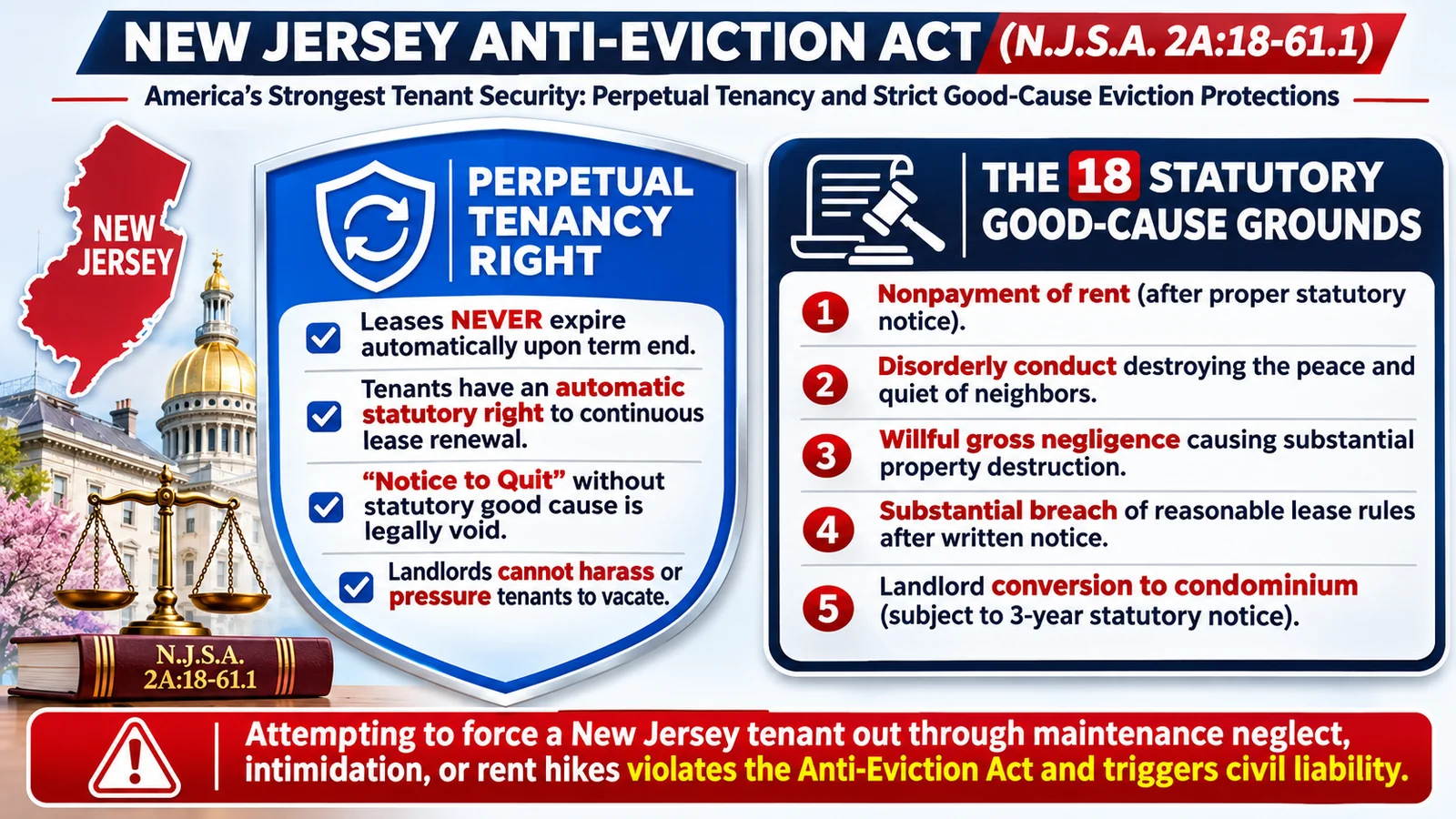
New Jersey provides stronger statutory security of tenure than virtually any other state in the country. Under the New Jersey Anti-Eviction Act (N.J.S.A. 2A:18-61.1 et seq.), residential tenants enjoy what the Supreme Court of New Jersey has characterized as "perpetual tenancy."
A landlord cannot simply decline to renew a lease or issue a 30-day notice to quit when a lease expires. Unless the property is an owner-occupied building with two or fewer rental units, a tenant can only be evicted if the landlord establishes one of 18 strictly enumerated statutory "good causes" (such as nonpayment of rent, substantial breach of lease rules after written notice to cease, or disorderly conduct).
Because landlords cannot easily remove tenants under the Anti-Eviction Act, unethical owners sometimes resort to intimidation, bogus violation notices, or failing to address hazardous conditions to force a surrender. When a landlord's conduct causes emotional distress in New Jersey, understanding these baseline statutory protections is crucial to holding predatory property owners liable.
Criminal Disorderly Persons Lockouts: N.J.S.A. 2C:33-11.1
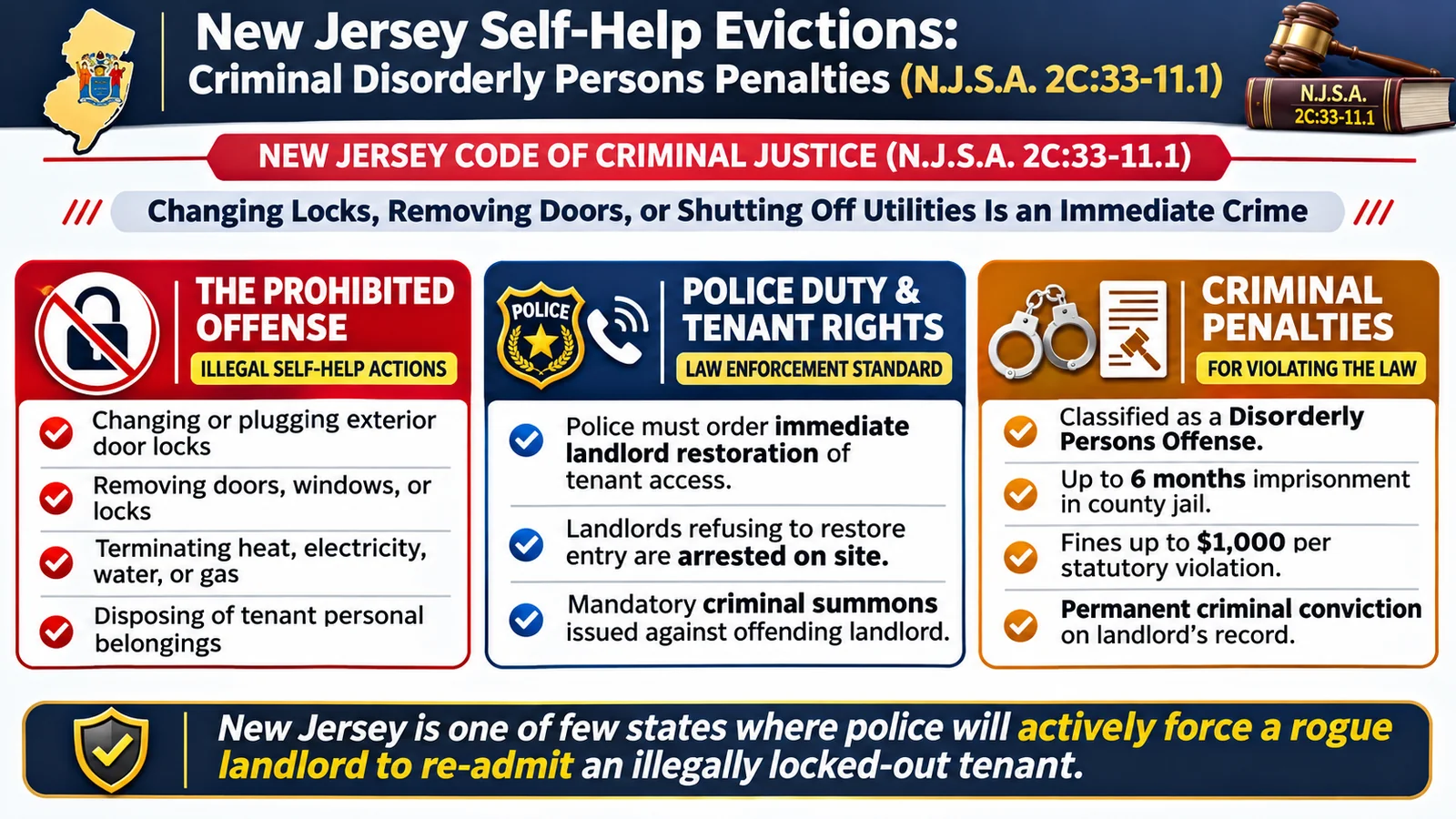
In many states, an illegal lockout is treated merely as a civil contract dispute. In New Jersey, self-help eviction is explicitly defined as a criminal offense under the New Jersey Code of Criminal Justice.
Under N.J.S.A. 2C:33-11.1, a person is guilty of a disorderly persons offense if they:
- Take possession of residential premises by force or threat, or by changing padlocks, deadbolts, or key codes without judicial authorization.
- Willfully shut off or cause the interruption of essential services, including heat, gas, water, or electric utilities.
- Remove the tenant's doors, windows, personal possessions, or furniture to render the dwelling uninhabitable.
New Jersey municipal police departments are legally required under state Attorney General Law Enforcement Directives to intervene immediately when a tenant is subjected to an unlawful self-help lockout. Police officers must instruct the landlord to restore entry or face arrest, criminal fines up to $1,000, and up to six months in county jail.
Treble Damages for Unlawful Lockouts: N.J.S.A. 2A:39-8
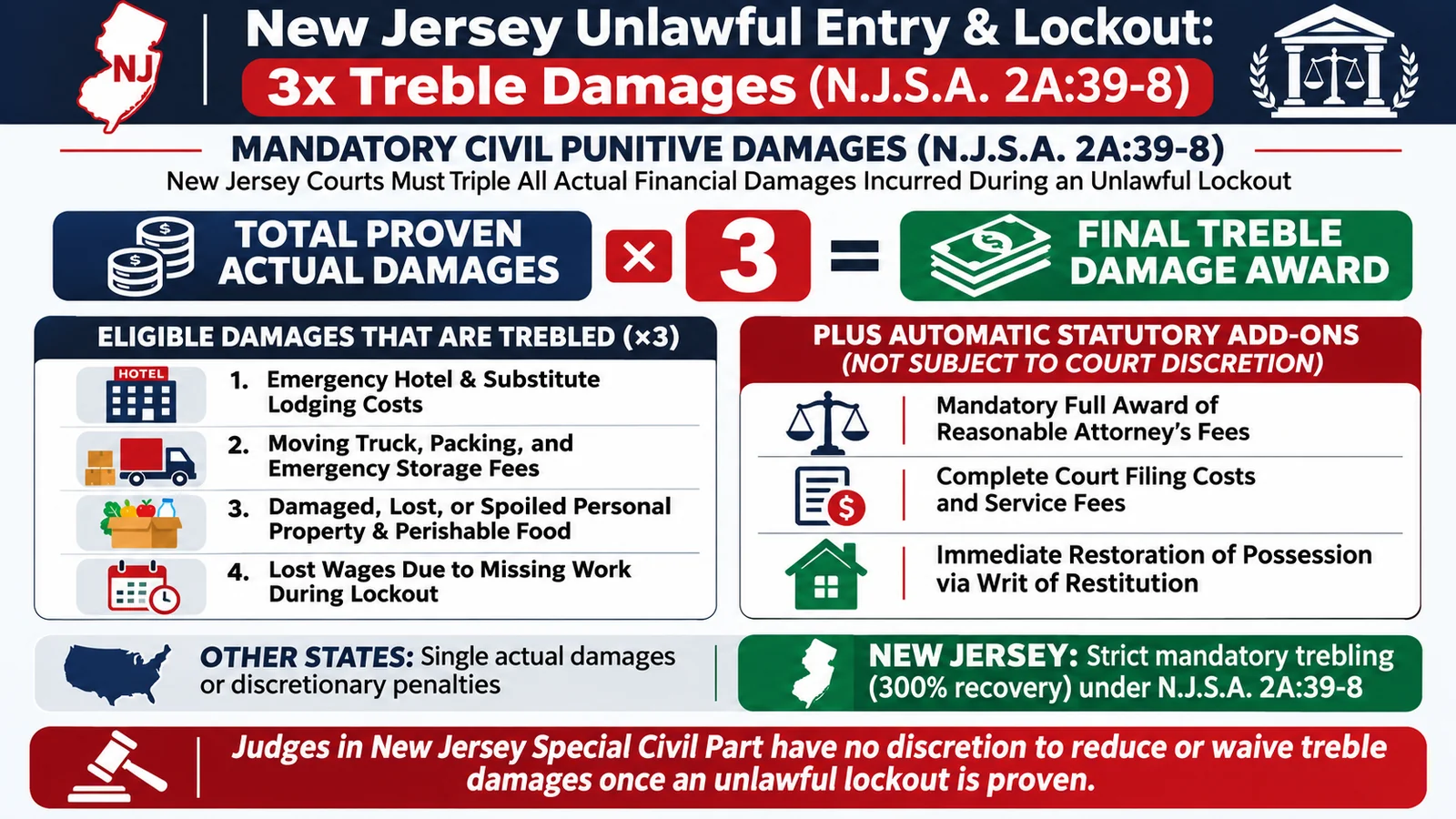
Beyond criminal charges, New Jersey civil law provides mandatory punitive financial compensation for victims of unlawful dispossession.
Under N.J.S.A. 2A:39-8, if a tenant is put out of real property in a forcible or unlawful manner, or is kept out by force, threat, or by changing locks, the tenant is statutorily entitled to recover treble (triple) damages in addition to full restitution of possession, reasonable attorney's fees, and court costs.
| Loss Category | Actual Tenant Expense | N.J.S.A. 2A:39-8 Treble Award |
|---|---|---|
| Emergency Hotel Lodging | $2,400 (8 nights @ $300) | $7,200 (Mandatory 3x award) |
| Damaged Clothing & Belongings | $1,800 personal property loss | $5,400 (Mandatory 3x award) |
| Storage & Emergency Moving | $900 moving truck and storage | $2,700 (Mandatory 3x award) |
Unlike common-law mental distress claims where recovery amounts are subjective and uncertain, N.J.S.A. 2A:39-8 automatically multiplies your proven actual damages by three, providing powerful financial relief.
When Can New Jersey Tenants Sue for Severe Emotional Harm?
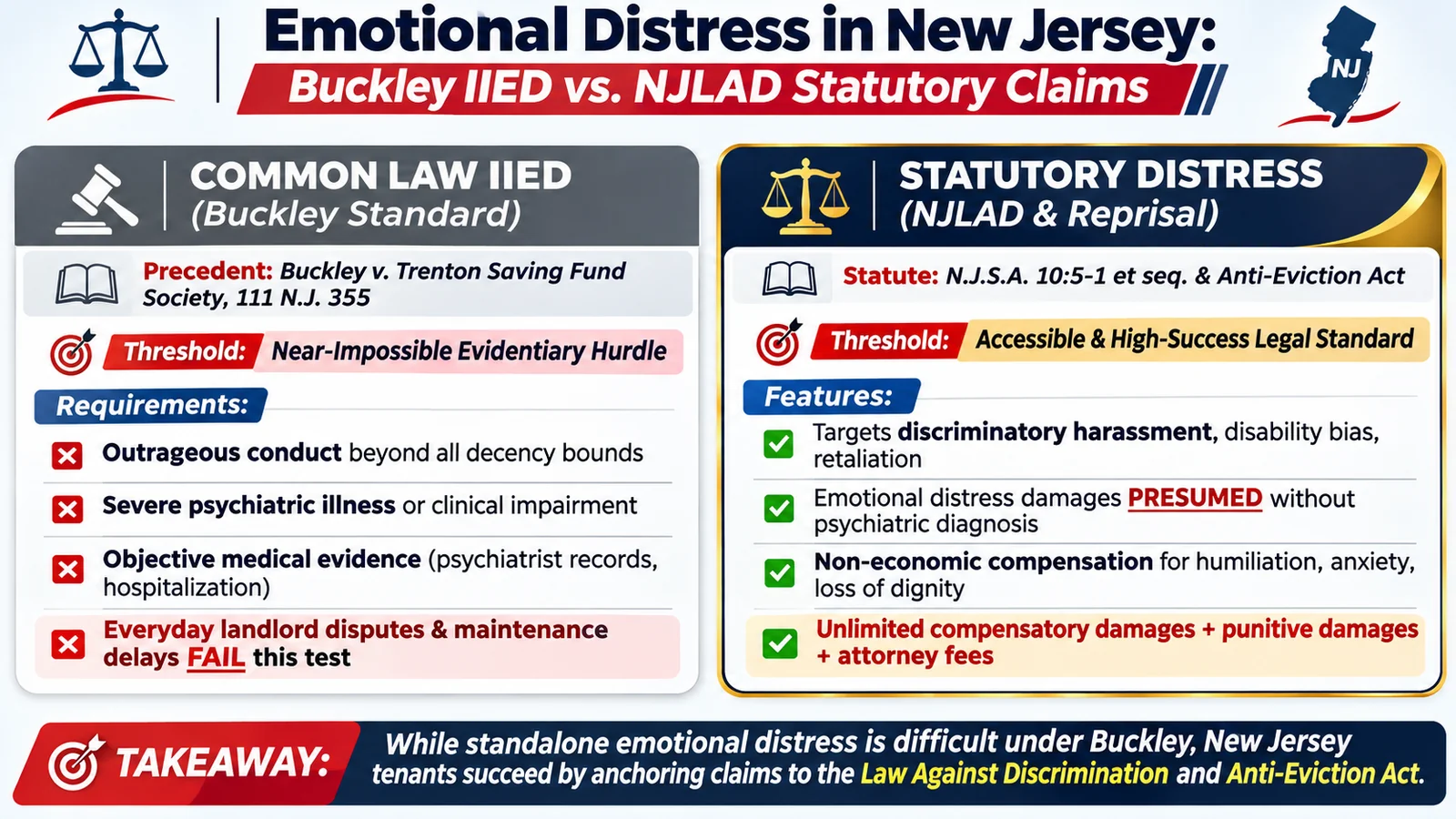
To pursue a standalone common-law tort claim for Intentional Infliction of Emotional Distress (IIED) in New Jersey, a plaintiff must satisfy the rigorous standard defined in Buckley v. Trenton Saving Fund Society (111 N.J. 355). Under Buckley, the emotional distress must be "so severe that no reasonable person could be expected to endure it." Typical stress, anger, and loss of sleep do not suffice without clinical psychiatric treatment evidence.
However, New Jersey tenants possess an exceptional alternative when the landlord's bad conduct is motivated by discrimination. Under the New Jersey Law Against Discrimination (NJLAD), N.J.S.A. 10:5-1 et seq., landlords are strictly prohibited from harassing or treating tenants unequally based on race, disability, familial status, source of lawful income (such as Section 8 vouchers), or sexual orientation.
In decisions such as Tarr v. Ciasulli (181 N.J. 70), the New Jersey Supreme Court confirmed that under the NJLAD, emotional distress damages can be awarded based on tenant testimony without requiring medical or psychological expert witnesses. If a landlord targets you with discriminatory landlord harassment, NJLAD claims can be filed directly with the New Jersey Division on Civil Rights (DCR) or in Superior Court.
Real Court Example: How a Jersey City Tenant Won Triple Damages
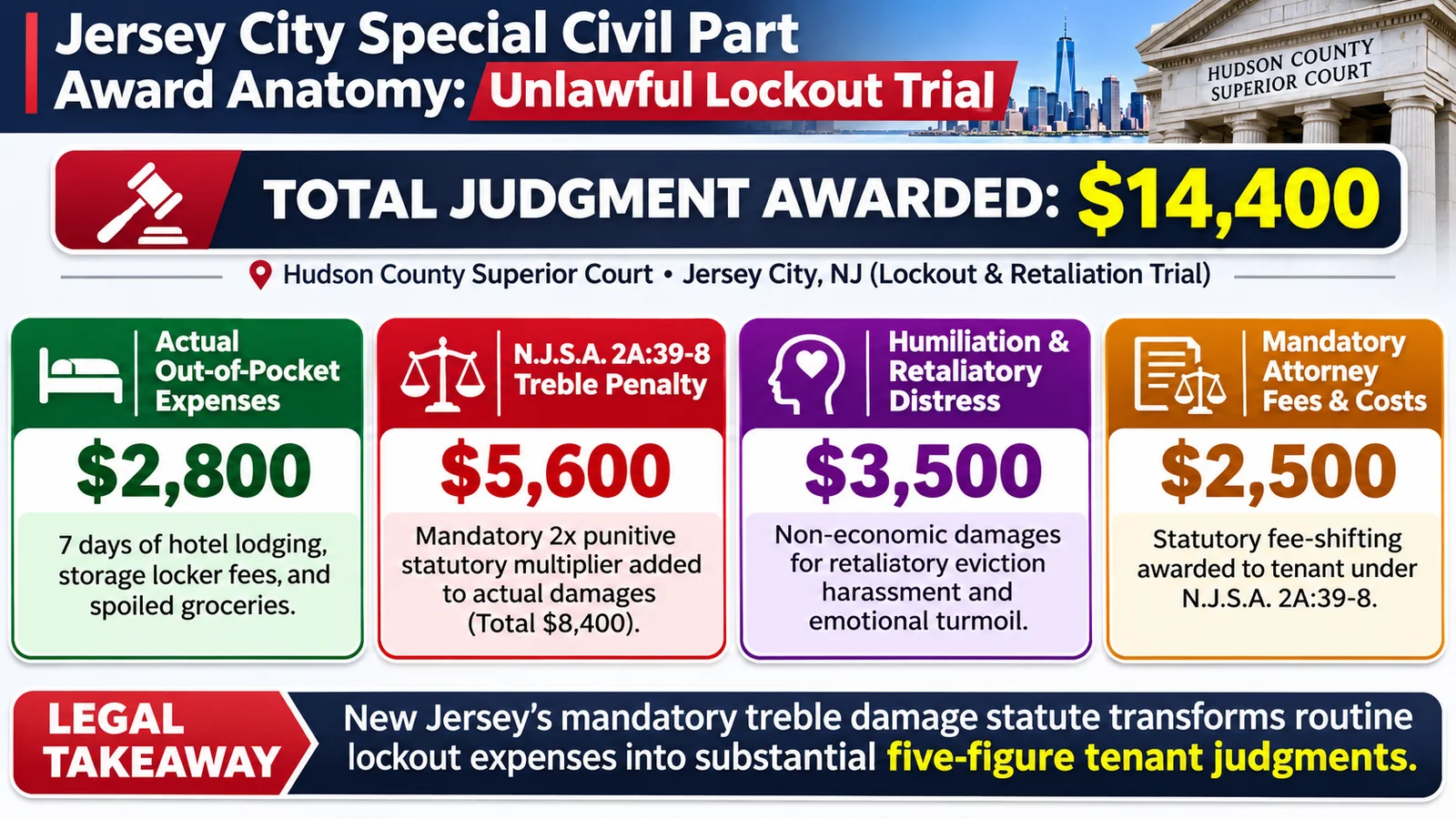
To see how New Jersey courts handle lockout and distress claims, consider this representative composite trial from Jersey City (Hudson County Superior Court, Special Civil Part):
Hudson County Special Civil Part Lawsuit Summary
The Dispute: A Jersey City tenant paying $1,900/month complained about water leaks and lack of heat in late November. Following a heated argument, the landlord padlocked the front entrance, shut off the gas meter, and refused to grant access until the tenant signed a voluntary surrender agreement. The tenant contacted Jersey City Police, who ordered the landlord to restore entry; the landlord refused and fled the scene.
The Legal Strategy: The tenant retained legal aid and filed an emergency Order to Show Cause for Illegal Lockout under N.J.S.A. 2A:39-8 in Hudson County Special Civil Part, demanding treble damages, immediate re-entry, and rent abatements under Berzito v. Gambino. The tenant submitted the police incident report, photos of padlocks, receipts for a local hotel, and winter temperature logs.
The Special Civil Part Judgment: The presiding judge entered a final judgment awarding:
- $6,300 in trebled actual lodging expenses under N.J.S.A. 2A:39-8 ($2,100 hotel expenses x 3).
- $4,500 in trebled damaged personal property under N.J.S.A. 2A:39-8 ($1,500 spoiled groceries & ruined clothes x 3).
- $1,900 in 100% rent abatement for the month without essential services under Marini.
- $2,500 in statutory attorney's fees and court costs.
- Total Monetary Judgment: $15,200, plus an immediate warrant for police-assisted lock removal.
This ruling shows that New Jersey statutory lockout laws deliver concrete financial justice that far surpasses the uncertainty of common-law mental anguish lawsuits.
What to Do Immediately If Your Landlord Shuts Off Utilities or Locks You Out
If you are unlawfully locked out or deprived of heat in New Jersey, follow this emergency procedure:
- Call Local Police Immediately: State clearly: "I am a residential tenant experiencing an illegal lockout under N.J.S.A. 2C:33-11.1." Ask officers to order the landlord to restore access and ensure a detailed CAD incident report is filed.
- File an Emergency Order to Show Cause (OTSC): Go directly to the County Superior Court, Special Civil Part clerk's office. Request the emergency lockout packet to obtain an immediate judicial order compelling the landlord to provide keys.
- Document Every Expense: Save all receipts for emergency lodging, restaurant meals, replacement clothing, and storage. These receipts will be multiplied by three under N.J.S.A. 2A:39-8.
- Record Habitability Breaches: If the lockout followed repair complaints regarding the implied warranty of habitability, notify the local municipal board of health or code enforcement office immediately.
Sample New Jersey Tenant Demand Letter (Ready to Use)
In New Jersey, sending a formal certified demand establishes an immediate record of landlord misconduct under the Anti-Eviction Act and triggers potential criminal disorderly persons liability under N.J.S.A. 2C:33-11.1, as well as treble damages under N.J.S.A. 2A:39-8.
Frequently Asked Questions: New Jersey Tenant Rights
SueLegal is an independent educational legal publisher, not a law firm or lawyer referral service. The information provided in this guide is for general informational and educational purposes only and does not constitute formal legal advice. Residential landlord-tenant laws, repair notice periods, and statutory remedies vary significantly across state and municipal jurisdictions. If you are facing eviction, severe uninhabitable conditions, or complex litigation, consult a licensed attorney in your jurisdiction or contact your local legal aid organization. For more details on our standards, read our Editorial Policy and Legal Research Methodology.