

What to Know Before You Act
- Key Condition: Conduct must be utterly outrageous and atrocious; habitability breaches alone do not sustain emotional distress torts.
- Typical Deadline: Strict 1 year for Intentional Infliction of Emotional Distress (CPLR 215(3)); 3 years for negligence or property damage.
- Cost Range: $15 to $20 for NYC Small Claims filing; $45 for NYC Housing Court HP Action filing.
- Best Next Step: Call 311 to request a HPD inspection and file an emergency HP Action in NYC Housing Court.
Why Emotional Distress Is Hard to Win in New York (And What Works Instead)
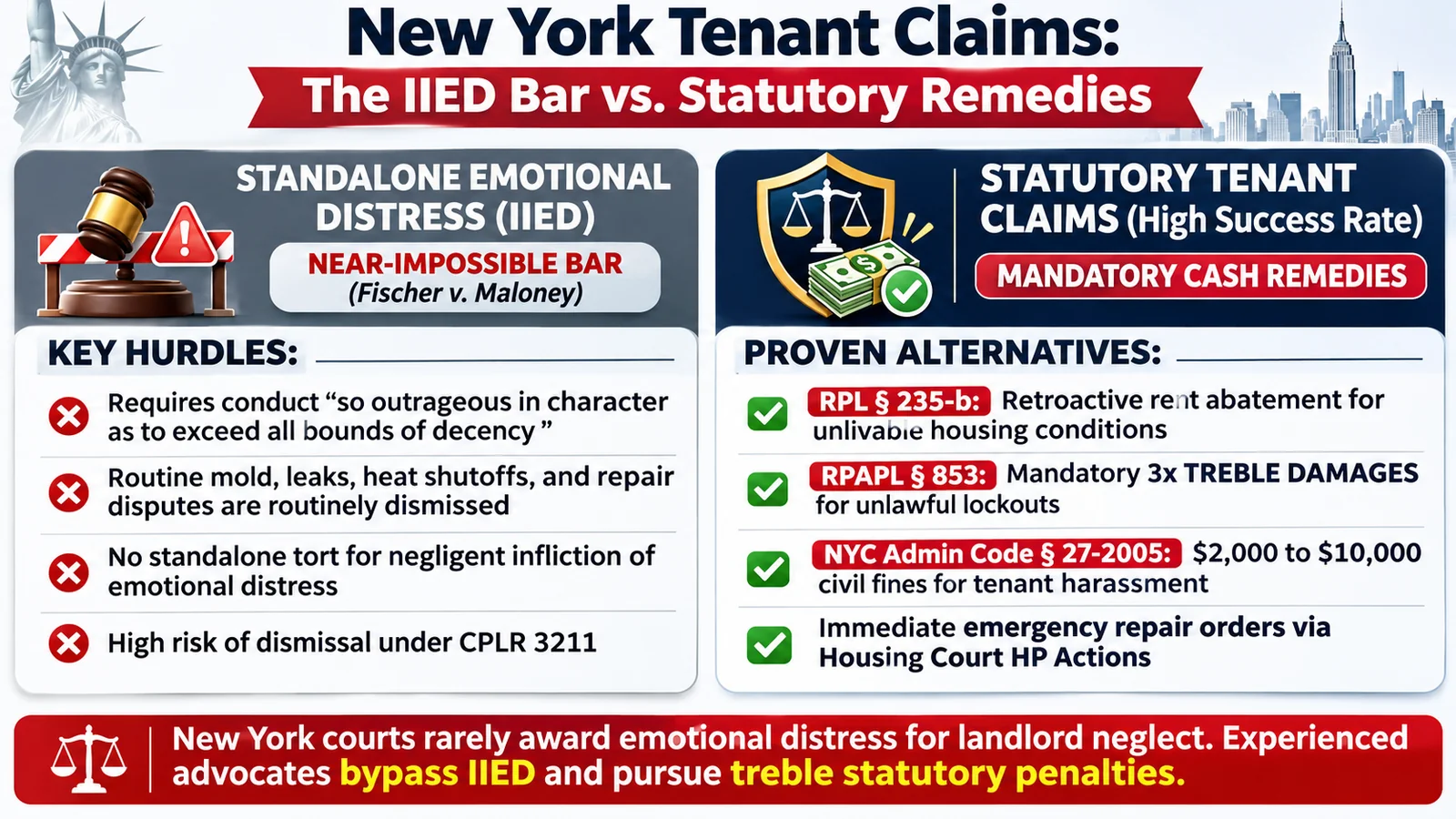
New York courts take a notoriously restrictive approach to standalone emotional distress claims in landlord-tenant disputes. When evaluating Your options for suing a landlord for emotional distress, New York tenants must confront the foundational Court of Appeals precedent in Fischer v. Maloney (43 N.Y.2d 553).
Under Fischer and its progeny (such as Howell v. New York Post Co.), an Intentional Infliction of Emotional Distress (IIED) claim requires conduct so outrageous in character and so extreme in degree as to go beyond all possible bounds of decency, and to be regarded as atrocious and utterly intolerable in a civilized society.
Routine housing disputes—such as delayed boiler repairs, hostile emails from a property manager, minor noise conflicts, or disputes over lease renewals—never satisfy this severe standard under New York law. New York judges routinely dismiss IIED claims at the preliminary motion stage unless there is evidence of physical violence, criminal stalking, or an intentional campaign designed to endanger human life.
Rent Reductions for Unlivable Homes: The Warranty of Habitability
In New York, the statutory Implied Warranty of Habitability is codified in Real Property Law (RPL) § 235-b. Under the landmark Court of Appeals ruling in Park West Management Corp. v. Mitchell (47 N.Y.2d 316), a breach of Section 235-b is measured as a contract damages claim, not a personal injury tort.
This means that if your apartment suffers from toxic mold, vermin infestations, or lack of winter heat, New York law awards damages based on the difference between the agreed contract rent and the fair market value of the premises in its defective condition. While you can win a substantial retroactive rent abatement (frequently 20% to 100% of the rent paid during the hazardous period) for warranty of habitability breaches, you cannot tack on general damages for anxiety or mental anguish under Section 235-b alone.
To obtain non-economic emotional damages in New York, the landlord's conduct must cross over into an independent intentional tort or trigger specific statutory protections against unlawful eviction and harassment.
Triple Damages: Taking Action When a Landlord Illegally Evicts You
Where New York law provides extraordinary financial remedies is in cases of self-help evictions and illegal lockouts.
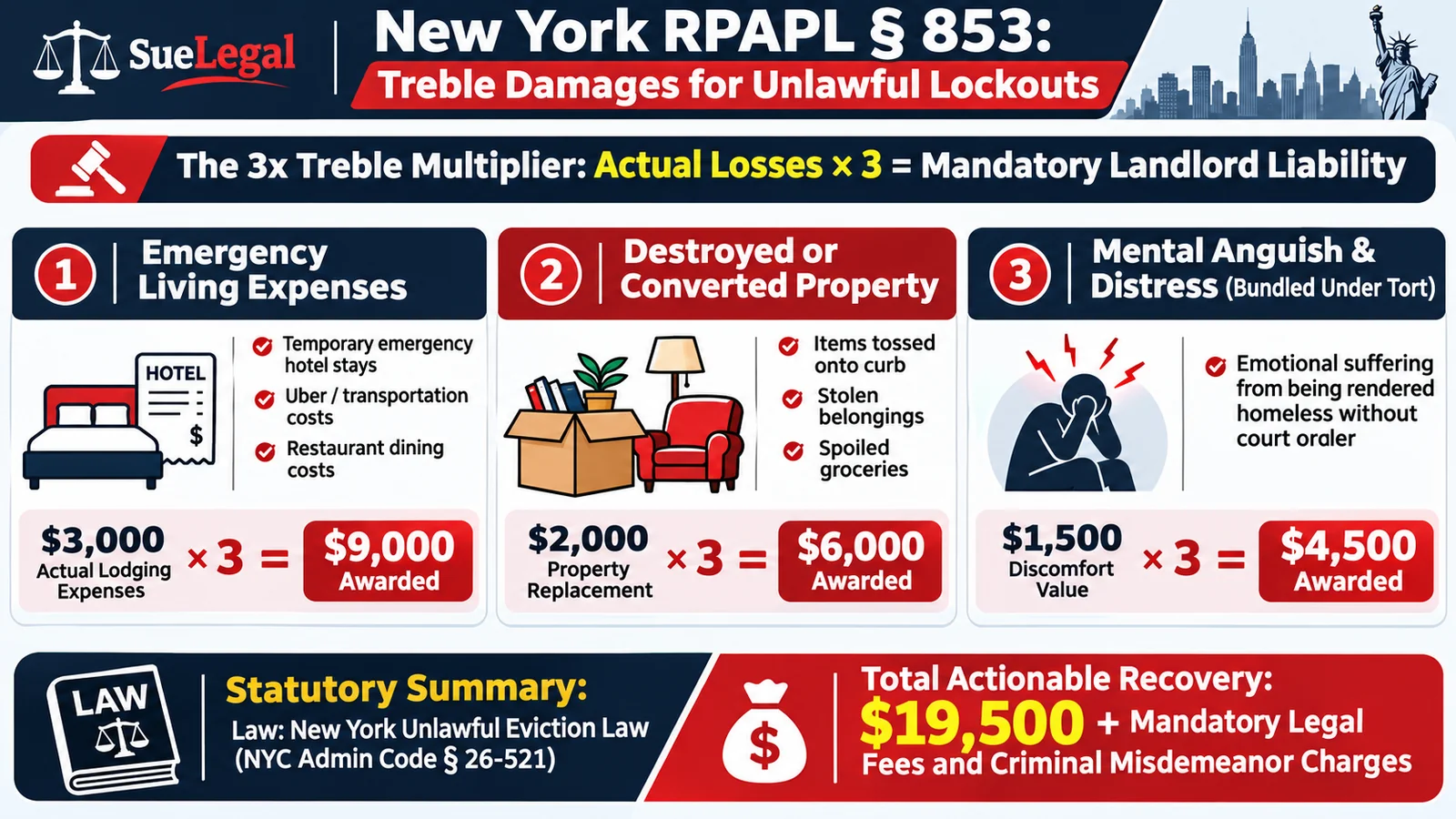
Under Real Property Actions and Proceedings Law (RPAPL) § 853, if a tenant is disseized, ejected, or put out of real property in a forcible or unlawful manner, or is kept out by force or by putting him or her in fear of personal violence or by unlawful means, the tenant is entitled to recover treble (3x) damages against the landlord.
| Damage Category | Standard Actual Loss | RPAPL § 853 Treble Recovery |
|---|---|---|
| Emergency Hotel Lodging | $3,000 (10 nights @ $300) | $9,000 (Trebled by court) |
| Lost or Damaged Possessions | $2,000 in clothing & belongings | $6,000 (Trebled by court) |
| Moving and Storage Fees | $1,200 emergency truck & unit | $3,600 (Trebled by court) |
Furthermore, under the Housing Stability and Tenant Protection Act of 2019 (HSTPA), New York enacted RPAPL § 768, which makes an unlawful self-help eviction a Class A misdemeanor criminal offense punishable by civil penalties of $1,000 to $10,000 per violation, on top of treble civil damages.
NYC Housing Court HP Actions: Forcing Repairs and Fining Bad Landlords
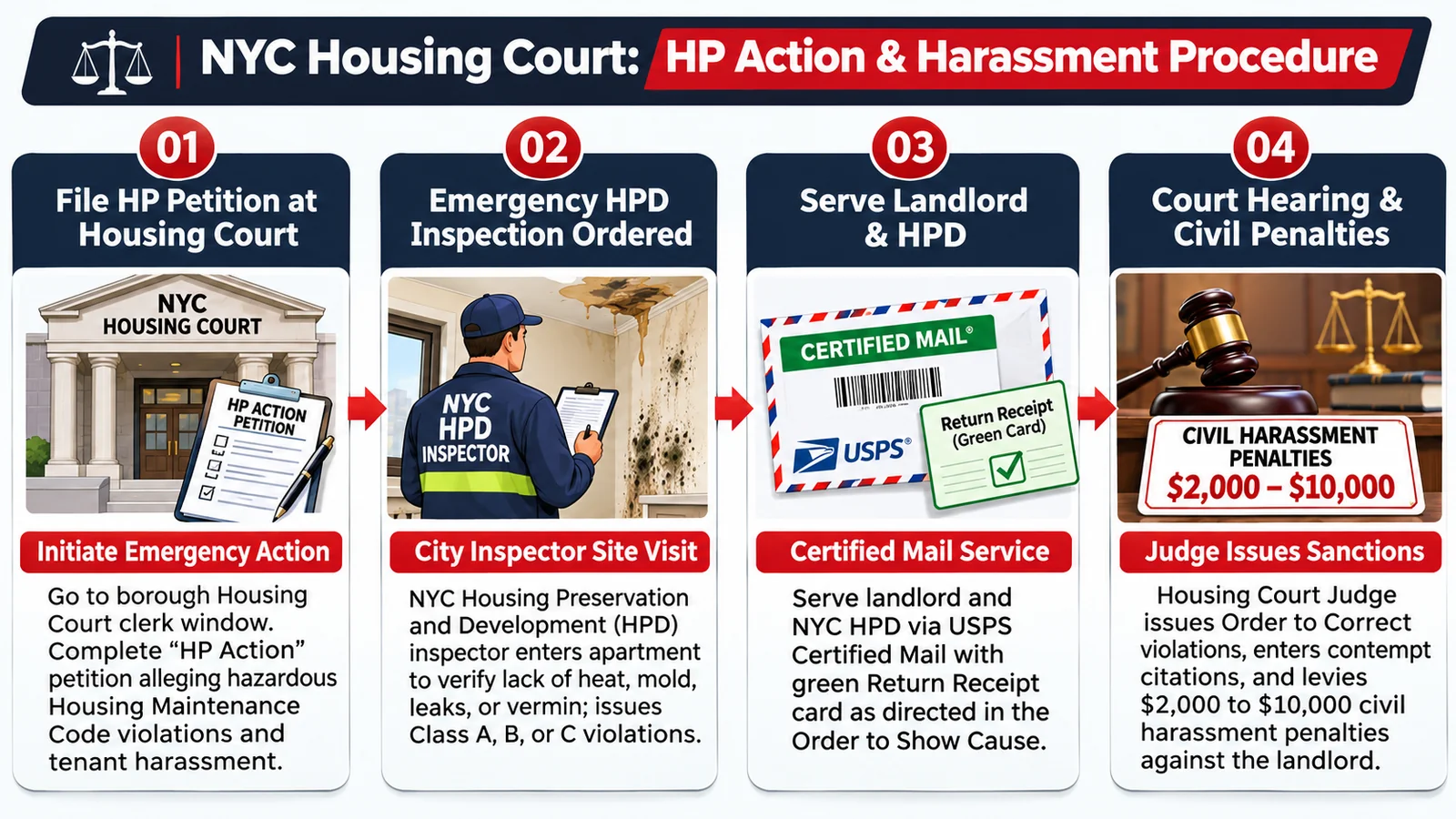
For tenants residing within the five boroughs of New York City, the NYC Housing Maintenance Code (NYC Admin. Code § 27-2004 et seq.) provides an emergency procedural pathway that bypasses the high common-law emotional distress threshold: an HP Action for Tenant Harassment.
Under NYC Admin. Code § 27-2005(d), landlords are strictly prohibited from engaging in any act or omission that causes or is intended to cause any person lawfully entitled to occupancy to vacate or surrender rights. Qualifying acts of landlord harassment include:
- Repeatedly interrupting or discontinuing essential services (heat, hot water, gas, electricity, elevator).
- Filing frivolous or baseless nonpayment eviction proceedings in bad faith.
- Removing entrance doors, changing locks, or padlocking the premises.
- Entering the apartment repeatedly without advance written consent, constituting landlord trespass and unlawful entry.
- Threatening or using physical force against the tenant or tenant's family.
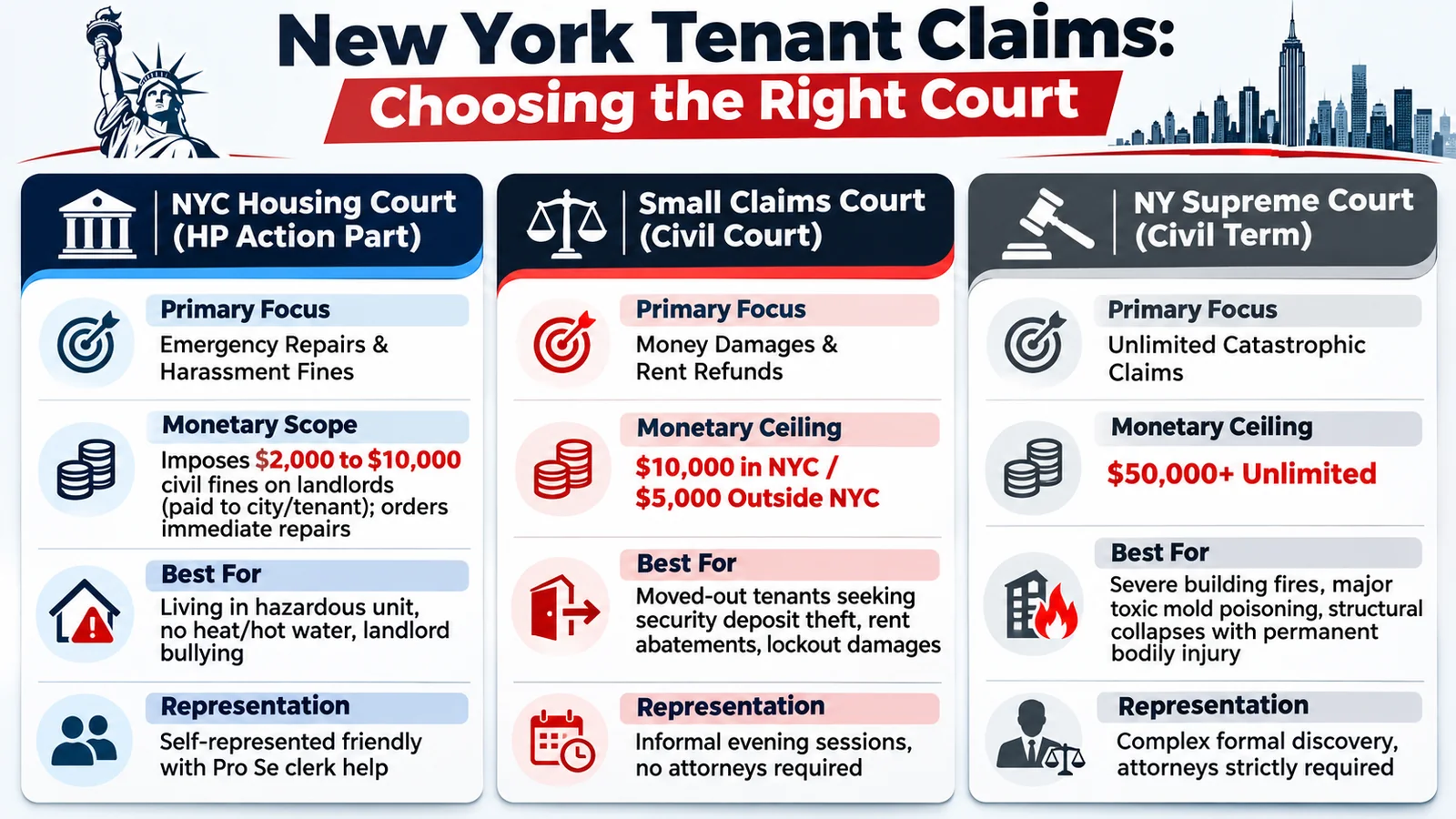
Under § 27-2115(m), if an NYC Housing Court judge finds that harassment occurred, the court must impose a mandatory civil penalty payable by the landlord to the City of New York of not less than $2,000 and not more than $10,000 for each violation, issue a restraining order, and award the tenant reasonable attorney's fees.
Real Court Example: How a Brooklyn Tenant Won Against an Unlawful Lockout
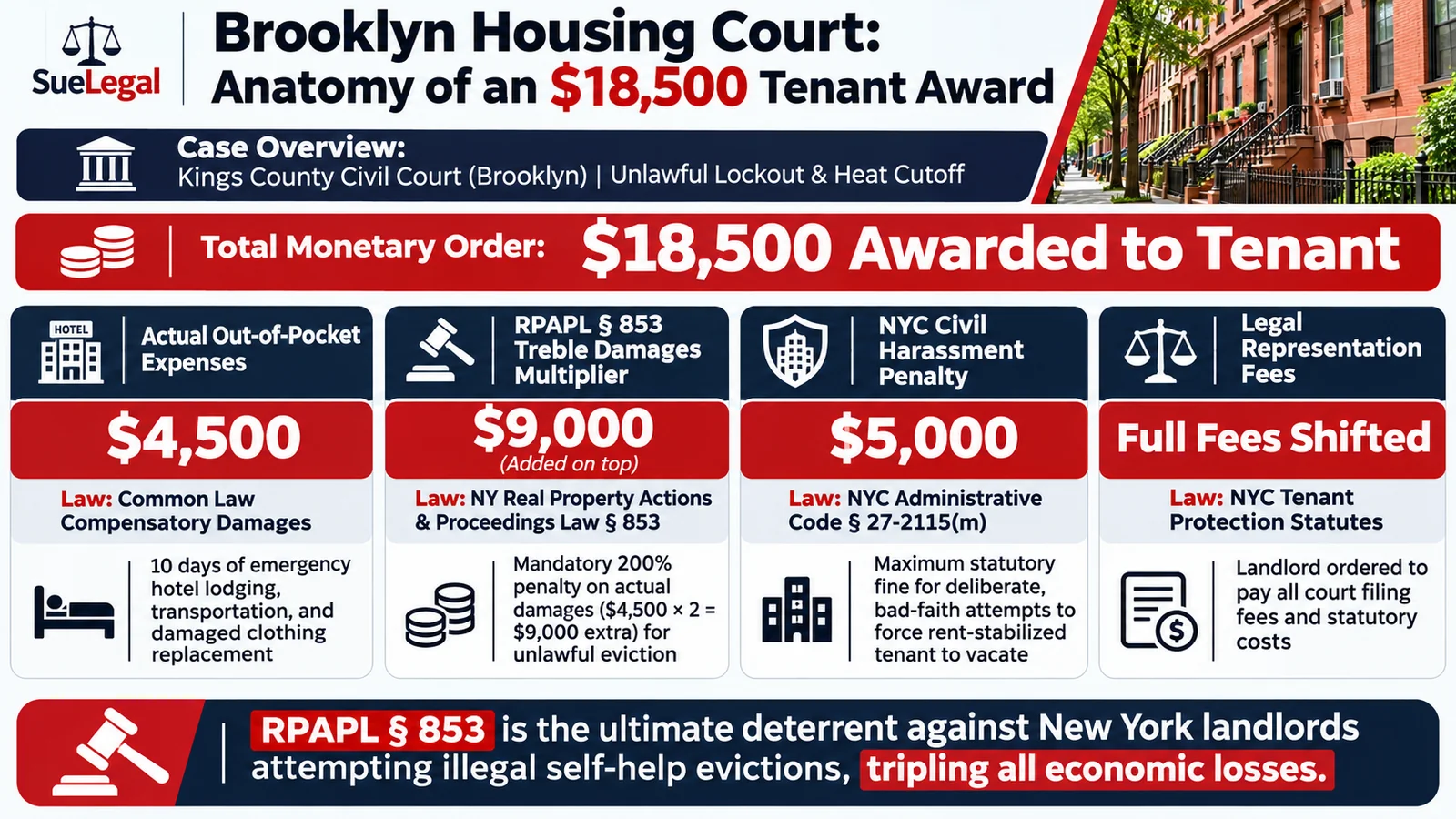
To demonstrate how New York courts apply RPAPL § 853 and habitability abatements, consider this representative composite case from Brooklyn (Kings County Civil Court):
Kings County Civil Court Lockout Trial Summary
The Dispute: A rent-stabilized tenant in Crown Heights paying $1,650/month withheld rent for two months after the apartment's primary heating radiator ruptured and remained unheated through January. Rather than making repairs or bringing a nonpayment proceeding, the landlord entered while the tenant was at work, removed the front door, changed the lock cylinder, and placed the tenant's belongings in trash bags on the sidewalk.
The Legal Action: The tenant immediately obtained an emergency Order to Show Cause for Illegal Lockout in Kings County Civil Court. The tenant asserted claims under RPAPL § 853 for treble damages, RPAPL § 768 statutory fines, and retroactive rent abatements under RPL § 235-b. Evidence included NYPD police complaint reports, photos of removed doors, HPD heat violation citations, and hotel invoices.
The Judgment: The Civil Court Judge ruled decisively for the tenant, awarding:
- $7,200 in trebled actual damages under RPAPL § 853 ($2,400 hotel & storage expenses x 3).
- $3,300 in 100% rent abatement for the two months without heat under RPL § 235-b.
- $2,500 in statutory damages under RPAPL § 768 for criminal self-help lockout.
- $3,500 in court costs and attorney's fees.
- Total Financial Judgment: $16,500, plus an immediate writ of restoration returning possession to the tenant.
By relying on New York's specific statutory lockout penalties rather than an abstract mental anguish claim, the tenant secured full treble damages and restored possession.
Filing in New York Small Claims: The $10,000 Maximum
In New York City, Small Claims Court is a special division of the Civil Court of the City of New York. Effective September 2019, the monetary jurisdiction of NYC Small Claims was increased to $10,000 (outside NYC, District Courts handle up to $5,000, and Town/Village Justice Courts handle up to $3,000).
Small Claims Court is designed for pro se litigants where neither side requires an attorney. Claims can be filed for:
- Retroactive rent abatements for broken heat, plumbing leaks, or vermin.
- Damaged personal property and out-of-pocket expenses.
- Security deposit retention under General Obligations Law (GOL) § 7-108, which awards double damages for bad-faith withholding.
If your claim exceeds $10,000 (such as a trebled lockout case), you must file in the regular Civil Court (monetary jurisdiction up to $50,000) or Supreme Court (unlimited monetary jurisdiction).
How to Document Housing Problems So a Housing Judge Believes You
To succeed against a landlord in any New York forum, your evidence must be documented contemporaneously:
- Place 311 Calls for HPD Inspections: In NYC, dial 311 or use the 311-online portal to request an official inspection by the Department of Housing Preservation and Development (HPD). HPD open violations (Class A non-hazardous, Class B hazardous, or Class C immediately hazardous) provide official judicial evidence of habitability defects.
- Maintain a Certified Mail Paper Trail: While emails and texts are admissible, a formal letter sent via Certified Mail with Return Receipt Requested establishes undisputed notice under New York real property law.
- Secure Police Incident Reports: If locked out, call the local NYPD precinct immediately. Under Patrol Guide Procedure 214-12, police officers are instructed to advise landlords that self-help evictions are illegal and order the landlord to readmit the tenant. An official police report documenting an unlawful eviction is devastating to a landlord's defense.
Sample New York Tenant Demand Letter (Ready to Use)
In New York, sending a certified demand letter establishes a paper trail of willful neglect under Real Property Law § 235-b and lays the mandatory foundation for statutory treble damages under RPAPL § 853 if the landlord engages in self-help exclusion.
Frequently Asked Questions: New York Tenant Rights
SueLegal is an independent educational legal publisher, not a law firm or lawyer referral service. The information provided in this guide is for general informational and educational purposes only and does not constitute formal legal advice. Residential landlord-tenant laws, repair notice periods, and statutory remedies vary significantly across state and municipal jurisdictions. If you are facing eviction, severe uninhabitable conditions, or complex litigation, consult a licensed attorney in your jurisdiction or contact your local legal aid organization. For more details on our standards, read our Editorial Policy and Legal Research Methodology.