
Quick Legal Guide
- Key Condition: The landlord or superintendent must have substantially interfered with your reasonable enjoyment or engaged in harassment.
- Typical Deadline: Strict 1 year from the date of the incident under Residential Tenancies Act s. 29(2); late claims are permanently barred.
- Cost Range: $53 to $58 for LTB online filing; licensed paralegal representation is optional but common.
- Best Next Step: Document all incidents in an interference log and file an LTB Form T2 Application.
Why Ontario Renters Deal with the Landlord and Tenant Board (Not Regular Court)
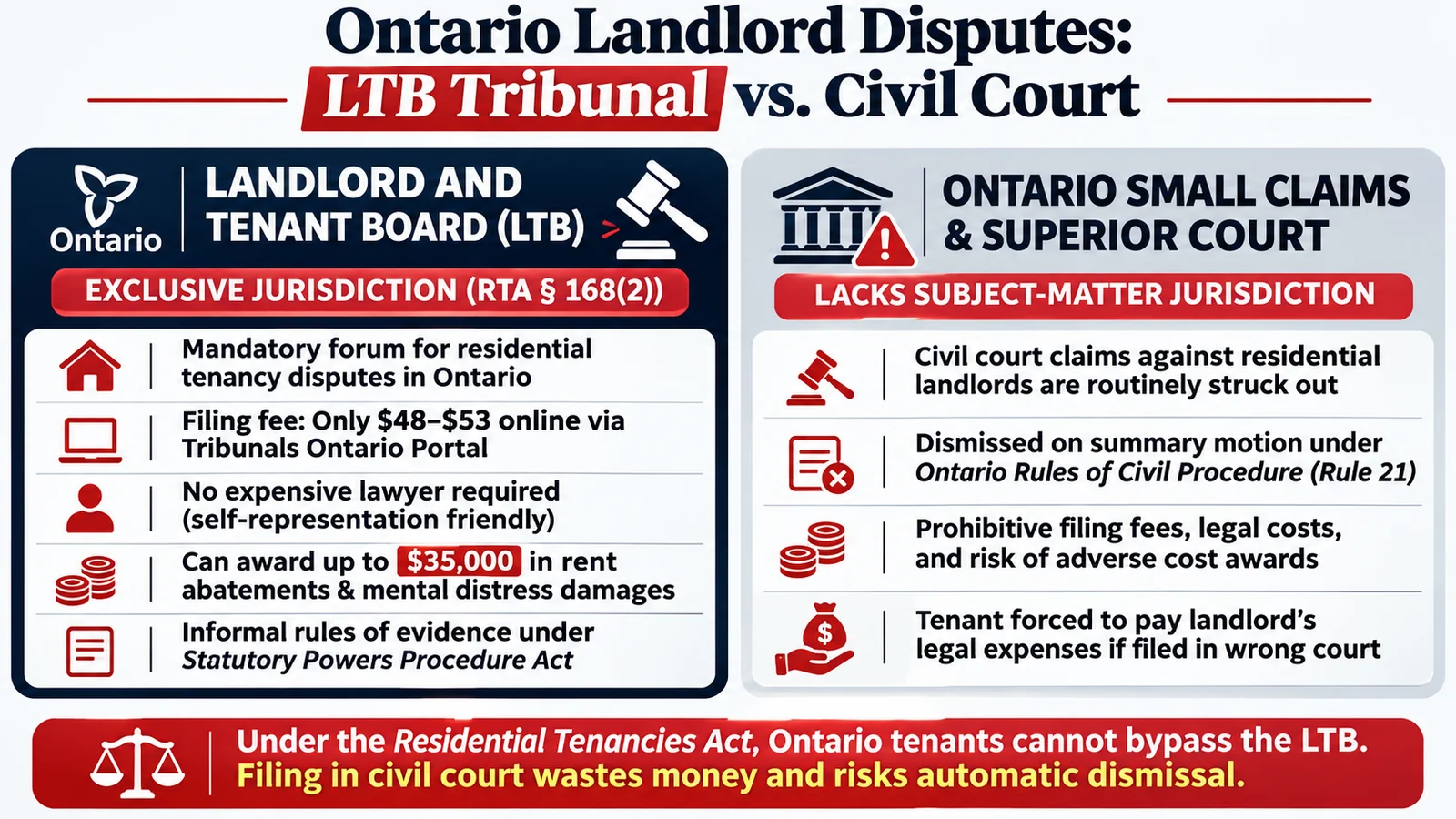
While Understanding landlord emotional distress claims in traditional common-law jurisdictions involves strict tort lawsuits, Ontario handles tenant mental distress through an administrative tribunal framework. Many Ontario tenants make the costly mistake of retaining a lawyer and attempting to sue their landlord in Small Claims Court or the Ontario Superior Court of Justice.
Under Section 168(2) of the Residential Tenancies Act, 2006 (RTA), the Landlord and Tenant Board (LTB) holds exclusive original jurisdiction to hear and determine all applications arising between residential landlords and tenants. Ontario courts strictly enforce this jurisdictional boundary. If a tenant files a civil lawsuit in Small Claims Court claiming emotional distress, harassment, or habitability failures against a landlord, the court will dismiss the action on jurisdictional grounds under Rule 2.1 of the Rules of Civil Procedure.
While this guide focuses strictly on Ontario LTB jurisprudence, tenants comparing provincial legal systems across the country can examine our companion guide on landlord emotional distress claims in Canada. To pursue remedies for emotional suffering in Ontario, you must work through the administrative dispute resolution mechanisms established under the RTA.
Filing a Form T2: Protecting Your Right to Peace and Quiet in Your Home
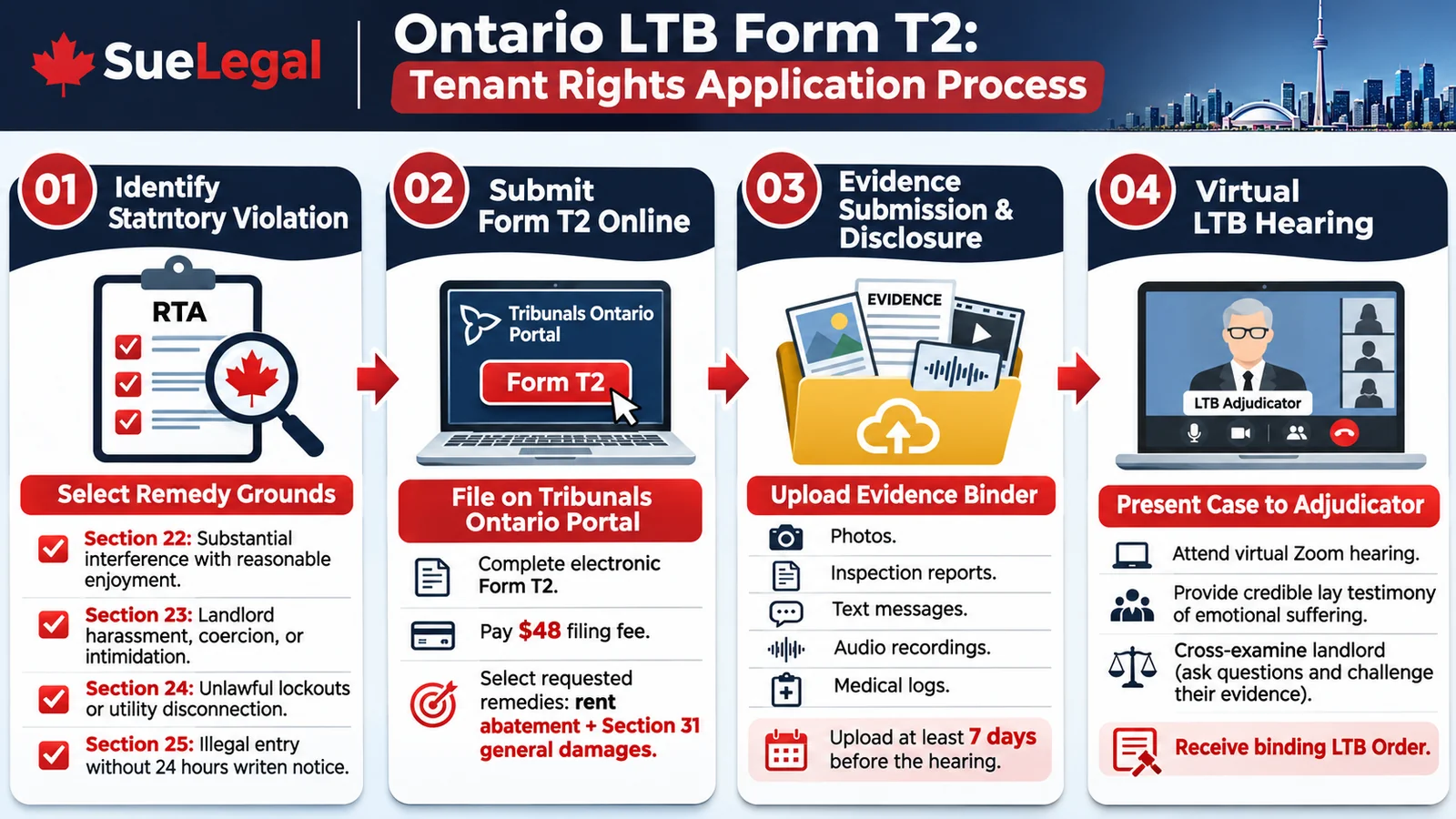
The primary procedural vehicle for claiming emotional distress compensation before the LTB is Form T2: Application about Tenant Rights. On Form T2, tenants check off specific statutory violations established under Part III of the RTA:
- Substantial Interference with Reasonable Enjoyment (RTA Section 22): Landlords, superintendents, and property managers are prohibited from substantially interfering with the reasonable enjoyment of the rental unit or residential complex by the tenant or members of their household. This covers noise, foul odors, maintenance disruption, and unreasonable rules.
- Harassment, Coercion, or Intimidation (RTA Section 23): Landlords are strictly barred from harassing, obstructing, coercing, threatening, or interfering with a tenant. Submitting an application alleging landlord harassment triggers heightened scrutiny from Board Adjudicators.
- Illegal Entry Without Proper Notice (RTA Section 27): Landlords must provide at least 24 hours written notice stating the reason and specifying a time window between 8:00 AM and 8:00 PM before entering. Challenging repeated unauthorized visits under illegal landlord entries provides solid grounds for mental distress damages.
- Altering Locking Systems (RTA Section 24): Changing locks without immediately providing the tenant with replacement keys constitutes an illegal lockout. When landlords resort to self-help eviction tactics, tenants can seek immediate reinstatement alongside financial sanctions for forced eviction.
Mental Distress Compensation: What the Board Can Actually Award You
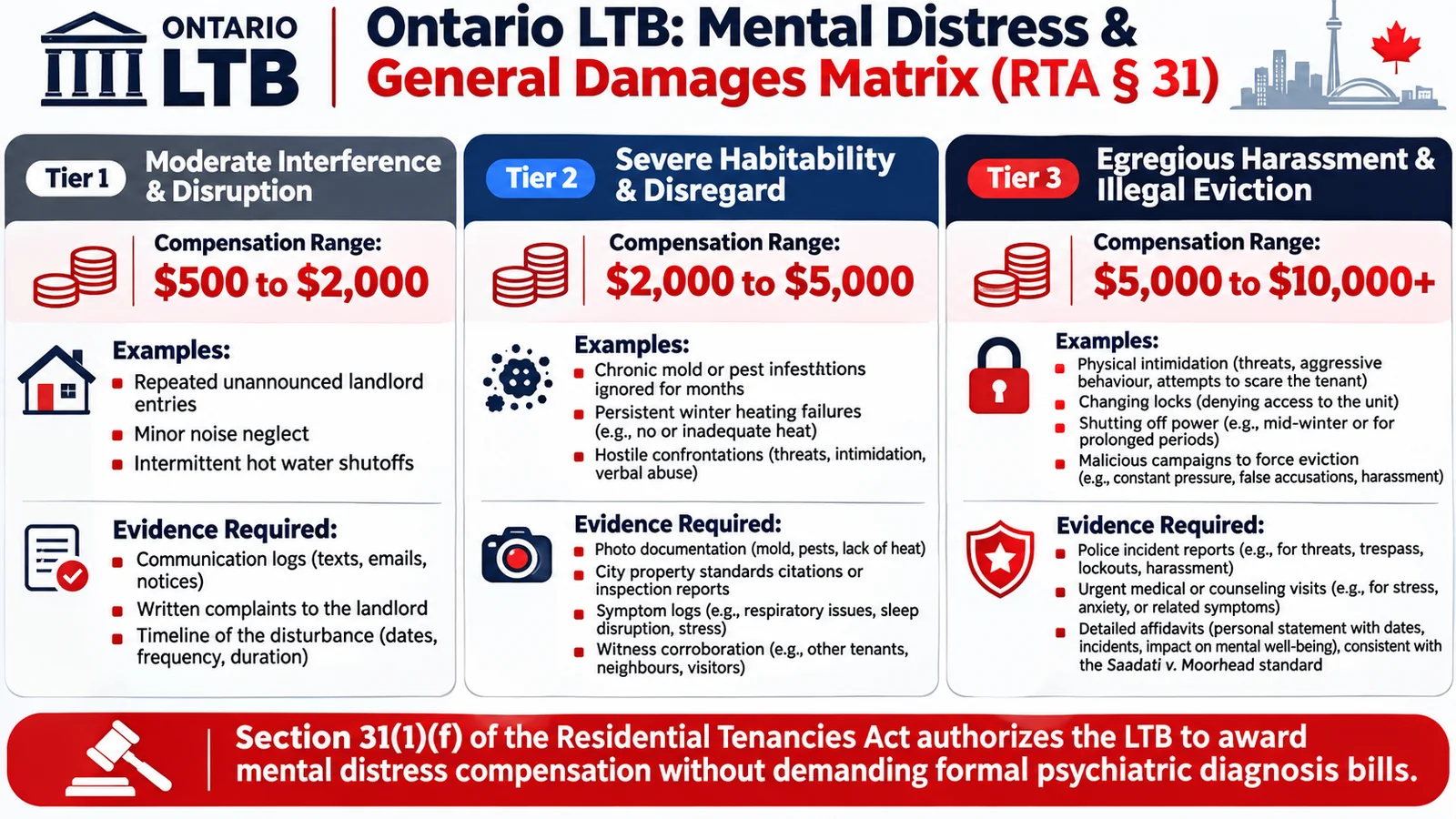
When an adjudicator determines that a landlord has violated Section 22, 23, 24, or 27, the Board turns to Section 31(1) of the RTA to determine remedies. Under Section 31(1)(f), the Board has broad statutory discretion to "make any other order that it considers appropriate."
For years, landlords argued that Section 31(1)(f) only covered direct out-of-pocket expenses. However, in the foundational Ontario Divisional Court decisions Onyskiw v. CJM Property Management Ltd. (2016 ONSC 4776) and Mejia v. Cargojet Airways Ltd., Ontario courts affirmed that Section 31(1)(f) grants the LTB full legal authority to award general damages for mental distress, anxiety, humiliation, and loss of peace of mind.
Crucially, the Divisional Court held that tenants do not need to present medical expert testimony or prove a recognized psychiatric disorder to qualify for general damages. An adjudicator can evaluate the credible, sworn testimony of the tenant regarding sleep disruption, emotional stress, anxiety, and loss of privacy, and award lump-sum mental distress compensation (typically ranging from $500 to $10,000 depending on severity).
The 1-Year Time Limit: Don't Miss the Deadline to File a Claim
The single most dangerous legal trap in Ontario landlord-tenant law is the strict statute of limitations set forth in Section 29(2) of the RTA:
"No application may be made under subsection (1) more than one year after the day the alleged conduct occurred."
This one-year limitation window is absolute. Unlike Superior Court actions where the Limitations Act, 2002 permits discovery-based extensions or equitable tolling, the LTB possesses no statutory power under Section 29(2) to extend the one-year deadline, regardless of how severe your emotional distress was or how reasonable your delay may seem.
If your landlord harassed you or entered your unit illegally on September 15, 2025, and you file your Form T2 on September 16, 2026, the Board Adjudicator must dismiss that incident on jurisdictional grounds. If the landlord's bad conduct is ongoing, you can claim for all incidents occurring within the 365 days immediately preceding your filing date.
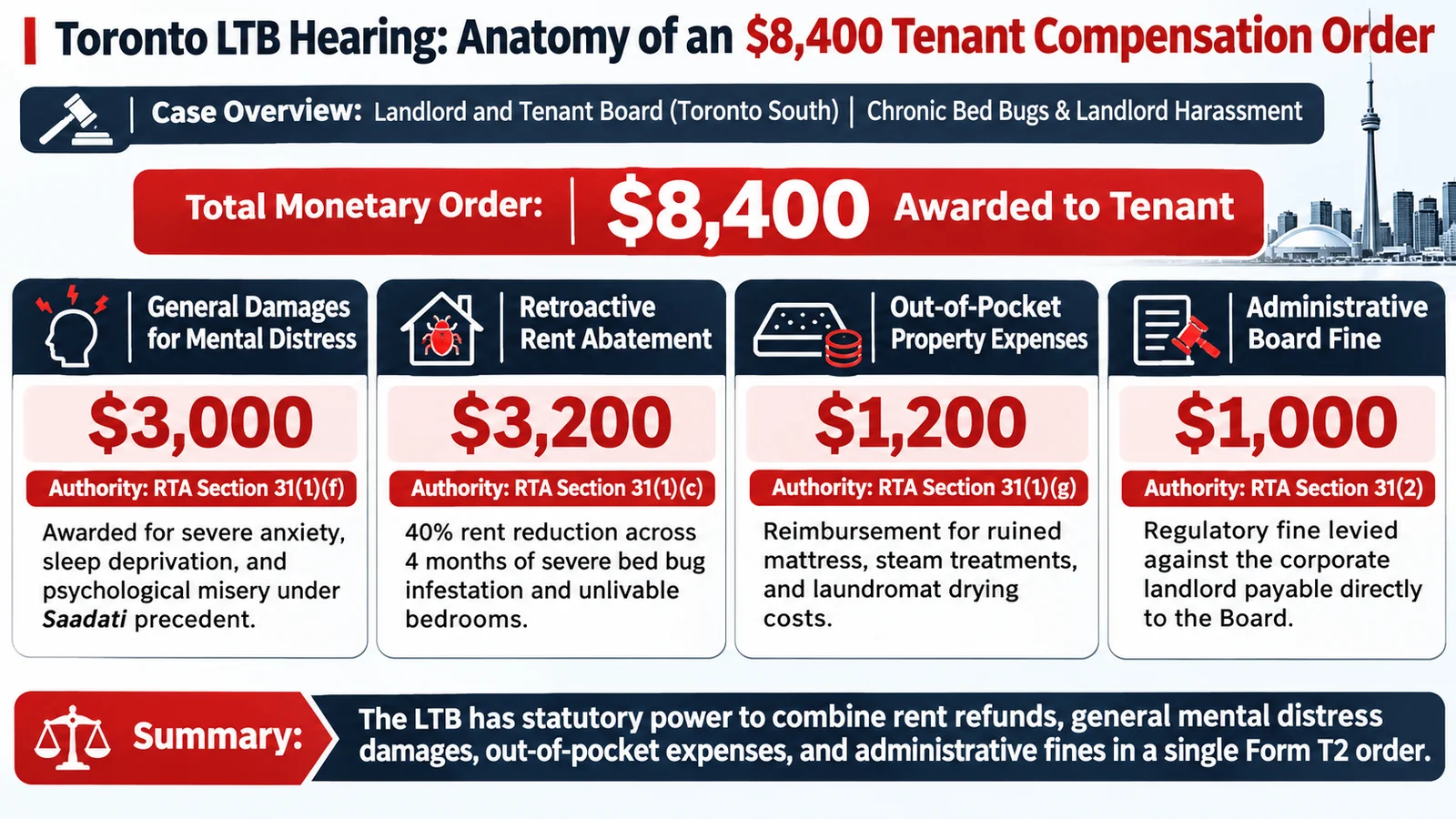
Real Hearing Example: How a Toronto Tenant Recovered $8,400 at the LTB
To illustrate how the LTB evaluates mental distress claims, consider a representative composite decision from the Toronto South LTB regional office:
Toronto LTB Form T2/T6 Order Summary
The Dispute: A downtown Toronto tenant paying $2,100/month endured chronic bedbug infestations and multiple unannounced entries by the superintendent over an eight-month span. The tenant sent numerous emails reporting bites and sleep loss. Instead of hiring professional exterminators, the landlord entered without 24 hours notice to spray over-the-counter insecticides, threatening to evict the tenant if they contacted Toronto Public Health.
The Filing: The tenant submitted a combined Form T2 (Tenant Rights) and Form T6 (Maintenance) through the Tribunals Ontario Portal, claiming substantial interference with reasonable enjoyment (s. 22), harassment (s. 23), illegal entry (s. 27), and failure to repair (s. 20). Evidence included calendar logs, photographs of insect bites, text message threats from the superintendent, and Toronto Bylaw inspection reports.
The Adjudicator's Order: The LTB Member issued a binding order awarding:
- $4,200 in retroactive rent abatement (25% rent abatement across 8 months).
- $3,500 in general damages for mental distress and loss of quiet enjoyment under Section 31(1)(f).
- $1,100 for replacement of infested mattress and bedding.
- $1,500 administrative fine payable by the landlord to the Board under Section 31(1)(e) for blatant harassment.
- $53 rebate of the LTB application filing fee.
- Total Award to Tenant: $8,853, plus an order requiring certified pest management within 14 days.
This order demonstrates that Ontario tenants can recover significant compensation for mental anguish and harassment through the LTB without ever stepping foot inside a traditional civil courtroom.
How Much Money You Can Ask For: The $35,000 Maximum Limit
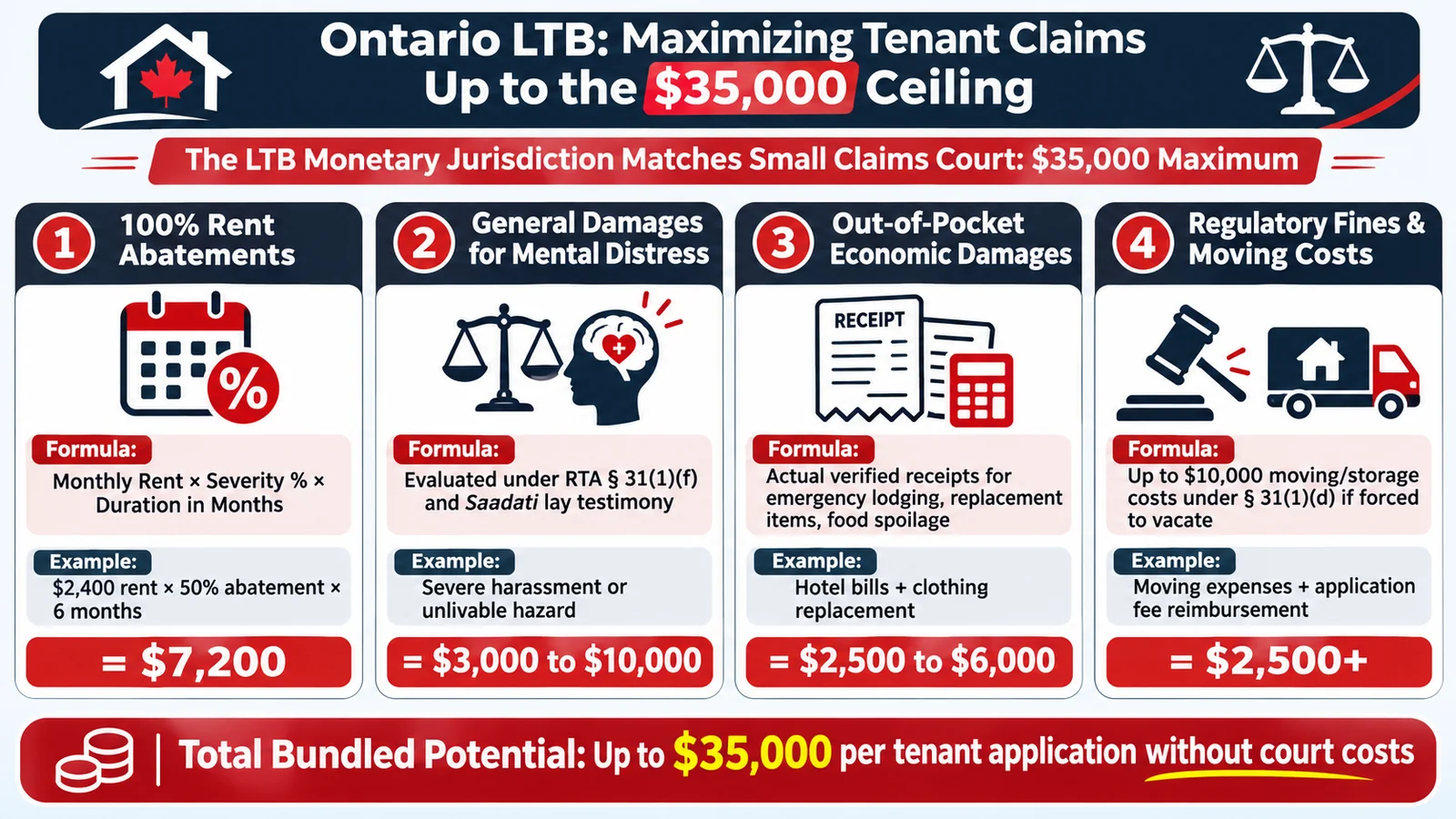
Under Section 207(1) of the RTA, the maximum monetary compensation the Landlord and Tenant Board can order is pegged to the monetary limit of the Ontario Small Claims Court—currently $35,000.
When compiling your Form T2 remedy request, you can combine multiple remedies up to the $35,000 ceiling:
| Remedy Category | RTA Section | How It Is Calculated |
|---|---|---|
| Rent Abatement | s. 31(1)(c) | 10% to 100% refund of monthly rent for period of disruption |
| General Damages (Mental Distress) | s. 31(1)(f) | Lump sum compensation for anxiety, distress, and loss of peace ($500–$10,000) |
| Out-of-Pocket Expenses | s. 31(1)(d) | Hotel bills, laundry costs, damaged personal belongings, moving costs |
| Administrative Board Fine | s. 31(1)(e) | Penalty up to $35,000 paid to the Board to deter bad landlord conduct |
The fee to file Form T2 online via the Tribunals Ontario Portal is $53 ($58 if filed in paper). Low-income tenants receiving Ontario Works (OW), the Ontario Disability Support Program (ODSP), or falling below established income thresholds can apply for a full fee waiver.
Organizing Your Photos, Messages, and Proof for the Hearing
Because LTB hearings are currently conducted virtually via Zoom, digital document preparation is vital to winning your case:
- Follow LTB Evidence Disclosure Rules: Under LTB Practice Directions, you must upload all evidence to the Tribunals Ontario Portal and serve copies on the landlord at least 7 calendar days before the hearing (or 5 days for reply evidence). Evidence not disclosed in advance will be excluded.
- Create an Indexed, Numbered PDF: Merge your evidence into a single, indexed PDF file with clear page numbers. Include your written correspondence, inspection reports from Municipal Licensing & Standards, text transcripts, and photos.
- Document the Human Impact: Present evidence showing how the harassment or conditions impaired your daily life. While medical records are not mandatory under Onyskiw, doctor's notes, prescription receipts, or therapist records significantly strengthen claims for high-tier general damages.
Sample Formal Notice to Landlord (Ready to Use)
In Ontario, residential tenancy disputes fall under the exclusive jurisdiction of the Landlord and Tenant Board. Serving this formal notice puts your landlord on notice of an impending Form T2 Application and provides compelling evidence of willful interference before an LTB Adjudicator.
Frequently Asked Questions: Ontario Tenant Rights
SueLegal is an independent educational legal publisher, not a law firm or lawyer referral service. The information provided in this guide is for general informational and educational purposes only and does not constitute formal legal advice. Residential landlord-tenant laws, repair notice periods, and statutory remedies vary significantly across state and municipal jurisdictions. If you are facing eviction, severe uninhabitable conditions, or complex litigation, consult a licensed attorney in your jurisdiction or contact your local legal aid organization. For more details on our standards, read our Editorial Policy and Legal Research Methodology.