

What You Should Know
- Key Condition: Objective medical evidence of psychological harm from a physician or licensed psychiatrist is strictly mandatory.
- Typical Deadline: 2 years for personal injury, intentional torts, and fraud under 42 Pa.C.S. § 5524; 4 years for lease contract claims.
- Cost Range: $65 to $130 for Magisterial District Court filing and constable service fees.
- Best Next Step: Consult a physician for documented medical records and send a Pugh v. Holmes escrow withholding notice.
Medical Records: What You Need to Prove Emotional Harm in Court
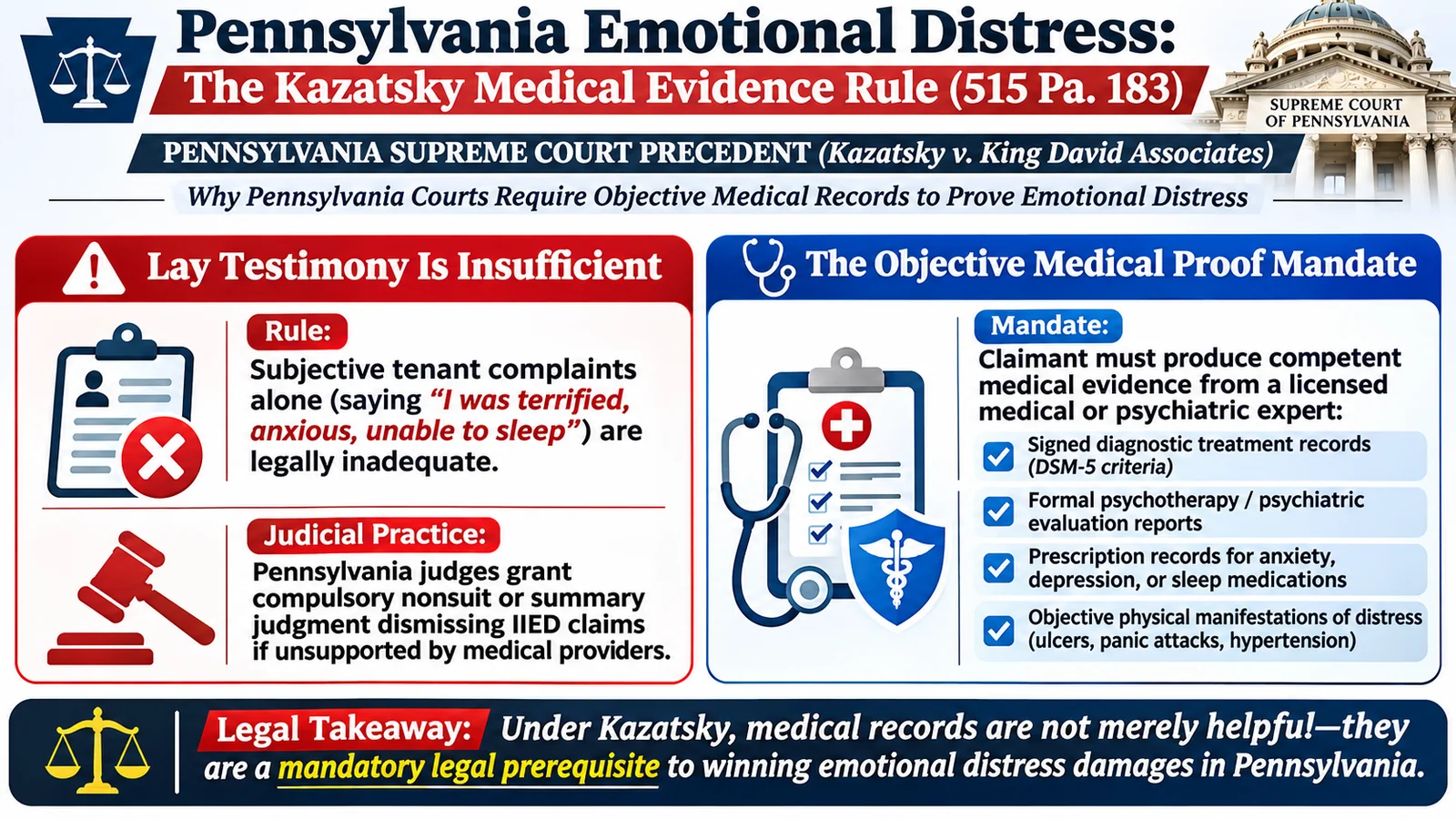
When evaluating whether you can sue your landlord for emotional distress in Pennsylvania, you must navigate the strict evidentiary barrier established in Kazatsky v. King David Memorial Park, Inc. (515 Pa. 183).
In Kazatsky, the Pennsylvania Supreme Court ruled that if a plaintiff claims Intentional Infliction of Emotional Distress (IIED), the existence of severe distress must be supported by competent objective medical evidence. This requirement means that subjective tenant testimony regarding anxiety, sleeplessness, or emotional trauma will be rejected as legally insufficient.
To survive preliminary objections or a motion for summary judgment in Pennsylvania, a tenant must produce medical treatment records, prescription histories, or testimony from a licensed medical physician or clinical psychologist diagnosing severe psychological injury directly caused by the landlord's conduct.
Unbearable Living Conditions: When Neglect Becomes an Outrageous Offense
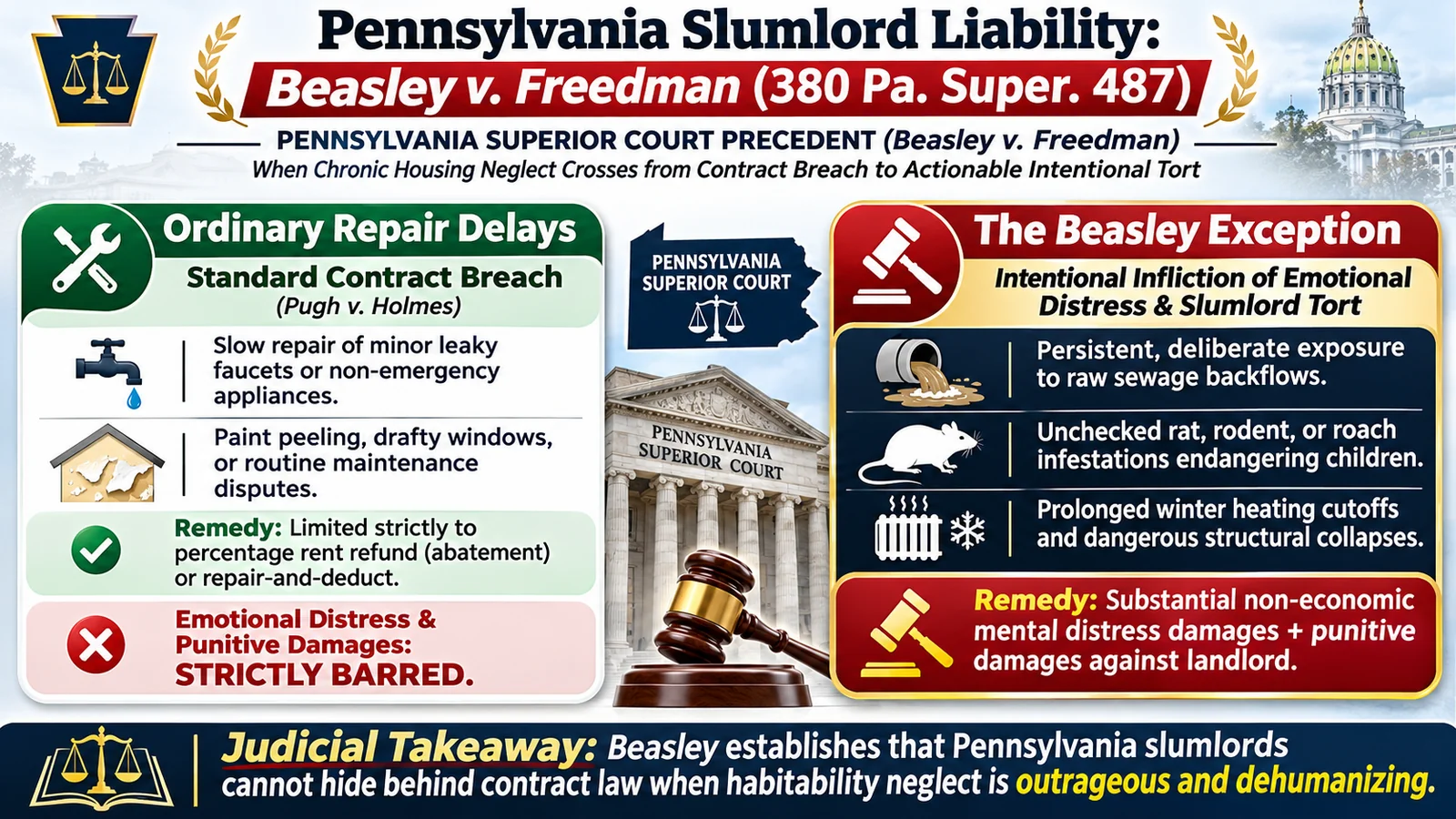
While Kazatsky sets a high evidentiary standard, Pennsylvania law provides a powerful sword in Beasley v. Freedman (380 Pa. Super. 487). In Beasley, the Pennsylvania Superior Court addressed whether a landlord's failure to maintain basic living conditions could constitute extreme and outrageous conduct.
The court held that when a landlord intentionally maintains squalid, substandard living conditions—such as raw sewage leaks, rodent infestations, structural collapses, or severe heating failures—over an extended duration while collecting rent, that conduct constitutes an intentional tort actionable as IIED.
The court reasoned that a residential landlord holds significant leverage over low-income tenants who cannot readily relocate. Intentionally exploiting that power by forcing families to live in hazardous squalor crosses the line from mere contract breach to outrageous conduct that exceeds all bounds of decency in a civilized community.
Holding Back Rent Legally: How the Implied Warranty of Habitability Works
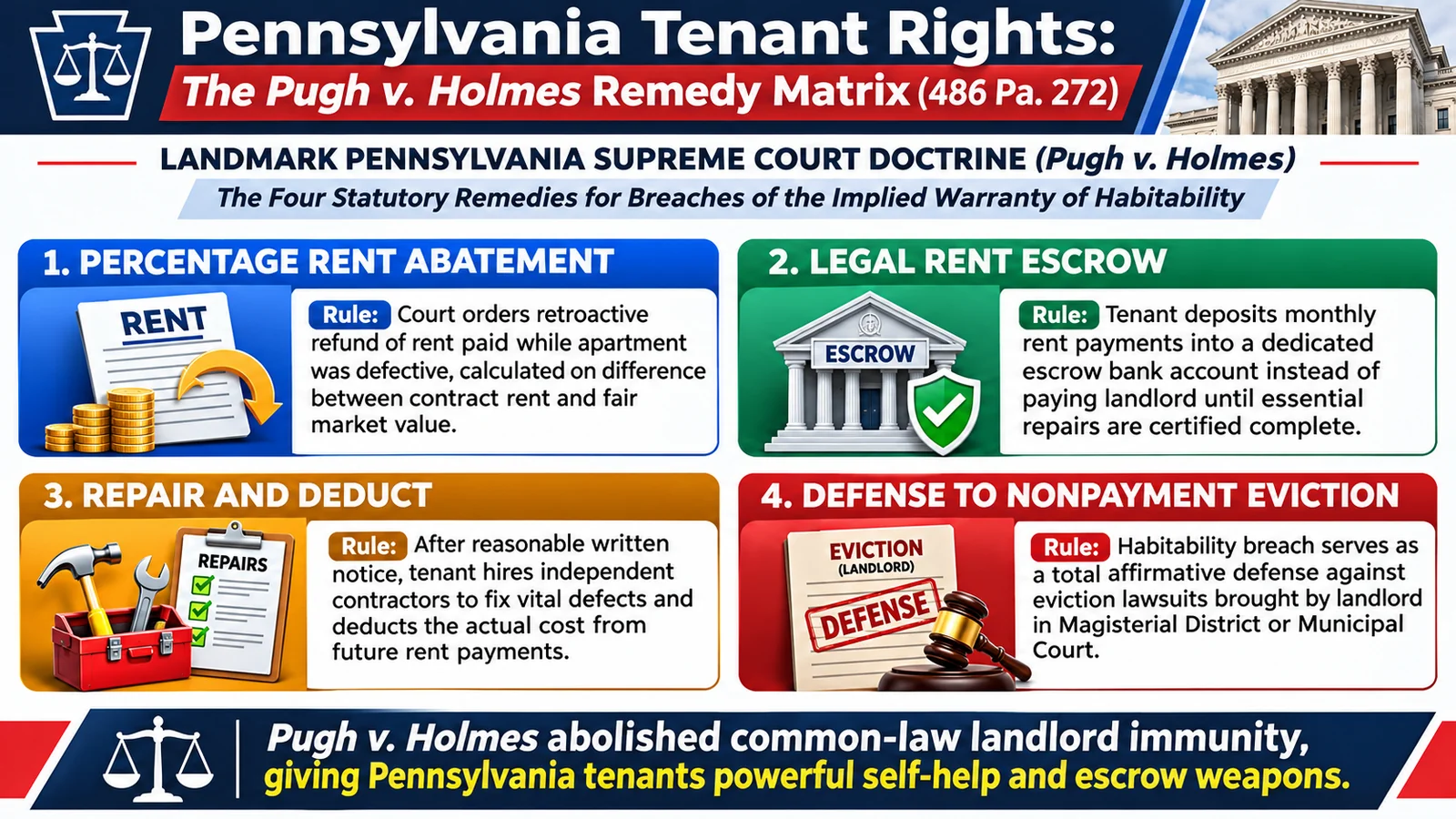
Beyond intentional tort claims, the bedrock of Pennsylvania tenant law is the landmark Supreme Court decision Pugh v. Holmes (486 Pa. 272). In Pugh, the court adopted the implied warranty of habitability in all residential leases as a mutual and dependent covenant.
| Remedy Under Pugh v. Holmes | Procedural Requirements | Financial Outcome |
|---|---|---|
| Rent Withholding into Escrow | Written notice to landlord + deposit into bank escrow account | Rent withheld until repairs completed or abated by court |
| Repair and Deduct | Reasonable notice and failure of landlord to act | Deduct actual reasonable cost of repair from future rent |
| Percentage Rent Abatement | Proof of percentage reduction in usable living space | 10% to 100% retroactive refund of rent paid during defect |
In Philadelphia, under the Philadelphia Rent Withholding Act (35 P.S. § 1700-1), when the Department of Licenses and Inspections (L&I) certifies a rental property as unfit for human habitation, the tenant can deposit rent into an official city escrow account for up to six months while repairs are pending.
Eviction Warning Rules: When a Landlord's Threats Violate State Law
Under the Landlord and Tenant Act of 1951 (68 P.S. § 250.101 et seq.), landlords must follow strict statutory notice requirements before filing for eviction. Under Section 250.501, landlords must provide a 10-day notice to quit for nonpayment of rent (or 15 to 30 days for end-of-term lease termination).
Self-help evictions—such as padlocking doors, cutting off electricity, or tossing belongings onto the street—are strictly prohibited under Pennsylvania common law (Kuriger v. Cramer, 345 Pa. Super. 595). Tenants subjected to an unlawful lockout can file an emergency petition in court for immediate restoration of possession, actual property losses, and punitive damages.
Real Court Example: How a Philadelphia Tenant Won $7,800 for Sewage Problems
To see how Pennsylvania courts apply Pugh v. Holmes, Beasley, and Kazatsky, consider this representative composite case from Philadelphia (Philadelphia Municipal Court, Civil Division):
Philadelphia Municipal Court Hearing Summary
The Dispute: A North Philadelphia tenant paying $1,200/month lived with severe raw sewage backups in the basement and defective plumbing for four months. The Philadelphia Department of Licenses and Inspections (L&I) issued Class 1 hazardous violation notices. The tenant began depositing rent into a separate bank escrow account under Pugh v. Holmes. In retaliation, the landlord shut off the hot water valve and threatened to throw the tenant's belongings into the alley.
The Court Action: The tenant filed a lawsuit for $12,000 in Philadelphia Municipal Court alleging breach of warranty of habitability, illegal lockout/utility cutoff, and IIED under Beasley v. Freedman. Crucially, the tenant complied with the Kazatsky requirement by presenting clinical records from a family medical physician documenting severe gastroenteritis from sewage exposure and prescribed anti-anxiety medication for acute distress.
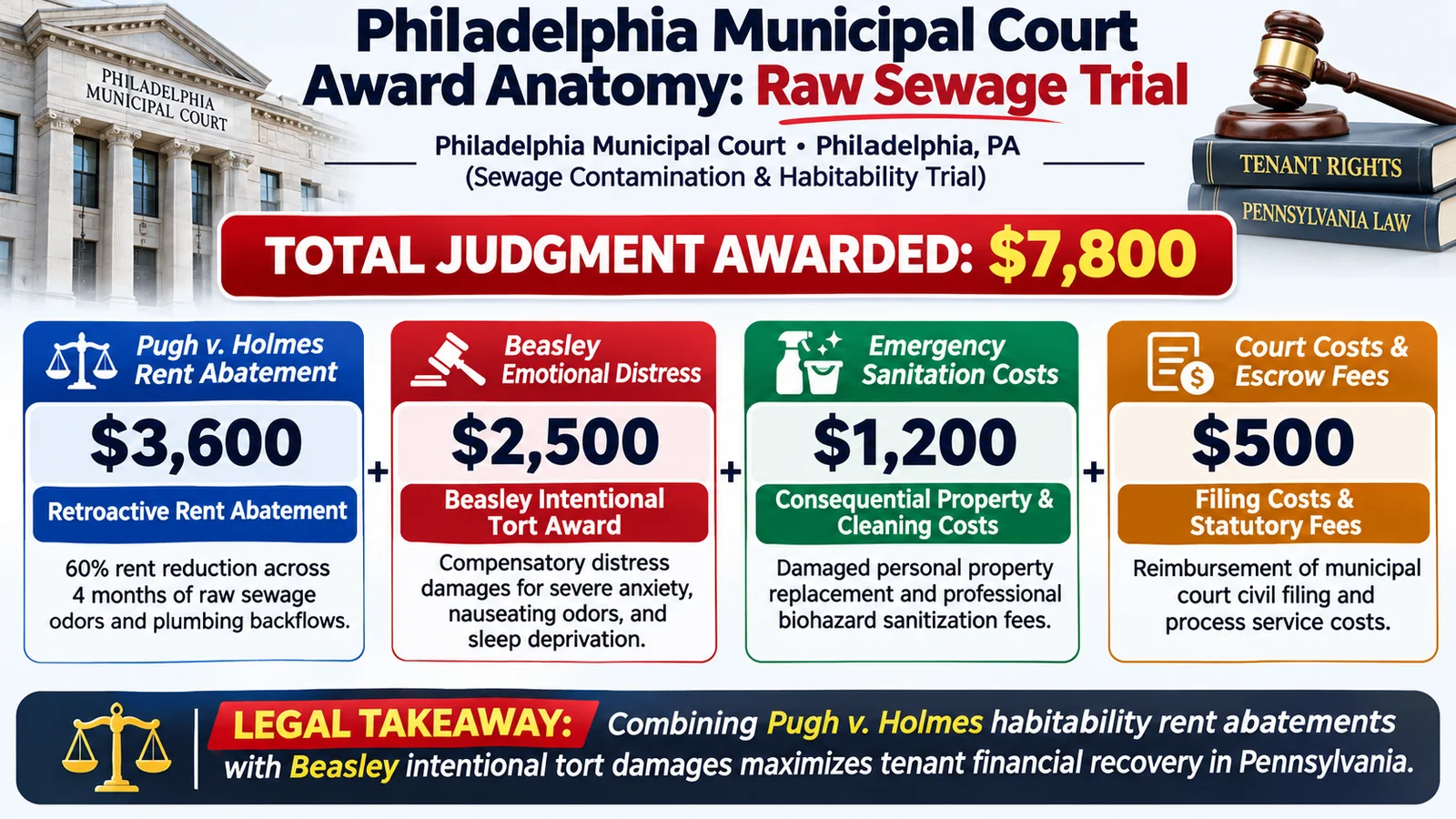
The Municipal Court Order: The judge ruled in favor of the tenant, awarding:
- $3,600 in retroactive rent abatement under Pugh v. Holmes (75% rent abatement across 4 months).
- $2,500 in statutory damages for utility termination and harassment.
- $3,500 in general damages for Intentional Infliction of Emotional Distress under Beasley and Kazatsky, supported by medical evidence.
- $800 for damaged personal property in the basement.
- $120 in court filing and service fees.
- Total Money Judgment: $10,520, plus release of all escrowed funds to the tenant.
This case illustrates how Pennsylvania tenants can successfully win emotional distress damages by pairing habitability claims with objective medical records.
Pennsylvania Small Claims: Filing Limits and Local Court Procedures
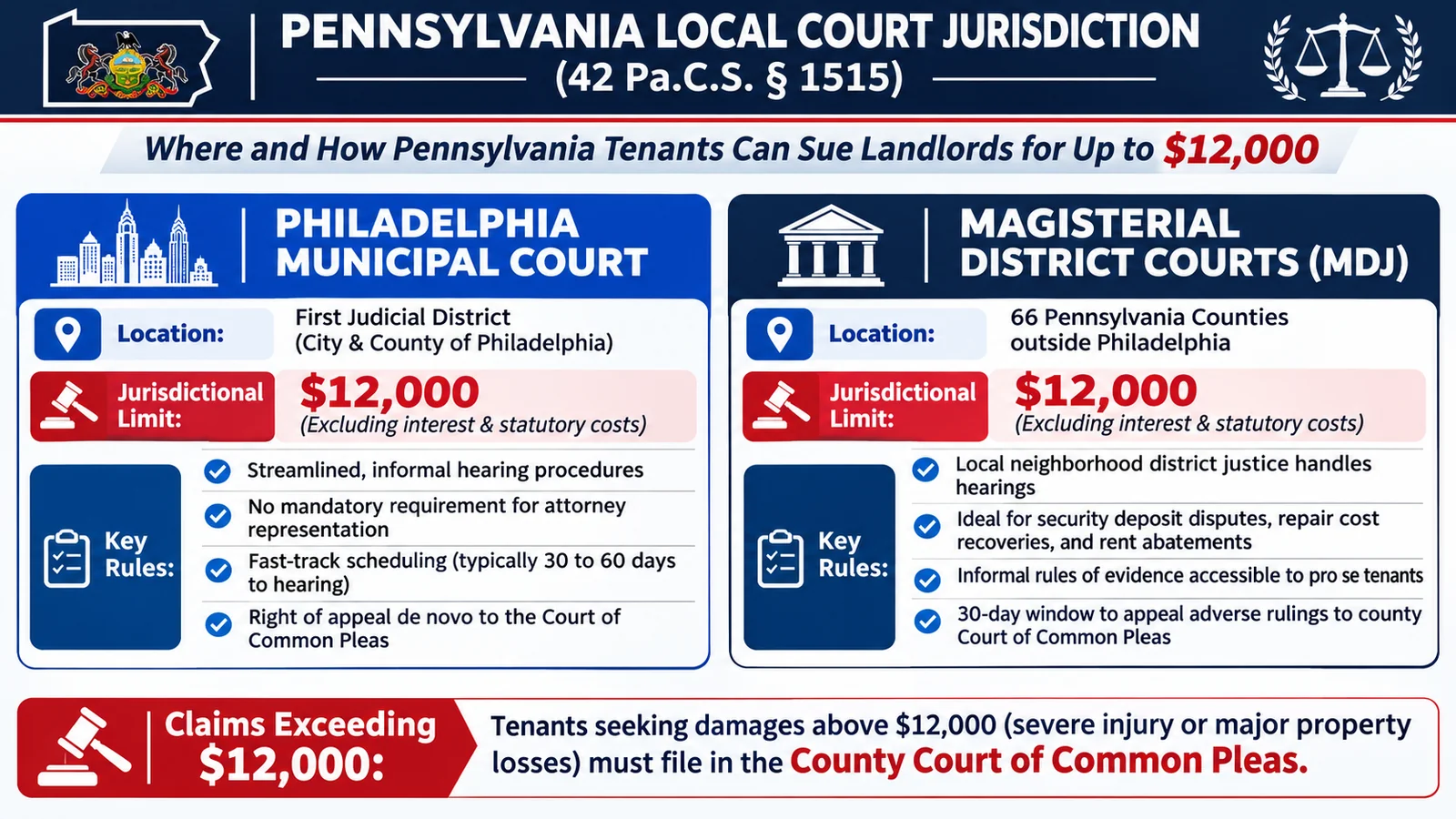
In Pennsylvania, small civil lawsuits are heard in two court systems depending on location, both sharing a $12,000 jurisdictional limit:
- Philadelphia Municipal Court: Hears civil claims up to $12,000 within the City and County of Philadelphia. Pro se representation is standard, and hearings are scheduled promptly.
- Magisterial District Courts (MDCs): Serve the remaining 66 Pennsylvania counties, handling landlord-tenant disputes up to $12,000 before a local Magisterial District Judge (MDJ).
If your damages exceed $12,000, you must file in the County Court of Common Pleas, where formal Pennsylvania Rules of Civil Procedure apply and legal representation is strongly advised.
Assembling Your Proof: How to Build an Irrefutable Evidence File
To present an airtight case before an MDJ or Municipal Court judge:
- Secure Objective Medical Records: In compliance with Kazatsky, obtain signed treatment notes from your treating physician or therapist showing physical manifestations of distress.
- Certified Municipal Inspection Notices: Request an inspection from Philadelphia L&I or your local municipal code official. A government violation notice disproves landlord claims that complaints were exaggerated.
- Escrow Account Statements: If withholding rent under Pugh v. Holmes, bring bank statements showing that rent was deposited into a dedicated escrow account on time each month.
- Notice of Unauthorized Entries: Log all instances where the landlord entered without consent. In Pennsylvania, landlord illegal entry violates the covenant of quiet enjoyment.
Sample Pennsylvania Tenant Demand Letter (Ready to Use)
In Pennsylvania, delivering a certified demand letter establishes notice of breach under Pugh v. Holmes, protects your right to withhold rent into escrow, and builds the factual record required to prove intentional slumlord misconduct under Beasley v. Freedman.
Frequently Asked Questions: Pennsylvania Tenant Rights
SueLegal is an independent educational legal publisher, not a law firm or lawyer referral service. The information provided in this guide is for general informational and educational purposes only and does not constitute formal legal advice. Residential landlord-tenant laws, repair notice periods, and statutory remedies vary significantly across state and municipal jurisdictions. If you are facing eviction, severe uninhabitable conditions, or complex litigation, consult a licensed attorney in your jurisdiction or contact your local legal aid organization. For more details on our standards, read our Editorial Policy and Legal Research Methodology.