

Before You Take Action
- Key Condition: Requires intentional, outrageous misconduct or physical injury; lease breaches alone do not qualify under Texas common law.
- Typical Deadline: 2 years from the incident date for personal injury and intentional torts; 4 years for written lease contract claims.
- Cost Range: $54 to $125 for Justice Court filing and constable service; attorney representation is optional.
- Best Next Step: Send a formal repair notice via USPS Certified Mail with Return Receipt Requested under Texas Property Code § 92.056.
Why You Cannot Sue in Texas for Simple Frustration or Repair Delays
When Texas tenants face uninhabitable living conditions—such as a non-functioning air conditioner in July, raw sewage backups, or severe mold infestations—their immediate reaction is often to seek compensation for the severe mental anguish and stress they endured. As outlined in our foundational Landlord emotional distress legal guide, Texas courts draw a sharp line between contract breaches and tort liability.
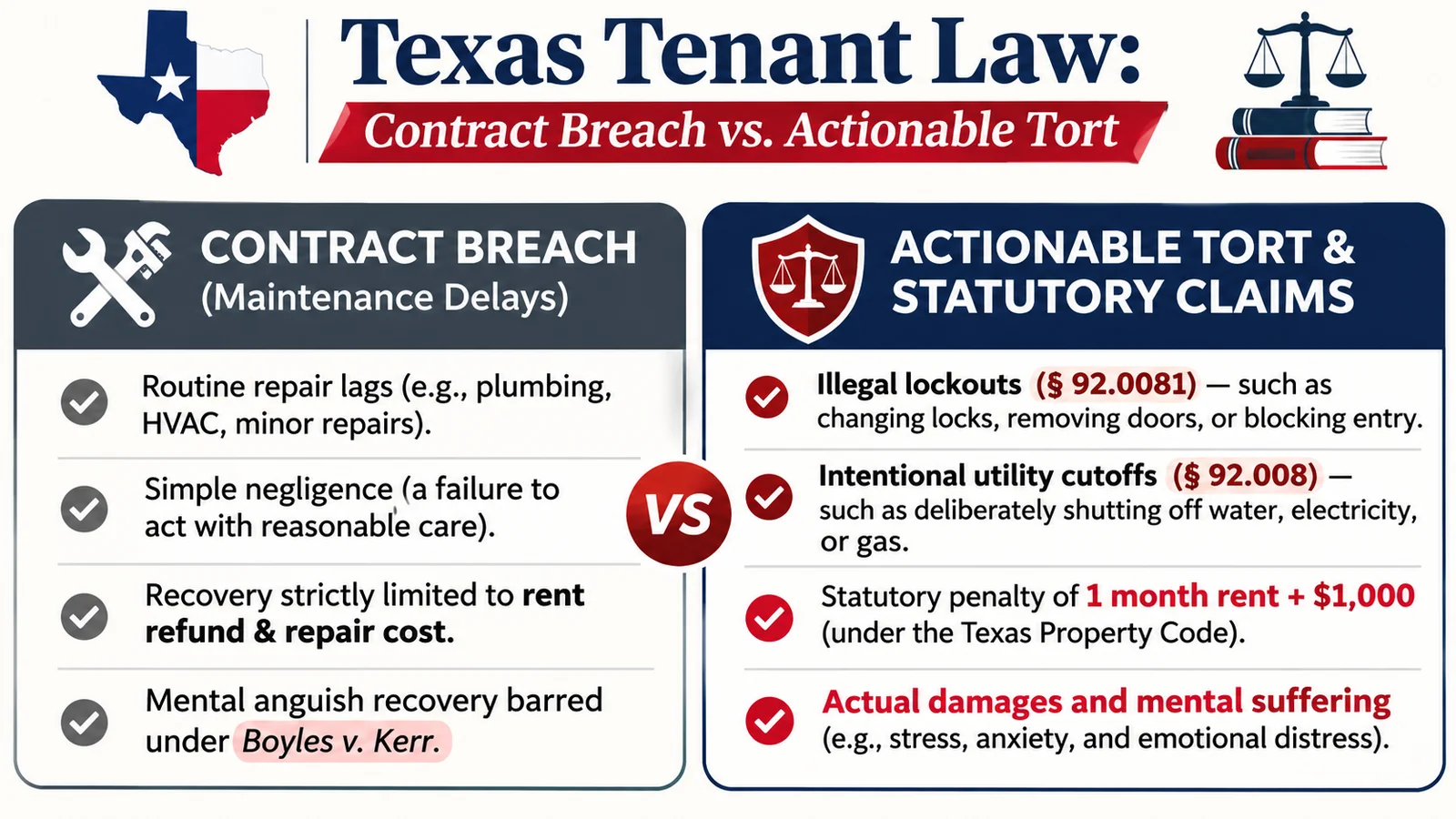
Under long-standing Texas jurisprudence, a residential lease is governed by contract principles. In Boyles v. Kerr (855 S.W.2d 593), the Supreme Court of Texas definitively ruled that our state does not recognize an independent cause of action for negligent infliction of emotional distress (NIED). The court held that mental anguish damages cannot be recovered for the mere breach of a contractual duty or for damage to economic interests. If a landlord fails to maintain the property or acts negligently, Texas law limits the tenant's recovery to actual economic losses—such as out-of-pocket lodging expenses, repair costs, and rent abatements—barring any recovery for emotional suffering alone.
To recover mental anguish damages in Texas outside of a physical impact, a plaintiff must prove an intentional tort—such as civil assault, battery, malicious prosecution, or intentional infliction of emotional distress. In landlord-tenant relationships, establishing these intentional claims requires satisfying legal thresholds that most housing disputes cannot clear.
What Texas Courts Actually Require for Emotional Distress Lawsuits
While Texas does recognize the tort of Intentional Infliction of Emotional Distress (IIED), appellate courts enforce strict constraints designed to prevent it from becoming a catch-all lawsuit. In Twyman v. Twyman (855 S.W.2d 619) and later reaffirmed in Hoffmann-La Roche Inc. v. Zeltwanger (144 S.W.3d 438), the Texas Supreme Court established that IIED is strictly a "gap-filler" tort.
The gap-filler doctrine dictates that IIED was created solely to provide a judicial remedy for atrocious conduct that slips through the cracks of existing statutory and common-law frameworks. If a plaintiff's grievances are addressed by a specific statute or established tort, an IIED claim cannot be maintained. Because the Texas Property Code comprehensively regulates habitability, lockouts, utility terminations, and security deposits, Texas judges routinely grant summary judgment dismissing separate IIED claims asserted by tenants.
Even in rare instances where no other statutory remedy applies, a Texas tenant asserting an IIED claim must satisfy all four rigorous common-law elements:
- Intentional or Reckless Conduct: The landlord must have acted with the specific purpose of inflicting severe emotional distress or with conscious disregard of a substantial risk.
- Extreme and Outrageous Character: The conduct must be so outrageous in character and extreme in degree as to go beyond all possible bounds of decency, and to be regarded as atrocious and utterly intolerable in a civilized community.
- Direct Causation: The landlord's conduct must be the proximate cause of the plaintiff's distress.
- Severe Emotional Distress: The distress must be so severe that no reasonable person could be expected to endure it, typically requiring documented medical intervention or psychiatric treatment.
Rudeness, aggressive demands for rent, delayed repairs, and unpleasant interactions do not satisfy the extreme and outrageous standard under Texas law.
The Smarter Path: Getting Cash Penalties for Broken Heat, AC, or Lockouts
Because common-law mental anguish claims face near-insurmountable hurdles in Texas, experienced tenant advocates shift their strategy entirely to statutory penalties codified in Chapter 92 of the Texas Property Code. These statutes do not require proof of psychiatric trauma or medical expenses; rather, they penalize specific landlord misconduct with mandatory financial awards.
| Landlord Violation | Texas Property Code Section | Mandatory Statutory Remedies |
|---|---|---|
| Unlawful Lockout / Key Change | Tex. Prop. Code § 92.0081 | 1 Month's Rent + $1,000 Civil Fine + Actual Damages + Legal Fees |
| Unlawful Utility Disconnection | Tex. Prop. Code § 92.008 | 1 Month's Rent + $500 Civil Fine + Actual Damages + Legal Fees |
| Failure to Repair Health Hazards | Tex. Prop. Code § 92.0563 | 1 Month's Rent + $500 Fine + Pro-Rata Rent Abatement + Termination |
| Retaliatory Eviction or Rent Hike | Tex. Prop. Code § 92.331 | 1 Month's Rent + $500 Civil Fine + Moving Costs + Legal Fees |
| Bad-Faith Deposit Withholding | Tex. Prop. Code § 92.109 | $100 Fine + 3x Withheld Amount + Full Deposit Return + Legal Fees |
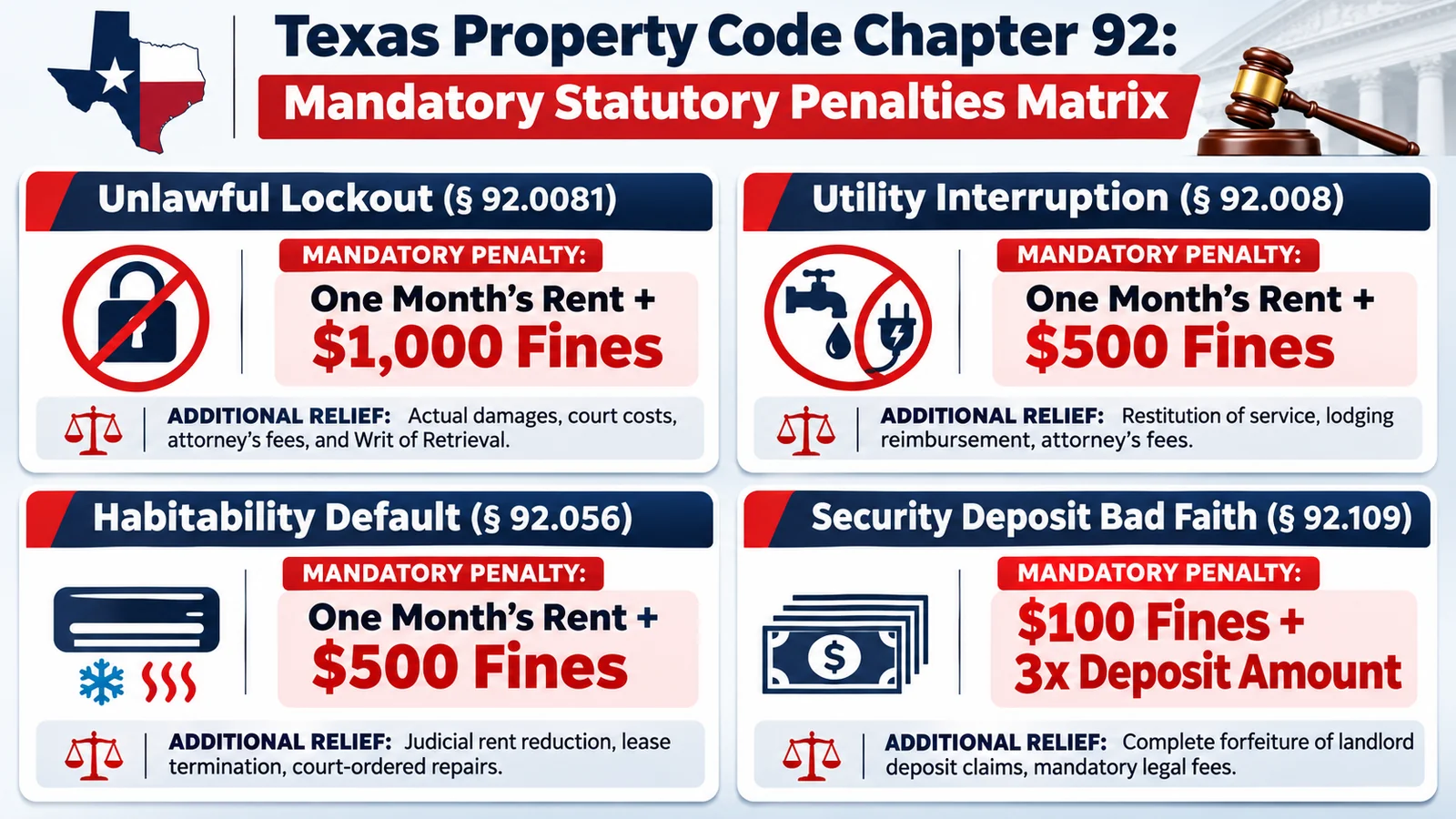
When a landlord engages in an unlawful self-help eviction by changing the locks without providing a key or shutting off the electricity during nonpayment, Texas Property Code § 92.0081 allows the tenant to file a sworn petition for a writ of reentry and immediately seek the mandatory one month's rent plus $1,000 penalty. Similarly, landlords who retaliate against tenants for exercising legal rights or wrongfully withhold a security deposit in bad faith face automatic financial damages under Section 92.109.
The 2-Notice Rule: Sending Certified Mail to Protect Your Legal Rights
Before a Texas tenant can file a lawsuit or withhold rent for habitability defects, they must strictly comply with the statutory notice rules of Texas Property Code § 92.056. This statute enforces a mandatory procedural process that trips up unrepresented tenants:
- Rent Must Be Current: Under § 92.056(a), the tenant must not be delinquent in any portion of rent when the repair notice is delivered. If you owe even $50 in late fees, your landlord's statutory duty to repair never legally arises.
- Condition Affecting Physical Health or Safety: The defect must materially affect the physical health or safety of an ordinary tenant under the implied warranty of habitability (e.g., sewage overflows, non-working heat in winter, structural hazards, or severe infestations). Cosmetic defects do not qualify.
- The Certified Mail Single-Notice Rule: If you send your written repair request via Certified Mail with Return Receipt Requested, Texas law requires only one notice, and the landlord has seven days to make a diligent effort to repair. If you deliver the notice in person, by regular mail, or via an online tenant portal, you must send a second written notice after seven days before statutory remedies become available.
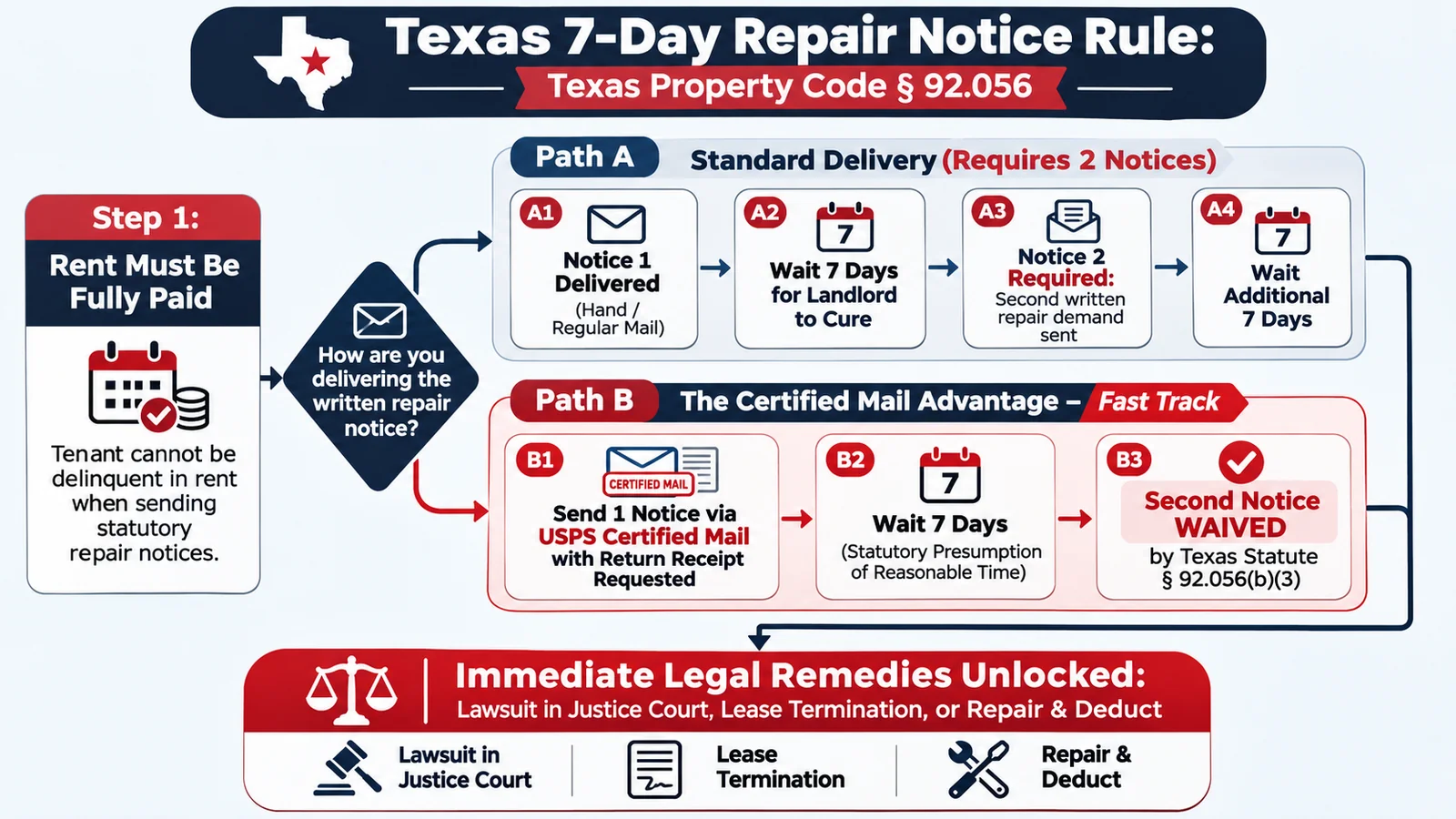
Failing to send the notice via Certified Mail is the number one reason tenant lawsuits are dismissed in Texas Justice Court. Always keep the white post office receipt, the green certified mail card, and a stamped copy of the letter.
Real Court Example: How an Austin Tenant Won $5,400 for a Broken Air Conditioner
To illustrate how Texas law operates in practice, consider a realistic composite case handled in Austin (Travis County Justice of the Peace Court, Precinct 2):
Travis County JP Court Dispute Summary
The Situation: An Austin tenant paying $1,800/month experienced an air conditioning breakdown during a July heatwave where indoor temperatures exceeded 94°F. The tenant submitted maintenance requests through an online portal that were repeatedly closed without action. When the tenant threatened to report the property to Austin Code Enforcement, the landlord disabled their key fob access and padlocked the exterior entry, demanding immediate surrender of the apartment.
The Legal Strategy: Rather than filing a complex tort lawsuit for mental anguish or severe anxiety, the tenant immediately filed a sworn Petition for Relief Under Texas Property Code Section 92.0081 in Travis County Justice Court, alleging an illegal lockout and intentional retaliation under § 92.331. The tenant presented date-stamped video evidence of the locked door, temperature logs, and emergency hotel receipts.
The Final Judgment: The Justice of the Peace awarded the tenant:
- $2,800 under § 92.0081 ($1,800 monthly rent + $1,000 civil fine for unlawful lockout).
- $2,300 under § 92.331 ($1,800 monthly rent + $500 civil fine for unlawful retaliation).
- $1,450 in actual damages (7 nights of emergency hotel lodging and food spoilage).
- $1,200 in court-awarded attorney's fees and statutory filing costs.
- Total Award: $7,750, plus an order immediately restoring key fob access and terminating the lease without penalty.
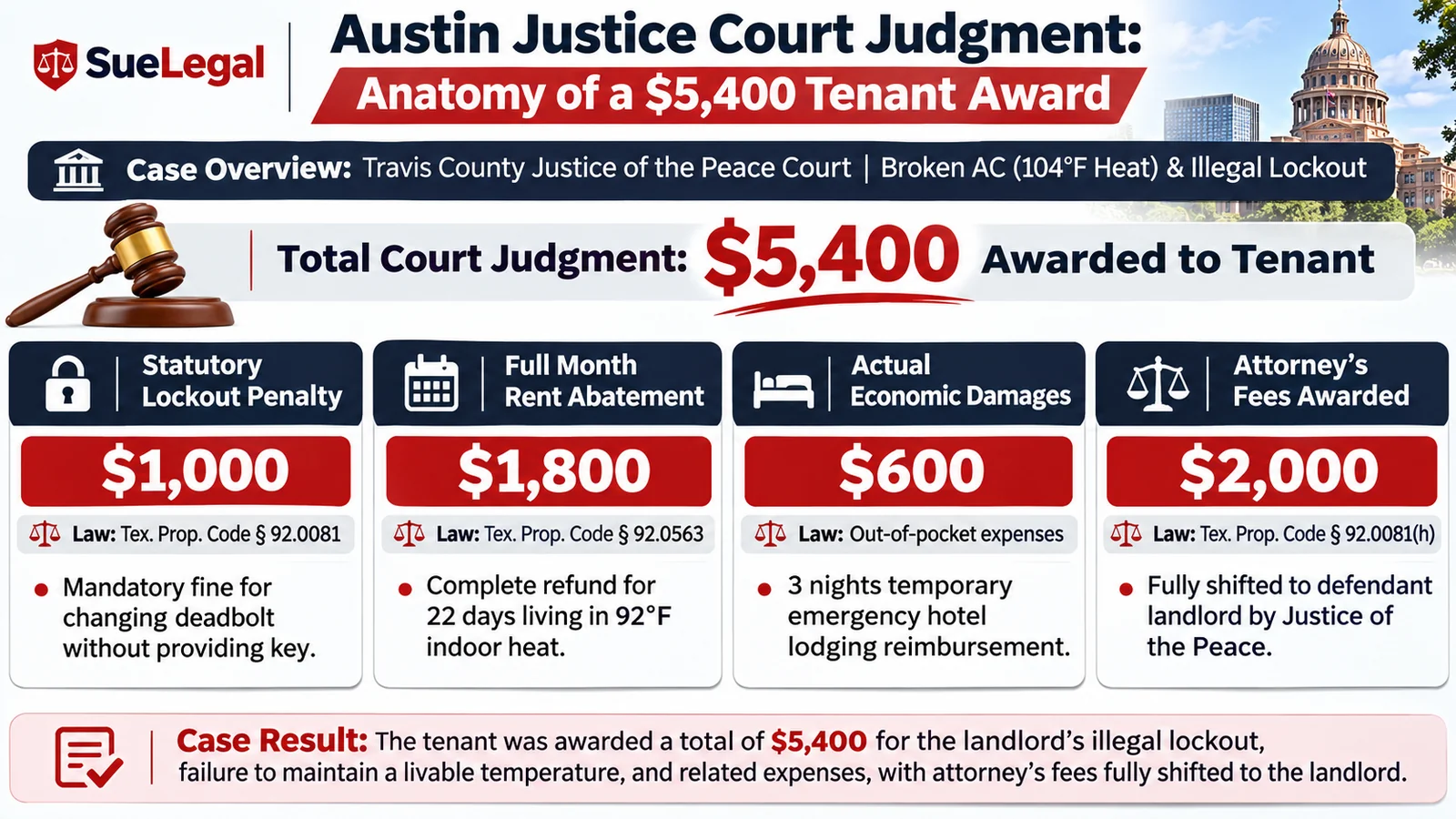
Had this tenant solely pursued a claim for emotional distress, the case likely would have been dismissed under Boyles v. Kerr. By framing the claim under Chapter 92 statutory violations, the tenant achieved full financial compensation and punitive fines.
Taking Your Landlord to Justice Court: The $20,000 Maximum Limit
In Texas, small monetary claims between tenants and landlords are adjudicated in Justice of the Peace (JP) Courts, governed by the Texas Rules of Civil Procedure (Part V, Rules 500-510). Effective September 1, 2020, the Texas Legislature increased the jurisdictional ceiling of Justice Courts to $20,000, excluding statutory interest and court costs.
This $20,000 limit gives tenants ample room to bundle multiple statutory claims without incurring the prohibitive expenses of filing in County Court at Law or District Court. A typical Justice Court repair or lockout petition can combine:
- Statutory civil penalties ($1,000 for lockout + $500 for repair failure + $500 for retaliation).
- One month's rent penalty ($1,500 to $2,500).
- Out-of-pocket lodging and repair expenses.
- Triple security deposit damages under § 92.109.
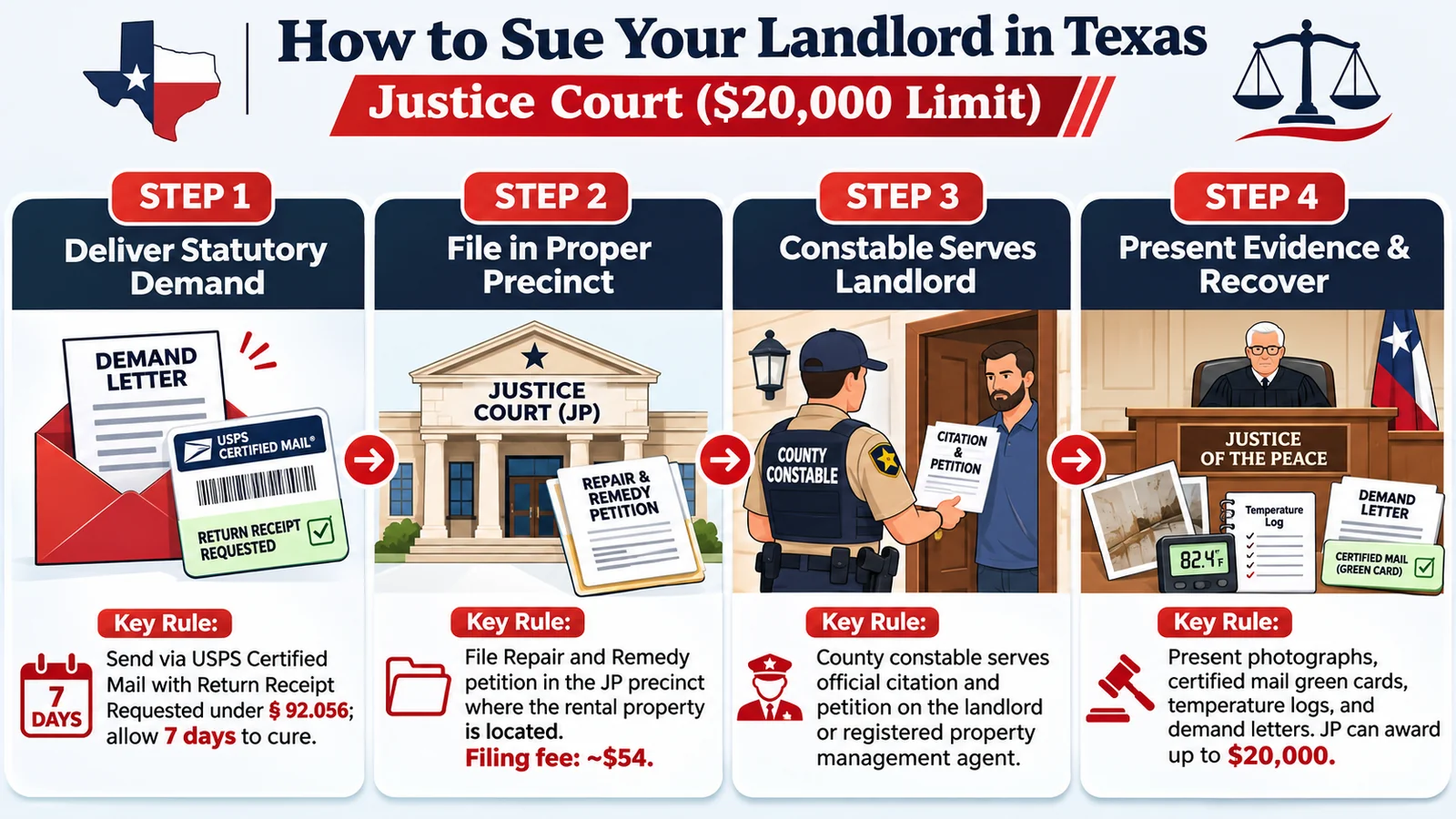
Filing fees in Texas Justice Courts typically range from $54 to $120 depending on the county, plus service of process fees (usually $75 to $100 per defendant via the precinct constable). If you cannot afford court fees, you can submit a Statement of Inability to Afford Payment of Court Costs under Texas Rule of Civil Procedure 502.3.
Common Tenant Mistakes That Can Ruin an Otherwise Solid Claim
When handling their own litigation in Justice Court, tenants frequently make fatal procedural errors that destroy an otherwise valid claim:
- Withholding Rent Improperly: In Texas, you cannot unilaterally stop paying rent or pay reduced rent simply because repairs are unaddressed. Under Tex. Prop. Code § 92.058, a tenant who withholds rent without following the judicial escrow process or without statutory authorization is liable to the landlord for one month's rent plus $500.
- Relying on Text Messages as Formal Notice: While texts and portal messages establish that the landlord had actual knowledge of an issue, they do not satisfy the statutory certified mail requirements of § 92.056. Judges will dismiss repair lawsuits if the formal statutory notice ladder was not completed.
- Failing to Name the Correct Legal Entity: Many landlords operate through LLCs or property management firms. You must check your lease agreement and county appraisal district records to name the actual legal property owner as well as the management agent on the lawsuit.
- Ignoring Intrusions on Privacy: Landlords who enter your unit without permission or reasonable notice violate the covenant of quiet enjoyment. When documented alongside repair failures, instances of landlord trespass and unlawful entry substantiate intentional harassment.
Sample Texas Tenant Demand Letter (Ready to Use)
Before filing a lawsuit in Texas Justice of the Peace Court, sending a formal written demand via USPS Certified Mail with Return Receipt Requested is a mandatory prerequisite under Texas Property Code § 92.056. This letter establishes incontrovertible proof that the landlord had statutory notice and reasonable time to cure.
Frequently Asked Questions: Texas Tenant Rights
SueLegal is an independent educational legal publisher, not a law firm or lawyer referral service. The information provided in this guide is for general informational and educational purposes only and does not constitute formal legal advice. Residential landlord-tenant laws, repair notice periods, and statutory remedies vary significantly across state and municipal jurisdictions. If you are facing eviction, severe uninhabitable conditions, or complex litigation, consult a licensed attorney in your jurisdiction or contact your local legal aid organization. For more details on our standards, read our Editorial Policy and Legal Research Methodology.