

Yes, you can sue your landlord for constructive eviction—and walk away from your lease owing $0 in future rent.
When a landlord refuses to fix unlivable conditions (such as no heat, no water, toxic mold, sewage backups, severe pest infestations, or ongoing harassment) and forces you to move out before your lease ends, the law treats it the same as an illegal eviction. Once you give written notice, let the repair deadline pass, and move out, you can sue in Small Claims or Civil Court to recover four payouts:
- 100% Return of Your Security Deposit (plus 2x to 3x bad-faith penalties if the landlord tries to keep your deposit for breaking the lease).
- A Retroactive Rent Refund (25% to 75%+ Off Rent) for the weeks or months you suffered in the unlivable apartment before moving out.
- All Moving, Hotel & Relocation Expenses: 100% reimbursement for moving trucks, movers, storage units, utility transfer fees, and emergency hotel nights.
- "Rent Differential" Damages: If you had to rent a comparable safe apartment that costs more than your old lease (for example, $350/month more), the landlord owes you that monthly difference for the remainder of your lease term!
What Tenants Should Know
- Follow the 3 Mandatory Steps Before You Hand In the Keys: To win a constructive eviction case in all 50 states, you must prove three things: (1) the problem was a serious health, safety, or privacy violation (not a minor cosmetic issue), (2) you warned the landlord in writing and gave them a reasonable window (24 hours to 14 days) to fix it, and (3) you actually moved out after they failed to fix it.
- Get a Free 311 City Inspector Report BEFORE You Move Out: The #1 way landlords fight back is claiming "The apartment was fine, the tenant just wanted to break their lease." Calling 311 / City Code Enforcement so an inspector writes an official violation report before you leave makes your constructive eviction claim 100% bulletproof in court.
- Don't Wait Too Long After Your Final Deadline ("The Waiver Trap"): Once your written 7-to-14-day repair deadline expires and the landlord does nothing, you must move out within a reasonable time (typically 15 to 45 days while finding a new place). If you stay another 8 months without new complaints, a judge may rule you accepted the condition.
- What If You Can't Afford to Move Out? Claim "Partial Constructive Eviction": If a collapsed ceiling, leak, or mold makes one bedroom or half your apartment unusable while you sleep on the living room couch, you can stay and sue for a 30% to 60% rent refund under Partial Constructive Eviction.
- Long-Term or Rent-Controlled Tenants Can Win $25,000 to $200,000+: If a landlord intentionally ignored repairs to force you out of a below-market or rent-stabilized apartment so they could jack up the rent, you can sue for years of lost rent savings (plus 3x Triple Damages in many cities and states).
The 3 Legal Requirements to Prove Constructive Eviction (And How Long You Have to Wait)
In residential landlord-tenant jurisprudence, constructive eviction occurs when a landlord does not physically lock you out, but makes your home so dangerous, unhealthy, or intolerable that any reasonable person would be forced to abandon the premises. Constructive eviction functions as both a shield and a sword: it acts as a shield to cancel your remaining lease with zero early termination fee, and as a sword allowing you to sue for moving expenses, rent refunds, and higher replacement rent.
To prevail on a constructive eviction claim in Small Claims or Civil Court across all 50 states, you must establish three distinct legal elements. Failing to satisfy any one of these three elements can allow a landlord to argue that you simply abandoned the lease prematurely. For broader legal rules governing tenant rights and landlord disputes, review our comprehensive guide on suing your landlord for tenant rights violations.
| Legal Requirement | What It Means Under State Law | How to Prove It in Court |
|---|---|---|
| 1. Substantial Interference With Habitability or Quiet Enjoyment | The condition must be a severe health, life-safety, or privacy hazard that renders the premises unfit for human occupancy. Minor aesthetic defects or cosmetic flaws do not qualify. | Photographs and timestamped videos + 311 City Code Enforcement / Health Department Violation Report + medical records or repair technician logs. |
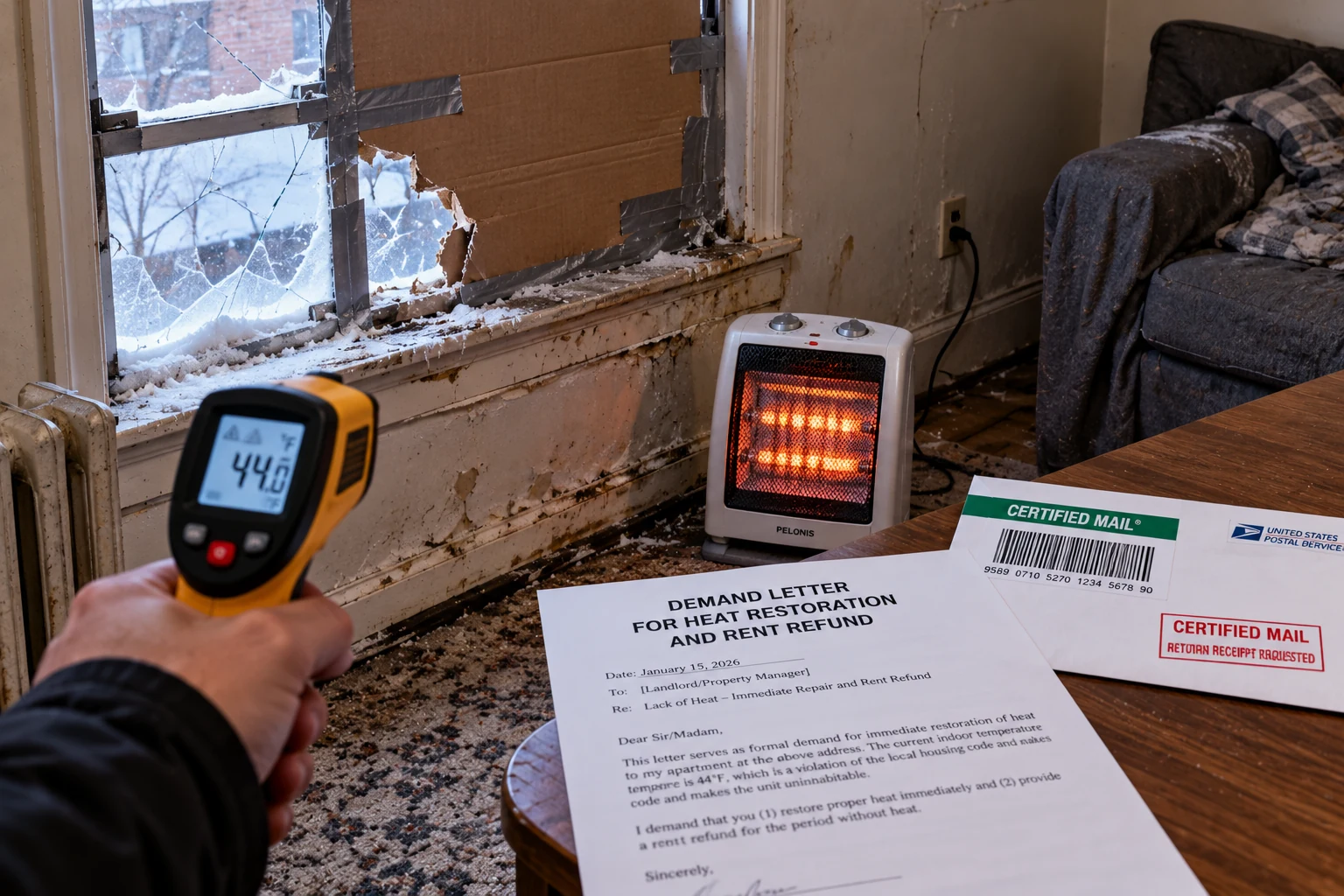
| 2. Written Notice + A Reasonable Time for the Landlord to Fix It | You must deliver formal written notice of the specific defect and afford the property owner a statutory opportunity to cure before moving out. | 24 to 72 Hours for life-safety emergencies (no heat, no water, raw sewage, gas leak); 7 to 14 Days for chronic leaks, mold, or vermin. |
| 3. You Actually Move Out Within a Reasonable Time | Once the cure window expires without repair, you must surrender possession and vacate the apartment within a reasonable time frame (typically 15 to 45 days). | Signed Notice of Constructive Eviction & Key Surrender Receipt + dated photos of your empty, broom-clean unit. |
To understand the difference between a lock change and conditions that force you out, explore our guide on suing your landlord for illegal eviction.
How to Eliminate the #1 Risk of Constructive Eviction Before You Move Out ("The 311 Shield")
When a tenant moves out and declares constructive eviction, the landlord's standard legal defense is predictable: "The tenant fabricated minor complaints because they wanted to break their lease early without paying rent." If a judge believes the defect was exaggerated, the tenant risks being held liable for months of empty rent. You can eliminate this defense entirely by deploying the 311 Shield before you pack a single box.
1. Secure an Official Municipal Inspection Report BEFORE Surrendering Keys
Never rely solely on personal testimony or phone snapshots. While you still reside in the unit, contact your municipal building department by dialing 311 (or calling the County Health Department / Code Enforcement Office) to request an urgent on-site housing inspection.
When a licensed municipal inspector examines your apartment and issues an official Notice of Housing Code Violation for toxic mold, rat harborage, lack of heat, or sewage contamination, you establish independent, government-verified proof of unhabitability. In court, judges give overwhelming weight to official municipal inspection citations over landlord denials.
2. Issue a Final "7-Day Cure or Constructive Eviction Warning"
Even if you have sent numerous text messages over several months, send one final, unequivocal letter via certified mail and tracked email. State clearly:
"Because the severe habitability hazard ([describe defect]) reported on [prior dates] remains uncured, and municipal inspectors have cited the building under Housing Code Violation #[Number], this serves as formal notice that if full professional remediation is not completed within 7 days, I will declare the lease terminated by Constructive Eviction, vacate the premises, and pursue full statutory damages."
3. Neutralize the "Waiver by Delay" Trap
Landlords often argue that if you endured a leak or pest issue for four to six months, you "waived" your right to claim constructive eviction by remaining too long. Appellate courts reject this waiver defense when the tenant shows that they gave the landlord good-faith opportunities to fix the problem while searching for replacement housing.
In your final notice, document that the condition has progressively worsened over the preceding 30 days, or that recent professional testing revealed toxic mold or structural deterioration that posed an escalating threat to your family's health.
For detailed rules regarding physical standards, review our guide on suing your landlord for an uninhabitable apartment.
What You Can Sue For After a Constructive Eviction (The 4 Payout Buckets)
Many tenants mistakenly believe that constructive eviction merely allows them to stop paying rent moving forward. Under contract and tort law, a constructive eviction is a material breach of the lease contract and a breach of the covenant of quiet enjoyment. Once you vacate, you can file a claim in Small Claims Court to recover four substantial categories of economic damages.
| Payout Bucket | What the Landlord Owes Under State Law | Real-World Dollar Example |
|---|---|---|
| 1. 100% Security Deposit Return + Penalties | Because the landlord forced the move-out through habitability failures, they cannot deduct a single penny for early termination. Withholding the deposit triggers 2x to 3x statutory bad-faith penalties across California, New York, Texas, Washington, and Illinois. | A $2,000 deposit yields $4,000 to $6,000 in Small Claims recovery. |
| 2. Retroactive Rent Refund (Abatement) | You are entitled to a refund of rent already paid during the weeks or months you lived with the defect, measured by the diminished rental value of the property (typically 25% to 75%+ off rent). | 3 months enduring sewage or mold at $2,000/mo (50% reduction) = $3,000 refund. |
| 3. Moving, Storage & Hotel Expenses | Full reimbursement for all consequential expenses necessitated by the emergency relocation, including moving trucks, professional movers, packing supplies, utility transfer fees, and temporary hotel bills. | Direct reimbursement of $1,200 to $3,500+ in documented moving receipts. |
| 4. Rent Differential Damages | Under contract expectation principles, if you are forced into a more expensive comparable apartment for the remainder of your original lease term, the landlord must pay the monthly difference. | $350/mo rent difference × 8 remaining lease months = $2,800 in damages. |
If your landlord attempts to retain your funds, review our tactical guide on suing your landlord for withholding your security deposit.
What If You Can't Afford to Move Out? Use "Partial Constructive Eviction"
Relocating on short notice requires thousands of dollars in upfront moving costs, application fees, and new security deposits. Many families who face severe habitability failures cannot afford to immediately lease a new apartment. If an uncured defect renders a portion of your home unusable, you can invoke the doctrine of Partial Constructive Eviction without moving out completely.
Courts in major tenant-protection jurisdictions—including New York, California, Illinois, Massachusetts, and New Jersey—recognize that when a landlord's failure to maintain the premises deprives a tenant of the beneficial use of a substantial portion of the apartment, a partial constructive eviction has occurred. Under this doctrine, you remain in possession of the habitable rooms while legally entitled to a substantial ongoing rent reduction.
Common Scenarios Qualifying for Partial Constructive Eviction
- Loss of a Bedroom: An active roof leak, ceiling collapse, or extensive black mold infests a child's bedroom, forcing the child to sleep in the living room. (Entitles tenant to a 30% to 50% monthly rent abatement).
- Unusable Kitchen or Bathroom: Plumbing backups or broken fixtures leave your secondary bathroom or primary kitchen out of service for weeks while repairs stall. (Entitles tenant to a 35% to 60% rent reduction).
- Flood Damage in a Finished Basement or Home Office: Raw sewage or rainwater floods a finished lower level, destroying the space you use for remote work or storage. (Entitles tenant to a 25% to 40% rent reduction).
- Revocation of Promised Amenities: The landlord padlocks a private garage, storage locker, or deck included in your written lease. (Entitles tenant to the replacement market value of the amenity).
To establish partial constructive eviction, you must physically abandon the unusable room or space. Take photos showing that your bed or furniture has been relocated out of the damaged area, deliver written notice to the landlord describing the loss of usable square footage, and request an immediate proportional rent adjustment. If the landlord refuses, you can sue in Small Claims Court for the cumulative rent overpayment.
For related exit strategies, explore our guide on suing your landlord for refusing to let you break your lease.
How to Hand Back the Keys on Move-Out Day (So the Landlord Can't Claim "Abandonment")
A frequent tactic used by property management companies when a tenant departs under constructive eviction is claiming abandonment. Landlords may assert that they were unaware you vacated, allow the property to sit vacant for months, and then forward a $5,000 claim to debt collections for unpaid rent. You can stop this maneuver cold by executing a strict, verifiable key surrender protocol.
The 3-Step Key Surrender Protocol
- Film a Comprehensive Walkthrough Video: Once all personal belongings and furniture are removed, film a continuous 2-minute video walkthrough of every room. Show broom-clean floors, empty closets, clean appliances, and the specific habitability defects that forced your exit. Display a mobile phone showing the current date and time to create tamper-proof evidence.
- Secure Written Proof of Key Surrender: Return all apartment keys, mailbox keys, and electronic gate fobs in person to the leasing office. Require the manager to sign and date a written receipt stating: "Received all keys to Unit [Number] from [Tenant Name] on [Date]." If the office is closed or refuses to sign, record a video of yourself dropping the keys and notice into the management drop box, or send the keys via USPS Priority Mail Express with signature tracking.
- Attach the Formal Move-Out Notice Below: Never surrender keys in silence. Always accompany keys with our formal Notice of Completed Constructive Eviction, explicitly stating that your departure is a termination for cause resulting from uncured habitability failures, and providing your new mailing address for your security deposit refund.
If heating or moisture failures caused your move-out, see our specific analyses on suing your landlord for no heat and mold infestation claims.
Ready-to-Send Constructive Eviction Warning & Final Move-Out Demand Letter (With Copy Button)
Protect your legal standing by utilizing the dual-tab pre-litigation notices below. Choose Tab 1 before vacating to establish your final cure deadline, or Tab 2 on your move-out date to demand full financial compensation.
How Much Can You Sue for in a Constructive Eviction Claim?
When taking your landlord to Small Claims Court or Housing Court, financial recovery is determined by statutory damages categories, proven out-of-pocket losses, and rent reduction formulas:
| Recovery Category | Calculation Standard | Statutory Authority & Limits |
|---|---|---|
| 1. Lease Termination Without Penalty | Complete cancellation of remaining lease term, with zero early break fees or future rent liability. | Constructive eviction common law doctrine. |
| 2. Relocation & Moving Expenses | Reasonable moving truck, professional movers, storage fees, and emergency temporary hotel lodging. | Consequential tort and contract damages. |
| 3. Security Deposit & Prepaid Rent Refund | 100% refund of all security deposits and unused prepaid rent from the date possession was surrendered. | Security deposit statutory return rules. |
Small Claims Filing Limits: Most tenants resolve these disputes without hiring an attorney in Small Claims Court. Maximum claim limits vary by state: for example, $12,500 in California (California Courts Self-Help), $10,000 in New York City (NY Courts Small Claims), and $20,000 in Texas (Texas Judicial Branch). If your total damages exceed small claims thresholds, you may file in standard civil district court.
Frequently Asked Questions
To claim full Constructive Eviction and cancel your remaining lease, you must actually vacate the premises within a reasonable time after the landlord fails to repair the hazard. However, if you are still living in the apartment, you do not lose your legal remedies. While remaining in possession, you can sue in Small Claims Court under the Implied Warranty of Habitability, Private Nuisance, or Partial Constructive Eviction (if an uncured defect forced you to abandon one bedroom or an area of the home) to recover a 25% to 75% retroactive rent refund without vacating the entire property.
An Actual Illegal Eviction occurs when the landlord physically bars you from the dwelling—such as changing your deadbolt locks without a judicial warrant, removing the exterior entry door, or dumping your personal belongings onto the street. A Constructive Eviction occurs when the landlord does not physically alter your locks, but permits or creates conditions so intolerable—such as shutting off utilities, allowing raw sewage or toxic mold to fester, or engaging in relentless harassment—that no reasonable person could continue living there, effectively forcing you to surrender the home.
Once you issue formal written notice and the landlord's statutory repair deadline expires without cure, courts generally consider 15 to 45 days a reasonable window to locate a new dwelling, arrange professional movers, and vacate. If extenuating circumstances require additional time—such as a competitive rental market, specialized medical needs, or waiting on municipal code inspection results—document your replacement housing search in writing to prevent the landlord from asserting a waiver defense.
No. In a constructive eviction, the landlord is the breaching party, having defaulted on the covenant of quiet enjoyment and warranty of habitability. You owe zero dollars in early termination fees or future rent, and you are entitled to the full return of your security deposit. If the property owner attempts to retain your deposit or forwards a lease-break balance to a collection agency, you can sue in Small Claims Court for the deposit plus statutory bad-faith penalties of two to three times the withheld amount, and issue formal debt validation disputes under the Fair Debt Collection Practices Act.
Judges uphold constructive eviction for severe health, life-safety, or quiet enjoyment failures. Qualifying conditions include lack of operational winter heating, lack of running or potable water, raw sewage overflows, widespread toxic black mold, severe infestations of rats, mice, or bed bugs, active roof or structural ceiling collapses, unaddressed gas leaks or hazardous electrical wiring, utility shutoffs, and persistent, egregious landlord harassment or unauthorized entries that destroy residential privacy.
Calculate Your Constructive Eviction Lawsuit Payout
Estimate your total financial recovery across past rent refunds, security deposit returns, moving costs, and higher replacement rent.
SueLegal is an independent educational legal publisher, not a law firm or lawyer referral service. The information provided in this guide is for general informational and educational purposes only and does not constitute formal legal advice. Residential landlord-tenant laws, repair notice periods, and statutory remedies vary significantly across state and municipal jurisdictions. If you are facing eviction, severe uninhabitable conditions, or complex litigation, consult a licensed attorney in your jurisdiction or contact your local legal aid organization. For more details on our standards, read our Editorial Policy and Legal Research Methodology.