

Yes, you can sue your landlord if they illegally trap you in a lease, charge an unlawful lease-break fee, or "double-dip" on rent.
A landlord cannot hold you hostage in a rental agreement or invent punitive thousands-of-dollars exit penalties. You can take your landlord to Small Claims or Civil Court (and wipe out their fee demands) in four major situations:
-
They Refused a Legally Protected Lease Break ($0 Penalty By Law): If you needed to break your lease due to unfixed habitability hazards (mold, pests, leaks, no heat), a doctor-certified medical or mental health disability (under the Federal Fair Housing Act), domestic violence or stalking, or active-duty military orders (
SCRA), the landlord must let you out with $0 penalty, return 100% of your security deposit, and can be sued for $2,500 to $50,000+ in statutory/civil rights damages if they refuse. - They "Double-Dipped" (Kept a 2-Month Lease-Break Fee AND Re-Rented Your Unit): Even if you broke the lease for a personal reason, a landlord cannot charge you 2 months of lease-break rent ($3,000–$6,000) and then move a new tenant in 5 days later. You can sue to get every overlapping day of rent refunded!
- They Turned Away a Qualified Replacement Tenant ("Failure to Mitigate"): In 44+ states, if you bring the landlord a replacement tenant with good credit and income ready to take over the lease—or if the landlord refuses to advertise the unit at the same rent—their failure to mitigate damages wipes out your remaining rent liability.
- They Kept Your Security Deposit as an Automatic "Fine": In almost every state, a landlord can only deduct actual vacant days (or legitimate cleaning/repairs) from a deposit—keeping 100% of your deposit as an automatic "punishment" for leaving early triggers 2x to 3x bad-faith deposit penalties!
Before You Take Action
- Catch the "Double-Dipping" Scam after You Move Out: Did your landlord force you to pay a 2-month early termination fee (or keep your deposit)? Drive by or check the mailbox/lights 2 weeks after moving out—if a new tenant moved in right away, the landlord is illegally collecting double rent and owes you a refund in Small Claims Court!
- A Doctor's Note Can Force a Penalty-Free Lease Break in All 50 States: Under the Federal Fair Housing Act (
42 U.S.C. § 3604), if a physical injury, chronic illness, severe mold/smoke allergy, or PTSD/mental health condition makes continuing to live in the unit unsafe or inaccessible, early lease termination with $0 fee is a legally required Reasonable Accommodation. - Handing Them a Replacement Tenant Stops the Rent Clock: If you need to move for a job or family reason, find a qualified applicant on Facebook/Craigslist/Zillow who meets the building's credit/income standard and email their application to the landlord. If the landlord ignores them or tries to jack up the rent by $400 so they walk away, you owe $0 in future rent!
- In New York (
RPL § 226-b), Refusing a Lease Assignment Releases You Automatically in 30 Days: If you live in a New York building with 4+ units and your landlord unreasonably refuses to let you assign your lease to a replacement tenant, state law says you are 100% released from the lease in 30 days! - Sue First in Small Claims Court Before They Touch Your Credit Score: If a greedy landlord sends you a bill for $5,000 in bogus lease-break fees and keeps your $2,000 deposit, don't wait for a collection agency—file a $50 Small Claims lawsuit for your deposit refund and send a formal Disputed Debt Notice so they cannot trash your credit report.
The 6 Situations Where Your Landlord MUST Let You Break Your Lease for $0 (And What You Win If They Refuse)
Landlords and corporate property managers routinely treat a 12-month lease like an inescapable contract. When life happens and a tenant needs to move, property managers often insist that the tenant must pay four to six months of remaining rent or a punitive $4,000 to $8,000 early termination fee. That position is legally incorrect.
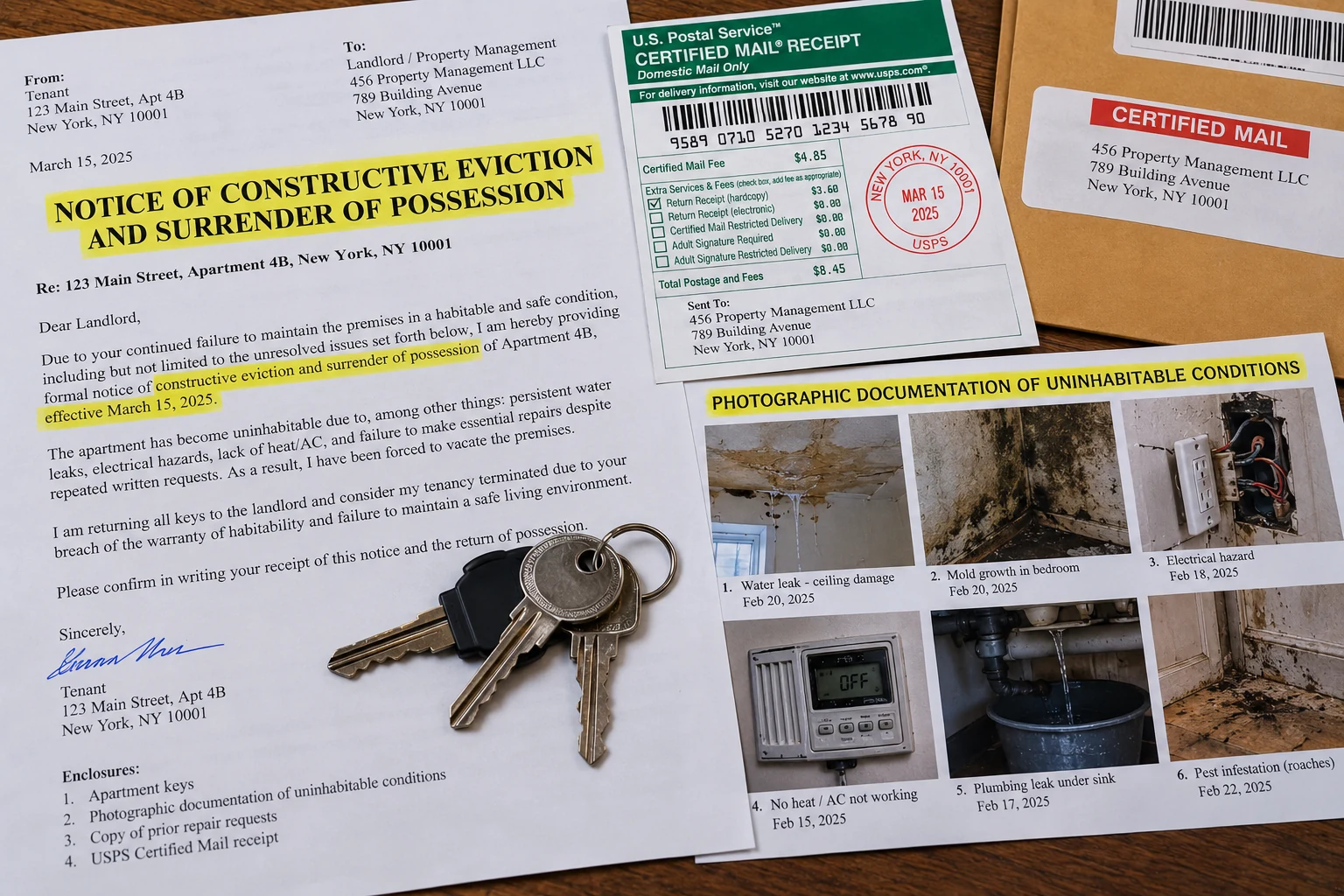
Both state statutory codes and federal civil rights laws carve out strict exceptions where you have an absolute, unconditional right to terminate a residential lease early with zero penalty. If your situation falls into any of the six categories below, your landlord cannot charge an exit fee, must return your full security deposit, and faces statutory civil damages if they refuse to release you. For broader contract rules governing rental agreements, review our comprehensive guide on suing your landlord for tenant rights violations.
| Why You Are Breaking the Lease | Governing Legal Authority | Notice You Must Give | What You Can Sue For If Landlord Refuses |
|---|---|---|---|
|
1. Unlivable Conditions (Mold, Rats, Bed Bugs, Sewage, Leaks, No Heat, Harassment) |
Constructive Eviction & Implied Warranty of Habitability (All 50 States) | Written repair deadline (24 hours to 14 days) + Final Move-Out Notice. | 100% Deposit Return (up to 3x penalty) + 25%–75% Retroactive Rent Refund + Moving Truck & Hotel Expenses. |
| 2. Physical or Mental Health Disability Worsened by the Unit |
Federal Fair Housing Act (42 U.S.C. § 3604) + State Senior/Medical Laws (NY RPL § 227-a, NJ N.J.S.A. 46:8-9.2)
|
30 Days' Notice + Short Healthcare Provider Accommodation Letter. | $10,000 to $75,000+ Federal Civil Rights Damages via HUD or Federal Court + 100% Waiver of Lease-Break Fees. |
| 3. Domestic Violence, Stalking, Sexual Assault, or Abuse | Safe-Homes Statutes in 45+ States (CA Civ. Code § 1946.7, NY RPL § 227-c, TX Prop. Code § 92.016, IL Safe Homes Act, WA RCW 59.18.575) | 14 to 30 Days' Written Notice + Protective Order, Police Report, or Counselor Statement. | Statutory Civil Penalties + 100% Deposit Return + Mandatory Attorney's Fees. |
| 4. Active-Duty Military Orders (PCS, Deployment 90+ Days) |
Federal Servicemembers Civil Relief Act (SCRA — 50 U.S.C. § 3955)
|
Written notice + Copy of Military Orders (Terminates 30 days after next rent due date). | Federal Misdemeanor Crime for Landlord + Punitive Damages, Full Deposit Return, and Legal Costs. |
| 5. Replacement Tenant Handed to Landlord & Unreasonably Refused | Statutory Duty to Mitigate Damages (44+ States) & State Assignment Laws (NY RPL § 226-b) | 30 Days' Notice + Application of Credit-Qualified Replacement Applicant. | All Future Rent Wiped Out to $0 + Automatic Lease Release in 30 Days (in NY) + Full Deposit Return. |
|
6. Illegal or Unpermitted Unit (Unpermitted Basement, Garage, Attic) |
Void / Illegal Contract Doctrine (CA, NY, NJ, IL, WA, etc.) | Immediate Written Notice of Municipal Violation. | Immediate Lease Voidance + Up to 6x Rent Relocation Cash (in NJ) + 100% Security Deposit Return. |
If your landlord failed to maintain basic living standards, explore our in-depth guidance on suing your landlord for an uninhabitable apartment and toxic mold claims.
Catching the #1 Landlord Scam: "Double-Dipping" on a 2-Month Lease-Break Fee!
Every year, property management companies pocket millions of dollars in unlawful fees through the two-month early termination trap. When an unexpected job change, family emergency, or home purchase requires you to move, landlords often demand an upfront payment equal to two or three months of rent to sign an early exit agreement. If they re-rent the apartment quickly, collecting that fee is illegal double-dipping.
Under established contract law and landlord-tenant statutes across the country, rental damages are compensatory, not punitive. A property owner is only entitled to recover actual financial losses resulting from your departure. Collecting full rent from an outgoing tenant while simultaneously collecting rent from a replacement tenant for the same space during the same calendar days represents unjust enrichment.
How the Illegal Double-Dipping Scheme Operates
Suppose your monthly rent is $2,000. Your employer transfers you out of state, and you give notice that you must leave on May 31st. Your landlord states: "Per Section 18 of your lease, you must pay an early termination fee equal to two months' rent ($4,000) to be released."
You pay the $4,000 under protest and return your keys on May 31st. Behind the scenes, rental demand in your neighborhood is strong. On June 5th, a new tenant signs a lease at $2,050 per month and moves into your exact unit. The landlord only experienced five days of vacancy (worth roughly $333 in lost rent), yet kept your entire $4,000 check plus the new tenant's full June and July rent checks.
In that scenario, the landlord pocketed approximately $3,667 in pure windfall profit. Under statutes in California (Civ. Code § 1951.2), New York (RPL § 227-e), Washington (RCW 59.18.310), Illinois (735 ILCS 5/9-213.1), and Texas (Prop. Code § 91.006), that money belongs back in your bank account.
Furthermore, in many states, pre-set liquidated damages clauses in standard residential leases are presumed void. Under California Civil Code Section 1671(d), an agreed-upon penalty clause is unenforceable unless calculating actual damages at the time the contract was formed was virtually impracticable. Because calculating vacant days between tenants involves simple calendar arithmetic, courts routinely strike down pre-set two-month exit penalties as unlawful contract fines.
How to Prove the New Tenant Moved In (The 14-Day Audit Protocol)
To recover your double-dipped termination fee in Small Claims Court, you need simple evidentiary proof showing the date the subsequent tenant occupied the premises. Follow this reliable three-step verification process:
- Monitor Online Rental Listings Daily: Check Zillow, Trulia, Apartments.com, and your building management's website two weeks after your move-out. Take timestamped screenshots when your unit listing transitions from "Active" to "Off Market" or "Rented."
- Verify Physical Move-In: Visit the building or have a friendly former neighbor check your old unit. Note active interior lights, furniture delivery trucks, or name updates on the resident intercom and lobby directory.
- Politely Inquire with the New Occupant: Stop by the unit, introduce yourself as the previous tenant inquiring about misdirected mail, and ask what day their tenancy commenced. Tenants are almost always happy to share their move-in date. Once you have that calendar date, calculate the overlapping days and issue a formal demand for an immediate refund.
If your landlord also fabricated damages to withhold your deposit upon departure, examine our tactical guide on suing your landlord for withholding your security deposit.
How to Use the "Replacement Tenant Trick" to Pay $0 When Moving for a Job or Personal Reason
What if you do not have a habitability problem or medical emergency—you simply purchased a home, accepted a promotion in another city, or experienced a relationship change, and your landlord refuses to negotiate? You do not have to forfeit thousands of dollars. You can neutralize your landlord's claims by triggering their mandatory Duty to Mitigate Damages.
In at least 44 states, statutory codes or appellate court precedents impose an affirmative duty on landlords to mitigate damages when a tenant vacates before lease expiration. Under statutes such as Texas Property Code Section 91.006, New York Real Property Law Section 227-e, California Civil Code Section 1951.2, and Section 4.203 of the Uniform Residential Landlord and Tenant Act (URLTA), a landlord cannot simply sit on an empty property, make zero marketing effort, and bill the departing tenant for months of vacant rent.
The 3-Step Replacement Tenant Strategy
By finding and presenting a credit-qualified replacement applicant yourself, you create a legal trap where the landlord either accepts the tenant (eliminating your lost rent) or breaches their statutory duty to mitigate (eliminating your future rent liability):
- Step 1: Market Your Apartment at Current Contract Rent: Photograph your clean, staged apartment and publish listings on Zillow Rentals, Craigslist, Facebook Marketplace, and local housing boards. Explicitly advertise the unit at your current rent amount. Screen for prospective renters who boast credit scores over 680 and verifiable household income exceeding three times the monthly rent.
- Step 2: Formally Submit Their Application via Certified Written Communication: Deliver the replacement applicant's contact details, proof of income, and authorization to your property manager via certified mail and tracked email. State clearly that the applicant is prepared to assume the lease or sign a new one-year agreement immediately upon your move-out date.
- Step 3: Analyze the Landlord's Legal Response: If the landlord approves the applicant, the replacement tenant steps in seamlessly and you owe zero rent beyond your departure date. If the landlord arbitrarily rejects the applicant, demands an extortionate fee before reviewing applications, or attempts to hike the monthly rent by $400 for the replacement, the landlord has breached their duty to mitigate. That statutory breach relieves you of any further obligation to pay vacant rent.
Special statutory protections apply in New York. Under Real Property Law Section 226-b, tenants in dwellings containing four or more residential units possess the statutory right to request a lease assignment. If a landlord unreasonably withholds consent to a qualified replacement assignee, the statute dictates that the landlord must release the tenant from the lease agreement within 30 days of receiving the request.
For additional details regarding landlord contract defaults and unfulfilled promises, check our breakdown on suing your landlord for breach of lease.
The Federal Fair Housing Act (FHA) Medical Lease-Break Rule (Works in All 50 States!)
Most renters believe that medical emergencies only provide a moral reason to break a lease, not a legal one. In reality, federal civil rights legislation supersedes standard contract clauses in every state, territory, and municipality across the United States. Under the Federal Fair Housing Act (42 U.S.C. §§ 3601–3619), a tenant who experiences a physical or mental health disability that renders their current apartment unsafe or inaccessible has a federally protected right to request early lease termination as a reasonable accommodation.
Under Section 3604(f)(3)(B) of the Fair Housing Act, discrimination includes a housing provider's refusal to make reasonable accommodations in rules, policies, practices, or services when such accommodations are necessary to afford a person with a disability equal opportunity to use and enjoy a dwelling. Because early termination fees are contractual policy rules, housing providers must waive them when a tenant's relocation is medically necessitated by a qualifying disability.
| Qualifying Medical Condition | Why the Apartment Triggers Early Lease Break | Mandatory Landlord Accommodation |
|---|---|---|
|
Mobility Impairments & Surgeries (Fractures, spinal surgery, joint replacements) |
Tenant lives in an upper-floor walk-up apartment without an elevator and cannot safely navigate stairwells. | Transfer tenant to an accessible ground-floor unit or release tenant from the lease with $0 penalty fee. |
|
Severe Respiratory Illnesses (Asthma, chronic bronchitis, autoimmune disorders) |
Building dampness, recurrent mold spores, or neighboring secondhand tobacco/cannabis smoke exacerbates airway restriction. | Grant immediate penalty-free lease cancellation and return the full security deposit. |
|
Mental Health & Psychological Trauma (PTSD, severe clinical panic disorder, agoraphobia) |
On-site physical assault, severe stalking, or disruptive harassment creates debilitating psychological symptoms requiring relocation near support systems. | Approve 30-day early termination without penalty or credit bureau reporting. |
| Senior Care & Assisted Living Relocation | Elderly tenant can no longer live independently and must move to a licensed residential care facility or family home. | Full statutory release under state senior protection laws (e.g., NY RPL § 227-a, NJ N.J.S.A. 46:8-9.2). |
To exercise this right, you only need to submit a concise one-page letter signed by your treating physician, psychiatrist, clinical social worker, or nurse practitioner. The letter does not need to disclose your confidential diagnosis. It merely needs to verify that you have an impairment that significantly limits one or more major life activities, and that relocating from the apartment is medically necessary. Under HUD enforcement guidelines, landlords who demand early termination fees from disabled tenants face substantial civil money penalties and mandatory compensatory damages.
How to Protect Your Credit Score When Breaking a Lease (Stopping Fake Collection Accounts)
The primary weapon property managers use to extract unlawful termination fees is credit coercion. Many landlords warn tenants that failing to pay a $4,000 fee will result in immediate placement with a debt collection agency, ruining their FICO score and blocking future rental applications. You can disarm this tactic completely using federal consumer protection statutes.
Debt reporting is governed by strict statutory procedures. A disputed residential claim cannot simply be dumped onto your credit profile without verification. Follow this proactive three-stage defense protocol to keep your credit report spotless:
The 3-Step Tenant Credit Shield Protocol
- Send a Formal "Notice of Disputed Debt & Mitigation Audit" Immediately: Within five business days of receiving any final move-out statement demanding a lease-break fee or withholding your deposit, send our formal dispute letter via certified mail. State unequivocally that the fee is contested as unlawful liquidated damages under state law, cite the landlord's duty to mitigate, and demand an accounting of replacement tenant move-in dates.
-
Issue an FDCPA Debt Validation Demand to Any Third-Party Collector: If your landlord forwards the claim to a collection agency, submit a written validation demand within 30 days under the Fair Debt Collection Practices Act (
15 U.S.C. § 1692g) and Consumer Financial Protection Bureau (CFPB) rental debt rules. The collector is legally prohibited from continuing collection efforts or reporting the tradeline to Experian, Equifax, or TransUnion until they obtain verified proof from the landlord documenting mitigation efforts and actual vacant calendar days. -
Initiate Small Claims Action First: Rather than waiting for a collection agency to strike, take the legal offensive. File a Small Claims complaint for your security deposit return plus statutory bad-faith penalties ($35 to $75 average filing fee). When an active court proceeding is pending regarding the validity of a debt, any reporting to credit bureaus constitutes an actionable violation of the Fair Credit Reporting Act (
FCRA — 15 U.S.C. § 1681s-2). Once you obtain a court judgment in your favor, credit bureaus must delete any erroneous collection marks immediately.
If your landlord subjected you to abusive communications or threats regarding your credit, review our legal analysis on suing your landlord for harassment.
Ready-to-Send Lease-Break Notice, Fee Refund & Mitigation Demand Letter (With Copy Button)
Do not rely on verbal telephone conversations when terminating a lease early or challenging an unlawful fee. Use the dual-tab pre-litigation notices below to create an indisputable written record of your legal position.
How Much Can You Recover When Breaking a Lease for Cause?
When taking legal action in Small Claims Court or Housing Court, financial recovery is calculated using established statutory remedies, documented out-of-pocket expenses, and rent reduction standards:
| Recovery Category | Calculation Standard | Statutory Authority & Limits |
|---|---|---|
| 1. Judicial Declaration of Lawful Termination | Court judgment establishing lease was terminated for cause (constructive eviction, domestic violence, military orders) with zero penalty. | Constructive eviction doctrine. |
| 2. 100% Security Deposit Return | Full refund of security deposit wrongfully withheld as a purported early termination penalty or future rent forfeiture. | State security deposit codes. |
| 3. Offset of Landlord Damage Claims (Duty to Mitigate) | Complete defense against landlord rent claims due to landlord's affirmative statutory duty to re-rent the property. | Restatement (Second) of Property § 12.1. |
Small Claims Filing Limits: Most tenants resolve these matters pro se (without a lawyer) in Small Claims Court. Maximum claim limits vary by state: for example, $12,500 in California (California Courts Self-Help), $10,000 in New York City (NY Courts Small Claims), and $20,000 in Texas (Texas Judicial Branch). If damages exceed local small claims thresholds, lawsuits proceed to standard Civil Court.
Frequently Asked Questions
No. That practice constitutes unlawful double-dipping in almost every state. Under landlord-tenant jurisprudence and statutory mitigation codes in states such as California, New York, Washington, Illinois, Texas, Massachusetts, and New Jersey, a property owner cannot collect double rent for the same residential space during the same calendar days. If you paid a two-month early termination fee ($4,000) and a replacement tenant took occupancy ten days after your departure, you can sue in Small Claims Court to recover the 50 days of overlapping rent pocketed by the landlord.
In 44+ states, housing providers are bound by a statutory Duty to Mitigate Damages when an occupant moves out early. If you deliver a replacement applicant who satisfies the property's standard credit score and income criteria and is prepared to sign an agreement at your existing rent level, the landlord cannot arbitrarily turn them away. Unreasonably rejecting a credit-worthy applicant constitutes a failure to mitigate damages, which legally terminates your ongoing liability for future rent. In New York (RPL § 226-b), an unreasonable refusal to permit a lease assignment automatically releases the tenant from the lease within 30 days.
Yes, provided your physical or mental health impairment qualifies as a disability under the Federal Fair Housing Act (42 U.S.C. § 3604). If an illness, mobility impairment, severe respiratory reaction to building dampness, or psychological condition like PTSD makes remaining in the apartment unsafe or inaccessible, requesting early lease cancellation constitutes a reasonable accommodation request. Because housing providers can re-rent the apartment, federal HUD guidelines mandate that early termination penalties must be waived as a necessary accommodation.
In many jurisdictions, pre-set residential penalty clauses are legally void. In California (Civ. Code § 1671(d)), fixed liquidated damages provisions are presumed unenforceable in residential leases because calculating actual vacant rental days is simple arithmetic. The landlord is limited to recovering rent for the exact calendar days the unit sat empty during reasonable re-rental efforts. Even in Florida (Fla. Stat. § 83.595)—one of the few states permitting liquidated termination clauses—the fee is only valid if the tenant signed an optional separate addendum at move-in, and it caps damages at a maximum of two months' rent with zero double-dipping allowed.
No. A security deposit is tenant trust money and cannot be confiscated as an automatic exit fine. Even upon an early departure, the landlord must comply with state statutory accounting deadlines (typically 14 to 30 days) and can only deduct actual unpaid rent accrued prior to re-rental, or documented physical damage exceeding normal wear and tear. Retaining a security deposit as a punitive measure or after immediately re-renting the property constitutes bad-faith retention, entitling the tenant to recover the deposit plus statutory penalties of up to two or three times the withheld amount.
SueLegal is an independent educational legal publisher, not a law firm or lawyer referral service. The information provided in this guide is for general informational and educational purposes only and does not constitute formal legal advice. Residential landlord-tenant laws, repair notice periods, and statutory remedies vary significantly across state and municipal jurisdictions. If you are facing eviction, severe uninhabitable conditions, or complex litigation, consult a licensed attorney in your jurisdiction or contact your local legal aid organization. For more details on our standards, read our Editorial Policy and Legal Research Methodology.