

Yes, you can sue your landlord for refusing to make repairs if the unaddressed defect violates the statutory implied warranty of habitability or municipal building codes, you delivered formal written notice, the landlord failed to repair the condition within a reasonable statutory cure window (typically 14 to 30 days for routine matters, or 24 to 72 hours for emergencies), and you suffered financial loss, property damage, or diminished rental value as a direct result.
Before You Take Action
- The Safest Way to Win Is "Pay Your Rent, Then Sue for a Refund": Simply refusing to pay rent on your own can get an eviction filed against you. By paying rent and suing in Small Claims Court (or putting rent into an official court escrow account), you protect your credit score while forcing the landlord to pay you back.
- How Long You Have to Wait Depends on the Problem: Landlords only get 24 to 72 hours to fix emergencies (like no heat, no water, raw sewage, or a broken front lock), 7 to 14 days for major issues (like a broken fridge, stove, or pests), and up to 30 days for non-urgent repairs.
- You Can Sue for Broken Appliances Too (Not Just Health Hazards): Even if a broken washer/dryer, dishwasher, or air conditioner isn't considered an emergency health hazard in your state, if it was provided with the apartment, refusing to fix it breaks your lease contract.
- Screenshot Online Maintenance Tickets Before They Disappear: Property managers often mark online portal requests as "Completed" without fixing anything so they look good on paper. Always screenshot your ticket with the date, and send a follow-up email with a photo showing it is still broken.
- Wait-on-a-Part Excuses Have Limits: If a landlord claims a furnace or refrigerator part is "on backorder" for weeks, they must provide a temporary fix (like safe heaters, a loaner fridge, or a rent discount)—they cannot charge you 100% rent while you go without essentials for months.
How Long Does My Landlord Legally Have to Fix It? (The 3 Deadline Tiers)
Renters dealing with an unaddressed problem constantly ask: "How many days do I have to wait before I can take legal action?" Under state housing codes and the implied warranty of habitability, landlords do not have an infinite amount of time to make repairs. State law requires every landlord to keep core living essentials in safe working order, no matter what fine print is written in your lease agreement.
The exact deadline depends on how dangerous the condition is. Emergencies that threaten your physical safety require action within hours, while standard contract amenities give landlords several weeks. The table below breaks down the legally recognized repair tiers, your required waiting time after delivering written notice, and typical court rent refund percentages:
| Repair Category | Examples & Topic Guides | Legal Waiting Time After Written Notice | Typical Court Rent Refund |
|---|---|---|---|
| Tier 1: Life & Safety Emergencies | No heat in freezing weather, no running water or hot water, raw sewage backups, active gas leaks, broken front door locks, or exposed sparking electrical wiring. | 24 to 72 Hours | 50% to 100% of daily rent (plus full hotel room reimbursement) |
| Tier 2: Major Health & Living Hazards | Active roof or ceiling leaks, persistent indoor water damage, toxic mold growth, broken refrigerators or cooking stoves, rats, mice, roaches, or bed bugs, and broken air conditioning during extreme heat waves. | 3 to 14 Days (7 days in most states like TX and FL) | 25% to 50% of monthly rent (plus spoiled groceries or ruined furniture) |
| Tier 3: Lease Contract Amenities | In-unit washer or dryer, dishwasher, garbage disposal, broken apartment elevator, broken fitness room, unassigned assigned parking space, or broken security gate. | 14 to 30 Days | 10% to 20% of monthly rent (plus laundromat or parking receipts) |
| Tier 4: Minor Cosmetic Wear | Peeling non-lead paint on dry drywall, stained carpets, hairline plaster cracks, chipped laminate countertops, or a squeaky closet hinge. | Not Actionable in Court | $0 (Document with photos so the landlord cannot deduct it from your deposit!) |
When Does the Clock Actually Start Ticking? The legal repair window begins on the exact date and hour your landlord receives verifiable written notice. Telling the building manager in passing in the hallway or leaving a voicemail does not start the statutory clock. If you enter a formal maintenance ticket in an online portal, send an email, or deliver a letter via certified mail, the landlord has until the deadline expires to begin substantial repairs.
Understanding these categories protects you from common landlord delays. If an emergency heater failure occurs in December, a landlord cannot take 3 weeks claiming parts are delayed. They must provide safe, working temporary heating units or pay for alternate accommodations immediately while parts are shipped.
For a complete step-by-step guide to filing a small claims lawsuit against a landlord, review our master pillar on suing your landlord.
Your 5 Legal Options When a Landlord Refuses to Repair (Ranked From Safest to Riskiest)
When a landlord refuses to fix a serious problem, angry tenants often think: "I will simply stop paying my rent." Doing that without following strict legal procedures is dangerous and often results in an immediate nonpayment eviction filing. To protect your credit rating and rental history while forcing your landlord to pay, review these five legal remedies ranked from safest to riskiest:
Option 1: Call City Code Enforcement / Building Inspector (Safest & 100% Free)
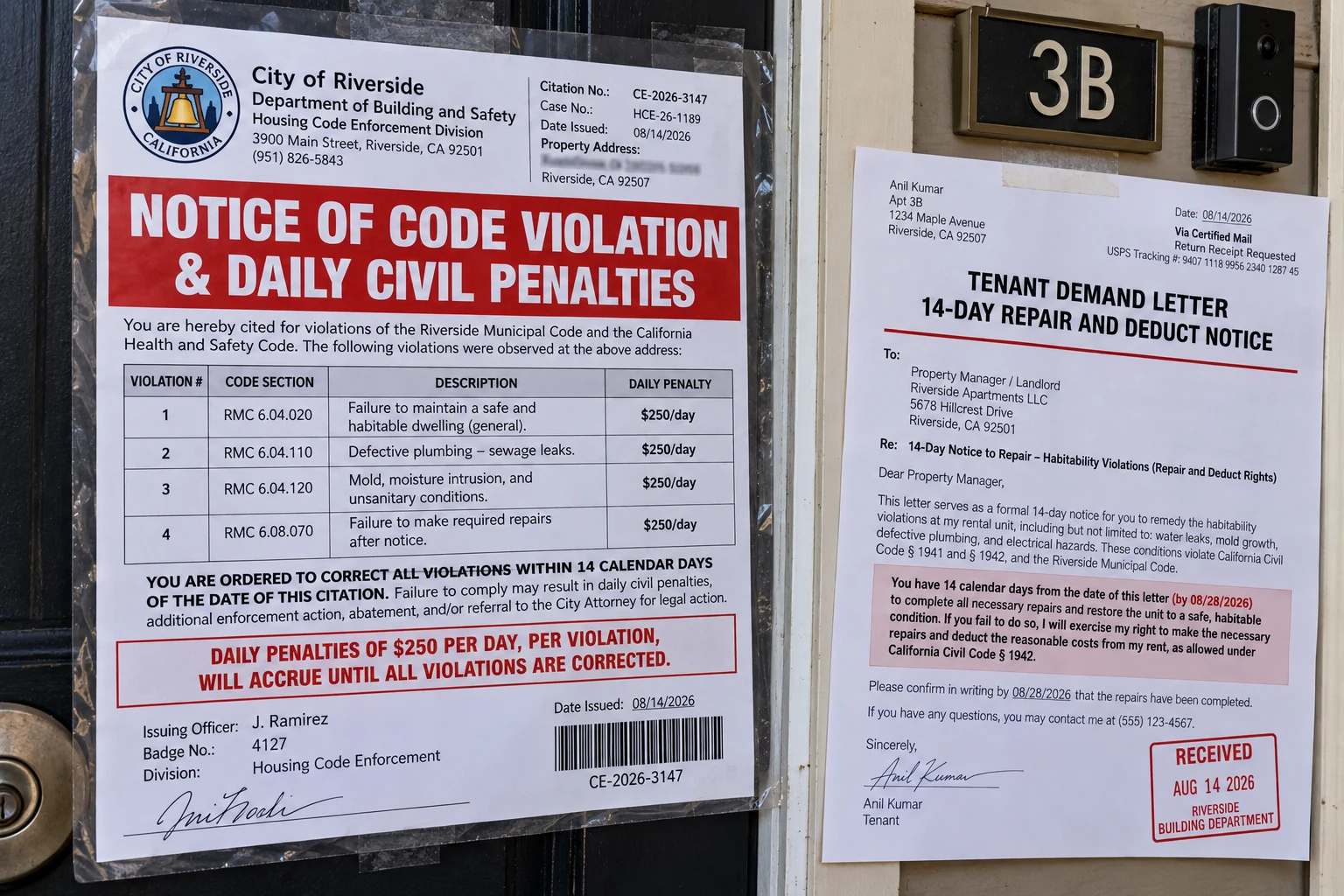
SAFEST • ZERO COSTFor any Tier 1 or Tier 2 health or safety hazard, call your municipal code enforcement agency or dial 311. A certified municipal housing inspector will visit your apartment for free, take photographs, measure violations against building and health codes, and issue a formal Notice of Violation to the landlord with a mandatory repair deadline.
Why this works: Cities assess escalating daily fines (often $250 to $1,000 per day) against property owners who ignore city citations. Furthermore, the inspector's official certified report serves as bulletproof, objective evidence if you later sue the landlord in Small Claims Court.
Option 2: Keep Paying Rent & Sue in Small Claims Court for a Refund (Zero Eviction Risk)
ZERO EVICTION RISK • HIGHEST PAYOUTThis is the single most effective legal strategy for tenants. You continue paying your normal rent on time each month so your landlord has zero grounds to file an eviction against you. Then, you file a lawsuit in your local Small Claims Court (court filing fees are typically $30 to $90 and you do not need an attorney).
What you win: Under the legal doctrine of rent abatement (diminution of rental value), the court orders the landlord to refund 15% to 75% of every dollar of rent you paid during the months the problem remained unfixed. You also recover all verified out-of-pocket expenses (heaters, spoiled food, laundromat bills) plus court fees. Once served with a court summons, most landlords settle or hire licensed contractors immediately to avoid having a public judgment entered against them.
Option 3: "Repair and Deduct" (Hire a Pro Yourself & Subtract the Bill From Rent)
MODERATE RISK • REQUIRES STATUTORY COMPLIANCEAuthorized by statute in roughly 35 states (including California, Illinois, Washington, Arizona, and Montana), this procedure allows you to hire a licensed, insured contractor to fix the defect yourself and deduct the paid invoice from next month's rent check.
Strict rules you must follow: You must deliver a formal written notice explicitly warning the landlord that you intend to exercise repair-and-deduct rights if the work is not completed within statutory deadlines (e.g., 14 to 30 days). You cannot exceed your state's statutory cap (usually one month's rent or $500), and you must attach the contractor's itemized paid receipt to your next reduced rent payment.
Option 4: Official Rent Escrow / Rent Withholding (Strict State Procedures)
HIGH RISK IF PROCEDURES MISSEDInstead of paying rent directly to an uncooperative landlord, you deposit your full monthly rent payment on or before the due date into a dedicated Court Clerk Escrow Account (or a segregated escrow bank account where permitted by state statute). The court holds the money until the landlord proves the repairs have been fully inspected and completed.
The danger: In states like Texas, North Carolina, and Georgia, self-help rent withholding without a prior court order is completely illegal and will result in an immediate eviction notice. Even in states where withholding is permitted, failing to send statutory cure notices before withholding can forfeit your legal protections.
Option 5: Break Your Lease & Move Out ("Constructive Eviction")
HIGHEST DISRUPTION • LAST RESORTWhen a landlord allows a severe defect—such as raw sewage, zero heat in winter, massive water intrusion, or hazardous mold—to persist so long that the home is genuinely unlivable, the landlord has committed constructive eviction. The law considers the landlord to have kicked you out by making the home unlivable.
Requirements to protect yourself: You must send a final written notice giving the landlord a deadline to fix the defect or you will vacate. You must have airtight evidence (city inspection citations, professional mold or plumbing inspection reports, timestamped video). Finally, you must actually move out within a reasonable window after the deadline passes. You can then sue in Small Claims Court to recover your full security deposit, moving expenses, and prepaid rent.
State-by-State Repair Deadlines, "Repair & Deduct" Caps & Rent Rules
Landlord-tenant statutory rights vary significantly across state lines. While every state except Arkansas enforces an implied warranty of habitability, each state legislature sets its own statutory deadlines, dollar limits for tenant-funded repairs, and rent withholding procedures. Review the rules for major jurisdictions below before taking action:
| State | Standard Repair Deadline (Non-Emergency) | Is "Repair & Deduct" Allowed? | Maximum Amount You Can Deduct | Can You Withhold Rent? |
|---|---|---|---|---|
| California | 30 Days (24–72 hrs for emergencies) | Yes (Cal. Civ. Code § 1942) | Up to 1 Month's Rent (maximum 2 times per 12-month period) | Yes, for substantial habitability breaches. Best practice is keeping funds in a separate bank account. |
| Texas | 7 Days (Tex. Prop. Code § 92.056) | Yes (Strict certified mail rules) | Greater of 1 Month's Rent or $500 | NO! Withholding rent on your own in Texas triggers immediate legal eviction. Use Repair & Deduct or sue in Justice Court. |
| New York | Reasonable Time (24 hrs for Class C emergencies, up to 30 days for Class A) | Yes (Established under judicial precedent for essential defects) | Reasonable cost to repair (obtain 2–3 contractor estimates and retain all paid receipts) | Yes, under NY Real Property Law § 235-b. Be prepared to deposit full rent into Housing Court escrow if landlord files nonpayment. |
| Florida | 7 Days (Fla. Stat. § 83.56) | No statutory right (Unless lease explicitly authorizes) | N/A — Must utilize formal 7-Day Notice to Withhold or Terminate | Yes, ONLY if you deliver a formal written 7-Day Notice of Noncompliance before the next rent payment is due. |
| Illinois | 14 Days (765 ILCS 742/5) | Yes (Residential Tenants' Right to Repair Act) | Lesser of $500 or 1/2 of Monthly Rent (must include contractor estimate with initial 14-day notice) | Authorized under Chicago RLTO with 14-day notice; highly risky outside local tenant protection ordinances without escrow. |
| Georgia & North Carolina | Reasonable Time (typically 7 to 14 days) | Limited / Risky in GA; No statutory right in NC without court order | In GA, tenant must prove proper notice and reasonable repair cost; in NC, sue in Small Claims for Rent Abatement | NO! Never withhold rent on your own in GA or NC. Pay your rent on time and sue in Small Claims Court for a full retroactive refund. |
| Washington | 24 Hours (heat/water/electricity); 72 Hours (fridge/stove/plumbing); 10 Days (other) | Yes (RCW 59.18.100) | Up to 2 Months' Rent for licensed contractor work (1 Month for self-completed repairs) | No self-help withholding. You must use statutory Court Escrow (RCW 59.18.115) or Repair-and-Deduct procedures. |
Crucial Rule for Tenants in Strict States (Texas, North Carolina, Georgia): If you live in a state that bars self-help rent withholding, remember that you are never powerless. You hold the strongest legal leverage by paying your rent on time and immediately suing your landlord in Small Claims Court for rent abatement. Landlords in these states count on tenants illegally withholding rent so they can file quick eviction proceedings. By keeping your rent current, you rob the landlord of their eviction defense and force them into court solely on their maintenance failure.
How to Beat Dirty Landlord Tricks (Closed Portal Tickets & "Backordered Parts")
Property management companies and corporate landlords use repeatable delay tactics designed to wear tenants down until they give up or move out. Understanding these common tricks and having ready countermeasures allows you to build an unbreakable paper trail for court:
Trick #1: Closing Your Online Maintenance Ticket Without Fixing Anything
Property management software tracks employee response times. To keep internal corporate metrics looking good, maintenance staff frequently mark online resident portal tickets as "Completed" or "Closed" when they have only conducted an initial look or done nothing at all. Worse, if you dispute a charge later, management companies can lock your portal account and eliminate your ticket history.
"Maintenance Work Order #408 was marked 'Completed' today, [Date], by management staff. However, as documented in the attached timestamped photograph taken 10 minutes ago, the ceiling leak in my hallway is still actively dripping and remains completely unfixed. Please reopen this work order immediately and dispatch a licensed professional."
Trick #2: Sending an Unlicensed Handyman Who Puts Duct Tape on the Problem
Rather than hiring an expensive licensed plumber, electrician, or HVAC technician, cheap landlords often send a general handyman who performs cosmetic "band-aid" patches—like applying silicone caulk over crumbling drywall, painting over active mold, or rigging electrical wires.
Trick #3: "We Are Waiting on a Backordered Part for 6 Weeks"
When furnaces, air conditioning compressors, or refrigerators break down, property managers routinely blame global supply chains: "We ordered the compressor part, but it is on backorder from the manufacturer for 4 to 6 weeks."
"While I acknowledge that a specific replacement part may be on order, state habitability statutes require functional heating and refrigeration. Because this essential service remains unavailable, please provide temporary loaner appliances (or safe, manufacturer-approved portable space heaters/AC units) within 48 hours, along with a daily rent credit of $[Daily Amount] until full repairs are completed."
What About Landlord Retaliation?
Tenants often fear that demanding repairs will result in a revenge eviction, a rent hike, or a non-renewal notice. Under the Uniform Residential Landlord and Tenant Act (URLTA § 5.101) and statutory laws across virtually all 50 states, landlord retaliation is strictly illegal. If your landlord serves you with a lease termination notice, raises your rent, or reduces your amenities within 90 to 180 days of your written repair request or city code complaint, judges apply an automatic legal presumption that the landlord acted in illegal retaliation, entitling you to monetary statutory damages and attorneys' fees.
Ready-to-Send Final Notice for Unfixed Repairs & Rent Refund Demand Letter
Before filing a lawsuit in Small Claims Court or exercising statutory repair-and-deduct remedies, you must serve your landlord with a formal, unequivocal demand letter. This document serves as your ultimate piece of evidence in court, establishing that the landlord had clear knowledge of the defect, missed statutory cure deadlines, and ignored their contractual obligations.
Send this notice via Certified Mail (Return Receipt Requested) as well as via email and through your resident portal. Retain the postal tracking number and signed green card receipt.
FINAL FORMAL NOTICE TO CURE UNFIXED DEFECTS & DEMAND FOR RENT ABATEMENT
SENT VIA CERTIFIED MAIL (RETURN RECEIPT REQUESTED) & ELECTRONIC MAIL

DATE: [Date]
CERTIFIED MAIL TRACKING NUMBER: [Certified Mail Tracking Number]

TO (LANDLORD / PROPERTY MANAGEMENT):
[Landlord or Property Management Company Name]
[Management Street Address]
[City, State, ZIP Code]
[Management Office Email Address]

FROM (TENANT):
[Your Full Legal Name(s)]
[Rental Property Address & Unit Number]
[City, State, ZIP Code]
[Your Phone Number]
[Your Email Address]

RE: FINAL NOTICE OF MATERIAL BREACH OF THE IMPLIED WARRANTY OF HABITABILITY, BREACH OF LEASE AGREEMENT, AND FORMAL DEMAND FOR REPAIRS & RENT REFUND
PREMISES: [Full Rental Property Address, Including Unit #]

Dear [Landlord or Property Manager Name]:

This letter serves as formal legal notice under state landlord-tenant statutes and the implied warranty of habitability that the residential premises leased to me at [Your Rental Address, Unit Number] contain persistent, uncorrected maintenance defects that materially affect my physical health, safety, and quiet enjoyment.

1. SUMMARY OF UNRESOLVED DEFECTS & PRIOR WRITTEN NOTICES:
Despite multiple timely notifications, the following defective conditions remain unaddressed:
• Defect Description: [Describe the problem in detail—e.g., active water leak in bathroom ceiling causing plaster deterioration and mold / non-functioning refrigerator / complete lack of heating in bedrooms].
• Prior Notice History:
  - Initial Maintenance Portal Ticket #[Ticket Number] submitted on [Date] (marked closed without repairs).
  - Written follow-up email sent on [Date] with attached timestamped photographs.
  - Text message communication with on-site manager [Name] on [Date].
• Duration of Defect: The premises have remained in this defective, substandard condition for [Number of Days or Months], representing an unacceptable and unlawful delay.

2. STATUTORY VIOLATION & DIMINUTION OF VALUE:
Under state law and residential building codes, you have an ongoing, non-waivable legal duty to maintain the premises in a fit, safe, and habitable condition. Under the lease contract, my full monthly rental payment of $[Monthly Rent Amount] compensates you for a fully functional, habitable home.

Due to your failure to correct this condition, the fair market rental value of the property has been significantly diminished by approximately [Estimate Percentage, e.g., 35% to 50%] during the past [Number of Months] months. In addition, I have incurred verified out-of-pocket expenses totaling $[Out-of-Pocket Amount] for [itemized expenses, e.g., space heaters, spoiled food, laundromat bills, or diagnostic plumber fees].

3. DEMAND FOR IMMEDIATE ACTION & FINANCIAL RESOLUTION:
I hereby demand the following corrective actions:
1. Licensed Professional Repair: Dispatch a licensed, qualified contractor to perform permanent, professional repairs on the above-described defect within [48 Hours for emergency utilities / 7 Days for major habitability issues / 14 Days for standard amenities] from receipt of this notice, no later than [Specific Deadline Date, e.g., Friday, October 10, 2026].
2. Retroactive Rent Abatement: Issue a retroactive rent refund or written rental ledger credit in the amount of $[Total Rent Refund Amount, e.g., $1,800.00] to compensate for the diminished living value during the period the condition persisted.
3. Out-of-Pocket Expense Reimbursement: Reimburse $[Total Out-of-Pocket Amount, e.g., $450.00] for direct expenses incurred as a consequence of this unfixed defect (itemized receipts attached).

4. RESERVATION OF ALL STATUTORY RIGHTS:
If permanent, professional repairs are not commenced and completed within the statutory cure window specified above, please be advised that I intend to exercise all available legal remedies without further notice, including but not limited to:
• Requesting an immediate formal inspection from the City / County Department of Building & Housing Code Enforcement (dialing 311).
• Exercising my statutory right to Repair-and-Deduct under state law, hiring an independent licensed contractor and deducting the full cost from subsequent rent payments.
• Depositing monthly rental payments into an official Court Escrow Account pursuant to state rent withholding procedures.
• Terminating the lease agreement under the legal doctrine of constructive eviction and vacating the premises without lease break penalty.
• Filing an immediate lawsuit in Small Claims / Housing Court seeking full retroactive rent abatement, property damages, statutory damages, and court costs.

Please be reminded that under state law (including anti-retaliation statutes), any attempt to retaliate against a tenant for exercising statutory repair rights—including eviction notices, rent increases, reduction in services, or negative credit reporting—is strictly unlawful and carries severe statutory civil penalties.

I expect your prompt written confirmation within 48 hours specifying the date and time a licensed technician will arrive to complete repairs.

Sincerely,

________________________________________
[Your Signature]

[Your Printed Full Legal Name]
Tenant, Unit #[Your Unit Number]
How Much Can I Sue My Landlord for Refusing Repairs?
When pursuing a legal claim against your landlord in Small Claims Court or Housing Court, financial recovery is determined by statutory damages categories, proven out-of-pocket losses, and rent reduction formulas:
| Recovery Category | Calculation Standard | Statutory Authority & Limits |
|---|---|---|
| 1. Repair-and-Deduct Reimbursement | Deduction of licensed contractor repair bills directly from subsequent rental payments. | State repair-and-deduct codes (typically capped at 1 or 2 months' rent). |
| 2. Partial Rent Abatement | Retroactive reduction in rent corresponding to the time elapsed after statutory notice deadline. | Common law diminution in value rule. |
| 3. Injunction / Specific Performance | Court order in Housing Court compelling the landlord to complete required structural repairs immediately. | Municipal housing court equitable powers. |
Small Claims Filing Limits: Most tenants resolve these disputes without hiring an attorney in Small Claims Court. Maximum claim limits vary by state: for example, $12,500 in California (California Courts Self-Help), $10,000 in New York City (NY Courts Small Claims), and $20,000 in Texas (Texas Judicial Branch). If your total damages exceed small claims thresholds, you may file in standard civil district court.
Frequently Asked Questions
Be very careful: in states like Texas, Georgia, and North Carolina, simply keeping your rent money will get you evicted even if the landlord is in the wrong. In states that allow rent withholding—like Florida, California, Massachusetts, or Pennsylvania—you must first send a formal written notice, wait the legal deadline, and put the rent money into a separate bank or court escrow account.
In most states, Small Claims judges primarily award money judgments—forcing the landlord to pay you thousands in rent refunds and out-of-pocket costs. However, as soon as a landlord has to pay you $3,000 for an unfixed problem—and realizes you can sue them again if they still don't fix it—they almost always make the repair immediately.
No—nearly every state has Anti-Retaliation Laws. If your landlord tries to evict you, raise your rent, or cut services within 90 to 180 days after you asked for repairs in writing or called a city building inspector, the court presumes it is illegal retaliation and you can countersue for extra penalties.
Under state law, landlords are responsible for normal wear and tear and aging equipment. If a 10-year-old water heater, dishwasher, or pipe breaks, the landlord cannot charge you for it unless they have proof from an independent technician that you intentionally broke or misused it.
Yes! Even after you move out, you have 2 to 6 years—depending on your state's written contract deadline—to sue your former landlord in Small Claims Court for a retroactive rent refund for the months you lived with unfixed major repairs, as long as you kept copies of your old texts, emails, and photos.
SueLegal is an independent educational legal publisher, not a law firm or lawyer referral service. The information provided in this guide is for general informational and educational purposes only and does not constitute formal legal advice. Residential landlord-tenant laws, repair notice periods, and statutory remedies vary significantly across state and municipal jurisdictions. If you are facing eviction, severe uninhabitable conditions, or complex litigation, consult a licensed attorney in your jurisdiction or contact your local legal aid organization. For more details on our standards, read our Editorial Policy and Legal Research Methodology.