
The Short Answer
Yes, you can sue your landlord for secondhand cigarette or marijuana smoke in 3 specific situations.
While smoking inside an apartment is not automatically illegal everywhere, you can sue your landlord in Small Claims Court for rent refunds (15%–40% off rent), HEPA air purifiers, cleaning/deodorizing costs, and moving expenses—or break your lease with zero penalty—if:
- Your Lease Says It Is a "Smoke-Free Building": If your landlord advertised a non-smoking building or put a no-smoking rule in the lease, but refuses to stop a neighbor who smokes, they are breaking your contract.
- You or a Family Member Have Asthma, Allergies, or a Health Condition: Under the federal Fair Housing Act (FHA), a simple doctor's note turns secondhand smoke into a disability accommodation issue—forcing your landlord to seal vents, stop the smoke, move you to another unit, or let you leave penalty-free.
- Heavy Smoke Makes Your Home Unlivable (Nuisance & Quiet Enjoyment): Even in buildings without a no-smoking rule, courts have ruled that thick, constant smoke pouring through shared vents and electrical outlets violates your right to a safe, livable home.
Before You Take Action
- A Doctor's Note Is Your Strongest Weapon (Even in Smoking Buildings): If secondhand smoke triggers asthma, migraines, sinus infections, COPD, or harms a baby or pregnant tenant, hand your landlord a short doctor's letter requesting a Fair Housing Reasonable Accommodation. By federal law, the landlord cannot ignore it.
- Sue the Landlord, Not Just the Neighbor: Suing a smoking neighbor directly is hard to collect on. Suing the landlord works because the landlord controls the building's air vents, hallways, and lease enforcement.
- Marijuana & Vape Smoke Count Too: Even in states where recreational weed is legal, property owners can ban it—and landlords of "smoke-free" buildings must enforce the ban against heavy cannabis smoke drifting into your unit.
- Prove Midnight Smoke With a $40 Air Quality Monitor: Landlords always say "I walked by at noon and didn't smell anything." Buy a $40 digital PM2.5 air quality monitor, record a video showing the numbers spiking into the red zone when smoke enters your vents, and keep a daily smoke log.
- Check If Your City Bans Apartment Smoking Completely: Over 80 cities in California (plus cities in Colorado, Minnesota, and Maryland) have passed laws making it 100% illegal to smoke inside any multi-unit apartment or on balconies.
The 3 Legal Ways to Force Your Landlord to Act
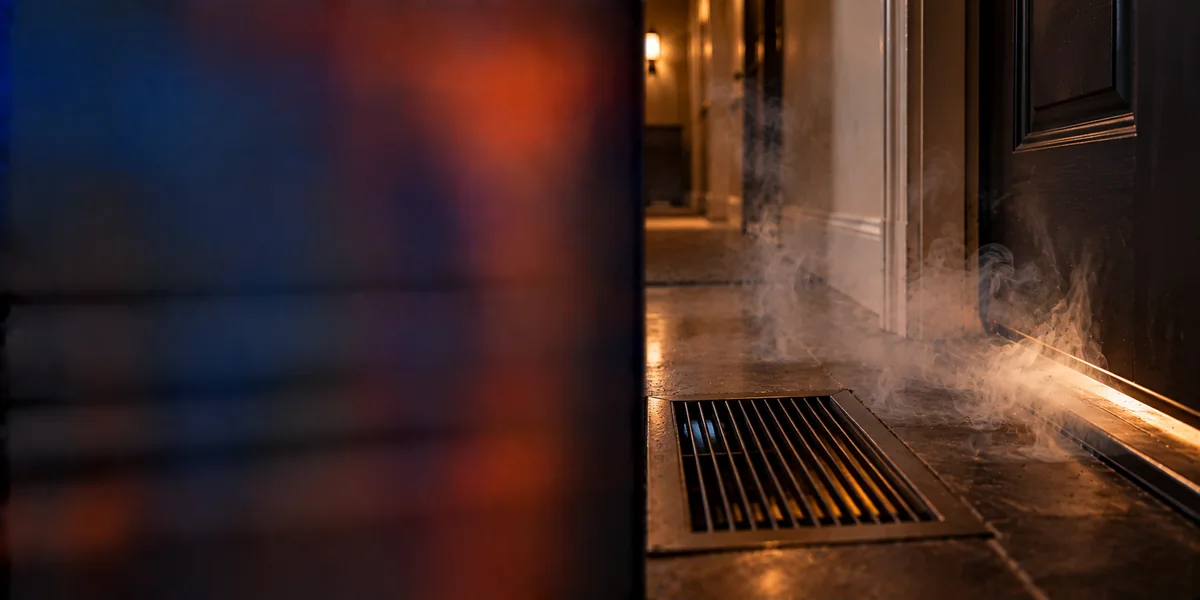
Drifting cigarette, cigar, and marijuana smoke does not respect apartment boundaries. In multi-unit buildings, smoke travels through shared HVAC ductwork, gaps around plumbing pipes under sinks, and empty wall cavities behind electrical outlets. When secondhand smoke invades your home every evening, you do not have to endure it silently or pay thousands in lease-break penalties.
Tenants have three primary legal paths to force landlords to stop drifting smoke, break their lease penalty-free, or recover substantial rent refunds in Small Claims Court:
| Legal Track | When It Applies | What It Forces Landlord to Do | Key Evidence Needed | Small Claims & Lease-Break Power |
|---|---|---|---|---|
| 1. "Smoke-Free Lease" Breach Track | Your lease has a no-smoking clause, or the property was advertised as 100% smoke-free. | Enforce lease rules against offending neighbors or issue formal lease violations and eviction warnings. | Copy of lease contract, original rental listing, and written complaint emails. | Very High: Landlord is in material breach of contract. Entitles tenant to penalty-free lease cancellation and rent refunds. |
| 2. Fair Housing Act (FHA) Doctor's Note Track | You or a household member have asthma, allergies, COPD, heart disease, or pregnancy affected by smoke. | Provide reasonable accommodation: seal ducts/outlets, install HEPA filtration, transfer units, or allow penalty-free exit. | One-page doctor's letter requesting reasonable accommodation under 42 U.S.C. § 3604(f)(3)(B). | Maximum: Overrides building rules. Landlords face severe federal civil rights liability if they ignore or reject reasonable accommodations. |
| 3. City Smoking Ban / Quiet Enjoyment Track | Building allows smoking, but smoke is so thick and persistent that it interferes with sleep and normal living. | Seal structural penetrations between units, repair shared ventilation shafts, or insulate common walls. | 14-day smoke log, PM2.5 air quality monitor readings, and witness statements. | Moderate to High: Constructive eviction and private nuisance claims allow 15%–40% rent abatements and moving cost recovery. |
Why the Fair Housing Act Is Your Strongest Weapon
Even in a building where smoking is completely permitted by lease rules, federal law supersedes property policy. Under the Fair Housing Act, severe asthma, chronic bronchitis, migraines, and reactive airway diseases qualify as physical impairments that substantially limit major life activities. When you submit a medical accommodation request, the landlord has a mandatory legal duty to engage in an interactive process to resolve the issue within 10 to 14 days.
For detailed procedural advice on taking a landlord to small claims court, consult our central guide on suing your landlord.
How to Prove Smoke Is Entering Your Apartment (When the Landlord "Doesn't Smell It")
The most frustrating obstacle for renters is the landlord's standard response: "I stopped by your apartment at 2:00 PM on Tuesday and didn't smell anything." Smokers rarely light up during midday property inspections; the heaviest smoke infiltration almost always occurs between 8:00 PM and 2:00 AM, or early on weekend mornings.
To win in Small Claims Court or convince a property manager's legal counsel to release you from your lease, you need objective, undeniable proof:
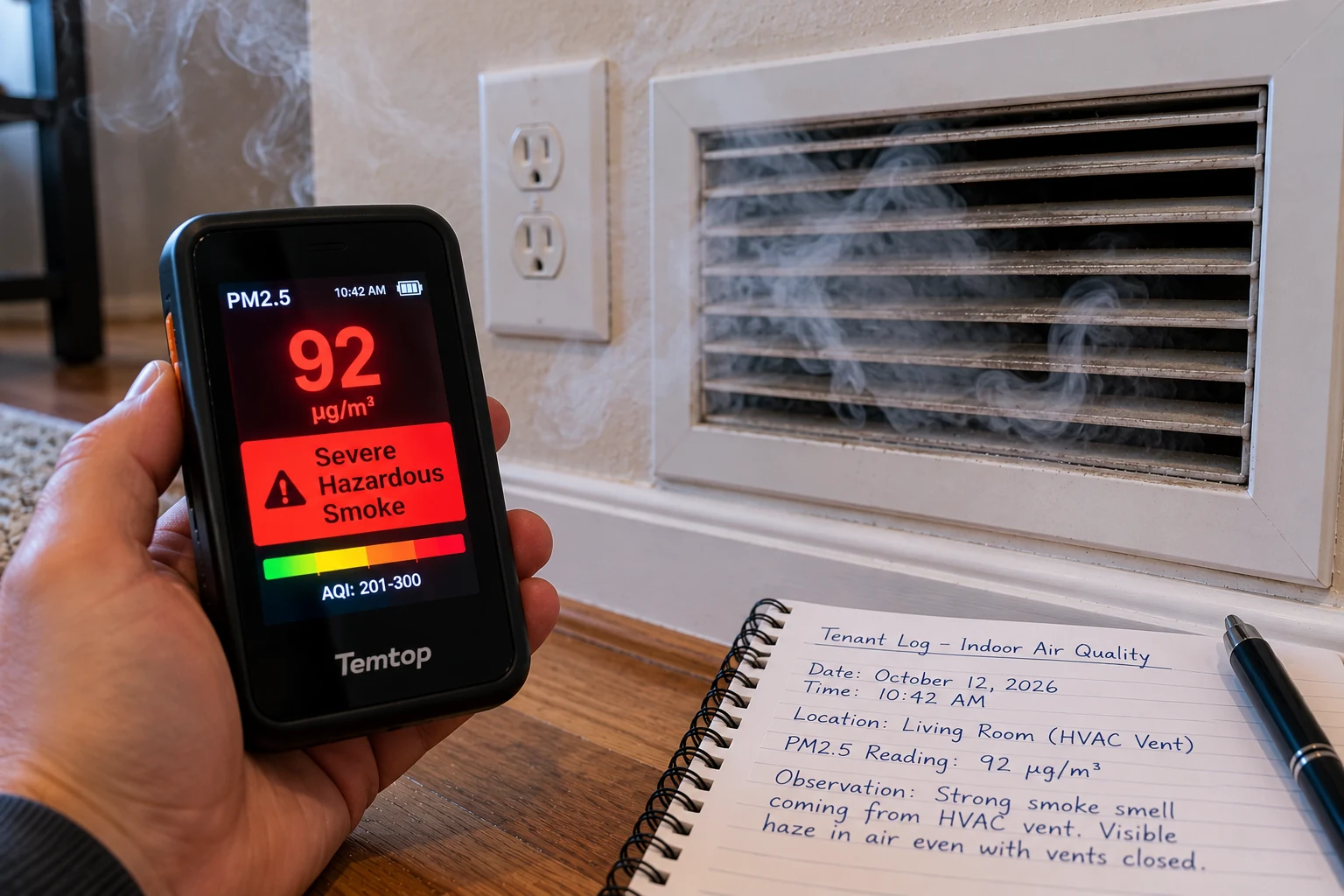
- $40 Digital PM2.5 Air Quality Monitor: Secondhand smoke generates microscopic fine particulate matter measuring 2.5 microns or smaller (PM2.5). Clean indoor air typically reads between 0 and 12 µg/m³. When smoke enters through vents or wall gaps, PM2.5 readings immediately spike to 35–150+ µg/m³ (the hazardous red zone). Record timestamped videos showing the monitor displaying red alert levels while holding it next to the affected vent.
- 14-Day Chronological Smoke Log: Keep a structured daily diary noting the exact date, start time, end time, specific room affected, smoke odor type (tobacco vs. marijuana), and physical symptoms experienced (headaches, coughing, nausea, burning eyes).
- Two Independent Witness Statements: Have two non-family visitors—such as an adjacent neighbor, friend, coworker, delivery courier, or municipal code inspector—step into your unit when the smoke is active. Ask them to write and sign a two-sentence statement confirming they smelled heavy smoke inside your living quarters.
- Inspect and Document Common Infiltration Chases: Remove switch plates and check around ceiling exhaust fans. Smoke commonly travels through unsealed cutouts around sink drain pipes, gaps in shared drywall cavities, and unbaffled bathroom ventilation ducts connecting adjacent units.
Judges in Small Claims Court love objective data. A landlord's verbal statement that they "didn't smell it" carries zero weight against a spreadsheet showing 14 days of logged incidents paired with smartphone photos of a PM2.5 monitor reading 85 µg/m³ at 11:30 PM.
What About Neighbor Weed / Marijuana Smoke in Legal States?
With the widespread legalization of recreational cannabis across more than half of the United States, landlords and tenants frequently misunderstand the legal boundaries. A common misconception is that because cannabis is legal in the state, tenants have an unrestricted right to smoke inside their rental apartments.
Under established property law and landlord-tenant jurisprudence, this assumption is completely false:
| Legal Principle | How the Law Treats Cannabis Smoke in Rentals | Tenant Rights & Legal Remedies |
|---|---|---|
| Legalization Does Not Grant Nuisance Rights | State cannabis legalization statutes only protect adults from criminal arrest. They do not grant a license to commit a common-law private nuisance by forcing smoke into neighboring homes. | You can sue both the neighbor and landlord for private nuisance and breach of quiet enjoyment regardless of state weed laws. |
| Landlords Have Total Authority to Ban Weed | Landlords hold absolute legal authority to ban smoking of any combustible plant material—including marijuana, cigars, and vaping products—anywhere on the property. | If the lease or house rules specify a non-smoking policy, the landlord is legally obligated to enforce it equally against marijuana smokers. |
| Strict Nationwide Federal HUD / Section 8 Ban | Cannabis remains an illegal Schedule I controlled substance under federal law (21 U.S.C. § 812). The U.S. Department of Housing and Urban Development (HUD) mandates a zero-tolerance policy. | In any HUD-subsidized property, Section 8 voucher unit, or public housing complex, marijuana smoke is an immediate federal lease violation requiring eviction warnings. |
Courts have repeatedly affirmed that strong marijuana terpenes and combustible odors constitute a substantial interference with a tenant's living environment. If your landlord dismisses your complaints by claiming "weed is legal in our state now," remind them in writing that state legalization acts do not override private property nuisance laws or lease covenants.
Cities & States With Strict Apartment Smoking Laws
Across the United States, municipal governments and state legislatures are increasingly recognizing drifting secondhand smoke as a public health hazard in multi-unit housing. In many jurisdictions, smoking inside an apartment is not merely a lease issue—it is an outright violation of municipal health codes.
| Jurisdiction | Statutory Rule / Ordinance | Protection for Multi-Unit Tenants |
|---|---|---|
| California (80+ Municipalities) | Cal. Civ. Code § 1947.5 & Local Municipal Codes | Over 80 California cities (including San Francisco, Berkeley, Pasadena, Santa Monica, Sunnyvale, Daly City, Culver City, and Beverly Hills) ban smoking inside 100% of multi-unit apartments, condos, and private balconies. |
| Utah | Utah Code § 78B-6-1101 | Utah law explicitly defines drifting tobacco smoke as a statutory nuisance if it drifts into any residential unit more than once in each of two or more consecutive weeks. Tenants have explicit statutory standing to sue. |
| New York City | NYC Local Law 147 of 2017 (NYC Admin Code § 17-506.1) | All residential buildings with three or more units must adopt and publicly post a written smoking policy and distribute it annually to all tenants, detailing where smoking is prohibited or allowed. |
| Colorado | Colorado Clean Indoor Air Act (C.R.S. § 25-14-204) & Municipal Codes | Grants local jurisdictions authority to enact stricter smoking regulations. Cities like Boulder prohibit smoking in multi-unit shared common areas and outdoor patios near entrances. |
| Minnesota & Maryland | Local County Health Regulations & Case Precedents | Counties like Montgomery County, MD mandate strict multi-unit disclosure, and state courts have consistently awarded rent abatements for secondhand smoke under the implied warranty of habitability. |
Check Your Local City Code
If you reside in a city with a multi-unit smoke-free ordinance, you can file a direct complaint with the municipal code enforcement or public health department. When a city health officer cites the landlord with a municipal code violation, the landlord faces daily fines until the smoking stops—giving you instant leverage to negotiate a clean lease break.
Ready-to-Send Secondhand Smoke & FHA Accommodation Demand Letter
Before filing a lawsuit in Small Claims Court or packing your boxes to move, you must deliver formal written notice to your landlord or property management company. This creates an unassailable legal paper trail proving the landlord had notice of the defect and was given a statutory opportunity to cure.
Use this battle-tested demand letter template. It combines lease breach notifications, common-law quiet enjoyment claims, and federal Fair Housing Act reasonable accommodation language:
VIA CERTIFIED MAIL (RETURN RECEIPT REQUESTED) & EMAIL

Date: [CURRENT DATE]

To: [LANDLORD OR PROPERTY MANAGEMENT COMPANY NAME]
Address: [OFFICIAL LEASE NOTICE ADDRESS]
City, State, Zip: [CITY, STATE, ZIP]

From: [YOUR FULL NAME]
Rental Address: [YOUR APARTMENT NUMBER AND STREET ADDRESS]
Phone Number: [YOUR PHONE NUMBER]
Email: [YOUR EMAIL ADDRESS]

SUBJECT: FORMAL WRITTEN NOTICE OF SECONDHAND SMOKE INTRUSION, BREACH OF LEASE / QUIET ENJOYMENT, AND REQUEST FOR REASONABLE ACCOMMODATION UNDER THE FAIR HOUSING ACT

Dear [LANDLORD OR PROPERTY MANAGER NAME],

I am writing to provide formal notice under state landlord-tenant statutes, the implied covenant of quiet enjoyment, and the federal Fair Housing Act (42 U.S.C. § 3604(f)(3)(B)) that substantial secondhand smoke is infiltrating my apartment from an adjacent unit.

1. DOCUMENTED SMOKE INTRUSION AND SOURCE:
For the past [NUMBER, e.g., 3] months, heavy [CHOOSE: cigarette / cigar / marijuana] smoke has been regularly penetrating my living quarters.
- Primary Entry Points: [SPECIFY: shared bathroom ventilation fan, HVAC ductwork, gaps under kitchen sinks, and electrical outlet boxes].
- Times of Occurrence: Infiltration occurs predominantly between [e.g., 8:00 PM and 1:00 AM daily], rendering the [bedroom / nursery / living room] uninhabitable.
- Objective Measurements: Digital particulate testing reveals PM2.5 spikes exceeding [e.g., 65 µg/m³] during active smoking episodes, significantly exceeding healthy air thresholds. (A copy of my 14-day smoke log and monitor photos is attached).

2. LEGAL BASIS AND LEASE VIOLATION:
[CHOOSE APPLICABLE BASIS:]
- BREACH OF SMOKE-FREE LEASE: My lease agreement (Section [X]) explicitly designates this property as a 100% smoke-free community. Your failure to enforce these terms against offending occupants constitutes a material breach of contract.
- COVENANT OF QUIET ENJOYMENT & NUISANCE: Even in the absence of an express smoke-free lease clause, constant toxic smoke infiltration constitutes a common-law private nuisance and violates my right to quiet enjoyment.
- FAIR HOUSING ACT DISABILITY ACCOMMODATION: A member of my household suffers from [asthma / severe allergies / respiratory condition / pregnancy], which is exacerbated by secondhand smoke. Under 42 U.S.C. § 3604(f)(3)(B), this letter constitutes a formal request for reasonable accommodation. (A doctor's verification note is attached).

3. REQUIRED REMEDIAL ACTIONS (STRICT 10-DAY DEADLINE):
To resolve this violation, I hereby demand that you complete one of the following corrective actions within TEN (10) CALENDAR DAYS of receipt of this notice:

OPTION A — EFFECTIVE MITIGATION AND ENFORCEMENT:
1. Issue a formal notice of lease violation / notice to cease to the source apartment occupant.
2. Dispatch a licensed HVAC and insulation contractor to seal all shared wall penetrations, plumbing chases, and electrical outlet boxes, and install commercial HEPA filtration in the shared ventilation system.
3. Reimburse me in the amount of $[AMOUNT, e.g., $350] for out-of-pocket air purifiers and provide a retroactive rent refund of $[AMOUNT] reflecting diminished rental value.

OPTION B — PENALTY-FREE LEASE TERMINATION OR UNIT TRANSFER:
If management cannot or will not eliminate the smoke infiltration within 10 days, I demand written agreement releasing me from all lease obligations without penalty, effective [PROPOSED MOVE-OUT DATE], accompanied by:
- A full 100% refund of my $[AMOUNT] security deposit.
- Reimbursement of $[AMOUNT] for out-of-pocket air filtration and relocation costs necessitated by constructive eviction.

4. RESERVATION OF RIGHTS:
If you fail to cure this condition or provide a written response within 10 days, I will exercise all available legal remedies, including filing a housing discrimination complaint with the U.S. Department of Housing and Urban Development (HUD), reporting code violations to local health authorities, and filing an action in Small Claims Court for rent abatement, property damages, and moving expenses.

Please confirm your planned course of action in writing at [YOUR EMAIL ADDRESS].

Sincerely,

_________________________________________
[YOUR SIGNATURE]

[YOUR PRINTED NAME]
Tenant at [YOUR APARTMENT NUMBER]
How to Deliver This Letter for Maximum Legal Standing:
- Fill in all brackets: Input your apartment number, dates, smoke types, PM2.5 readings, and specific out-of-pocket expenses.
- Attach supporting evidence: Include your 14-day smoke log, photos of air monitor spikes, and your doctor's accommodation note (if applicable).
- Send via USPS Certified Mail: Mail a physical copy with Return Receipt Requested (the green card), and immediately send an electronic copy via email or your tenant portal. Keep the tracking receipt in your lawsuit evidence folder.
How Much Can You Recover for Secondhand Smoke Nuisance?
When taking legal action in Small Claims Court or Civil Court, financial recovery is based on established tort principles, documented out-of-pocket expenses, and statutory damages:
| Recovery Category | Calculation Standard | Statutory Authority & Limits |
|---|---|---|
| 1. Quiet Enjoyment Rent Abatement | Refund of 15% to 40% of monthly rent for every month drifting tobacco or cannabis smoke penetrated into the rental unit. | Covenant of Quiet Enjoyment; Common-law Nuisance. |
| 2. Constructive Eviction Lease Cancellation | Immediate termination of lease agreement without penalty and full security deposit return when landlord failed to enforce smoking bans. | Constructive eviction doctrine. |
| 3. Air Scrubber & Medical Inhaler Reimbursement | Invoices for HEPA carbon air filtration equipment, prescription asthma inhalers, and allergist consultations. | Incidental health mitigation expenses. |
Small Claims Filing Limits: Most tenants resolve property and minor habitability disputes without hiring an attorney in Small Claims Court. Maximum claim limits vary by state: for example, $12,500 in California (California Courts Self-Help), $10,000 in New York City (NY Courts Small Claims), and $20,000 in Texas (Texas Judicial Branch). If physical injuries or permanent trauma damages exceed small claims limits, cases proceed to standard Civil Court.
Frequently Asked Questions
Yes. If drifting smoke substantially interferes with your health or quiet enjoyment of your home, and your landlord fails to remedy the condition after formal written notice, you can legally declare constructive eviction and terminate your lease without penalty. Alternatively, if anyone in your household has asthma, COPD, or an aggravated respiratory condition, you can submit a Fair Housing Act reasonable accommodation request allowing you to terminate your lease penalty-free with a full security deposit refund.
Yes. Even in buildings that permit smoking, landlords are legally required to maintain minimum habitability standards and prevent substantial nuisances. Heavy smoke infiltrating another tenant's private living space through shared vents or wall gaps remains an actionable nuisance. More importantly, federal Fair Housing Act protections override building policies: if you provide a doctor's note documenting that smoke exacerbates a medical condition, the landlord is legally mandated to provide reasonable accommodations such as sealing penetrations, installing HEPA filtration, or permitting a penalty-free lease exit.
Yes. In Small Claims Court, you can seek recovery of all reasonable out-of-pocket mitigation costs incurred as a direct result of the landlord's inaction. This includes the purchase price of HEPA air purifiers, replacement carbon filters, window seals, draft stoppers, and professional dry cleaning or deodorizing costs for smoke-damaged clothing and furniture.
Judgments in tenant secondhand smoke lawsuits typically range from a few thousand dollars in Small Claims Court up to tens of thousands of dollars in Civil Court. Courts frequently award rent abatements between 15% and 50% for every month the landlord allowed smoke intrusion to persist, reimbursement for air filtration and medical copays, and in egregious cases—such as Oregon's landmark Poyck v. Bryant habitability precedent and California small claims rulings—statutory damages, emotional distress, and attorney fees.
Yes, you can sue a smoking neighbor directly under common-law private nuisance if their conduct unreasonably and substantially interferes with the use and enjoyment of your apartment. However, suing the landlord is generally more effective and legally advantageous because the landlord holds the authority to enforce building rules, evict nuisance tenants, modify HVAC ductwork, and possesses substantial collectible assets and property insurance.
SueLegal is an independent educational legal publisher, not a law firm or lawyer referral service. The information provided in this guide is for general informational and educational purposes only and does not constitute formal legal advice. Residential landlord-tenant laws, repair notice periods, and statutory remedies vary significantly across state and municipal jurisdictions. If you are facing eviction, severe uninhabitable conditions, or complex litigation, consult a licensed attorney in your jurisdiction or contact your local legal aid organization. For more details on our standards, read our Editorial Policy and Legal Research Methodology.