

Before You Take Action
- Normal Wear and Tear vs. Actionable Damage: Landlords generally cannot deduct for natural sunlight fading, minor furniture scuff marks, or small picture nail holes used for standard wall art. However, large drywall gouges, unpatched toggle bolt anchors, heavy smoke residue, and unapproved bold colors may justify reasonable repair costs.
- Scope of Repainting Must Match Actual Damage: Charging to repaint an entire apartment when damage was localized to a single wall is widely scrutinized by courts. Under common-law mitigation principles and statutes such as Colorado C.R.S. § 38-12-103, landlords are generally restricted to the minimum restoration necessary.
- Paint Useful Life and Depreciation Are Fact-Dependent: Paint useful life is not governed by one nationwide federal statute. While consumer agencies (such as California DCA guidance) and small claims courts frequently apply a 2- to 3-year useful-life schedule to prorate damages, other jurisdictions evaluate reasonable restoration costs under contract terms.
- Automatic Move-Out Repainting Clauses Face State Scrutiny: In states like Massachusetts (Peebles v. JRK Property Holdings), California, and New York, lease provisions imposing automatic turnover painting fees are void as against public policy. Conversely, courts in some states (such as Indiana in Castillo-Cullather v. Pollack) give broad deference to lease restoration terms.
- Itemization and Receipt Rules Depend on State Law: Many jurisdictions (including California, New York, and Washington) require itemized statements backed by actual third-party contractor invoices or hourly labor logs for deductions above statutory thresholds, while others permit good-faith estimates under specified conditions.
- Remedies Vary by Jurisdiction: If a landlord wrongfully withholds deposit money in bad faith, several state statutes authorize penalty damages ranging from 1x to 3x the disputed amount plus court fees, though bad faith or willful retention must typically be proven.
At a Glance: Painting Deductions & Move-Out Disputes
Summary Matrix: When Is a Painting Charge Allowed?
Can My Landlord Charge Me for Painting After I Move Out?
When tenants move out of a rental apartment or house, one of the most common surprises is an itemized security deposit statement deducting $400, $950, or even $2,000 for "interior painting" or "drywall restoration." Many tenants immediately ask: Can my landlord legally do this?
The legal answer depends on why the repainting is happening:
- Routine Turnover Repainting: If the landlord is simply refreshing the unit with a fresh coat of paint for the incoming tenant, that cost is standard business overhead. In most jurisdictions, a landlord cannot pass the cost of routine turnover refurbishment onto the outgoing tenant.
- Ordinary Wear and Tear: Across U.S. landlord-tenant law, normal wear and tear is generally treated differently from tenant-caused damage. If the walls exhibit natural sunlight fading, minor scuffs from furniture, or small picture pinholes, the landlord is typically prohibited from deducting those costs from your security deposit.
- Actionable Tenant-Caused Damage: If the tenant inflicted damage beyond ordinary wear—such as ripping out large sections of drywall with heavy anchors, leaving extensive crayon marks, smoking inside an unauthorized non-smoking unit, or painting a room dark purple without written consent—the landlord may legally deduct reasonable, documented costs to restore the walls.
- State Statutes and Lease Provisions: Security deposit return deadlines, receipt requirements, useful life proration rules, and statutory remedies differ significantly by state. Moreover, while some states declare automatic turnover fees void, others give broader deference to lease terms.
To determine whether your charge is legitimate or an unlawful deduction, you must understand where the legal line is drawn between normal wear and actionable property damage.
When Is Painting Normal Wear and Tear vs. Tenant-Caused Damage?
The central question in virtually every painting dispute is whether the condition of the walls represents ordinary wear and tear or actionable tenant damage. While every state defines the concept slightly differently, "normal wear and tear" universally refers to the unavoidable, natural deterioration that occurs through reasonable, careful residential occupancy over time.
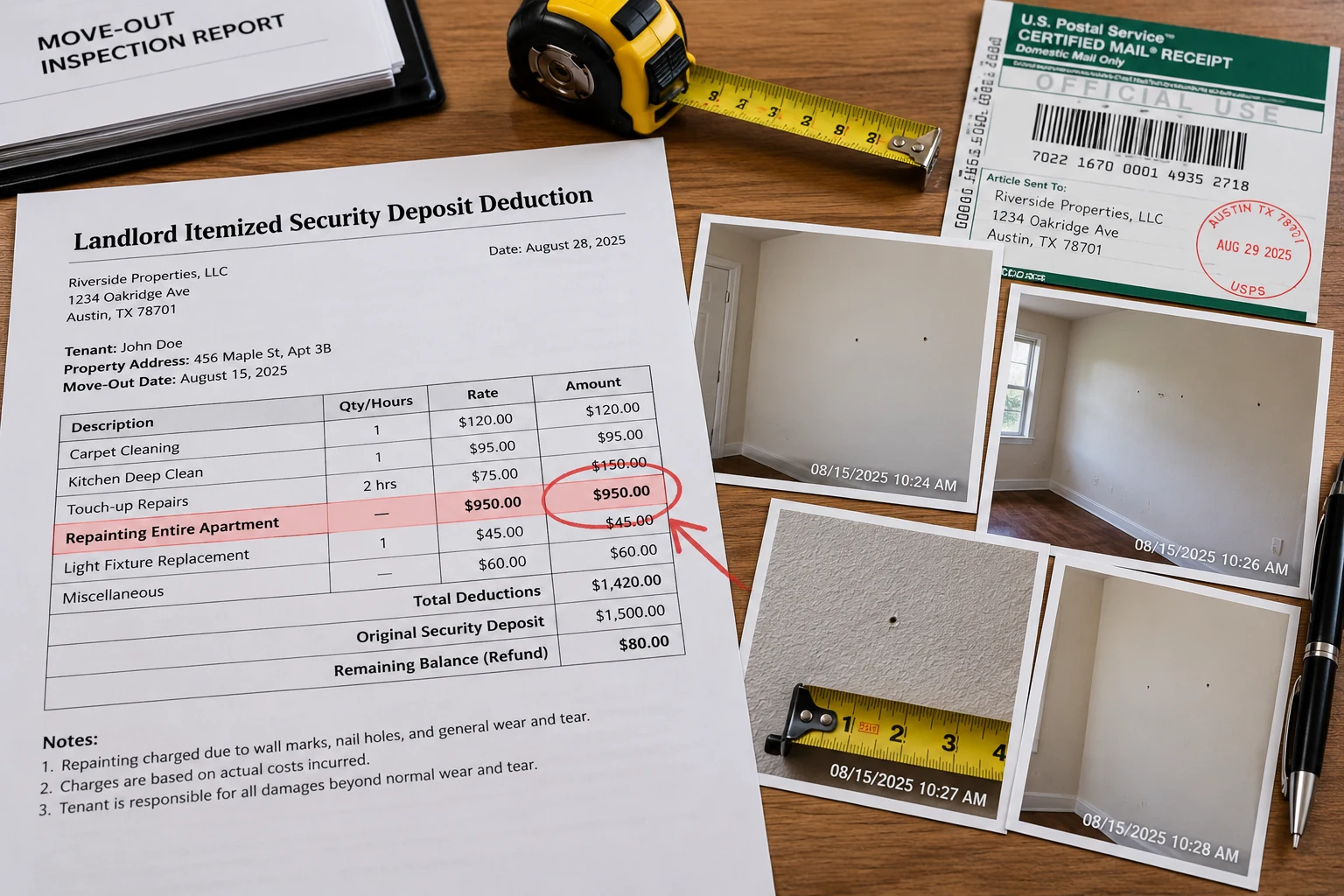
Conditions Commonly Classified as Normal Wear and Tear
Courts, small claims judges, and state housing agencies routinely treat the following conditions as normal wear and tear that a landlord cannot lawfully deduct:
- Sunlight Fading and Discoloration: Gradual yellowing or lightening of paint caused by natural UV light, or slight shadowing where artwork, mirrors, or headboards hung on the wall.
- Minor Furniture Scuffs: Light rubbing marks near sofas, dining chairs, or desks that did not gouge the underlying drywall and can be addressed through light touch-ups or gentle cleaning.
- Small Picture Nail and Pin Holes: Modest pinholes or small nails used to hang framed family photos, clocks, or artwork. In most jurisdictions, reasonable hanging of wall decor is considered an inherent incident of residential living.
- Minor Door Handle Contact: Light surface scuffs where an interior door handle contacted the wall without punching through the drywall surface.
- Hairline Settling Cracks: Thin drywall cracks along door frames, window corners, or ceiling seams caused by foundation shifting, seasonal humidity, or building settling.
Conditions Often Classified as Tenant-Caused Damage
Conversely, landlords may legitimately claim deductions if the deterioration resulted from misuse, negligence, intentional conduct, or unapproved alterations:
- Large Anchor Holes and Drywall Gouges: Heavy toggle bolts, expanding plastic anchors, large TV wall mounts, or deep gouges where drywall paper was torn away down to the gypsum core.
- Extensive Stains and Scribbles: Concentrated grease splatters extending across non-cooking kitchen walls, permanent marker, ink, wine stains, or pet urine and claw marks on baseboards and drywall.
- Heavy Tobacco, Cannabis, or Vape Smoke Residue: Thick nicotine coating, yellow tar, or ingrained smoke odor that requires specialized shellac/oil-based stain-blocking primers and multiple sealant coats.
- Unauthorized Color Changes: Painting walls a dark, bright, or non-neutral shade without written permission, or applying paint sloppily across trim, ceiling edges, or electrical faceplates.
- Water Damage from Tenant Neglect vs. Landlord Defects: Mildew or peeling paint caused by failing to use bathroom ventilation or failing to report a leaking pipe promptly. However, if water stains or peeling paint stemmed from roof leaks, structural sweating, or building plumbing defects, the landlord is strictly responsible—see our guides on landlord water damage liability, unaddressed plumbing defects, and landlords refusing to make necessary repairs.
- Flaking Paint in Older Units (Lead Hazard Considerations): If your rental was built before 1978 and paint is peeling or chipping due to age, federal EPA Title X disclosure mandates apply—see our guide on suing a landlord for lead paint hazards.
Normal Wear vs. Tenant Damage: Practical Decision Table
Because legal classifications depend on specific facts and jurisdiction, use this reference table to evaluate your wall condition:
| Wall Condition / Mark | Likely Classification | Why It Is Classified This Way | What Could Change the Analysis |
|---|---|---|---|
| Sunlight fading / shadow lines | Generally Normal Wear | Natural, unavoidable chemical breakdown of paint from daylight. | Extremely short tenancies (under 6 months) if unnatural staining occurred. |
| Minor furniture scuffs | Usually Normal Wear | Expected friction from chairs, couches, or beds against drywall. | If gouges punctured drywall paper or caused structural crumbling. |
| Small picture pin / nail holes | Often Normal Wear | Hanging standard wall art is recognized as ordinary residential use in most states. | Lease with enforceable explicit prohibition, or excessive hole clusters (dozens in one area). |
| Drywall anchor holes / TV mount bolts | Usually Tenant Damage | Leaves substantial holes requiring spackle, mesh patching, and texture matching. | If tenant professionally patched, sanded, and paint-matched prior to move-out. |
| Unauthorized paint color | Breach of Lease / Alteration | Requires multiple primer and topcoats to return unit to original condition. | Written landlord permission, or if landlord chose to keep the color for next tenant. |
| Heavy cigarette smoke / nicotine yellowing | Actionable Damage | Leaves oily residue and deep odor requiring specialized stain-blocking primers. | If lease expressly allowed smoking and landlord failed to maintain HVAC/paint standards. |
| Hairline settling cracks | Building Condition | Structural movement, foundation settling, or humidity shifts unrelated to tenant. | Never chargeable to tenant unless tenant directly caused structural impact. |
| Pre-existing chips / blemishes | Pre-Existing Condition | Condition originated prior to tenancy; tenant is not liable for predecessor damage. | Tenant must produce move-in baseline photos or inspection checklist to prove prior existence. |
| Pet scratches on drywall / trim | Tenant Property Damage | Physical destruction caused by domestic animal beyond ordinary wear. | Charge must reflect reasonable localized repair, not whole-apartment overhaul. |
The 7-Question Painting Charge Test
When evaluating whether a landlord's painting deduction can withstand legal scrutiny, you need a structured method to analyze the facts. SueLegal developed this practical editorial framework to help tenants assess their situation:
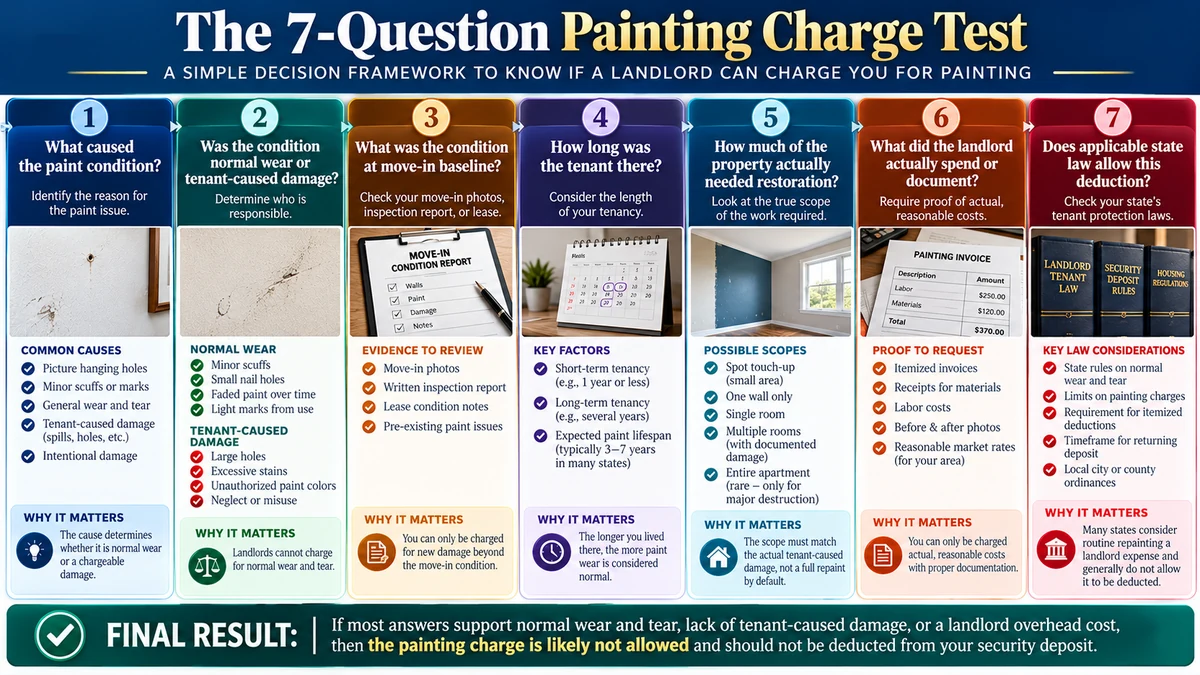
SueLegal's Practical Seven-Question Framework
- Question 1: What Caused the Paint Condition? Identify the physical origin of the wall condition. Was it caused by sunlight exposure, furniture contact, kitchen grease, smoke, or accidental impact? The cause dictates whether the condition can be attributed to ordinary residential living.
- Question 2: Was the Condition Normal Wear or Tenant-Caused Damage? Compare the condition against established definitions. Fading, small nail holes, and minor scuffs generally constitute normal wear; large holes, deep gouges, and unapproved paint alterations do not.
- Question 3: What Was the Condition When the Tenant Moved In? Examine your move-in condition checklist, baseline photos, and walkthrough notes. A tenant is only responsible for deterioration that occurred during their specific occupancy.
- Question 4: How Long Was the Tenant There? Tenancy duration directly impacts the amount of expected wear. A tenant living in a rental for 3 or 4 years naturally produces more wall wear than someone living there for 6 months. In jurisdictions applying useful-life proration, age substantially reduces allowable recovery.
- Question 5: How Much of the Property Actually Needed Restoration? Look at the actual scope of work. Did one wall need attention, or did the entire apartment require repainting? Landlords generally cannot use localized damage to fund a complete unit overhaul unless color matching was genuinely impossible.
- Question 6: What Did the Landlord Actually Spend and Document? Demand verifiable proof. Did the landlord provide itemized third-party contractor invoices, material receipts, and reasonable hourly labor logs within the statutory deadline? Self-written lump sums often fail statutory scrutiny.
- Question 7: Does Applicable State Law Allow This Deduction? Check controlling state statutes and judicial precedents. Does your state require signed move-in checklists (like Washington)? Does it restrict painting deductions to substantial damage (like Colorado)? Are mandatory turnover fees void (like Massachusetts)?
How Much Can a Landlord Charge for Painting?
There is no universal nationwide dollar amount that a landlord is allowed to charge for painting. The law does not set a flat "$500 maximum" or a fixed rate per square foot. Instead, in the event of legitimate tenant damage, a landlord may only recover the reasonable, actual cost of restoring the damaged area to its prior condition.
To understand how courts evaluate disputed dollar amounts, consider these three realistic scenarios:
Case A: The $800 Full Turnover Repaint (Normal Fading, 3-Year Tenancy)
A tenant vacates after a 3-year lease. The walls show normal daylight fading and a handful of small picture hanger nail holes. The landlord deducts $800 to repaint the entire apartment for the next tenant.
Legal Analysis: In most states, this charge is completely improper. The deterioration consists entirely of normal wear and tear that the landlord must absorb as an operating expense. Furthermore, after three years of residential use, interior paint in many jurisdictions is considered largely or fully depreciated.
Case B: The $500 Dark Accent Wall Restoration (6-Month Tenancy)
A tenant resided in a freshly painted apartment for 6 months and painted a living room wall charcoal black without written permission. Upon move-out, the landlord hired a painting contractor who billed $500 for two coats of stain-blocking primer and two coats of matching neutral latex paint.
Legal Analysis: The landlord's deduction is likely enforceable. The tenant breached the lease alteration clause, the paint was relatively new (only 6 months old), and the landlord documented the actual, reasonable expense incurred to restore the wall.
Case C: The $1,500 Whole-Unit Repaint for One Damaged Wall
A tenant caused drywall damage and anchor holes on a single bedroom wall. The landlord billed $1,500 to repaint the entire two-bedroom apartment, including unaffected rooms, hallways, and ceilings.
Legal Analysis: While the tenant may be liable for the reasonable cost of repairing and repainting the single damaged wall (or room if paint matching was truly impossible), charging for unaffected rooms constitutes an unmitigated capital improvement that small claims judges routinely reduce or disallow.
Can a Landlord Charge for Repainting the Entire Apartment?
A common point of dispute between landlords and tenants is scope: Can a landlord bill for an entire unit when wall blemishes were confined to one small area?
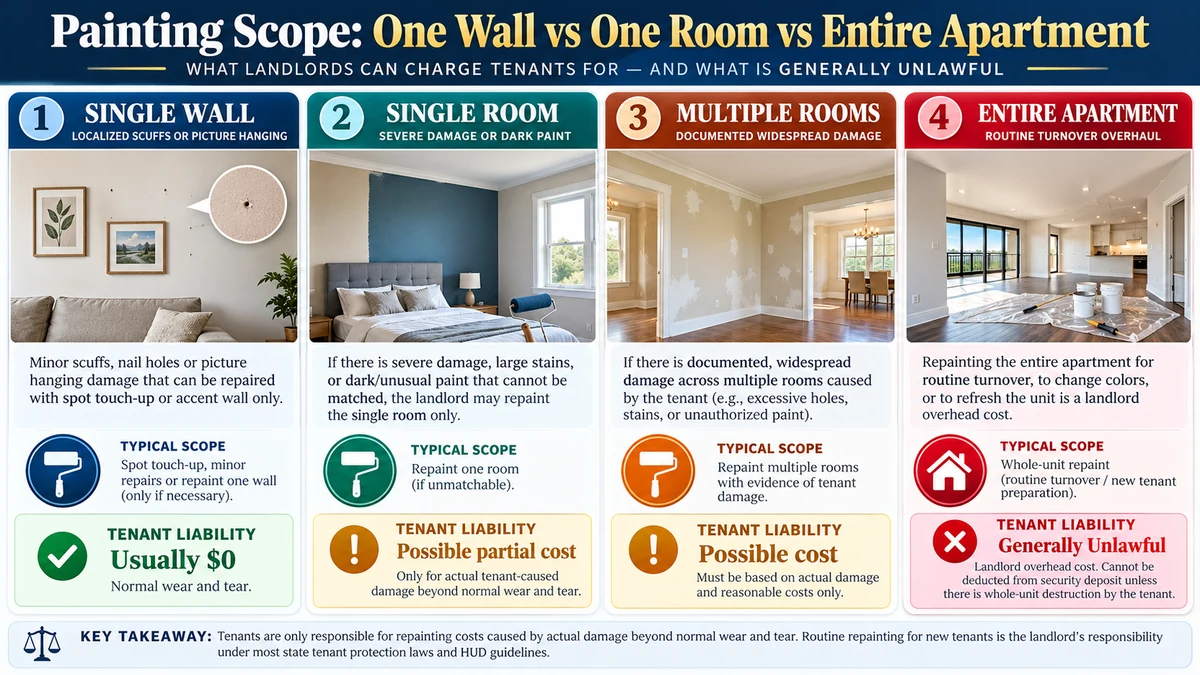
The Principle of Reasonable Scope and Mitigation
A tenant can legitimately challenge charges for areas that were completely unaffected by tenant-caused damage. However, whether a broader repaint is reasonably necessary depends on the physical facts:
- Single Wall: If localized nail holes or scuffs occur on one wall, a spot patch and touch-up—or at most repainting that specific accent wall—is generally the expected standard.
- Single Room: If wall damage is severe or the paint color cannot be matched due to age and fading, repainting the entire room may be reasonably necessary to achieve uniform appearance. In such cases, courts often accept single-room repainting costs.
- Multiple Rooms: A landlord may only bill for multiple rooms if actual tenant-caused damage is documented across each of those specific rooms.
- Entire Apartment: Repainting an entire apartment because of damage in one room is rarely justified. Under the common-law duty to mitigate damages and the doctrine against capital betterment, landlords cannot use localized damage to finance a complete turnover renovation.
Statutory Protections: The Colorado Example
Some states have codified this scope restriction directly into law. Under Colorado Revised Statutes § 38-12-103 (as updated by HB25-1249), a landlord does not have legal cause to retain deposit funds for interior painting absent "substantial damage" exceeding normal wear and tear that was not preexisting. Even then, the landlord is statutorily restricted to deducting only the "minimum amount necessary to repaint the specific damaged area."
Does the Age of the Paint Matter? Useful Life & Depreciation Explained
When a tenant legitimately damages a wall, does the landlord get to charge the price of brand-new paint? Under property loss principles, the answer in many jurisdictions is no: damages must account for the depreciated economic value of the item at the time of loss, rather than the cost of a brand-new upgrade.
Useful-Life Guidelines vs. National Law
It is critical to distinguish between statutory law and agency guidance:
- No Universal 50-State Statutory Formula: There is no single federal statute or nationwide law decreeing that interior paint expires after exactly 2 or 3 years in every private rental property.
- California DCA Guidance: Under official guidance published in the California Department of Consumer Affairs (DCA) Tenants Guide, interior paint is assigned an expected useful life of 2 to 3 years. Under this framework, if a tenant resided in a rental property for two or more years, repainting costs upon move-out are generally viewed as normal turnover overhead unless exceptional destruction occurred.
- HUD Assisted Housing Guidelines: The U.S. Department of Housing and Urban Development publishes property lifespan schedules (often 3 to 5 years for paint) in documents such as HUD Management & Occupancy Review Directives. These directives formally govern federally assisted or HUD-insured multifamily properties; they are frequently cited in private disputes as persuasive benchmarks, but are not automatically controlling statutes for private leases.
- Small Claims Court Application: Many small claims judges use straight-line depreciation principles as an equitable tool to prevent landlords from reaping an unfair windfall (betterment) at a tenant's expense.
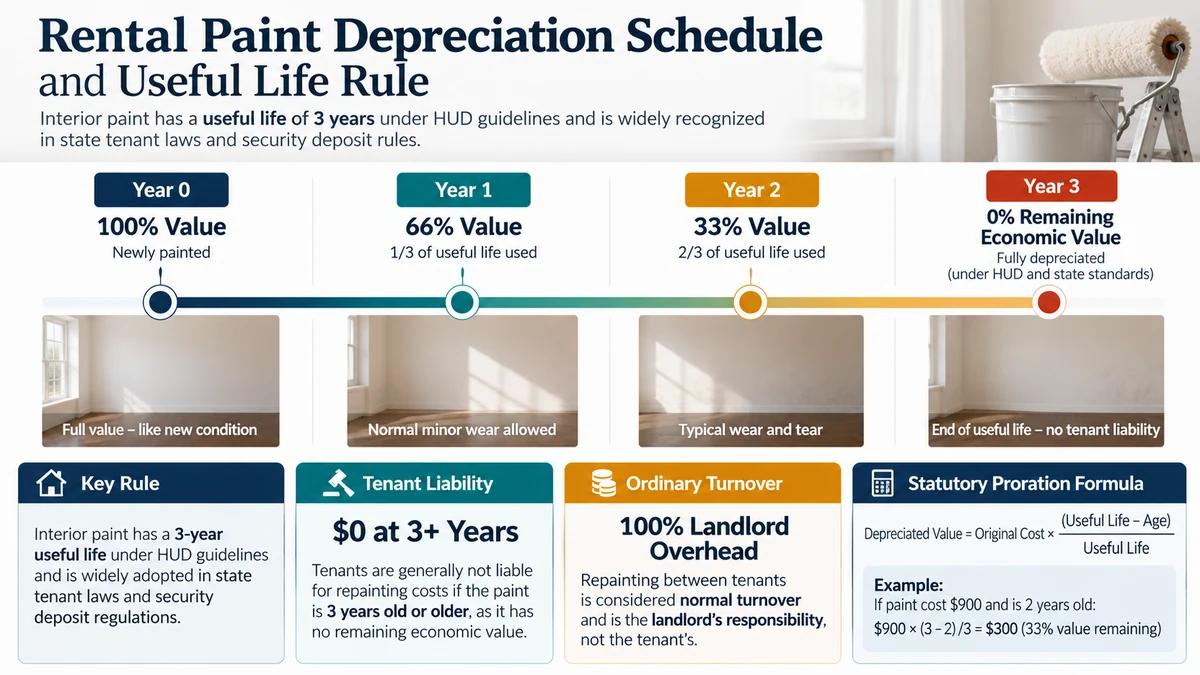
The Proration Formula
In jurisdictions that apply depreciation to rental property damage, allowable charges are calculated using this straight-line formula:
Example: Suppose paint has a recognized 3-year useful life in your local court. You lived in the apartment for 2 years (24 months). A damaged bedroom wall requires $400 in restoration.
- Remaining economic life = 3 years − 2 years = 1 year (33.3% remaining value).
- Allowable charge = $400 × 33.3% = $133.33.
- If the landlord deducted the full $400, they overcharged you by $266.67.
Does the Length of My Tenancy Matter?
Yes. The duration of your tenancy is one of the most critical factors considered by courts and hearing officers.
The longer you reside in a rental property, the more physical wear and tear is legally expected:
- Tenancy of 3+ Years: After three or more years of occupancy, walls naturally accumulate scuffs, fading, and pinholes from normal daily activities. In many jurisdictions, routine repainting after a long tenancy is considered standard landlord turnover overhead.
- Tenancy of 1 to 2 Years: Moderate wear is expected. Courts examine whether marks exceed what a reasonable occupant would produce in that timeframe.
- Tenancy of Under 1 Year: If walls were freshly painted when you moved in and require full repainting after only 6 months, landlords have a stronger argument that the deterioration exceeded normal wear—unless the damage pre-existed your tenancy or resulted from building defects.
Can My Landlord Charge Me for Paint Materials and Labor?
If a landlord establishes legitimate, tenant-caused damage beyond normal wear, what specific expenses can they include in the deduction?
Materials and Supplies
Landlords may charge for the actual, reasonable cost of materials needed to effect the repair—such as primer, latex paint, spackle, and sanding blocks. However, they must provide verifiable purchase receipts or supplier invoices showing the actual amounts paid. They cannot charge for leftover paint used on other properties or bill inflated retail markups.
Third-Party Professional Labor vs. Landlord Self-Labor
Who performed the painting work matters significantly:
- Independent Contractors: If the landlord hired a third-party painting company, they must provide a copy of the contractor's invoice detailing the hours billed, labor rate, and specific work completed.
- Landlord's Own Labor: When landlords repaint units themselves, courts do not allow them to charge whatever rate they please. Under statutes like California Civil Code § 1950.5(g)(2), if a landlord or their employee performs the work, they must document the specific tasks performed, the exact hours spent, and claim only a reasonable hourly rate consistent with local market wages for basic painting labor.
- Non-Recoverable Time: Landlords cannot charge tenants for time spent traveling to hardware stores, obtaining estimates, or inspecting the unit.
What If I Painted the Walls a Different Color?
Most standard residential lease agreements include an "Alterations and Improvements" clause requiring written landlord consent before painting or modifying walls. What happens if you painted a room without authorization?
The Landlord's Right to Restoration
If a tenant changes neutral walls to a bold, dark, or non-standard shade (such as navy blue, deep red, or black), the landlord is generally entitled to restore the walls to their original neutral condition. Because covering dark pigments requires specialized stain-blocking primers and multiple coats of latex, the landlord may legitimately deduct the reasonable restoration cost.
Limits on Restoration Charges
Even in cases of unauthorized color changes, landlord recovery is subject to important legal limitations:
- Unaffected Rooms: Painting one bedroom accent wall does not entitle the landlord to repaint the entire apartment at the tenant's expense.
- Written Permission: If your landlord approved the color change in writing (via email, text, or lease addendum) and did not condition approval on repainting upon surrender, they may have waived the right to deduct restoration costs.
- Incremental Cost Only: If the paint was already several years old and due for turnover painting anyway, the landlord is generally limited to charging only for the additional primer coats required to mask the dark color, rather than the entire baseline paint job.
What If the Paint Damage Was Already There When I Moved In?
A frequent frustration for tenants is being billed for peeling paint, chips, or scuffs that existed before they ever set foot in the rental.
A tenant is legally responsible only for damage caused during their tenancy. However, evidentiary rules and burdens of proof vary by state:
- Evidentiary Burdens: In small claims court, the party seeking to withhold deposit funds or establish a claim must produce sufficient credible evidence. If a tenant presents clear baseline move-in documentation showing that wall blemishes existed on day one, the landlord cannot legitimately deduct for those pre-existing conditions.
- Statutory Move-In Checklists (The Washington Example): In some states, a written move-in inspection is a mandatory statutory prerequisite. Under Washington State RCW 59.18.260, a landlord is prohibited from collecting or retaining a security deposit unless a written move-in condition checklist signed by both parties was completed at the start of the tenancy. In Washington, failing to complete this checklist forfeits the landlord's right to withhold deposit funds for damage.
To defeat claims of pre-existing paint damage in any jurisdiction, gather your signed move-in inspection checklist, timestamped move-in photos, and any early maintenance tickets where you reported wall or leak defects during your occupancy—see our guide on suing a landlord for refusing repairs.
Does My Lease Allow a Painting Charge? Mandatory Turnover Fees Explained
Many residential leases contain clauses stating: "Tenant agrees to pay a mandatory $400 repainting fee upon move-out regardless of wall condition," or "Tenant shall be responsible for professionally repainting the entire unit upon vacating."
Are these clauses legally enforceable? The answer depends heavily on your state's statutory framework:
States Voiding Mandatory Turnover Fees: Peebles v. JRK Property Holdings
In states with robust tenant protection acts, residential leases cannot contract away statutory rights:
Massachusetts Precedent: Peebles v. JRK Property Holdings, Inc.
Citation: Peebles v. JRK Property Holdings, Inc., 496 Mass. 389 (2025) (Massachusetts Supreme Judicial Court, accessible on Justia Law).
Facts: A large property management company deducted mandatory turnover cleaning and refurbishment fees from departing tenants' security deposits pursuant to express lease clauses.
Holding: The Massachusetts Supreme Judicial Court held that landlords cannot deduct for reasonable wear and tear, and that any lease provision requiring tenants to pay mandatory move-out refurbishment or turnover fees is void and unenforceable under Mass. Gen. Laws ch. 186, § 15B.
Fact-Specific Standard: The SJC clarified that determining wear and tear is an objective, fact-specific inquiry considering: (1) nature and cause of deterioration, (2) deterioration expected from reasonable residential use, (3) move-in condition, and (4) length of tenancy.
Important Note: This decision is binding Massachusetts precedent—it is persuasive in other states, but not nationwide binding law.
Similar non-waivable statutory protections exist in California (Cal. Civ. Code § 1953), New York (NY GOL § 7-108), and Washington (RCW 59.18.230)—for an in-depth breakdown of prohibited lease fees, see our guide on suing your landlord for illegal fees.
States Giving Deference to Contract Terms: Castillo-Cullather v. Pollack
Conversely, some jurisdictions give greater weight to freedom of contract:
Indiana Appellate Decision: Castillo-Cullather v. Pollack
Citation: Castillo-Cullather v. Pollack, 685 N.E.2d 478 (Ind. Ct. App. 1997).
Facts: An Indiana tenant challenged deductions from her security deposit for carpet cleaning and wall painting. The lease agreement explicitly provided that entire walls could be repainted to return them to "as new" condition if scuffs or marks were noted.
Holding: The Indiana Court of Appeals held that parties have freedom of contract to define maintenance standards and determine how damages are assessed. The court declined to shift the burden of proof to the landlord and upheld wall painting charges where the lease and move-out inspection documented wall marks.
Key Takeaway: There is no universal nationwide rule that every painting charge or lease term is automatically void. In some states, courts enforce agreed-upon lease restoration terms unless prohibited by explicit statute.
Does My Landlord Have to Give Me Receipts for a Painting Charge?
Whether a landlord must provide third-party receipts or contractor invoices depends entirely on state statute:
- Mandatory Receipt Jurisdictions: In states like California (Civ. Code § 1950.5(g)), landlords who deduct more than $125 must attach actual copies of third-party contractor invoices or material receipts. If the landlord or their employee performed the painting, they must include a written statement describing the work, hours worked, and reasonable hourly rate.
- Itemized List Without Receipts: In Texas (Tex. Prop. Code § 92.104) and Colorado, landlords are required to provide a detailed written itemization of deductions, but the statute does not universally mandate third-party invoices upfront—though receipts become critical evidence if the deduction is challenged in court.
- Good-Faith Estimates: Some states allow landlords to provide good-faith estimates if repairs cannot be completed within the statutory window, but require final paid invoices to be delivered once the work is concluded.
- Consequences of Non-Compliance: In jurisdictions with strict documentation deadlines, failing to provide required itemizations or receipts within the statutory timeframe (e.g., 14 to 30 days) can result in the landlord forfeiting the legal right to retain any portion of the deposit.
Landlord Evidence vs. Tenant Evidence: What Matters in a Dispute
When a painting deduction is disputed in negotiations or in Small Claims Court, outcomes depend on documentary evidence. Here is how evidence from both parties is evaluated:
| Evidence Category | What Landlord Needs to Prove | What Tenant Should Present | What the Evidence Establishes |
|---|---|---|---|
| Move-In Condition | Signed move-in report showing pristine walls with no prior marks. | Move-in photos, video walkthrough, and inspection checklist noting pre-existing chips. | Establishes the baseline condition before tenant occupancy began. |
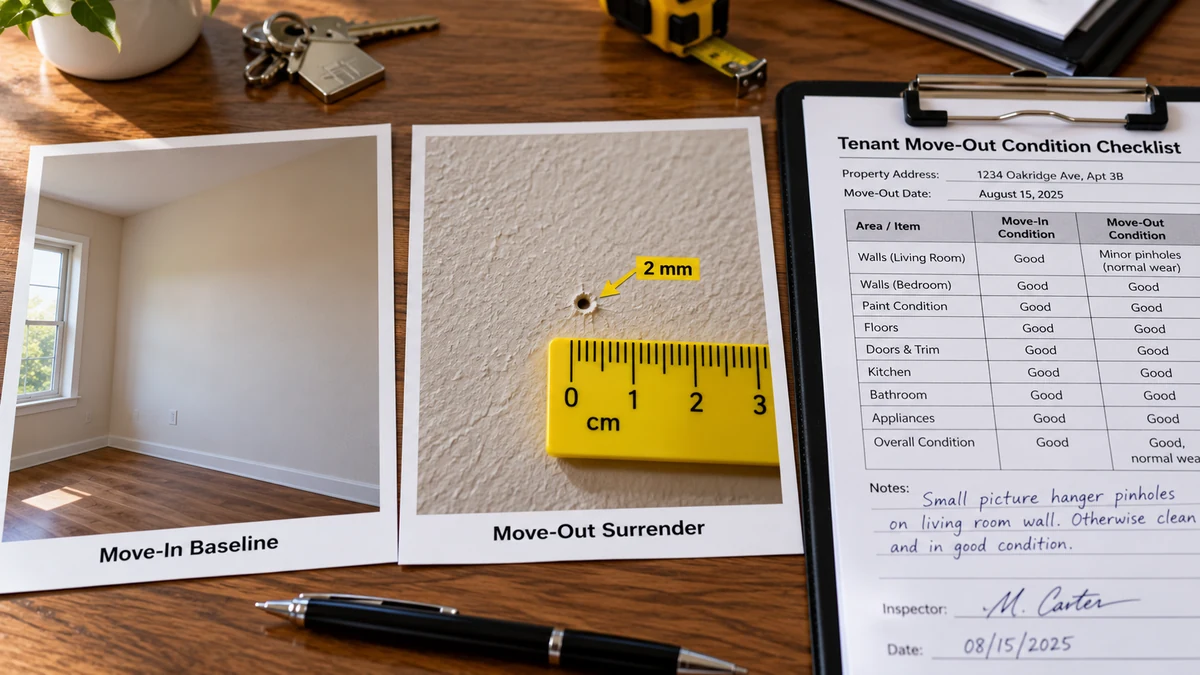
| Move-Out Condition | Photos of wall marks, gouges, or color changes taken at surrender. | Timestamped photos of clean walls, measuring tape showing small pinhole size. | Differentiates normal wear and tear from actionable physical destruction. |
| Scope of Work | Proof that repainting the full room/unit was reasonably necessary. | Photos proving marks were confined to one wall; unaffected rooms were clean. | Prevents landlord from claiming whole-unit renovation for localized issues. |
| Cost & Invoices | Third-party contractor invoice, receipt for paint, and hourly labor logs. | Proof landlord provided only an unsupported round-number estimate or no receipt. | Proves whether the deduction reflects actual, reasonable out-of-pocket costs. |
| Paint Age & History | Receipt showing date paint was originally applied before tenancy began. | Lease duration (e.g., 3 years of residency) showing paint exceeded useful life. | Establishes whether paint was already depreciated under local court guidance. |
Can I Prevent a Painting Charge Before Moving Out?
The most effective way to handle a painting deduction is to prevent it before handing over the keys:
- Request an Initial Pre-Move-Out Inspection: In states like California (Cal. Civ. Code § 1950.5(f)), tenants have a statutory right to request an initial walkthrough approximately two weeks before vacating. The landlord must provide an itemized list of identified repair issues, giving you time to remedy them before final surrender.
- Get Deficiencies in Writing: Ask the property manager to specify in writing any wall marks they consider beyond normal wear and tear.
- Exercise Caution with Spackle: A frequent mistake is filling small pinholes with mismatched white spackle without sanding or painting. Uneven spackle patches often create visible spots that give landlords a legitimate reason to repaint. If pinholes are tiny, wiping them clean is often better than creating conspicuous spackle blobs.
- Photograph and Video Walkthrough After Moving Furniture: Once all furniture, rugs, and artwork are removed, photograph every wall in bright daylight. Record a slow, continuous video walkthrough showing baseboards, trim, and wall surfaces.
- Confirm Key Handover in Writing: Return keys with a written statement noting that the premises were surrendered in good condition, and provide your formal forwarding address for security deposit return.
When Is a Painting Charge Worth Challenging vs. When Landlord Has Strong Claim?
Before escalating a dispute, assess the strength of each party's legal position:
Strong Tenant Case (Dispute Recommended)
- Charge is for natural sunlight fading or light furniture scuffs.
- Marks consist of modest nail holes from standard framed art.
- You resided in the rental for 3+ years and paint reached end of useful life.
- Pre-existing damage documented in move-in photos or checklist.
- Landlord charged for whole-apartment repaint for localized one-wall damage.
- Landlord failed to provide required invoices, receipts, or labor logs.
- Landlord missed the statutory security deposit return deadline.
- Lease contains an illegal mandatory turnover fee clause void by statute.
Strong Landlord Claim (Settlement Recommended)
- Tenant painted dark or bold colors without written permission.
- Multiple large drywall anchor holes or torn gypsum core.
- Heavy cigarette, cigar, or cannabis smoke residue and odor.
- Widespread crayon, marker, or grease stains across multiple rooms.
- Pet claw gouges on drywall, door frames, or baseboards.
- Short tenancy (e.g., under 1 year) with freshly painted baseline.
- Landlord provided detailed contractor invoices and photos of damage.
- Enforceable lease clause under state law allowing specific restoration charges.
How to Dispute a Landlord's Painting Charge (Step-by-Step)
If you determine that your painting charge was improper, follow this procedural roadmap to seek a refund:
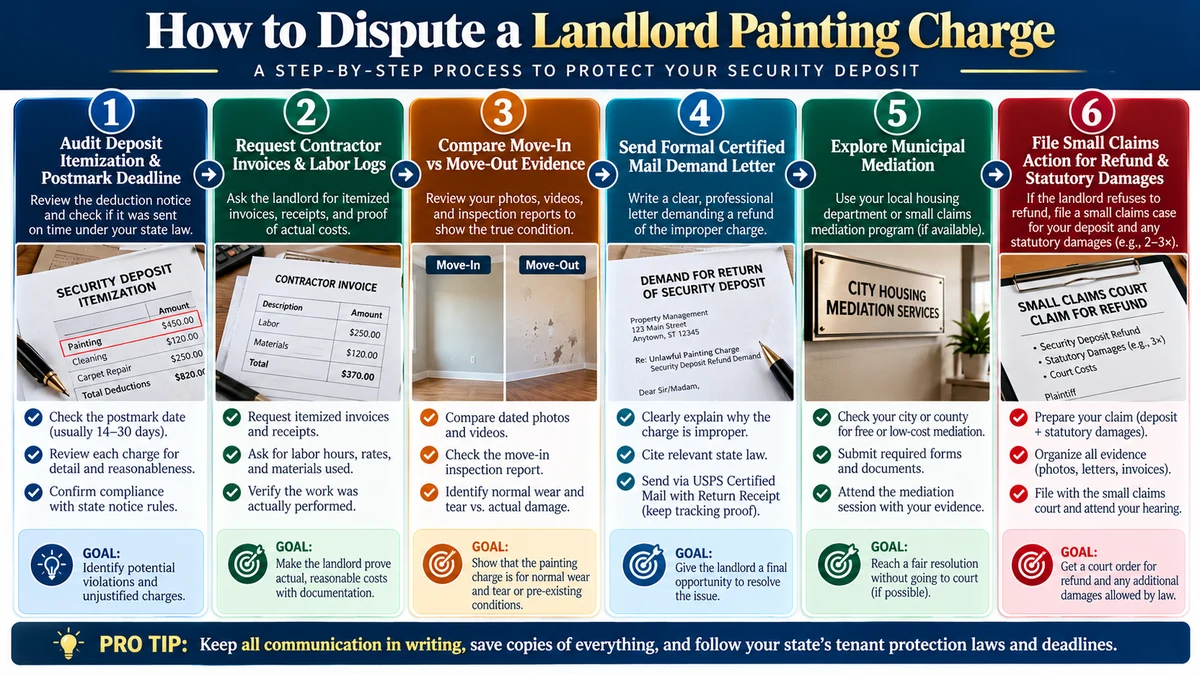
- Step 1 — Audit the Itemization and Postmark Deadline: Check the date your landlord delivered the security deposit statement. If they missed your state's statutory return deadline (e.g., 14 days in NY, 21 days in CA, 30 days in TX/WA), they may have forfeited the right to retain deductions—see our guide on security deposit return deadlines.
- Step 2 — Request Itemized Invoices and Labor Logs: Send a written request asking for copies of third-party contractor invoices, paint material receipts, and specific hours billed. Clarify that unsupported lump-sum charges are insufficient.
- Step 3 — Compare Move-In vs. Move-Out Evidence: Review your baseline photos, video walkthrough, and inspection checklist side-by-side with the landlord's claims to demonstrate that the condition represents normal wear or pre-existing deterioration.
- Step 4 — Audit Scope of Work and Depreciation: If the landlord repainted an entire apartment for minor localized scuffs, raise the duty to mitigate damages. If you lived there for multiple years, highlight useful-life proration where applicable.
- Step 5 — Check Applicable State Bad-Faith Penalties: Research whether your state provides statutory damages for bad-faith withholding (e.g., Texas Prop. Code § 92.109, Cal. Civ. Code § 1950.5(l)). If the deduction occurred following complaints about habitability, explore claims for unlawful landlord retaliation.
- Step 6 — Send a Formal Written Demand Letter: Send a polite, firm dispute letter via USPS Certified Mail with Return Receipt Requested, outlining your objections and requesting a refund within a reasonable timeframe.
- Step 7 — Explore Municipal Mediation: Many municipal housing departments and local court systems offer voluntary mediation programs that resolve deposit disputes without formal litigation.
- Step 8 — Evaluate Small Claims Litigation: If the landlord refuses to negotiate or refund the disputed amount, consider filing an action in Small Claims Court—consult our complete walkthrough on how to sue your landlord.
How to Write a Painting Charge Dispute Letter (Free Template)
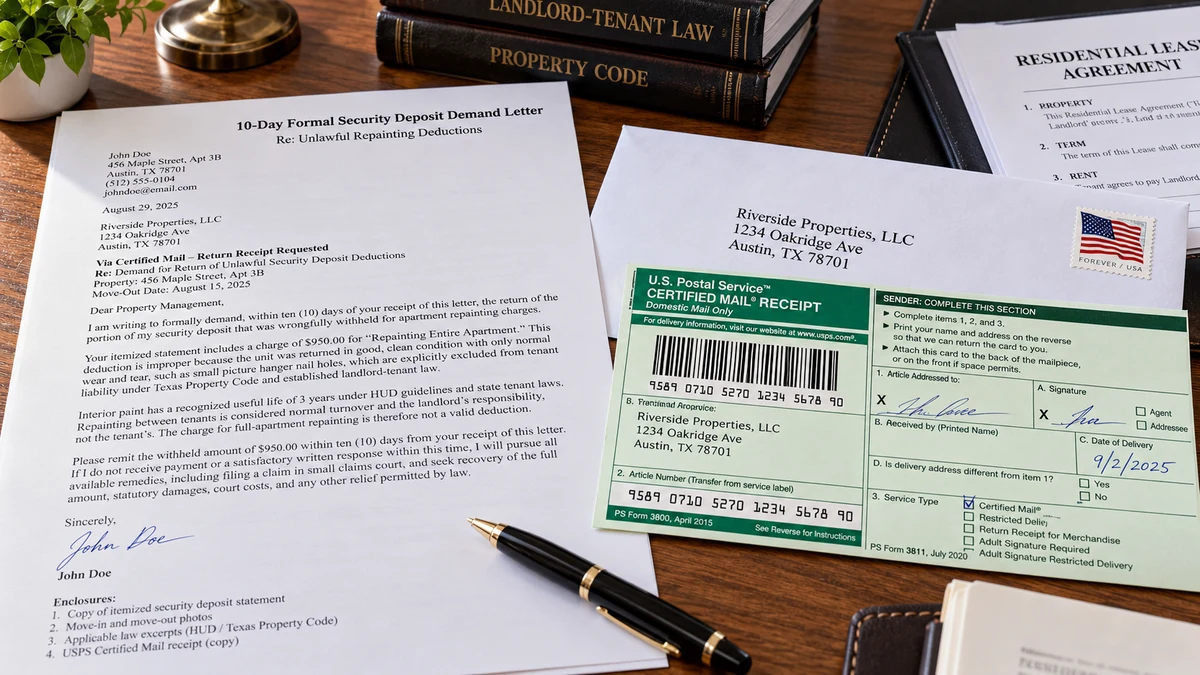
A formal written dispute letter sent via USPS Certified Mail creates a documented record of your objections, demonstrates that you acted reasonably, and provides evidence if the matter proceeds to court.
[Your Full Name]
[Your Current Mailing Address]
[Your Phone Number]
[Your Email Address]

[Date]

VIA USPS CERTIFIED MAIL — RETURN RECEIPT REQUESTED
[Landlord or Property Management Company Name]
[Landlord Mailing Address]
[City, State, ZIP Code]

RE: DISPUTE OF PAINTING DEDUCTION FROM SECURITY DEPOSIT
Rental Property: [Full Address of Rental Unit, including Unit #]
Tenancy Period: [Move-In Date] to [Move-Out Date]
Total Deposit Paid: $[Total Deposit Amount]
Amount Deducted for Painting: $[Amount Deducted for Painting]

Dear [Landlord or Property Manager Name],

I am writing to formally dispute the deduction of $[Amount Deducted for Painting] assessed against my security deposit for painting following my move-out on [Move-Out Date].

I dispute this charge for the following reasons:

1. Nature of Condition: The wall conditions at surrender consisted of ordinary residential wear and tear, including minor furniture scuff marks and small picture hanger pinholes, which are non-deductible under applicable landlord-tenant law.
2. Tenancy Duration: I resided in the rental property for [Number] years. Over this timeframe, ordinary fading and surface wear naturally occur through reasonable residential use.
3. Scope of Work: Repainting areas beyond those affected by tenant-caused damage exceeds reasonable restoration.
4. Documentation Request: The itemized statement did not include third-party contractor invoices, material purchase receipts, or an hourly labor log detailing the work performed.

REQUEST FOR DOCUMENTATION AND REFUND:
Please provide the following within a reasonable timeframe:
- An itemized explanation and calculation of the $[Amount Deducted for Painting] charge;
- Copies of paid third-party contractor invoices or material receipts;
- The specific lease provision relied upon for this deduction; and
- Photographic evidence comparing wall conditions at move-in versus move-out.

If this documentation cannot be provided, I request that you refund the disputed amount of $[Amount Deducted for Painting] to my forwarding address listed above by [Reasonable Date, e.g., 14 days from receipt].

If we cannot reach an amicable resolution, I reserve the right to pursue available remedies under applicable state landlord-tenant law, including filing a claim in Small Claims Court for the return of the deposit and any applicable statutory penalties and court costs.

Thank you for your prompt attention to this matter.

Sincerely,

_________________________________________
[Your Signature]
[Your Printed Full Name]
*Note: Do not send a dispute letter containing specific statutory citations or penalty claims until you verify the exact security deposit statute for your state.
When Can I Sue My Landlord Over a Painting Charge? Small Claims Guide
If your landlord ignores your dispute letter or refuses to refund an improper deduction, Small Claims Court is often the primary venue designed to resolve residential security deposit disputes.
How Small Claims Procedures Work
Small claims courts operate with simplified rules designed for self-represented individuals:
- Filing Fees: Filing fees typically range from $30 to $120 depending on county and claim amount. If you prevail, courts generally order the opposing party to reimburse court filing and process server fees.
- Jurisdictional Limits: Dollar limits vary by state—typically $5,000 to $15,000 (and up to $25,000 in Tennessee, but as low as $2,500 in Kentucky)—which is generally sufficient to cover disputed painting deductions and security deposits.
- Attorney Representation: Rules on attorneys differ: in states like California and Michigan, lawyers are generally prohibited from representing parties in small claims hearings (both parties represent themselves), while in other states attorneys are permitted.
- Timeline: Small claims hearings are typically scheduled within 30 to 90 days after service of process.
What You Must Prove in Court
To present a compelling claim before a small claims judge or magistrate:
- Establish that you paid a security deposit and surrendered the rental property.
- Show that the landlord deducted funds specifically for interior painting.
- Demonstrate through photos, video, checklists, or tenancy duration that the wall conditions constituted normal wear and tear, pre-existed your tenancy, or represented unmitigated betterment.
- Show that the landlord failed to provide required itemizations or receipts, missed statutory deadlines, or improperly withheld the funds.
What Could I Recover in Court? Statutory Damages & Multipliers
Tenants often assume they can only recover the exact dollar amount the landlord deducted. In reality, state security deposit statutes provide remedies to deter unlawful withholding:
- Return of the Withheld Principal: Full recovery of the disputed painting deduction that was wrongfully withheld—see our comprehensive guide on recovering withheld security deposits.
- Statutory Penalty Damages: Several states authorize statutory multipliers if the court finds that the landlord withheld funds in bad faith, willfully, or without statutory cause:
- California: Up to double the withheld amount in statutory bad-faith damages (Cal. Civ. Code § 1950.5(l)). Bad faith must be proven.
- New York: Up to double punitive damages if the landlord willfully violates the deposit statute (NY GOL § 7-108).
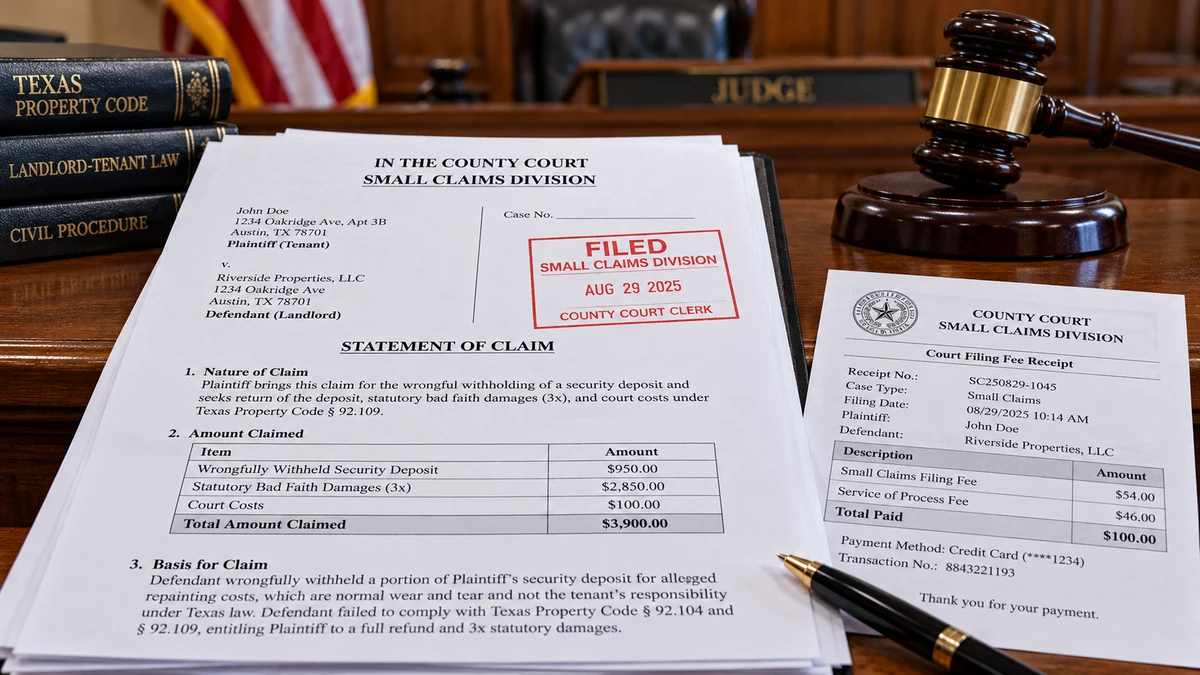
- Texas: $100 statutory penalty plus three times (3x) the amount wrongfully withheld (Tex. Prop. Code § 92.109). Bad faith is statutorily presumed if the landlord fails to provide an itemized list within 30 days.
- Colorado: Up to three times (3x) the amount wrongfully withheld plus attorney fees (C.R.S. § 38-12-103) following a written seven-day demand.
- Massachusetts: Treble damages (3x) plus interest and mandatory reasonable attorney fees (MGL c. 186 § 15B(7)).
- Court Filing and Service Fees: Prevailing parties typically receive judgment awards requiring the landlord to reimburse court costs.
- Attorney Fees Where Authorized: Several state statutes (such as Texas, Colorado, and Massachusetts) or bilateral lease reciprocity clauses authorize attorney fee awards to the prevailing tenant.
- Related Personal Property Claims: If painting contractors damaged your personal furniture, rugs, or electronics during work, you can join claims for compensation—see our guide on suing a landlord for property damage.
State-by-State Rules: Painting Deductions & Security Deposits
Because landlord-tenant law is fundamentally governed by state statute, accounting deadlines, receipt mandates, and penalty frameworks vary. Here is how representative states handle security deposit deductions for painting:
| State | Controlling Statute | Accounting Deadline | Documentation Requirements | Potential Remedies & Multipliers | Primary Source |
|---|---|---|---|---|---|
| California | Cal. Civ. Code § 1950.5 | 21 Calendar Days | Mandatory contractor invoices or hourly labor logs for deductions over $125 (§ 1950.5(g)). Initial walkthrough right (§ 1950.5(f)). | Up to 2x the withheld amount in statutory damages if bad faith is proven (§ 1950.5(l)). | Cal. Leg. Info |
| New York | NY GOL § 7-108; NYC Admin Code § 27-2013 | 14 Calendar Days | Itemized list and receipts required. Missing 14-day clock forfeits deductions. NYC multiple dwellings require repainting every 3 years. | Up to 2x punitive damages for willful retention under GOL § 7-108(1-a)(g). | NY Senate GOL |
| Texas | Tex. Prop. Code §§ 92.104, 92.109 | 30 Calendar Days | Written itemized list of deductions. Zero deduction for normal wear and tear permitted. | $100 + 3x treble damages plus reasonable attorney fees; bad faith legally presumed if deadline missed. | Texas Statutes |
| Colorado | Colo. Rev. Stat. § 38-12-103 (HB25-1249) | 30 to 60 Days (per lease) | Zero deduction for paint absent "substantial damage"; restricted to "minimum necessary" for specific damaged area. | Up to 3x treble damages plus reasonable attorney fees following 7-day notice. | Colo. Rev. Stat. |
| Washington | RCW 59.18.260, 59.18.280 | 30 Calendar Days | Zero deduction allowed without signed move-in condition checklist at lease inception; receipts mandatory. | Up to 2x the deposit amount plus court costs and reasonable attorney fees. | WA State RCW |
| Massachusetts | Mass. Gen. Laws ch. 186, § 15B | 30 Calendar Days | Sworn statement of damage with written estimates or receipts. Mandatory turnover fees void (Peebles). | 3x treble damages plus 5% interest and mandatory attorney fees (§ 15B(7)). | MA Gen. Laws |
| Florida | Fla. Stat. § 83.49(3) | 15 to 30 Days | Landlord must send written notice of claim via certified mail within 30 days specifying reasons. | Failure to send certified notice forfeits deposit claim; prevailing party attorney fees (§ 83.49(3)(c)). | FL Legislature |
| Indiana | Ind. Code § 32-31-3-12 | 45 Calendar Days | Written itemization of damages and estimated costs. Strong judicial deference to lease restoration terms (Castillo-Cullather). | Failure to deliver timely itemization forfeits deduction right and awards attorney fees. | Ind. Code § 32-31-3 |
Common Mistakes Tenants Make in Painting Disputes
Avoid these practical pitfalls when navigating a landlord's painting deduction:
Seven Critical Mistakes to Avoid
- Moving Out Without Dated Photos: Failing to take detailed, well-lit photos and video of all walls after furniture is cleared makes proving pre-existing condition vs. wear and tear much harder.
- Spackling Nail Holes with Mismatched Compound: Trying to patch pinholes with white spackle without sanding and paint matching often leaves visible spots that landlords cite as damage.
- Assuming Lease Clauses Are Always Enforceable: Accepting a landlord's claim that "the lease says you owe $400 for painting" without checking whether your state prohibits mandatory turnover fees.
- Disputing Charges Exclusively Over the Phone: Phone calls leave no written record. Always communicate in writing (email or USPS Certified Mail) to create a paper trail for court.
- Failing to Demand Invoices and Receipts: Many landlords retract arbitrary deductions when asked to produce third-party contractor invoices because no contractor was ever hired.
- Forgetting to Provide a Forwarding Address: In states like Texas and Florida, the landlord's return deadline does not begin ticking until the tenant provides a written forwarding address.
- Waiting Past the Statute of Limitations: While contract breach deadlines generally range from 2 to 6 years, disputing charges promptly within 14 to 60 days produces the highest likelihood of resolution.
How Much Can You Recover for Illegal Painting Deductions?
When taking your landlord to Small Claims Court or Housing Court, financial recovery is determined by statutory damages categories, proven out-of-pocket losses, and rent reduction formulas:
| Recovery Category | Calculation Standard | Statutory Authority & Limits |
|---|---|---|
| 1. 100% Refund of Improper Deduction | Full refund of all deposit monies withheld for painting walls that suffered only ordinary scuffs or normal wear and tear. | State Security Deposit Acts (e.g., Cal. Civ. Code § 1950.5; NY GOL § 7-108). |
| 2. Bad-Faith Multiplier Penalties | If the landlord acted in bad faith, courts award statutory damages of up to 2x (California) or 3x (Texas, Massachusetts) the withheld amount. | Tex. Prop. Code § 92.109; M.G.L. c. 186 § 15B. |
| 3. Court Filing & Service Fees | Recovery of small claims court filing fees and certified process server costs. | Prevailing party statutory court costs. |
Small Claims Filing Limits: Most tenants resolve these disputes without hiring an attorney in Small Claims Court. Maximum claim limits vary by state: for example, $12,500 in California (California Courts Self-Help), $10,000 in New York City (NY Courts Small Claims), and $20,000 in Texas (Texas Judicial Branch). If your total damages exceed small claims thresholds, you may file in standard civil district court.
Frequently Asked Questions About Landlord Painting Charges
A landlord can only legally charge you for painting if the walls suffered damage exceeding normal wear and tear, or if you made unauthorized alterations such as painting unapproved colors. A landlord cannot legally charge you for routine turnover painting or natural weathering resulting from ordinary residential living.
Yes, routine repainting required by natural sunlight fading, minor furniture scuffs, and small picture nail holes is generally considered normal wear and tear. Landlords must absorb routine turnover repainting as an ordinary cost of operating rental housing.
A landlord may deduct painting costs from your security deposit only if there is legitimate tenant-caused damage (such as large anchor holes, gouges, smoke residue, or unauthorized paint colors) and the deduction is supported by required statutory itemizations and receipts under state law.
There is no fixed national dollar amount. In cases of actionable damage, a landlord may only charge the reasonable, actual cost to restore the specific affected area. In jurisdictions that apply depreciation principles, charges must also be prorated based on the remaining useful life of the paint.
Generally no. Under the common-law duty to mitigate damages and specific statutes (such as Colorado C.R.S. § 38-12-103), landlords are expected to repair only the damaged area or room. Repainting unaffected rooms constitutes an unmitigated capital improvement that courts routinely disallow.
It depends on state law. In California (Civ. Code § 1950.5(g)), New York, and Washington, landlords must provide copies of third-party contractor invoices or hourly labor logs for deductions above statutory thresholds. In other states, a written itemization is required, with receipts becoming necessary evidence if challenged.
In jurisdictions, agencies (such as California DCA guidance), and small claims courts that apply useful-life schedules, residential interior paint is typically evaluated on a 2- to 3-year useful lifespan. After several years of tenancy, remaining economic paint value is substantially reduced or zero, limiting what a landlord may claim.
Yes. If your landlord improperly deducted painting costs from your security deposit, you can file a claim in Small Claims Court to recover the withheld funds. In several states, if bad faith or willful violation is established, you may also be awarded statutory damages of double or triple (2x to 3x) the withheld amount plus court costs.
Painting Charge Dispute Checklist
Use this practical checklist to organize your dispute:
Tenant Action Checklist
- Verify Return Deadline: Did the landlord deliver the deposit accounting within your state's statutory window (14–60 days)?
- Review Move-In Documentation: Check your move-in checklist, photos, and video for pre-existing wall marks.
- Review Move-Out Photos: Verify your move-out photos show wall marks consist of normal wear and tear.
- Check Tenancy Duration: Calculate your occupancy length to assess expected wear and tear and useful-life proration.
- Request Contractor Invoices: Ask the landlord in writing for paid receipts, invoices, and labor logs.
- Challenge Full-Apartment Overreach: If billed for the entire unit, cite mitigation rules and restrict scope to affected areas.
- Send Formal Dispute Letter: Mail a written dispute letter via USPS Certified Mail with Return Receipt Requested.
- Evaluate Small Claims Court: If unresolved, file in Small Claims Court for deposit refund and applicable statutory penalties.
Conclusion: Protecting Your Rights and Security Deposit
Receiving a security deposit statement with a steep painting deduction is common, but it does not mean the charge is lawful. Landlords are legally required to absorb ordinary wear and tear, and in many jurisdictions, they cannot pass routine turnover refurbishments onto departing tenants.
By applying a structured framework, understanding how your state treats security deposit deductions, and presenting clear photographic and documentary evidence, you can effectively dispute improper painting charges and recover your funds.
For additional procedural guidance on tenant rights, explore our related guides on withheld security deposits, illegal landlord fees, breach of lease claims, and our master guide to suing your landlord in small claims court.
SueLegal is an independent educational legal publisher, not a law firm or lawyer referral service. The information provided in this guide is for general informational and educational purposes only and does not constitute formal legal advice. Residential landlord-tenant laws, repair notice periods, and statutory remedies vary significantly across state and municipal jurisdictions. If you are facing eviction, severe uninhabitable conditions, or complex litigation, consult a licensed attorney in your jurisdiction or contact your local legal aid organization. For more details on our standards, read our Editorial Policy and Legal Research Methodology.