

Yes, you can sue your landlord for breaching your lease—and contract lawsuits have one of the longest filing windows in the law (4 to 6+ years).
A residential lease is a binding two-way contract. If your landlord breaks either a written promise in your lease (like taking away a parking spot, washer/dryer, or included utility, adding mid-lease fees, or failing to deliver the apartment on move-in day) OR an automatic legal promise (like keeping the home safe, repaired, and peaceful), you can sue in Small Claims or Civil Court to recover:
- Lost Amenity & Diminished Value Refunds ($1,000 to $10,000+): The exact monthly market value of any promised parking spot, garage, yard, storage unit, pool/gym, or appliance taken away—plus a 20% to 75% rent reduction for unfixed habitability breaches.
- 100% Refund of Illegal Mid-Lease Fees, Rent Hikes & Utility Bills: Every dollar your landlord forced you to pay above the locked price in your signed fixed-term lease.
- Move-In Day & Lease-Break Damages: Full return of your security deposit, prepaid rent, hotel bills, moving/storage truck fees, and the monthly rent difference if the landlord's material breach forced you to rent a more expensive apartment.
- 100% of Your Lawyer's Fees: If your lease contains an attorney-fee clause, most states allow you to force the landlord to pay your legal bills when you win.
Important Things to Know
- Your Landlord Cannot Change the Rules or Add Fees in the Middle of a Fixed Lease: Once you sign a 12-month lease, your rent price, parking, pet rules, and included utilities are locked in. A landlord cannot invent a mandatory $40 "Valet Trash" or "Resident Benefit Package" fee mid-lease without your written agreement.
- If They Take Away a Promised Amenity, They Owe You the Replacement Cost: Did your lease include a parking spot, in-unit laundry, dishwasher, or Wi-Fi that the landlord took away or refused to fix? Under contract law, you can sue for the exact cost of replacing that service out of pocket (like a nearby paid parking lot or wash-and-fold laundry service) for every month of the breach.
- Apartment Not Ready on Move-In Day? You Can Cancel & Sue for Hotel + Moving Costs: If you show up with a moving truck on the start date written in your lease and the apartment isn't ready (or the old tenant hasn't left), the landlord has committed a Material Breach for Failure to Deliver Possession—entitling you to cancel immediately or sue for your hotel, storage, and moving bills.
- Check Your Lease for the "Lawyer Fee Boomerang": Almost every landlord puts a one-sided attorney-fee clause in their lease. In states like California (Civ. Code § 1717), New York (RPL § 234), Florida (§ 57.105), and Washington (RCW 4.84.330), the law automatically flips that clause so the landlord must pay your lawyer's fees when you sue them for breaching the lease!
- You Have 4 to 6+ Years to Sue for a Written Lease Breach: Even if you already moved out a year or two ago, the statute of limitations for a written contract is 4 years in CA and TX, 5 years in FL, 6 years in NY, NJ, MA, and WA, and 10 years in IL—giving you plenty of time to take your former landlord to Small Claims Court.
The 6 Most Common Ways Landlords Breach a Lease (And What You Can Sue For)
When most renters think about taking legal action against a property owner, they picture broken heaters or toxic black mold. While unaddressed housing hazards are serious, a residential rental agreement is first and foremost a binding contract. If your landlord breaks a promise written directly into your agreement, you do not have to prove that your apartment is unlivable to win a lawsuit in Small Claims or Civil Court.
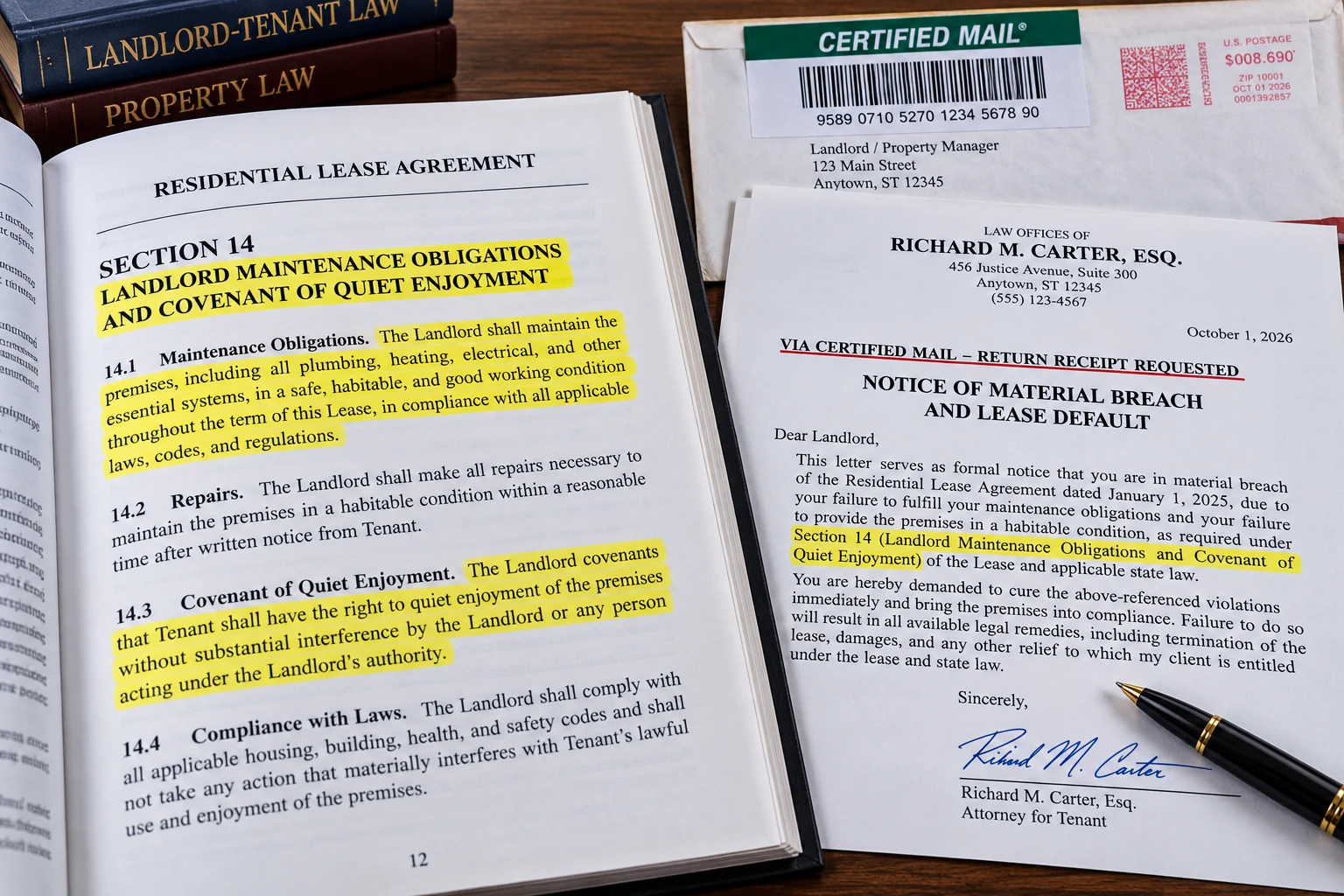
Contract claims fall into two clear legal categories: Express Breaches and Implied Breaches. An express breach happens when your landlord violates a specific term typed into your lease agreement—such as taking away your assigned parking space, charging you an unlisted administrative fee, or locking you out of the on-site gym. An implied breach happens when a landlord breaks promises automatically created by state law, such as the Warranty of Habitability and the Covenant of Quiet Enjoyment.
| How Landlord Breached the Lease | Type of Contract Breach | What You Can Sue For in Court | Penalty-Free Lease Break? |
|---|---|---|---|
|
1. Taking Away a Promised Amenity Parking spot, garage, in-unit washer/dryer, storage cage, private yard, pool, or gym access. |
Express Breach of Written Lease | 100% of monthly replacement costs ($150–$350/mo for paid parking or $80/mo for laundry) plus a 10% to 20% rent reduction for lost convenience. | Usually a money refund claim, unless the amenity was central to the rental agreement (like an elevator for a disabled tenant). |
|
2. Adding New Monthly Junk Fees or Raising Rent Mid-Lease Valet trash fee, online portal charge, or cutting off lease-included water/Wi-Fi. |
Express Breach of Fixed-Term Price Lock | 100% refund of every uncontracted dollar or utility bill you paid under protest during the fixed term, plus statutory interest. | You can refuse to pay the fee while paying base rent, or sue for reimbursement. |
|
3. Apartment Not Ready on Move-In Day Prior tenant still inside, unfinished renovations, or unit filthy and uninhabitable. |
Failure to Deliver Possession (Material Breach) |
Zero rent owed while displaced, 100% refund of deposit and prepaid rent, hotel bills, moving/storage fees, and up to 2x rent penalties in URLTA states. | YES — Immediately on Day 1 with a complete refund of all funds paid. |
|
4. Ignoring Major Repairs No heat, plumbing leaks, raw sewage, toxic mold, rodent infestations, or faulty wiring. |
Breach of Implied Warranty of Habitability | 25% to 75%+ retroactive rent refund, damaged personal belongings, emergency hotel bills, and statutory repair-and-deduct costs. | YES (after sending formal written notice and allowing statutory cure window). |
|
5. Unannounced Walk-Ins, Harassment, or Severe Noise Landlord entering without 24-hour notice, stalking, or tolerating severe neighbor disruption. |
Breach of Implied Covenant of Quiet Enjoyment | 20% to 50% rent refund plus state statutory penalties ($100 to 3x monthly rent per violation). | YES (under Constructive Eviction if landlord refuses to stop). |
|
6. Renting an Illegal / Unpermitted Unit Basement, attic, or converted garage lacking a valid Certificate of Occupancy. |
Illegal / Void Contract (Unenforceable by Landlord) |
Mandatory relocation assistance (up to 6x rent in NJ; statutory relocation in CA/NY), 100% deposit return, and rent disgorgement. | YES — Immediately (the law prohibits landlords from collecting rent on illegal dwellings). |
Did Your Landlord Take Away Parking, Laundry, Utilities, or Add Mid-Lease Fees? (How Contract Math Works)
When tenants complain about a broken in-unit washing machine or a lost parking space, property management companies frequently brush them off with the same tired excuse: "A broken dishwasher or lost parking space is not an emergency, so you still owe full rent on the first of the month."
This statement relies on confusing habitability emergencies with basic contract law. Under the legal doctrine of Benefit of the Bargain, you agreed to pay your monthly rent in exchange for a complete bundle of housing goods and services. If your lease agreement specifies an assigned parking space, working major appliances, or landlord-paid water and trash, the property owner cannot unilaterally subtract items while keeping your rent unchanged.
How Judges Calculate Expectation Damages in Small Claims Court
Contract law does not require you to prove physical illness or emotional trauma to collect money damages. Instead, the court calculates what it costs to put you in the exact financial position you would have enjoyed if the landlord had honored their word:
- Lost Parking Spot or Garage ($125 to $350 per month): If your landlord re-assigns your parking space or locks your garage, gather pricing sheets from nearby commercial garages or platforms like SpotHero. The court awards the actual commercial cost of replacing that spot for every month you were deprived, plus reimbursement for any street-sweeping or parking tickets you received due to the loss.
- Broken In-Unit Washer/Dryer or Dishwasher ($75 to $150 per month): If an appliance listed in your agreement sits broken for months, keep every laundromat receipt, drop-off wash-and-fold invoice, and delivery fee. Judges routinely award the actual out-of-pocket laundry costs plus a 10% to 15% rent abatement for the loss of residential convenience.
- Illegal Mid-Lease "Junk Fees" or Shifted Utility Charges: Landlords cannot introduce new fees during a fixed 12-month lease without your written consent. If management suddenly adds a $45 monthly valet trash fee or portal service charge, pay the charge with an attached note stating: "Paid strictly under protest to preserve housing; fee violates Section [X] of our fixed-term lease." You can then sue in Small Claims Court for a 100% refund of all fees paid under protest.
If the landlord falsely advertised features during leasing that never materialized, you may also have claims for landlord false advertising and deceptive trade practices, which in many states carry statutory double or triple damage multipliers.
Move-In Day Nightmare: What If the Apartment Isn't Ready on the Start Date of Your Lease?
Few rental situations create more immediate financial distress than arriving at your new apartment with a packed moving van on lease start day, only to be told that the previous tenant refused to move out or that renovations will take another three weeks. Because you gave up your prior home, you face immediate lodging and storage emergencies.
Under residential contract law across all 50 states, the landlord has an affirmative obligation to deliver physical possession of the property on the agreed date. Failing to turn over the keys constitutes a Material Breach for Failure to Deliver Possession, unlocking three immediate legal rights:
- Zero Rent Owed During Any Period of Non-Delivery: Your obligation to pay rent does not start until the landlord delivers keys to a habitable property. If you paid first month's rent in advance, the landlord must credit or refund every single day you were barred from entering.
- Option A: Cancel the Lease Immediately with Full Refund: Under statutes like New York Real Property Law § 223-a, Florida Statutes § 83.54, Texas Property Code § 92.052, and the Uniform Residential Landlord and Tenant Act (URLTA) § 4.102, you can terminate the contract immediately via written notice. The landlord must return 100% of your security deposit and prepaid rent without deducting any processing or administrative fees.
- Option B: Sue for Hotel Bills, Moving Delays, and Replacement Rent: Whether you wait for the property or secure another rental, you can sue the landlord for actual consequential damages. Recoverable items include emergency hotel bills, moving truck delay fees, furniture storage lockers, and the difference in monthly rent if you are forced to rent an alternative apartment at a higher price.
In states operating under the Uniform Residential Landlord and Tenant Act (such as Arizona under A.R.S. § 33-1362 and Oregon under ORS 90.370), if the landlord's failure to deliver possession was willful or in bad faith—such as renting the same unit to another applicant for higher rent—the tenant can recover two months' rent or twice the actual damages sustained, alongside reasonable attorney fees.
If you were locked out after already taking possession, see our guide on how to sue your landlord for an illegal eviction and lockout fines.
The "Lawyer Fee Boomerang" & Long Filing Deadlines (Two Huge Advantages of Contract Lawsuits)
Tenants often hesitate to hire a contract attorney because they assume legal fees will exceed their small claims recovery. However, contract lawsuits provide two unique strategic advantages that level the playing field against corporate property management companies.
Secret #1: How State Law Flips One-Sided Attorney Fee Clauses
Open your rental agreement and check the section titled "Attorney's Fees" or "Enforcement Costs." Landlords routinely draft this clause to protect themselves: "If Landlord brings legal action against Tenant to enforce terms of this Lease, Tenant shall reimburse Landlord for all reasonable legal fees."
What property managers fail to mention is that multiple state legislatures have passed reciprocal fee statutes. In states like California (Cal. Civ. Code § 1717), New York (NY Real Prop. Law § 234), Florida (Fla. Stat. § 57.105(7)), Washington (RCW 4.84.330), and Oregon (ORS 20.096), any one-sided attorney fee clause in a residential lease becomes reciprocal by law. If you prevail in a breach-of-lease action against your landlord, the judge will order the landlord to pay 100% of your attorney fees.
Secret #2: You Have 4 to 10 Years to File a Written Contract Claim
Personal injury and property negligence claims generally carry strict two-year statutes of limitations. By contrast, written contract actions allow tenants years to file suit, even long after moving out and receiving their initial security deposit accounting.
| Jurisdiction | Statute of Limitations (Written Lease) | Oral or Verbal Lease Agreement |
|---|---|---|
| California | 4 Years (Cal. Civ. Proc. Code § 337) |
2 Years (§ 339) |
| Texas | 4 Years (Tex. Civ. Prac. & Rem. Code § 16.004) |
4 Years |
| Florida | 5 Years (Fla. Stat. § 95.11(2)(b)) |
4 Years |
| New York, New Jersey, Massachusetts, Washington, Oregon, Georgia & Michigan | 6 Years (NY CPLR § 213(2); N.J.S.A. 2A:14-1) |
3 to 6 Years |
| Illinois, Ohio & Missouri | 6 to 10 Years (10 Years in IL under 735 ILCS 5/13-206) |
4 to 5 Years |
For broader strategies regarding security deposit recovery after vacating, review our breakdown on how to sue your landlord for withholding your deposit.
What If Your Landlord Rented You an Illegal Basement, Garage, or Unpermitted Apartment?
A surprising number of renters discover midway through their lease that their unit is illegal. Converted garages, uninspected basement suites, and subdivided single-family dwellings often lack a municipal Certificate of Occupancy, fire egress routes, or separate utility metering.
Under foundational contract principles, a contract executed for an illegal purpose or in direct violation of municipal building codes is void and unenforceable from inception. This legal reality provides tenants with decisive advantages:
- Immediate Penalty-Free Lease Rescission: Because the contract is legally void, the landlord cannot enforce early-termination fees, sue you for future rent, or report lease defaults to credit reporting bureaus when you move out.
-
Mandatory Municipal Relocation Assistance: In New Jersey (
N.J.S.A. 2A:18-61.1g & 61.1h), if an order of removal occurs because a dwelling violates zoning or safety codes, the landlord must pay the displaced tenant six times the monthly rent in relocation compensation before displacement. In rent-stabilized California jurisdictions (Los Angeles, San Francisco, Berkeley, and Oakland), landlords renting unpermitted units owe thousands of dollars in statutory relocation assistance, plus complete return of security deposits. - Full Return of Held Security Deposits: Courts uniformly hold that landlords operating unpermitted residences cannot withhold deposits for wear and tear, and in some jurisdictions, tenants can pursue full disgorgement of rent collected on illegal dwellings.
For a detailed analysis of tenant rights across general rental disputes, consult our complete guide on suing your landlord for tenant rights violations.
Ready-to-Send Breach of Lease Notice to Cure & Contract Demand Letter (With Copy Button)
Sending a formal demand letter via certified mail with return receipt requested creates an indisputable evidentiary paper trail for Small Claims Court. Select the appropriate notice template below based on your current tenancy plans.
How Much Can I Recover for Landlord Breach of Lease?
When pursuing a legal claim against your landlord in Small Claims Court or Housing Court, financial recovery is determined by statutory damages categories, proven out-of-pocket losses, and rent reduction formulas:
| Recovery Category | Calculation Standard | Statutory Authority & Limits |
|---|---|---|
| 1. Expectation Damages | Difference between the market value of the premises as promised versus the premises as delivered (loss of parking, storage, gym). | Contract law expectation interest (Restatement (Second) of Contracts § 347). |
| 2. Consequential Out-of-Pocket Losses | Foreseeable financial costs incurred due to the landlord's breach (e.g., parking tickets from unprovided assigned spot). | Hadley v. Baxendale contract rule. |
| 3. Mutual Rescission & Deposit Refund | Immediate cancellation of lease agreement and return of all security deposits and prepaid rent. | Material breach contract remedies. |
Small Claims Filing Limits: Most tenants resolve these disputes without hiring an attorney in Small Claims Court. Maximum claim limits vary by state: for example, $12,500 in California (California Courts Self-Help), $10,000 in New York City (NY Courts Small Claims), and $20,000 in Texas (Texas Judicial Branch). If your total damages exceed small claims thresholds, you may file in standard civil district court.
Frequently Asked Questions
A Material Breach strikes at the core foundation of the rental agreement, defeating the entire purpose of renting the home. Examples include failing to deliver keys on move-in day, leaving a tenant without heat or running water for weeks, or illegally locking a tenant out. A material breach allows you to terminate the lease immediately with zero penalty and sue for full damages. A Minor Breach involves a secondary contract term—such as taking away a storage locker, delaying repair of a dishwasher, or charging an improper $35 administrative fee. A minor breach generally does not justify walking away from the lease, but it entitles you to stay in the home and sue in Small Claims Court for the exact monetary value of the broken promise.
No. A fixed-term lease locks in your monthly rental payment and agreed services for the entire contract term. Unless your agreement contains a specific, lawful escalation clause that you explicitly signed at lease inception, the landlord cannot increase rent, introduce mandatory "valet trash" or "online resident portal" charges, or reassign utility obligations until the lease expires.
Yes. Even though luxury amenities like a swimming pool, covered parking stall, or in-unit laundry may not be required by local health and housing codes, including them in a signed lease makes them legally binding contract terms. If the landlord revokes access or refuses repairs, you can sue in Small Claims Court for the diminished rental value of the apartment or your actual replacement expenses, such as commercial parking fees or laundromat receipts.
Most residential agreements contain an Integration Clause stating that only terms written in the contract are enforceable. However, you can still enforce prior representations if you have written evidence—such as emails, text messages, or screenshots of the original rental advertisement—proving Fraudulent Inducement or deceptive marketing. Furthermore, oral promises involving basic habitability and life-safety repairs are non-waivable under state law regardless of what the written contract says.
Do not withhold rent for non-emergency contract disputes, such as a revoked parking space, a broken appliance, or a disputed $50 fee. Unilateral rent withholding allows the landlord to serve an eviction notice for non-payment, putting your tenancy and credit score at risk. Instead, continue paying your base rent on time, note "Paid Under Protest" on disputed charges, and file a low-cost claim in Small Claims Court to recover your financial damages safely.
SueLegal is an independent educational legal publisher, not a law firm or lawyer referral service. The information provided in this guide is for general informational and educational purposes only and does not constitute formal legal advice. Residential landlord-tenant laws, repair notice periods, and statutory remedies vary significantly across state and municipal jurisdictions. If you are facing eviction, severe uninhabitable conditions, or complex litigation, consult a licensed attorney in your jurisdiction or contact your local legal aid organization. For more details on our standards, read our Editorial Policy and Legal Research Methodology.