
The Short Answer
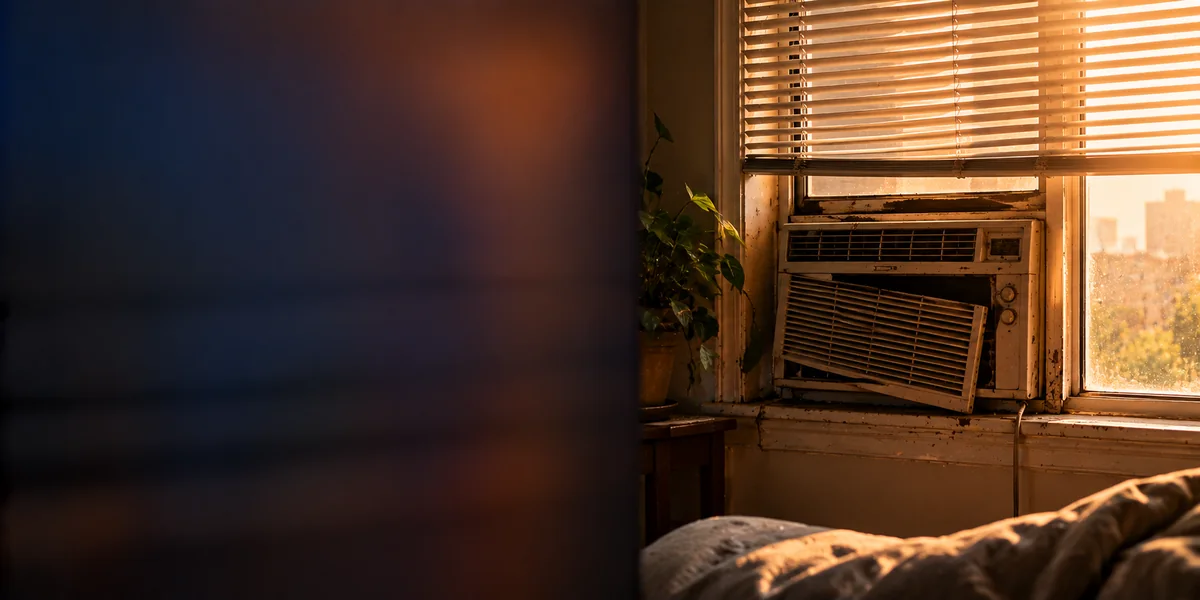
Yes, you can sue your landlord for a broken air conditioner.
Whether your case falls under emergency safe-housing laws (in hot states and cities like Arizona, Nevada, and Texas) or breach of lease contract (in any state where the apartment came with working AC when you moved in), your landlord cannot charge you 100% rent while leaving you sweltering with a broken AC. You can take your landlord to Small Claims Court to recover:
- A 25% to 100% Rent Refund for every week or month your AC was broken during warm weather.
- Portable AC Unit, Fan & Hotel Reimbursements if high indoor heat forced you to buy cooling gear or sleep at a hotel (up to 125% of monthly rent in states like Arizona).
- Your Summer Electric Bill Spike if a failing AC unit ran non-stop blowing warm air and doubled or tripled your electric bill.
- Spoiled Food, Ruined Medicine & Vet/Medical Bills caused by extreme indoor temperatures.
Key Points to Know
- If the Apartment Came With AC When You Moved In, the Landlord Must Fix It: Don't fall for a landlord in Florida, California, or North Carolina claiming "State law doesn't require AC." If the unit had working AC when you signed the lease, keeping it working is part of your rental contract!
- Know the "82°F to 85°F Maximum Indoor Temp" Rule: In cities like Phoenix (
82°F), Dallas (85°F), Houston (85°F), Austin (85°F), and Montgomery County, MD (80°F), if your AC cannot cool your rooms down to the city's legal maximum temperature, it is officially broken under city code—even if cool-ish air is barely coming out of the vent. - In Arizona & Nevada, You Only Have to Wait 48 Hours to 5 Days: Under Nevada law (
NRS 118A.380, 48 hours) and Arizona law (A.R.S. § 33-1364, 5 days), broken summer AC is an emergency. You can buy a portable window AC and deduct the receipt from rent, or check into a hotel and charge the landlord. - Make the Landlord Pay for Your $350 "Broken AC Electric Bill Spike": When an air conditioner leaks refrigerant or has a bad compressor, it runs 24 hours a day without cooling the apartment—causing your electric bill to jump by $150 to $300+. You can sue your landlord for 100% of that extra electricity cost.
- A Quick Doctor's Note Makes Broken AC an Emergency in All 50 States: If high heat worsens asthma, COPD, heart problems, pregnancy, or medication side effects, handing your landlord a doctor's note triggers federal Fair Housing Act rules—requiring urgent repair, portable units, or penalty-free lease cancellation nationwide.
State & City Air Conditioning Laws Lookup Table (Maximum Indoor Temps & Deadlines)
Air conditioning laws vary widely across the United States. In southern and desert regions, functioning air conditioning is classified as a mandatory essential service on par with running water or winter heat. In more temperate states, cooling rights are enforced under residential contract principles and lease warranties.
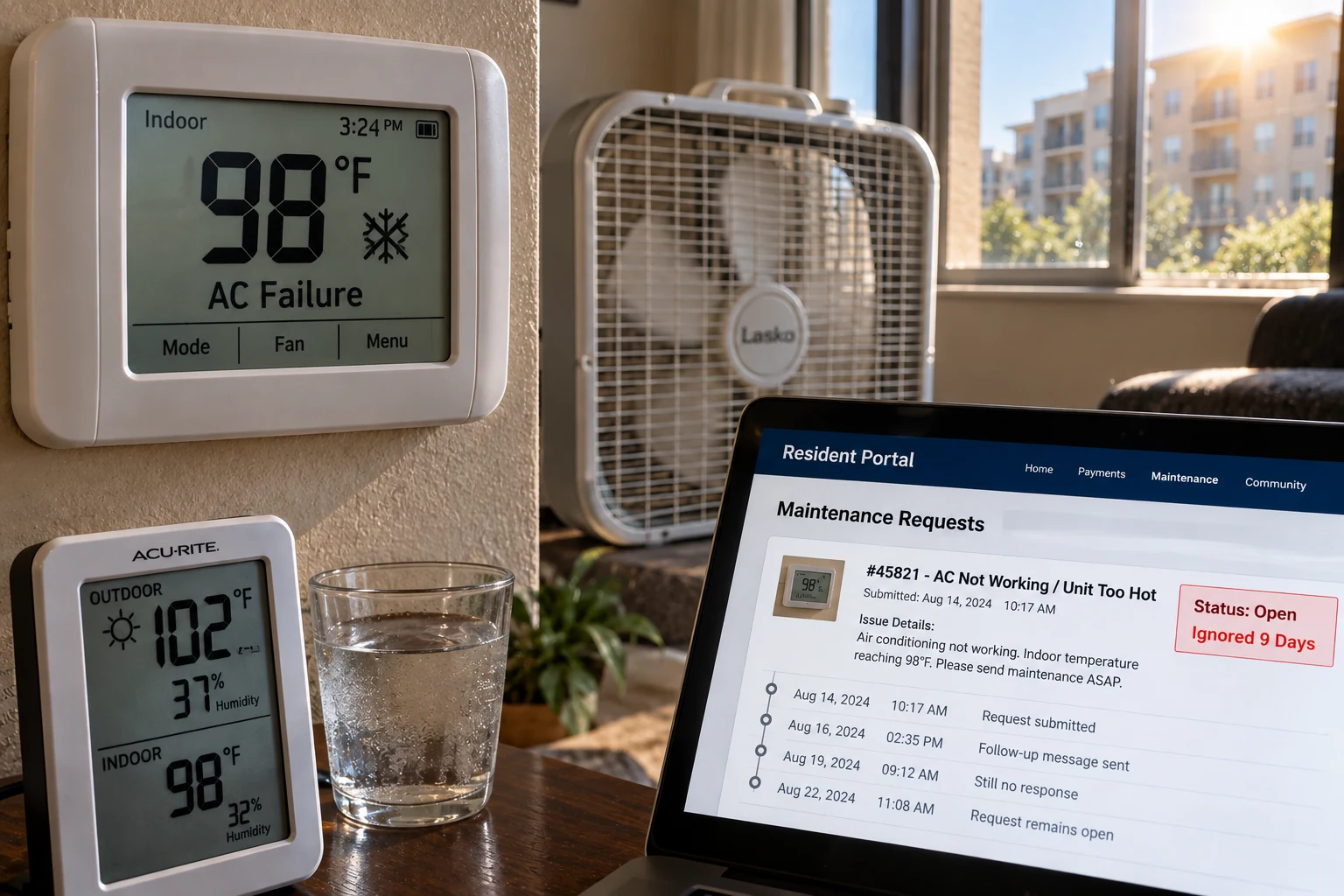
Consult the legal standard, maximum permitted temperature, and statutory repair deadlines for your jurisdiction in the lookup table below:
| State or City | Is Working AC Required by Law? | Maximum Legal Indoor Temperature | Landlord\'s Repair Deadline | Special Tenant Remedies |
|---|---|---|---|---|
| Arizona (Phoenix, Tucson, Tempe, Mesa) | YES — Mandatory Essential Service (A.R.S. § 33-1324 & § 33-1364) | 82°F for central AC (86°F for evaporative coolers) | 5 Calendar Days (or 48–72 hrs in extreme heat) | Buy portable cooling and deduct from rent, or stay in a hotel and deduct up to 125% of monthly rent! |
| Nevada (Las Vegas, Clark County, Reno) | YES — Mandatory Essential Service (NRS 118A.290 & § 118A.380) | Safe cooling (typically 80°F–85°F or 20°F below outdoor ambient) | 48 Hours (excluding weekends/state holidays) | Procure emergency hotel lodging, buy portable AC and deduct from rent, or sue for rent reduction. |
| Texas (Dallas, Houston, Austin, San Antonio) | YES in Major Cities (Plus statewide under Tex. Prop. Code § 92.052) | 85°F Maximum (or at least 20°F cooler than outdoor air in Dallas/Houston) | 72 Hours (Dallas Code § 27-11) to 7 Days (Statewide) | File 311 Code Compliance complaint ($500+ daily fines to landlord), use Repair-and-Deduct, or terminate lease. |
| Montgomery County MD & Washington D.C. | YES — Mandatory Summer Cooling (June 1 – Sept 30 in MD; May 15 – Sept 15 in DC) | 80°F Maximum (Montgomery County Bill 24-19) / 78°F (D.C. Code) | 24 to 72 Hours during excessive heat warnings | City housing code enforcement, mandatory inspector citations, and administrative rent abatement. |
| Florida (Fla. Stat. § 83.51 & § 83.56) | Enforceable If Supplied at Move-In (or stated in Lease) | Must maintain supplied unit in working order | 7 Days after delivering formal written 7-Day Notice to Cure | If ignored, tenant can legally withhold/reduce rent or terminate the lease agreement penalty-free. |
| California, Georgia, NC, NY, IL & Other States | Enforceable Whenever AC Came With the Unit (LA County now mandates 82°F max) | Must cool as designed (LA County: 82°F max) | 3 to 14 Days (expedited during heat emergencies) | Sue in Small Claims Court for 25%–50% rent refunds, portable cooling bills, and power spikes under Breach of Contract. |
Regardless of whether your municipality has codified specific temperature maximums, when an air conditioner provided at move-in breaks, your landlord cannot legally collect full rent while leaving you without cooling.
For general small claims court procedures and damage calculations across tenant disputes, consult our master guide on suing your landlord.
How to Win Even If Your State "Doesn't Require AC" (The Supplied-Appliance & Medical Rules)
Tenants in states like Florida, Georgia, North Carolina, and California are often dismissed by property managers claiming: "State habitability statutes only mention winter heating, not cooling, so we have no legal deadline to fix your air conditioning."
This statement is legally misleading. Renters have three powerful legal counter-arguments that defeat landlord excuses in every jurisdiction:
Counter-Punch #1: The "Supplied Appliance" Contract Rule
When you signed your lease, you agreed to pay market rent for a property equipped with working central air conditioning. Under universal contract law principles, every operational amenity present at the commencement of the lease is part of the consideration for your monthly rent.
If an apartment renting for $2,000 per month loses air conditioning during an 85°F summer heatwave, its fair rental value drops significantly. In Small Claims Court, judges routinely award tenants a 25% to 50% retroactive rent abatement—translating to $500 to $1,000 per month in cash restitution—because the landlord breached their express agreement to maintain supplied equipment.
Counter-Punch #2: The "20-Degree Differential" Rule for Failing AC
Property managers frequently argue that an air conditioner "is working" because the outdoor condenser fan spins and weak, lukewarm air trickles from supply registers, even while the apartment temperature hovers at 88°F.
Under American Society of Heating, Refrigerating and Air-Conditioning Engineers (ASHRAE) standards and municipal mechanical codes, a residential HVAC cooling system must maintain a temperature differential of 15°F to 20°F between ambient outdoor air and indoor supply air. If exterior temperatures are 96°F and your apartment interior remains at 87°F, the system has experienced mechanical failure under the law.
Counter-Punch #3: The Fair Housing Act (FHA) Doctor\'s Note
If any member of your household suffers from a medical condition sensitive to extreme heat—such as asthma, COPD, cardiovascular disease, multiple sclerosis, pregnancy, or takes psychiatric/blood pressure medications that impair thermal regulation—federal law supersedes state landlord-tenant statutes.
A concise letter from a licensed physician stating that excessive heat exacerbates a physical impairment transforms the broken AC into a federal disability accommodation request under the Fair Housing Act. Landlords must act immediately to restore cooling or provide temporary portable units; failure to do so exposes them to federal housing discrimination penalties and civil lawsuits.
Don't Forget to Sue for Your "$350 Electric Bill Spike"
A malfunctioning air conditioning unit creates substantial hidden financial damages that many tenants overlook when filing a lawsuit or rent reduction claim.
Why Failing Air Conditioners Skyrocket Electric Bills
When a central air conditioning system develops a refrigerant leak, a frozen evaporator coil, or a degraded compressor, the thermostat sensor never satisfies the set temperature. Consequently, the high-draw compressor and blower motor run twenty-four hours a day without cycling off.
Instead of cooling your living spaces, the unit continuously draws 3,500 to 5,000 watts of electrical power while blowing warm air. During summer billing tiers, this mechanical defect frequently causes monthly electric bills to surge from a normal $130–$160 up to $350, $500, or more.
How to Substantiate and Recover Utility Surges in Court
Because the surge in electrical charges stems directly from the landlord\'s failure to maintain mechanical equipment, courts classify the utility spike as recoverable consequential damages:
- Log into your utility provider portal and download billing statements for the two months preceding the AC breakdown and the uncooled months.
- Calculate the specific increase in kilowatt-hours (kWh) consumed and the corresponding dollar surcharge.
- Attach the utility usage graphs directly to your Small Claims statement of claim alongside photographs of the malfunctioning thermostat.
Judges routinely order landlords to reimburse 100% of the electrical utility spike on top of rent abatement (see our guide to suing landlords for repair delays).
How to Document a Sweltering Apartment (The 4-Step Proof Checklist)
To establish unassailable evidence of dangerous indoor heat before a Small Claims judge or housing inspector, implement this four-step documentation protocol:
1. Photograph Digital Thermometers and Supply Register Air
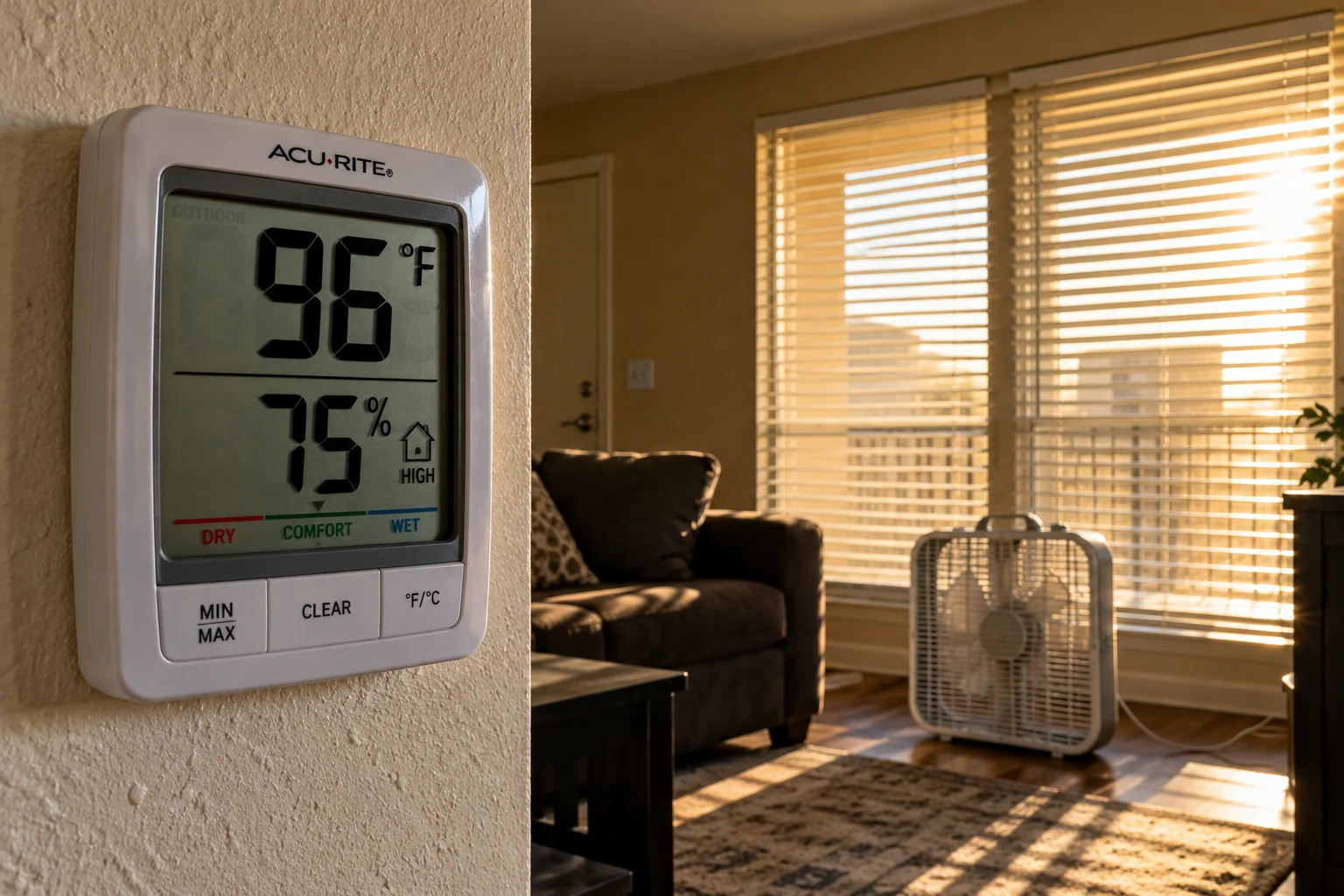
Do not rely on screenshots of weather apps alone. Place a calibrated digital thermometer in the center of your living room or bedroom, 3 feet off the floor. Photograph the thermometer displaying the room temperature with a second smartphone or watch in the frame showing the date and time. Then hold an instant-read probe thermometer directly at the AC supply register to prove the output air is discharging warm (e.g., 78°F+ rather than 55°F–60°F).
2. Request a 311 Municipal Code Inspection in Coded Jurisdictions
If you reside in Texas, Arizona, Nevada, Maryland, or Washington D.C., submit an immediate complaint via your city\'s 311 agency or building department. Municipal housing inspectors carry calibrated infrared temperature sensors. An official government inspection report documenting an indoor temperature above 82°F–85°F serves as conclusive evidence of code noncompliance.
3. Retain Receipts for Portable Air Conditioners, Fans, and Hotel Accommodations
If severe heat persists, purchase a dual-hose portable air conditioner ($250–$400) or window unit and keep all purchase receipts. If indoor temperatures exceed 90°F and threaten family health, retain detailed itemized folios for reasonable hotel or motel stays. These expenditures represent recoverable mitigation damages in civil court.
4. Maintain Continuous Rent Payments Unless Using Statutory Escrow
Never unilaterally withhold rent without following state-specific statutory notice procedures. In states like Texas and Florida, improper withholding exposes tenants to immediate eviction proceedings. The legally sound path is to pay rent under written protest, document the defect meticulously, and file in Small Claims Court for full restitution and damages.
For additional details on evaluating habitability violations, consult our comprehensive guide on the Warranty of Habitability.
Ready-to-Send Broken AC Repair, Portable Unit & Rent Refund Demand Letter
Before initiating litigation in Small Claims Court, serve your landlord with formal statutory notice. Send this communication via Certified Mail with Return Receipt Requested and transmit a digital copy via email and your tenant maintenance portal.
Select the appropriate template below, copy the text to your clipboard or download the text document, fill in your specific facts, and preserve a copy for your records.
How Much Can I Sue My Landlord for No Air Conditioning?
When pursuing a legal claim against your landlord in Small Claims Court or Housing Court, financial recovery is determined by statutory damages categories, proven out-of-pocket losses, and rent reduction formulas:
| Recovery Category | Calculation Standard | Statutory Authority & Limits |
|---|---|---|
| 1. Rent Abatement / Diminution of Value | Refund of rent reflecting the diminished rental value of the property without functioning air conditioning. | Contractual warranty & statutory cooling laws (AZ Rev. Stat. § 33-1364; NV Rev. Stat. § 118A.380). |
| 2. Portable AC & Hotel Expenses | Cost to purchase or rent portable air conditioning units, or hotel lodging during dangerous heat waves. | Mitigation of damages doctrine. |
| 3. Constructive Eviction / Lease Cancellation | Right to terminate lease without early break penalties when indoor heat exceeds habitable human thresholds. | Constructive eviction common law. |
Small Claims Filing Limits: Most tenants resolve these disputes without hiring an attorney in Small Claims Court. Maximum claim limits vary by state: for example, $12,500 in California (California Courts Self-Help), $10,000 in New York City (NY Courts Small Claims), and $20,000 in Texas (Texas Judicial Branch). If your total damages exceed small claims thresholds, you may file in standard civil district court.
Frequently Asked Questions About Landlord Air Conditioning Laws
Is broken air conditioning considered an emergency for landlords?
In hot states and cities—like Arizona, Nevada, Texas, and Montgomery County, MD—or whenever the National Weather Service issues an Excessive Heat Warning or a tenant has a heat-sensitive medical condition, broken AC is treated as a 24-to-72-hour emergency. In milder states without specific cooling codes, landlords generally have 7 to 14 days to repair an AC unit that came with the rental.
Can I buy a portable AC unit and deduct it from my rent if my landlord won't fix the central air?
In states with "essential service" or "repair and deduct" laws—such as Arizona (A.R.S. § 33-1364), Nevada (NRS 118A.380), California (Civ. Code § 1942), and Washington—yes, after giving written notice and waiting the required hours/days, you can purchase a reasonable window or portable AC unit and deduct the receipt from next month's rent. In states without repair-and-deduct, keep the receipt and sue for reimbursement in Small Claims Court.
Does my landlord have to pay for a hotel room if my AC breaks in the summer?
If indoor temperatures climb into the upper 80s or 90s and your landlord fails to provide portable cooling or fix the AC within the legal emergency window, states like Arizona allow you to deduct up to 125% of your monthly rent for a hotel, and courts in other states regularly award hotel reimbursement plus a 100% daily rent refund in Small Claims Court.
What if my landlord says "We are waiting on an AC compressor part that is on backorder"?
While a landlord can't magically manufacture a backordered part, they cannot charge you 100% rent for an uncooled apartment while you wait for weeks. If a part takes more than 48–72 hours in summer, the landlord must either supply temporary portable AC units at their expense or give you a significant rent reduction for every day the central AC is down.
Can I break my lease without a penalty if my landlord refuses to fix the air conditioning?
Yes—if your apartment is in a hot climate where uncooled indoor temperatures (85°F–90°F+) threaten your health and safety, or if your landlord ignores a formal written 5-to-7-Day Notice to Cure, you can document the indoor temperature with dated photos and a 311 city inspection and terminate your lease under state habitability or constructive eviction laws.
SueLegal is an independent educational legal publisher, not a law firm or lawyer referral service. The information provided in this guide is for general informational and educational purposes only and does not constitute formal legal advice. Residential landlord-tenant laws, repair notice periods, and statutory remedies vary significantly across state and municipal jurisdictions. If you are facing eviction, severe uninhabitable conditions, or complex litigation, consult a licensed attorney in your jurisdiction or contact your local legal aid organization. For more details on our standards, read our Editorial Policy and Legal Research Methodology.