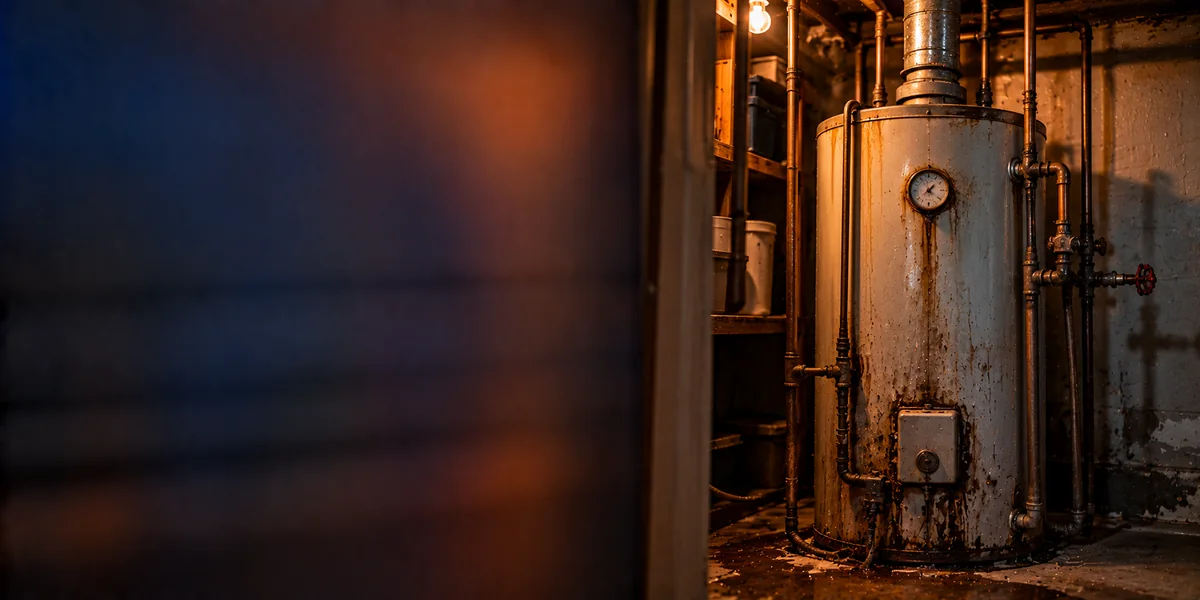
Yes, you can sue your landlord for leaving you with no hot water.
Running hot water (at least 110°F to 120°F year-round) is a mandatory legal right in every state. Because a broken water heater can be fixed or replaced by a plumber in 3 to 8 hours, most states treat no hot water as an emergency violation that your landlord must start fixing within 24 to 72 hours. If they delay or ignore you, you can sue in Small Claims or Housing Court to recover:
- A 35% to 75%+ Daily Rent Refund for every day your apartment lacked adequate hot water.
- Hotel Stays, Gym Memberships & Laundromat Bills (including temporary gym passes bought to shower before work, wash-and-fold laundry receipts, and hotel nights).
- Gas or Electric Bill Spikes & Water Damage if a leaking or malfunctioning water heater tank drove up your utility bills or flooded your closet/floors.
- Extra Daily Cash Penalties ($100 to $500+/day) if the landlord shut off the gas/water on purpose or let the building's utility bill go unpaid.
At a Glance
- Lukewarm Water (Under 110°F) Still Breaks the Law: Don't let your landlord claim the water is "warm enough." Nearly every housing code requires hot water to reach 110°F to 120°F at the faucet. Hold a $10 digital kitchen meat thermometer under the tap for 2 minutes and take a photo of the reading!
- Water That Turns Cold After 3 Minutes Is Also a Violation: If your shower gets hot for 3 minutes and immediately turns ice cold, your water heater likely has a broken dip tube or burned-out lower heating element (or the building boiler is failing). The law requires a continuous, adequate supply of hot water, not a 2-minute burst.
- A New Water Heater Only Takes 4 to 8 Hours to Install: Don't fall for a landlord claiming it takes "3 weeks" to replace a hot water tank. Every plumbing supply house and Home Depot carries standard 40- and 50-gallon water heaters in stock every day, and a licensed plumber can swap one out in a single afternoon.
- Save Receipts for Gym Showers, Laundromats & Hotels: If you don't want to front $1,000 for a hotel, judges in Small Claims Court love seeing practical mitigation receipts—like a $25 gym membership you bought just to take hot showers, laundromat receipts, paper plates/dishwashing costs, or reasonable hotel nights.
- Warning: Water Over 125°F–130°F Is an Illegal Scalding Hazard: If a broken water-heater thermostat makes your tap water dangerously scalding (130°F–150°F+) and burns you or your child, that violates anti-scald plumbing codes and gives you a strong personal injury claim against the landlord's insurance.
State-by-State Minimum Hot Water Temperature (110°F–120°F) & Emergency Repair Deadlines
Unlike winter space heating, which is only mandated during designated calendar months, running hot water is a non-negotiable health essential 24 hours a day, 365 days a year. State housing acts and municipal plumbing codes explicitly define the temperature threshold required at bathroom sinks, tubs, and kitchen taps.
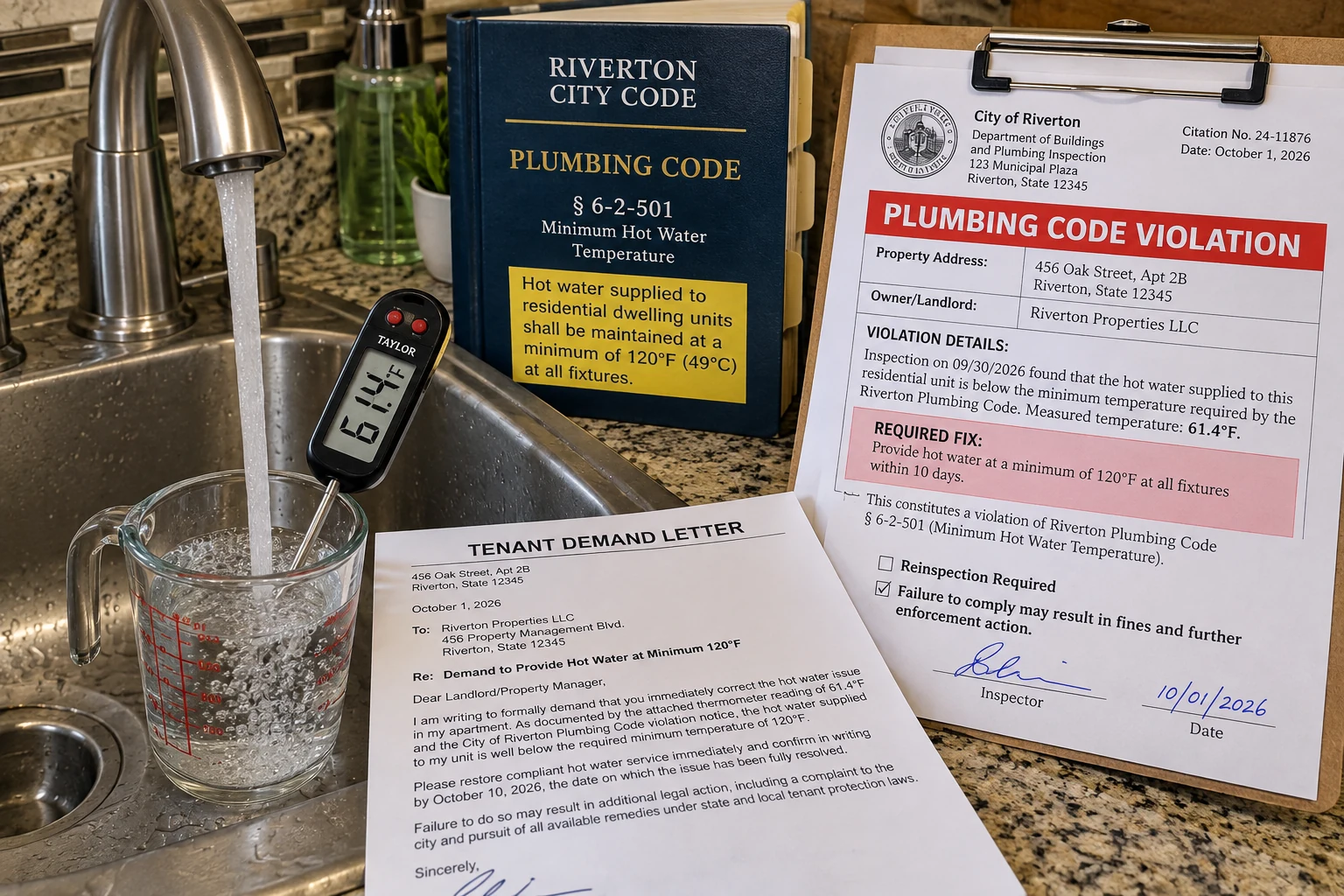
A landlord cannot satisfy the law by delivering lukewarm water or claiming that boiling water on a stove is an acceptable substitute. Review the mandatory temperature standards, statutory cure windows, and local enforcement remedies across major jurisdictions:
| State / City | Minimum Legal Hot Water Temp | Legal Repair Deadline | Key Tenant Remedies & Fines |
|---|---|---|---|
| New York City & NY State | 120°F Minimum (24 hours a day, 365 days a year at all taps) | 24 Hours (Class C immediately hazardous code violation) | Call 311 (HPD): Fines of $250–$500/day for initial violations and $500–$1,000/day for repeat noncompliance; substantial rent abatement in Housing Court. |
| California (Statewide) | 110°F to 120°F (Cal. Civ. Code § 1941.1 & Uniform Plumbing Code) | 24 to 72 Hours (Emergency habitability non-waivable covenant) | Contact County Environmental Health, exercise statutory Repair-and-Deduct (up to 1 month's rent), or sue in Small Claims Court (up to $12,500). |
| Massachusetts (Statewide) | 110°F Minimum (130°F anti-scald cap under 105 CMR 410.190) | 24 Hours (State Sanitary Code emergency violation) | Local Board of Health orders immediate repair; tenants can recover up to 3 months' rent or actual damages plus attorney fees (M.G.L. c. 186 § 14). |
| Illinois (Chicago & Statewide) | 120°F Minimum (Chicago Municipal Code § 13-196-430) | 24 to 72 Hours | Under Chicago RLTO (§ 5-12-110), tenants can secure hotel accommodations, obtain substitute service, or withhold rent proportionally. |
| Washington State | 110°F to 120°F (RCW 59.18.060 & § 59.18.070) | 24 Hours (complete loss) to 72 Hours (equipment repairs) | Following written notice, tenants can hire a licensed plumber and deduct up to 2 months' rent under RCW 59.18.100. |
| Texas & Arizona | 110°F–120°F (Continuous supply under A.R.S. § 33-1324 & TX codes) | 48 to 72 Hours (AZ); 7 Days max (TX Prop. Code § 92.056) | In AZ, deduct hotel stays up to 125% of rent; in TX, file a 311 citation and sue for rent reductions and repair costs in Justice Court (up to $20,000). |
| FL, OH, GA, PA, NJ & IPMC Cities | 110°F Minimum (International Property Maintenance Code § 505.4) | 24 Hours to 7 Days | Call municipal code enforcement for inspection citations, deliver a 7-day statutory notice to cure, and sue in Small Claims Court for rent refunds. |
When tap temperatures fall below these levels, living conditions breach the Warranty of Habitability. Landlords must act immediately or face statutory liabilities and financial refunds.
To review the full small claims process and statewide filing limits, explore our master guide on suing your landlord.
How to Prove "Lukewarm" or "3-Minute" Hot Water in 60 Seconds (The Kitchen Thermometer Trick)
One of the most frustrating experiences for renters occurs when water is neither scalding hot nor completely freezing, but sits at a frustratingly lukewarm 85°F to 95°F. Because human body temperature averages 98.6°F, taking a shower in 88°F water feels uncomfortable and cold.
Similarly, a water heater with a cracked internal dip tube or a burned-out lower heating element can produce hot water for two minutes before the tank discharges completely cold. Property managers often test the tap for thirty seconds and claim: "The water feels warm to me—repair request closed."
The Video Testing Protocol
You can definitively defeat this excuse in Small Claims Court by creating an uninterrupted video record:
- Obtain a Digital Probe Thermometer: Purchase an inexpensive instant-read digital cooking or meat thermometer ($10–$15) with an illuminated LCD display.
- Initiate a Continuous Video Recording: Turn on your shower or kitchen hot tap to its maximum setting and start filming on your phone without stopping or cutting.
- Submerge the Probe in the Running Stream: Hold the metal probe directly beneath the aerator or shower head for 2 to 3 continuous minutes.
- Capture the Temperature Plateau or Crash:
- If the reading tops out at 85°F–102°F, zoom in on the display to prove that the water fails to meet the legal 110°F–120°F standard.
- If the temperature starts at 115°F and plunges to 75°F after 120 seconds, keep filming so the judge observes the rapid temperature drop in real time.
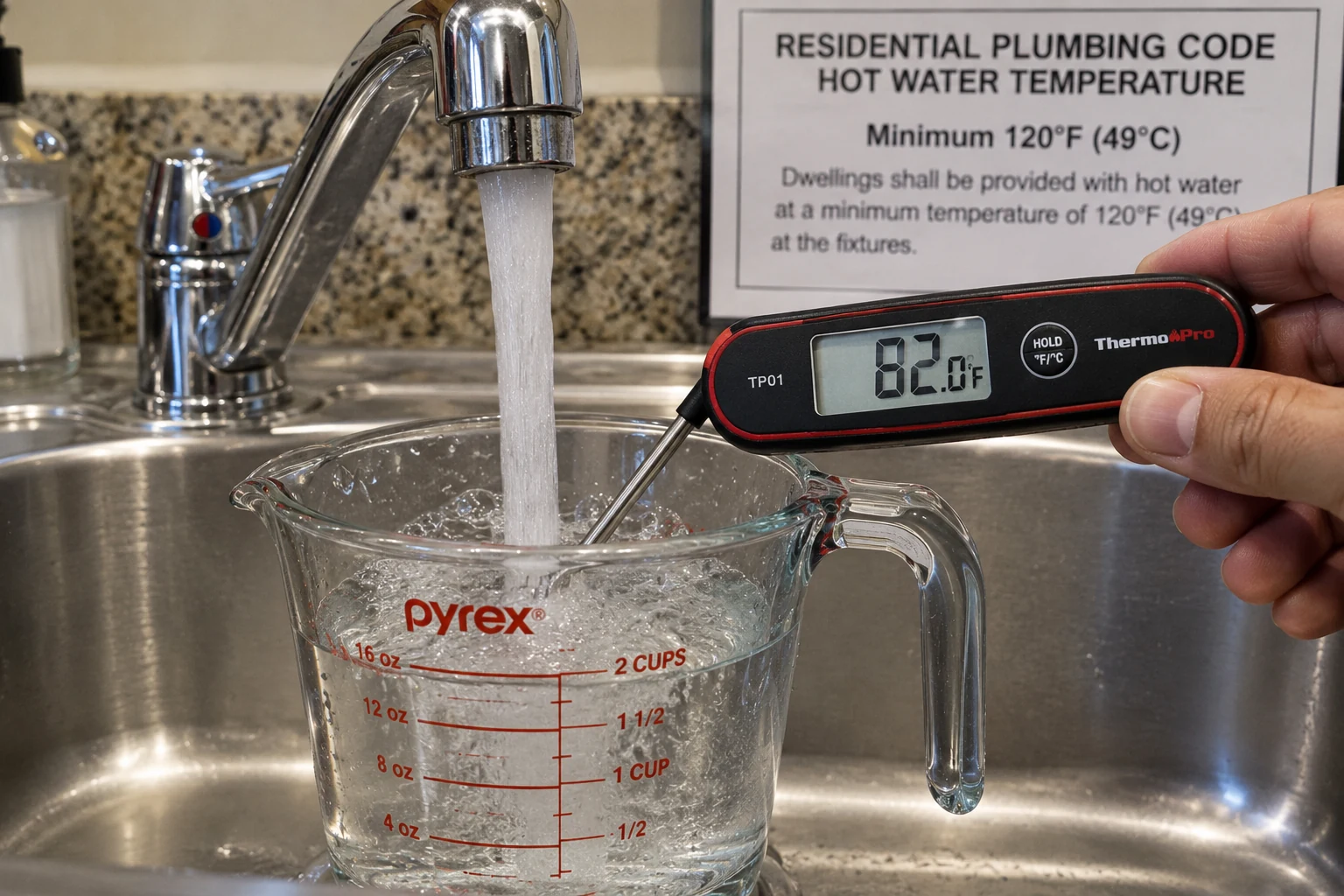
Judges and hearing officers consider this video evidence conclusive, eliminating any factual debate over whether the water was "warm enough."
The "Plumber Reality Check" (Why Landlords Have Zero Excuse for Multi-Week Delays)
When confronting landlords about hot water outages, tenants frequently encounter excuses: "The special commercial parts are backordered" or "Our home warranty company has not authorized the replacement yet."
In residential tenancy litigation, these arguments carry zero weight. Real-world plumbing realities expose why multi-week delays constitute bad faith:
1. Replacing Elements and Thermostats Takes 1 to 3 Hours
In electric water heaters, the vast majority of failures stem from burned-out heating elements or faulty upper/lower thermostats. In gas units, failures usually involve thermocouples or pilot assemblies. These components are universal, cost $25 to $75 at any plumbing distributor or home improvement store, and require less than three hours for a licensed technician to diagnose and install.
2. Standard Tank Replacements Require 4 to 8 Hours
Standard 40-gallon and 50-gallon atmospheric gas and electric water heaters sit in stock continuously at Home Depot, Lowe's, Ferguson, and regional wholesale suppliers. A certified plumbing contractor can drain and remove a failed tank, install a code-compliant new unit, and restore 120°F water in a single four-to-eight-hour service call.
3. Courts Reject the "Home Warranty Company" Defense
Landlords often delay repairs while waiting for cut-rate contractors assigned by third-party home warranty providers (such as American Home Shield). Your contractual agreement is strictly with your landlord, not their warranty carrier. Appellate courts across the country have ruled that a landlord cannot prolong an emergency habitability outage to minimize private insurance deductibles. If a warranty provider cannot dispatch technicians within 24 to 48 hours, the landlord has an immediate legal obligation to engage an independent licensed plumber.
For more guidance on handling prolonged maintenance delays, see our analysis on suing landlords for repair refusal.
Smart Expenses You Can Sue For (Gym Showers, Laundromats, Leaking Tanks & Scalding Burns)
A lawsuit for lack of hot water is not confined strictly to rent abatement. Tenants are legally entitled to recover all reasonable out-of-pocket mitigation costs incurred as a result of the outage:
1. Gym Showers and Fitness Memberships ($25 to $50)
If hotel lodging was cost-prohibitive, purchasing a short-term pass or monthly membership at a local fitness center (such as Planet Fitness or the YMCA) solely to access hot showers before work or school is fully compensable. Small Claims judges appreciate this mitigation measure because it reflects prudent, low-cost problem solving.
2. Hotel and Alternative Lodging Folios
When living without hot water extends over multiple days, particularly for families with infants or elderly dependents, checking into reasonable local hotel accommodations is recognized as necessary substitute housing under state landlord-tenant acts (URLTA § 4.104).
3. Laundromat and Sanitation Expenses
Washing clothes and sanitizing cooking equipment without hot water is impossible. Save all receipts for laundromat wash-and-fold services, self-service coin machines, and disposable dinnerware purchased while the kitchen sink lacked sanitizing water.
4. Utility Bill Surges From Leaking or Continuously Firing Tanks
When an internal water heater tank ruptures, water continually escapes into floor drains or crawlspaces. The heating coils or gas burners fire non-stop trying to warm incoming cold water. Compare your gas, electric, and municipal water statements to prior cycles; courts routinely award reimbursement for the utility cost surge (see our guide on water damage liability).
5. Scalding Burn Injuries (Water Exceeding 125°F–130°F)
Plumbing codes mandate thermostatic mixing valves capping domestic tap water at a maximum of 120°F. Water delivered at 140°F produces serious second- and third-degree scald burns in less than five seconds. If a malfunctioning commercial boiler or broken thermostat discharges scalding water that burns a resident, this establishes grounds for a substantial premises liability personal injury claim against the building's commercial liability insurance.
Ready-to-Send No-Hot-Water Emergency Repair & Refund Demand Letter
Before initiating legal proceedings in Small Claims Court or executing statutory repair-and-deduct remedies, deliver formal statutory notice to your landlord. Transmit this communication via Certified Mail with Return Receipt Requested, supplemented by an immediate transmission through your resident maintenance portal and email.
Select the template below that matches your current legal posture, copy the text to your clipboard or download the document, insert your claim details, and retain a copy for your evidentiary file.
How Much Can I Sue My Landlord for No Hot Water?
When pursuing a legal claim against your landlord in Small Claims Court or Housing Court, financial recovery is determined by statutory damages categories, proven out-of-pocket losses, and rent reduction formulas:
| Recovery Category | Calculation Standard | Statutory Authority & Limits |
|---|---|---|
| 1. Proportional Rent Abatement | Retroactive refund of 25% to 50%+ of monthly rent for days water heater failed to supply minimum 120°F water. | Warranty of Habitability; Uniform Plumbing Code standards. |
| 2. Laundromat & Gym Shower Expenses | Reimbursement for out-of-pocket costs to obtain hot sanitation off-site. | Incidental actual damages. |
| 3. Repair-and-Deduct Reimbursement | Direct deduction of licensed plumber repair invoices from next rent check where authorized by state code. | State statutory cure provisions (e.g. Cal. Civ. Code § 1942). |
Small Claims Filing Limits: Most tenants resolve these disputes without hiring an attorney in Small Claims Court. Maximum claim limits vary by state: for example, $12,500 in California (California Courts Self-Help), $10,000 in New York City (NY Courts Small Claims), and $20,000 in Texas (Texas Judicial Branch). If your total damages exceed small claims thresholds, you may file in standard civil district court.
Frequently Asked Questions About Landlord Hot Water Laws
How many days can a landlord legally leave you without hot water?
In almost every U.S. state and city, running hot water is an essential health and sanitation service, not a routine repair. Landlords must start fixing a complete loss of hot water within 24 to 72 hours in most states—and if they wait longer than 2 to 5 days, you can call 311 Code Enforcement, check into a hotel or use Repair-and-Deduct where allowed, and sue for a daily rent refund.
What is the minimum legal temperature for hot water in an apartment?
Most state housing codes, city ordinances, and the International Property Maintenance Code require hot water at residential bathroom and kitchen faucets to reach between 110°F and 120°F year-round. New York City and Chicago strictly require 120°F, while states like Massachusetts, California, and Washington require at least 110°F.
What if my landlord says we have to wait 2 weeks for their "Home Warranty Company" to approve a new water heater?
That is illegal. Your lease is with your landlord, not their third-party home warranty company. Courts across the U.S. rule that a landlord cannot leave a tenant without hot water for weeks just to save money through a slow home warranty vendor—they must hire a local plumber immediately or pay for your hotel and rent refund.
Can I hire a plumber myself to fix the water heater and deduct it from my rent?
In roughly 35 states—including California, Washington, Illinois, Arizona, and Texas (with strict notice rules)—if you give written notice and the landlord fails to restore hot water within the statutory emergency window, you can hire a licensed plumber to repair the heater and deduct the receipt from your rent up to your state's dollar cap. Always keep the plumber's itemized invoice and take photos of the broken part.
How much rent refund can I get for having no hot water?
Judges typically award a 40% to 75% daily rent refund for days you had zero hot water—and 25% to 40% for lukewarm or intermittent 3-minute hot water—plus 100% reimbursement for reasonable hotel nights, gym shower passes, laundromat bills, and utility bill spikes.
SueLegal is an independent educational legal publisher, not a law firm or lawyer referral service. The information provided in this guide is for general informational and educational purposes only and does not constitute formal legal advice. Residential landlord-tenant laws, repair notice periods, and statutory remedies vary significantly across state and municipal jurisdictions. If you are facing eviction, severe uninhabitable conditions, or complex litigation, consult a licensed attorney in your jurisdiction or contact your local legal aid organization. For more details on our standards, read our Editorial Policy and Legal Research Methodology.