
The Short Answer
Yes, you can take legal action against your landlord for high radon levels.
If your rental home or basement apartment tests at or above the EPA danger level of 4.0 pCi/L and your landlord refuses to fix it—or hid past high radon tests before you signed your lease—you have two legal paths:
- If Nobody Is Sick Yet (Break Your Lease, Get Rent Refunds & Moving Costs): You do not have to wait years to get sick to take action. If your landlord ignores a certified radon lab test showing 4.0 pCi/L or higher, you can legally break your lease without a penalty, get 100% of your security deposit back, and sue in Small Claims Court for partial rent refunds, testing fees, air purifiers/monitors, and moving expenses.
- If Long-Term Exposure Caused Lung Cancer ($250,000 to $1,500,000+ Settlements): Because radon is the leading cause of lung cancer in non-smokers, tenants who lived for years in a high-radon rental property and later develop lung cancer can hire a toxic exposure lawyer to sue the landlord for medical bills, lost wages, and pain and suffering.
What Matters Most
- 4.0 pCi/L Is the Magic Number in Court: The EPA and Surgeon General state that any home testing at 4.0 pCi/L or higher needs to be fixed. Breathing 4.0 pCi/L of radon every day exposes your lungs to the same radiation damage as smoking 8 cigarettes a day (and 10.0 pCi/L equals smoking a full pack a day).
- Back Up Your Digital Monitor With a $25 Certified Lab Kit: Plug-in digital monitors (like Airthings) are great for catching a radon spike, but landlords often argue in court that electronic gadgets aren't official. Before sending a legal demand or breaking your lease, run a $20–$30 NRPP-certified charcoal mail-in lab test so you have an official laboratory certificate a judge will accept.
- Basement, Garden-Level & 1st-Floor Renters Face the Highest Risk: Because radon gas rises out of dirt and bedrock underneath the building, basement bedrooms and ground-floor apartments trap the highest levels—especially in winter when windows are shut and heaters pull soil gas up through floor cracks.
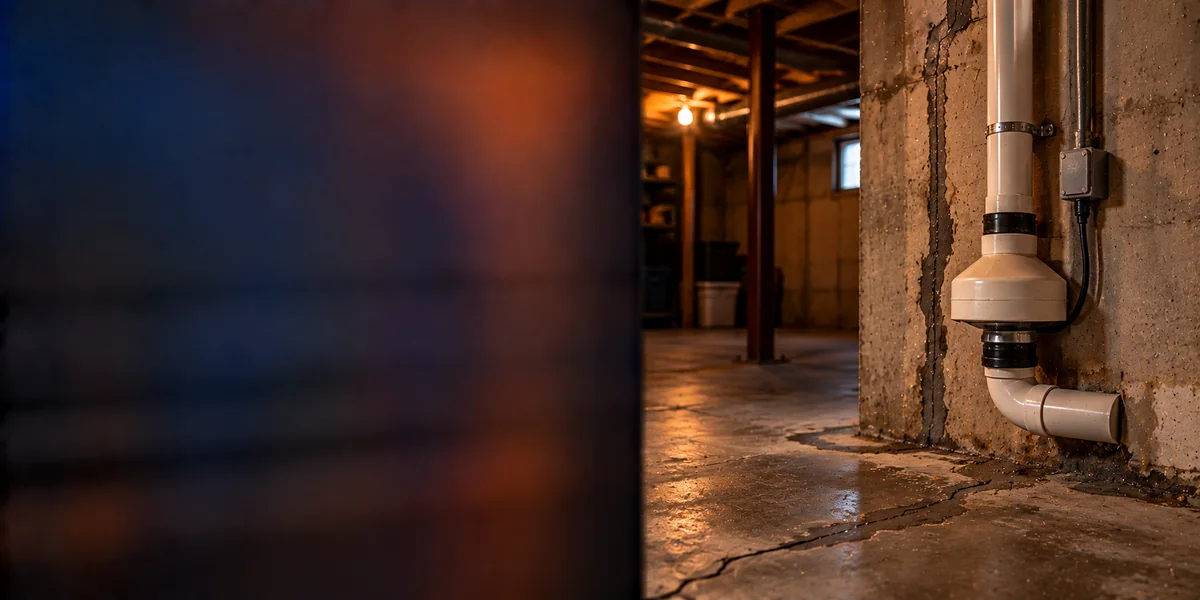
- Landlords Have No Excuse Because Fixing Radon Only Costs ~$1,200: Unlike a $20,000 roof replacement, a licensed radon mitigation system (a simple PVC pipe and quiet fan that vents gas from under the concrete slab to the outside roof) typically costs only $800 to $1,500 and drops radon levels by up to 99% in one day.
- Several States & Counties Have Strict Radon Rental Laws: Colorado, Maine, Illinois, Florida, and Montgomery County (Maryland) have specific laws requiring landlords to test for radon, disclose past test results, or let tenants break their lease immediately if high radon isn't fixed.
What Your Radon Number Actually Means (The EPA Cigarette & X-Ray Chart)
Because radon gas is completely invisible, odorless, and tasteless, landlords often dismiss tenant concerns by claiming, "Nobody in this building has ever complained." However, radon emits alpha radiation particles that lodge deep in bronchial tissue, causing irreversible cellular mutations. The U.S. Environmental Protection Agency (EPA) and the Surgeon General benchmark radon health risks directly against smoking cigarettes:
| Your Radon Level (pCi/L) | Equal to Smoking How Many Cigarettes Every Day? | Equal to How Many Chest X-Rays Per Year? | EPA & Court Legal Status |
|---|---|---|---|
| Under 2.0 pCi/L | ~1 to 3 cigarettes / day | ~50 to 100 X-rays | Normal Indoor Air — Average national indoor level is 1.3 pCi/L. No legal claim against landlord. |
| 2.0 to 3.9 pCi/L | ~4 to 7 cigarettes / day | ~100 to 195 X-rays | Caution Zone — EPA suggests considering mitigation; difficult to force landlord action in court unless explicitly guaranteed in the lease. |
| 4.0 pCi/L (EPA Action Limit) | 8 Cigarettes Every Day | 200 Chest X-Rays / Year | Official EPA Danger Line — Triggers mandatory mitigation or lease-break rights in strict jurisdictions, and establishes habitability claims nationwide. |
| 8.0 to 10.0 pCi/L | 16 to 20 Cigarettes / Day (Full Pack) | 400 to 500 Chest X-Rays / Year | Severe Health Hazard — EPA recommends professional mitigation within weeks. Strong legal standing to break lease and recover rent refunds and moving costs. |
| 20.0+ pCi/L | 2+ Packs of Cigarettes Every Day | 1,000+ Chest X-Rays / Year | Extreme Emergency — Immediate constructive eviction standing; demand rapid mitigation within days or vacate and sue for full relocation stipends. |
If your apartment also suffers from structural leaks or broken foundation barriers, review our guide to suing a landlord for unsafe living conditions.
For a full walkthrough of court procedures and damage thresholds across all tenant disputes, consult our master guide on suing your landlord.
State-by-State Radon Rental Laws: Where Renters Have Extra Power
While every American renter is protected under the basic implied warranty of habitability, several states and progressive counties have enacted specific rental housing statutes that impose automatic penalties on landlords:
| State / County | What the Landlord Must Do by Law | Your Right to Break the Lease or Sue |
|---|---|---|
| Colorado (SB 23-206 / C.R.S. § 38-12-803 & § 38-12-505) | Landlords must provide a state radon disclosure brochure before lease signing, disclose any known past radon tests, and disclose any existing mitigation systems. | If a certified test reveals 4.0 pCi/L or higher and management fails to remediate, the tenant has the explicit statutory right to void and terminate the lease with zero penalty and sue for breach of the warranty of habitability. |
| Maine (14 M.R.S. § 6030-D) | Landlords must test every residential rental building for radon every 10 years (unless an active mitigation system is operating) and hand written test results to prospective tenants before renting. | Concealing test results or falsifying records carries a $250 statutory penalty plus actual damages. If levels reach 4.0+ pCi/L and the owner fails to mitigate, tenants can terminate the lease immediately. |
| Montgomery County, Maryland (County Code § 29-35E / Bill 3-22) | Landlords must test all basement and ground-floor rental units before leasing and provide a certified radon test report completed within the preceding 24 months. | If testing reveals 4.0+ pCi/L, the owner must hire an NRPP/NRSB certified contractor to mitigate within 90 days—or face Department of Housing and Community Affairs (DHCA) citations and lease cancellation. |
| Illinois (Illinois Radon Awareness Act, 420 ILCS 46) | For any rental unit located on the 1st or 2nd floor (below the 3rd story), landlords must deliver the IEMA Radon Guide and disclose any known test results showing 4.0+ pCi/L. | If a landlord hid known high radon or refuses to address confirmed hazardous air documented by an official test, the tenant has strong legal standing to vacate without penalty. |
| Florida (Fla. Stat. § 404.056(5)) | Every residential lease lasting longer than 45 days must contain Florida's mandatory statutory notification paragraph regarding radon gas health risks. | If the rental tests at or above 4.0 pCi/L, the tenant can deliver a formal 7-Day Written Notice to Cure under § 83.56 demanding mitigation or terminating the rental contract. |
| All Other 45 States | Covered under your state's Implied Warranty of Habitability and common law concealment/fraud doctrines. | Once you deliver an official laboratory certificate confirming 4.0+ pCi/L, the landlord possesses actual legal knowledge of an unlivable hazard. Unreasonable refusal to install a standard $1,200 vent fan authorizes constructive eviction and Small Claims lawsuits. |
How to Test Your Apartment So Your Proof Holds Up in Court
Many tenants face dismissal in court because they rely solely on a smartphone screenshot from an uncalibrated digital monitor. To build an airtight legal case that compels a landlord to mitigate or a judge to award rent refunds, follow this testing protocol:
Do You Need Your Landlord's Permission to Test?
No. You do not need landlord permission to test your indoor air. Placing a silent, passive charcoal test canister on your dresser or bookshelf does not alter or damage the rental premises in any way. You have an absolute legal right to monitor the safety of the air you and your family breathe.
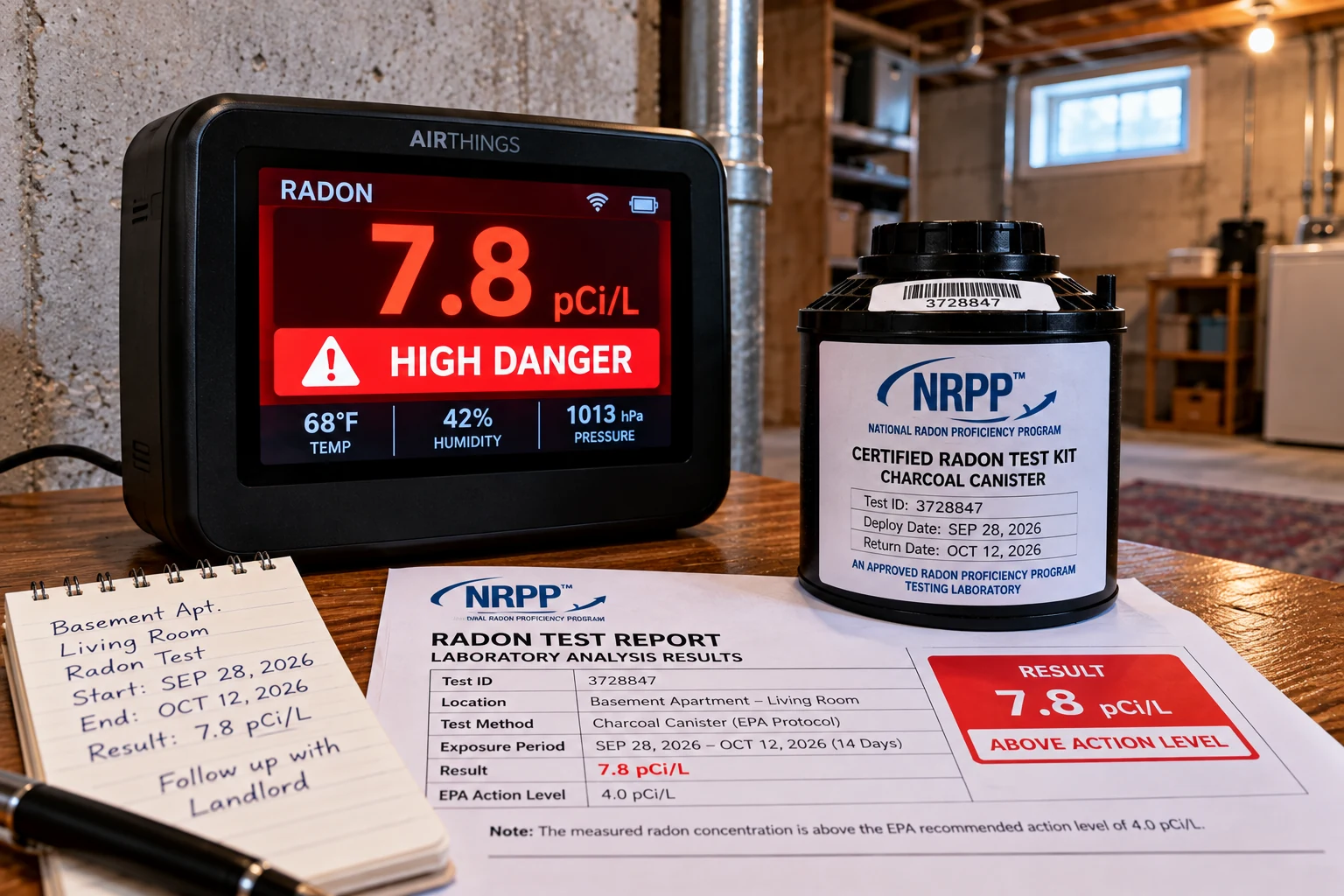
- Step 1: Purchase Two NRPP-Certified Charcoal Lab Kits: Buy two short-term activated charcoal canisters certified by the National Radon Proficiency Program (NRPP) or NRSB (available at hardware stores, state health department programs, or Sosradon.org for $20–$30 each, including lab fees). Running duplicate tests side-by-side eliminates defense claims of a defective canister.
- Step 2: Maintain Strict "Closed-House" Conditions: Keep all exterior windows and doors closed for 12 hours prior to the test and throughout the 48-to-96-hour testing period (normal entry and exit are permitted). Operate your normal heating and cooling systems, but do not run whole-house attic fans.
- Step 3: Position the Kits in the Lowest Lived-In Area: Place the canisters in the lowest living space (such as a basement bedroom, family room, or ground-floor bedroom). Position them at least 20 inches above the floor, 3 feet away from exterior walls and windows, and well away from high-humidity areas like bathrooms or kitchens.
- Step 4: Take a Timestamped Photo and Mail Promptly: Take a photo showing both canisters in place with their serial numbers visible. Once the test window concludes, seal the canisters immediately and mail them to the accredited laboratory. Within 3 to 5 business days, you will receive an official signed Laboratory Analysis Certificate establishing courtroom proof.
What If the Building Already Has a White Radon Pipe, But It's Broken?
In many older homes and apartment complexes, tenants notice a thick 3-inch or 4-inch white PVC pipe running vertically through the basement, utility closet, or along the exterior brick wall:
How to Read the "U-Tube" Manometer Gauge in 5 Seconds
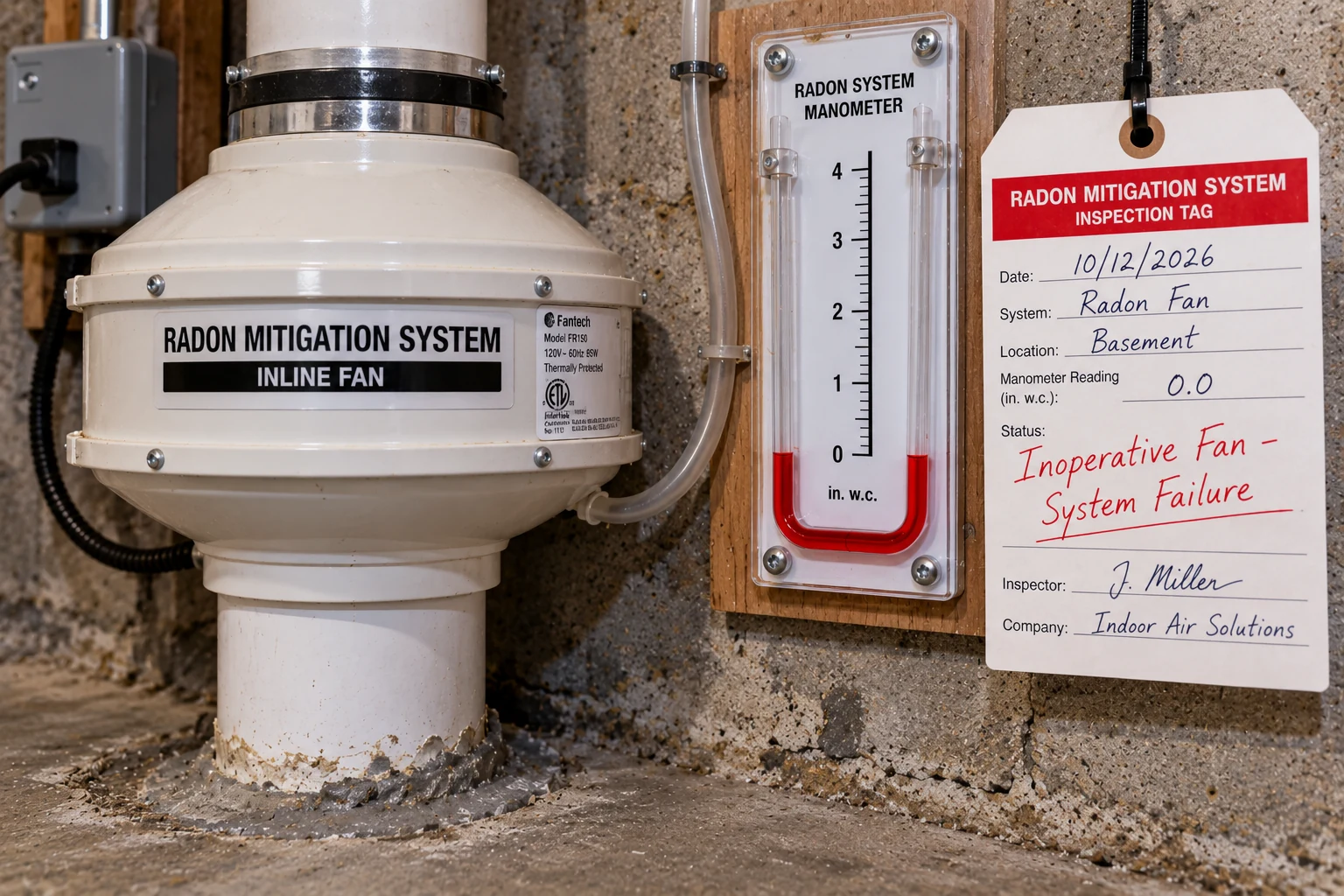
Every active sub-slab depressurization system is required by building code to feature a small, clear curved plastic tube filled with colored (red or blue) liquid mounted on the side of the PVC pipe, called a manometer:
- Working System (Uneven Liquid): When the inline exhaust fan is running, vacuum pressure pulls the liquid higher on one side of the "U" curve (typically showing a difference of 0.5 to 1.75 inches). This confirms negative suction beneath your slab.
- Broken System (Liquid Even at Zero): If the liquid on both sides of the "U" tube is completely flat and level at 0.0, the exhaust fan is dead, unplugged, or tripped at the circuit breaker.
- Slam-Dunk Negligence Proof: When the fan dies, underground radon gas is no longer vented through the roof—it backs up directly through foundation expansion joints into your apartment. Photographing a zeroed-out manometer proves that the landlord 100% knew the building had a dangerous radon problem and failed to maintain essential safety equipment.
If your apartment also experiences other hidden utility or environmental failures, review our guide on suing a landlord for carbon monoxide hazards.
Ready-to-Send High Radon Mitigation & Lease-Break Demand Letter
Before filing a lawsuit or vacating your apartment, send this formal legal demand letter. It establishes formal written notice of documented radon exceeding the EPA action level, cites specific state habitability standards, and gives your landlord a firm deadline to install a certified mitigation system or release you from your lease:
VIA CERTIFIED MAIL WITH RETURN RECEIPT REQUESTED
AND VIA ELECTRONIC DELIVERY (EMAIL / TENANT PORTAL)

Date: [TODAY'S DATE, e.g. October 15, 2026]

To: [LANDLORD OR PROPERTY MANAGEMENT COMPANY NAME]
Address: [OFFICIAL LEASE NOTICE ADDRESS]
City, State, Zip: [CITY, STATE, ZIP]

From: [YOUR FULL NAME]
Rental Address: [YOUR APARTMENT NUMBER AND STREET ADDRESS]
Phone Number: [YOUR PHONE NUMBER]
Email: [YOUR EMAIL ADDRESS]

SUBJECT: FORMAL NOTICE OF HAZARDOUS RADON GAS CONTAMINATION EXCEEDING EPA ACTION LEVEL — DEMAND FOR CERTIFIED MITIGATION OR IMMEDIATE PENALTY-FREE LEASE TERMINATION

Dear [LANDLORD OR PROPERTY MANAGER NAME],

This letter serves as formal written notice under state landlord-tenant housing statutes and the implied warranty of habitability that my rental home contains hazardous concentrations of radioactive radon gas requiring immediate corrective action.

1. DOCUMENTED RADON TEST RESULTS:
On [DATE TESTING COMPLETED], certified indoor air testing was completed inside my rental unit utilizing an NRPP-accredited laboratory test kit under closed-building protocol.

The certified laboratory analysis report confirms a radon concentration of:
- [INSERT READING, e.g., 6.5 pCi/L], significantly exceeding the U.S. Environmental Protection Agency (EPA) Action Level of 4.0 pCi/L.

According to EPA and U.S. Surgeon General data, residing in an indoor environment with this level of radon exposure inflicts pulmonary radiation damage equivalent to smoking approximately [CALCULATE: READING x 2, e.g. 13] cigarettes per day. (A copy of the official certified laboratory report is attached).

2. FAILURE OF EXISTING SYSTEMS / DISCLOSURE DEFECT:
[CHOOSE APPLICABLE OPTION:]
- The property lacks any active radon mitigation system, allowing soil gas to continuously penetrate living quarters.
- The property contains an existing radon mitigation system, but the inline exhaust fan has failed, as documented by the zeroed-out liquid level on the manometer gauge (photo attached).
- At the time of lease signing, management failed to provide statutory radon disclosures as required under state law.

3. REQUIRED CORRECTIVE ACTIONS AND STRICT 14-DAY DEADLINE:
Because radon is the leading cause of lung cancer among non-smokers and represents an acute habitability defect, I hereby demand that you choose one of the following two remedies within FOURTEEN (14) CALENDAR DAYS of receipt of this notice:

OPTION A — PROFESSIONAL MITIGATION:
1. Retain an NRPP- or NRSB-certified radon mitigation contractor to install an active sub-slab depressurization system with an exterior exhaust fan vented safely above the roofline.
2. Provide a post-mitigation clearance test conducted by an independent certified lab confirming that indoor radon levels have been reduced safely below 4.0 pCi/L.
3. Reimburse me in the amount of $[AMOUNT, e.g. $120] for out-of-pocket testing fees and provide a reasonable rent abatement of $[AMOUNT] for the period of exposure.

OPTION B — MUTUAL LEASE TERMINATION AND FULL REFUND:
If you do not intend to install a certified mitigation system, I demand written confirmation within 14 days releasing me from all lease obligations without penalty, effective [MOVE-OUT DATE], accompanied by:
- A full 100% refund of my $[AMOUNT] security deposit.
- Reimbursement of $[AMOUNT] for testing expenses and moving costs necessitated by constructive eviction.

4. NOTICE OF REGULATORY AND LEGAL ACTION:
If certified mitigation or a mutual release agreement is not confirmed in writing within the 14-day deadline, I will immediately report this violation to the municipal Health Department, Code Enforcement, and state environmental regulators, and initiate proceedings in Small Claims Court for rent abatement, moving costs, and statutory damages.

Please contact me in writing immediately at [YOUR EMAIL ADDRESS] to confirm your scheduled course of action.

Sincerely,

_________________________________________
[YOUR SIGNATURE]

[YOUR PRINTED NAME]
Tenant at [YOUR APARTMENT NUMBER]
How to Send This Letter So It Counts in Court:
- Fill in the brackets: Insert your certified lab test number, apartment address, move-out dates, and itemized expenses.
- Attach the lab PDF: Always include a physical or digital copy of the signed laboratory report showing the pCi/L score.
- Deliver via USPS Certified Mail: Send a physical copy by Certified Mail with Return Receipt Requested (the green card). Keep the tracking receipt alongside your electronic email timestamp as definitive evidence for a judge.
How Much Can You Sue for in Radon Exposure Claims?
When taking legal action in Small Claims Court or Civil Court, financial recovery is based on established tort principles, documented out-of-pocket expenses, and statutory damages:
| Recovery Category | Calculation Standard | Statutory Authority & Limits |
|---|---|---|
| 1. Professional Testing & Mitigation Reimbursement | Reimbursement for certified radon continuous monitor testing and active sub-slab depressurization installation expenses. | State radon disclosure & cure laws. |
| 2. Penalty-Free Lease Rescission & Deposit Return | Immediate judicial cancellation of the lease agreement with 100% deposit refund when radon levels exceed the EPA action level (4.0 pCi/L). | Constructive eviction / Habitability breach. |
| 3. Long-Term Pulmonary Medical Monitoring | Medical surveillance costs (low-dose chest CT imaging and pulmonary evaluations) for documented prolonged toxic gas exposure. | Toxic tort medical monitoring claims. |
Small Claims Filing Limits: Most tenants resolve property and minor habitability disputes without hiring an attorney in Small Claims Court. Maximum claim limits vary by state: for example, $12,500 in California (California Courts Self-Help), $10,000 in New York City (NY Courts Small Claims), and $20,000 in Texas (Texas Judicial Branch). If physical injuries or permanent trauma damages exceed small claims limits, cases proceed to standard Civil Court.
Frequently Asked Questions
Yes. If an NRPP-certified laboratory test confirms radon levels at or above the EPA 4.0 pCi/L action threshold and your landlord refuses or fails to install an active mitigation system within a reasonable timeframe, you have the legal right to terminate your tenancy. In states like Colorado (SB 23-206) and Maine, statutory lease termination is explicitly guaranteed by law, while in other states, tenants can declare constructive eviction under the implied warranty of habitability without early termination penalties.
The landlord must pay 100% of the cost. A radon mitigation system—which consists of a permanent sub-slab PVC suction pipe and an exterior continuous inline exhaust fan—is a permanent structural fixture attached to the property foundation. Typically costing between $800 and $1,500, it is exclusively a capital improvement and habitability maintenance duty belonging to the property owner, never the tenant.
Yes, you can sue for actual economic damages. Radon is an invisible, odorless carcinogen that does not cause acute short-term symptoms like headaches or coughing, but instead causes long-term cellular damage leading to lung cancer. While personal injury lawsuits require a diagnosed medical condition, you can immediately file in Small Claims Court for out-of-pocket testing fees, air monitoring devices, partial rent refunds for living in an unsafe home, moving expenses, and the full return of your security deposit.
Generally, no. Radon gas originates from the radioactive decay of uranium in bedrock and soil beneath the foundation slab, concentrating heavily in basements, garden units, and ground-floor apartments (and occasionally second-floor units). Upper floors rarely accumulate radon above the EPA action level unless the multi-story building draws its domestic water supply from a private, radon-contaminated bedrock well or incorporates rare radon-emitting granite concrete aggregates.
Absolutely not. Tenants have the protected legal right to monitor their indoor air quality with passive canisters or electronic detectors. Under state anti-retaliation statutes nationwide, a landlord who attempts to evict you, hike your rent, decrease housing services, or refuse lease renewal within 90 to 180 days of receiving a written notice of high radon levels is presumed to be engaging in illegal landlord retaliation, entitling you to statutory damages and legal fees.
SueLegal is an independent educational legal publisher, not a law firm or lawyer referral service. The information provided in this guide is for general informational and educational purposes only and does not constitute formal legal advice. Residential landlord-tenant laws, repair notice periods, and statutory remedies vary significantly across state and municipal jurisdictions. If you are facing eviction, severe uninhabitable conditions, or complex litigation, consult a licensed attorney in your jurisdiction or contact your local legal aid organization. For more details on our standards, read our Editorial Policy and Legal Research Methodology.