
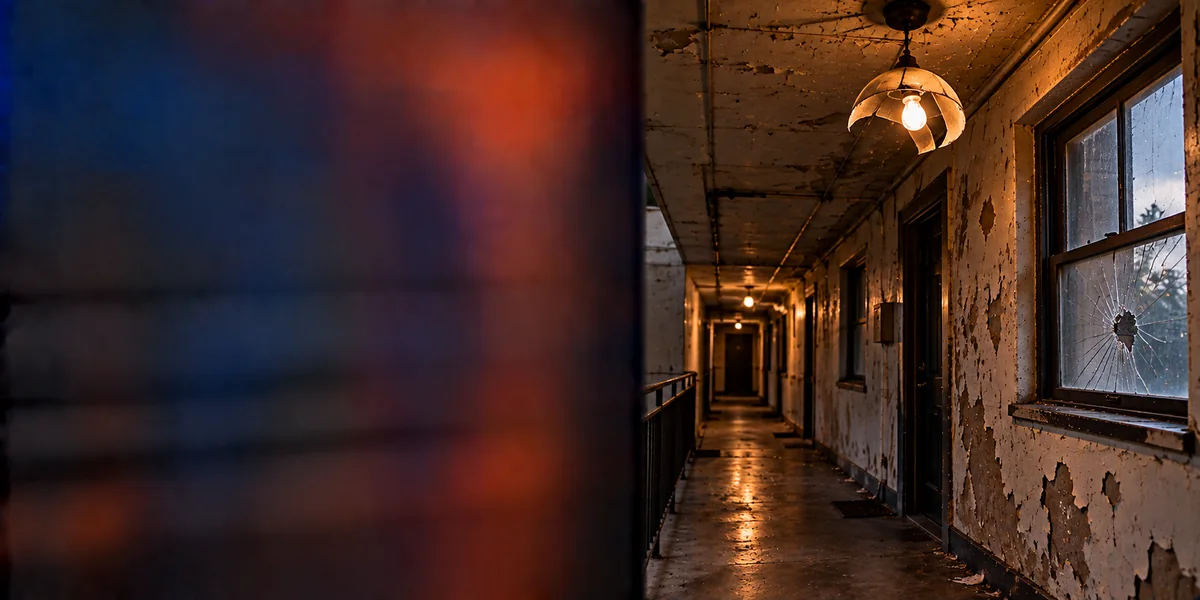
Yes, you can sue your landlord for unsafe living conditions.
Every landlord is required by state and city housing codes to keep rental homes safe, structurally sound, and free of health hazards. Depending on whether the unsafe condition cost you money or physically hurt you, you have two ways to sue:
- Sue for Rent Refunds, Moving Costs & Property Damage (Small Claims / Housing Court — $2,500 to $25,000): Even if nobody was physically injured, you can sue to get back 25% to 100% of the rent you paid while living with code violations (like mold, pests, no heat, bad wiring, sewage, or broken locks), plus hotel bills, ruined belongings, and moving expenses if you have to break your lease.
- Sue for Physical Injuries or Illness (Personal Injury Lawsuit — $25,000 to $500,000+ With a Lawyer): If an unsafe condition—like a collapsed ceiling, broken stair railing, electrical shock, carbon monoxide leak, or toxic mold—sent you or your family to the doctor, an injury lawyer can sue the landlord's insurance company for medical bills, lost wages, and pain and suffering at $0 upfront cost.
What Tenants Should Know
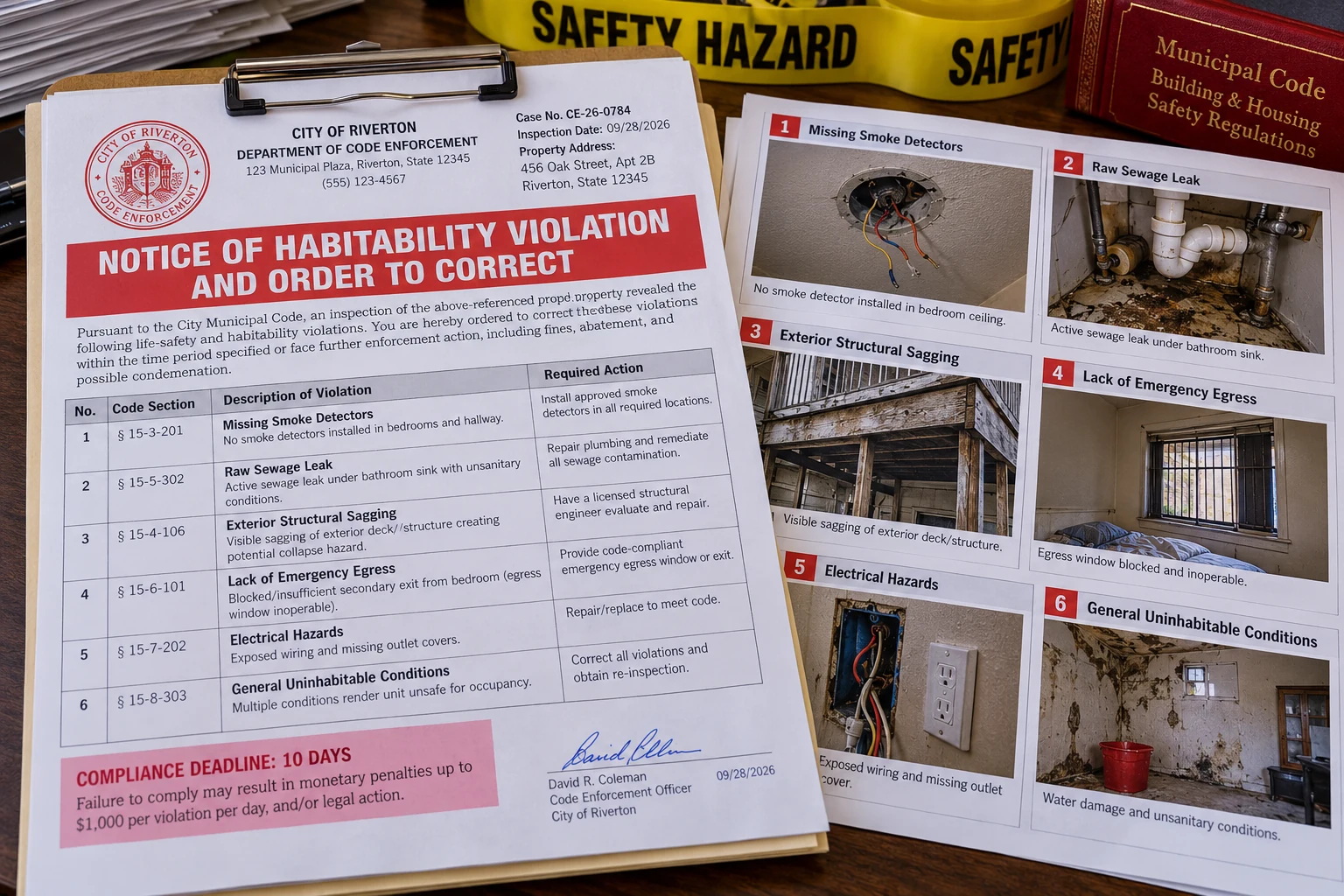
- A Free City Building Inspection Is Your Strongest Courtroom Proof: Calling 311 or your local Code Enforcement / Health Department brings a city inspector to your apartment for free. When the inspector writes an official Notice of Violation against your landlord, the landlord can no longer lie to a judge and claim the apartment was safe.
- Don't Fall for the "If You Call the City, You'll Be Homeless" Threat: Bad landlords often scare tenants by claiming the city will condemn the building and kick them out. In many states (like California, Washington, New York, and New Jersey), if the city shuts down an apartment because of the landlord's neglect, the law forces the landlord to pay you thousands of dollars in emergency relocation cash (often 2–3 months' rent) plus return your full deposit immediately.
- Multiple Unsafe Conditions Stack Up in Court: If your apartment has three or four problems at once—such as mice, a leaking ceiling, sparking outlets, and a broken hallway lock—judges combine those violations together, often awarding 50% to 100% rent refunds.
- You Don't Always Need Prior Written Notice If You Were Injured in a Common Area: While you must warn your landlord in writing about hidden problems inside your apartment, landlords have an automatic legal duty to inspect shared stairs, railings, walkways, roofs, and building wiring. If rotted stairs break under your foot, you can sue even if you never texted them about the stairs before.
- Renting an Illegal Basement or Garage Can Entitle You to Big Refunds: If you discover your landlord rented you an unpermitted basement, attic, or garage conversion without proper fire exits or a Certificate of Occupancy, many courts rule the lease illegal—stopping the landlord from collecting rent and helping you recover moving costs.
The 22 Conditions That Make an Apartment Legally "Unsafe" (And Who to Call)
Under state landlord-tenant laws and municipal housing maintenance codes, your landlord has an automatic, non-waivable duty to deliver and maintain a safe, habitable dwelling. State law automatically guarantees that any home you rent must be fit for human living, and landlords cannot use an "as-is" lease clause to avoid mandatory health and safety codes.
Courts group unsafe conditions into distinct legal tiers based on urgency. The table below outlines the 22 specific violations that give tenants immediate legal grounds to sue for rent abatement, break their lease, or recover personal injury compensation, along with the free government agency to contact:
| Hazard Category | Specific Unsafe Conditions | Legal Fix Deadline | Free Government Agency to Call |
|---|---|---|---|
| Immediate Life-Safety Emergencies (Class C) |
1. No heat in freezing weather 2. No running water or hot water 3. Raw sewage on floor or in tub 4. Carbon monoxide or gas leak 5. Sparking electrical panel or ungrounded wiring 6. Imminent or active ceiling collapse 7. Broken exterior front door lock or shattered security door |
24 to 72 Hours | 311 / City Building Inspector, Fire Marshal, or Gas Utility Emergency Line |
| Serious Health & Sanitation Hazards (Class B) |
8. Toxic black mold growth 9. Chronic roof or pipe water leaks 10. Rats, mice, or heavy roach infestation 11. Severe bed bug infestation 12. Peeling pre-1978 lead paint or lead dust 13. Crumbling friable asbestos insulation 14. Broken toilet in a single-bathroom apartment |
5 to 14 Days | County / City Health Department & Code Enforcement |
| Structural & Physical Fall Hazards |
15. Rotted exterior porch steps or missing tread 16. Loose or missing stair handrails 17. Unstable balcony or terrace railings 18. Shattered or stuck window sashes 19. Pitch-black stairwells or hallways due to burned-out lighting |
7 to 14 Days | City Department of Buildings (DOB) / Code Enforcement |
| Fire Code & Illegal Unit Violations |
20. Missing or expired smoke and carbon monoxide detectors 21. Nailed-shut windows or blocked secondary fire exits 22. Unpermitted basement, garage, or attic unit lacking a Certificate of Occupancy |
Immediate to 7 Days | Local Fire Department (Fire Prevention Bureau) & City Zoning/Building Dept. |
Actual Notice vs. Constructive Notice in Court: A common misconception is that a landlord cannot be held liable unless a tenant sent multiple written complaints. Under the legal doctrine of Actual Notice, you hold the landlord accountable because you sent texts, emails, or portal tickets reporting the defect. However, under Constructive Notice, if an unsafe condition—such as rotted common exterior stairs, a sagging hallway roof, or ancient corroded pipes—existed for months, the landlord is legally presumed to have known about it because routine property inspections would have uncovered the danger.
For an extensive walkthrough of tenant rights and small claims filing procedures, see our foundational guide on suing your landlord.
How to Use City Code Inspectors (311) to Guarantee a Win in Court
If you enter Small Claims Court or Housing Court armed only with photos on your phone, a seasoned property management lawyer will attempt to dismiss your claim. They will argue: "Your Honor, that is simply normal apartment wear and tear, the property was completely safe, and the tenant is merely trying to avoid their contractual rent obligations."
To decisively defeat this defense, call 311 or your local City Code Enforcement / Health Department. An official municipal inspection changes the entire dynamic of your lawsuit:
1. The Inspection Is 100% Free and Performed by a Licensed Official
You do not need to pay expensive private building consultants. A certified city code enforcement officer will inspect your apartment at no charge. They measure indoor temperatures with calibrated digital thermometers, test water pressure and heat levels, inspect electrical subpanels, probe rotted wood, and test for carbon monoxide or gas leaks.
2. The Inspector Issues a Formal Notice of Violation (NOV)
When an inspector identifies code breaches, they write a formal Notice of Violation (NOV) against the property owner. This government document lists the exact municipal code sections violated, specifies an mandatory compliance deadline (e.g., 24 hours to 14 days), and assesses escalating city fines (often $100 to $1,000+ per day) if the landlord fails to complete repairs.
3. The Certified Report Provides Irrefutable Proof in Court
Under judicial rules of evidence, an official government violation report is an authenticated public record. When you hand the judge a copy of an NOV showing multiple Class B or Class C violations, the landlord cannot claim the property was safe. The judge will treat the habitability breach as established fact, paving the way for maximum rent abatement awards.
What If the City "Red-Tags" or Condemns Your Apartment? (Mandatory Relocation Money)
Slumlords frequently intimidate tenants with a classic scare tactic: "If you report this water leak or broken furnace to the city, they will condemn the building, throw you out on the street, and you will be left homeless."
This is a complete falsehood. If a city building or health inspector "Red-Tags" or condemns your apartment—declaring it immediately unfit for human habitation due to dangerous electrical wiring, structural hazards, raw sewage, or an illegal basement conversion—the landlord cannot simply walk away with your rent money. State and municipal statutes across the country mandate substantial emergency cash payouts to displaced tenants:
California (Health & Safety Code § 17975)
If a residential unit is ordered vacated due to housing code violations, the landlord is legally mandated to pay the tenant relocation assistance equal to 2 to 3+ months of fair market rent (as determined by HUD), plus verified moving expenses and the immediate return of the tenant's entire security deposit within days of the order.
Washington State (RCW 59.18.085)
If a home is condemned or declared unlawful to occupy, the landlord must pay the displaced tenant 3 times (3x) the monthly rent OR $2,000 (whichever is greater) in cash or certified funds within 7 days of the displacement notice, plus return 100% of all prepaid rent and deposits. If the landlord fails to pay within 7 days, the city may advance the money and assess penalties plus 12% interest against the property owner.
New Jersey, New York, Connecticut, Oregon & Major Municipalities
Under New Jersey's Relocation Assistance Law (N.J.S.A. 20:4-1 et seq.), landlords whose code violations displace tenants can be ordered to pay up to 6 times monthly rent or emergency hotel stipends. In New York City, landlords must reimburse the Department of Housing Preservation and Development (HPD) for emergency family shelter costs while tenants retain the right to sue for treble damages.
Unpermitted Basement, Attic, and Garage Conversions: If your landlord rented you an illegal apartment—lacking a municipal Certificate of Occupancy, proper ceiling clearance, or required secondary egress windows—the lease agreement is legally void from its inception. In many jurisdictions, landlords are barred from collecting rent for illegal units and courts routinely order landlords to refund months of collected rent back to the tenant.
Did You Get Hurt? How Personal Injury Lawsuits Work Against Landlords
While an unaddressed repair or mold issue in Small Claims Court recovers between $2,500 and $25,000 in rent refunds, cases involving acute bodily injury or severe illness jump into a substantially higher monetary tier. In serious injury claims, tenants can recover between $25,000 and $500,000+ from the landlord's commercial insurance carrier.
1. Every Commercial Landlord Carries Premises Liability Insurance
Tenants often hesitate to pursue legal claims because their landlord claims to be "cash-strapped" or operates through an LLC. In reality, mortgage lenders and commercial property underwriters require landlords to carry $300,000 to $1,000,000+ in premises liability insurance. Your lawsuit is defended and paid by an insurance corporation, not from the landlord's personal checking account.
2. Prior Written Notice Is NOT Always Required for Common Area Defects
While tenants must notify landlords of defects hidden inside their private apartments, landlords have an ongoing, non-delegable duty to inspect and maintain shared structural spaces—such as exterior wooden stairways, porch railings, common entrance doors, hallway lighting, and building wiring. If a rotted step snaps beneath you or a hallway handrail pulls out of the wall, you can sue for full bodily injury damages even if you never complained about that specific step beforehand.
3. The Critical 24-Hour Action Checklist Following an Apartment Injury
- Photograph the Defect Instantly: Capture detailed photographs and high-definition video of the collapsed ceiling, snapped step, broken handrail, or sparking outlet immediately before maintenance arrives with tools or paint to cover up the evidence.
- Seek Same-Day Medical Evaluation: Visit an Urgent Care clinic or Emergency Department immediately. Ensure the attending physician documents the exact mechanism of injury in your medical charts (e.g., "Patient sustained lumbar sprain following structural collapse of residential stairway").
- Preserve Physical Evidence: Store the footwear and clothing you were wearing during the accident in an unwashed bag, and record the full names and contact numbers of neighbors who witnessed the fall or observed the hazardous condition prior to the incident.
Ready-to-Send Unsafe Living Conditions & Code Violation Demand Letter
Prior to initiating Small Claims litigation, hiring outside contractors, or vacating under constructive eviction, serving your landlord with an unequivocal written demand letter is a vital legal prerequisite. This document establishes an indisputable timeline of actual notice and provides formal notification of municipal code breaches.
Deliver this notice via Certified Mail (Return Receipt Requested) as well as via email. Retain the postal tracking receipt and green signature card for your court exhibits.
FORMAL NOTICE OF UNCORRECTED HEALTH & SAFETY CODE VIOLATIONS,
BREACH OF THE IMPLIED WARRANTY OF HABITABILITY, AND DEMAND FOR RENT REFUND
SENT VIA USPS CERTIFIED MAIL (RETURN RECEIPT REQUESTED) & ELECTRONIC MAIL

DATE: [Date]
CERTIFIED MAIL TRACKING NUMBER: [Certified Mail Tracking Number]

TO (LANDLORD / PROPERTY MANAGEMENT):
[Landlord or Property Management Entity Name]
[Management Office Street Address]
[City, State, ZIP Code]
[Management Official Email Address]

FROM (TENANT):
[Your Full Legal Name(s)]
[Rental Property Address & Unit Number]
[City, State, ZIP Code]
[Your Phone Number]
[Your Email Address]

RE: FINAL DEMAND TO REMEDY HAZARDOUS & UNLAWFUL LIVING CONDITIONS
PREMISES: [Full Rental Property Address, Including Unit #]

Dear [Landlord or Property Manager Name]:

This correspondence constitutes formal legal notice under state residential landlord-tenant statutes, municipal housing maintenance codes, and the statutory implied warranty of habitability that the leased premises at [Your Rental Address, Unit Number] contain severe, hazardous defects that materially endanger the life, health, and physical safety of the occupants.

1. SPECIFIC UNCORRECTED CODE VIOLATIONS & NOTICE TIMELINE:
Despite prior notifications, the following dangerous conditions remain unaddressed:
• Defect #1: [Detailed description of primary hazard—e.g., active water intrusion causing black mold contamination and ceiling sagging in main bedroom / non-operational heating system during winter].
  - Prior Notice History: Submitted via resident portal ticket #[Ticket Number] on [Date], followed by email communication with management on [Date].
• Defect #2: [Detailed description of secondary hazard—e.g., broken exterior deadbolt compromised by unauthorized entry / rotted wooden exterior stairway tread].
  - Prior Notice History: Reported in writing on [Date].
• Duration of Condition: These life-safety violations have persisted for [Number of Weeks or Months], representing an unexcused failure of statutory maintenance duties.

2. STATUTORY BREACH & DIMINISHED VALUE ASSESSMENT:
Under the implied warranty of habitability and local building codes, residential landlords must maintain leased properties in a structurally sound, sanitary, and habitable condition. Under our lease contract, my full monthly rent of $[Monthly Rent Amount] compensates you for safe, fully code-compliant living quarters.

Because these dangerous defects render substantial portions of the dwelling unlivable, the fair market rental value has been severely diminished by approximately [Estimate Percentage, e.g., 40% to 65%] throughout the affected period. Furthermore, I have incurred verified out-of-pocket expenses totaling $[Out-of-Pocket Amount] for [itemized expenses, e.g., hotel accommodations, space heaters, laundromat expenses, or damaged furniture].

3. DEMAND FOR IMMEDIATE REMEDIATION & FINANCIAL RESOLUTION:
I hereby demand that management take the following corrective actions:
1. Licensed Professional Remediation: Dispatch licensed, bonded contractors to inspect and permanently remedy the above-listed violations within [24–72 Hours for life-safety emergencies / 7 Days for general code violations] from receipt of this notice, no later than [Specific Deadline Date, e.g., October 8, 2026].
2. Retroactive Rent Abatement: Issue a retroactive rent refund or written ledger credit in the amount of $[Total Rent Refund Amount, e.g., $2,400.00] to account for the diminished living value during the period of violation.
3. Out-of-Pocket Expense Reimbursement: Reimburse $[Total Out-of-Pocket Costs, e.g., $650.00] for direct financial losses caused by these uncorrected defects (copies of receipts attached).

4. RESERVATION OF STATUTORY REMEDIES:
If professional remediation is not commenced and completed within the statutory cure window set forth above, please be advised that I will immediately exercise all legal remedies available under state law without further notice, including:
• Requesting an immediate, comprehensive on-site inspection from the City / County Department of Building & Housing Code Enforcement (311) and the Local Health Department.
• Terminating the lease agreement under the legal doctrine of constructive eviction, vacating the premises without lease-break penalty, and demanding mandatory statutory relocation assistance where provided by law.
• Exercising statutory Repair-and-Deduct or Court Escrow withholding rights pursuant to state law.
• Initiating a civil lawsuit in Small Claims Court or Housing Court to recover full retroactive rent abatement, consequential damages, statutory penalties, and court fees.

Please note that under state anti-retaliation laws, any adverse action—including eviction filings, rent increases, reduction of services, or negative credit reporting—taken within 90 to 180 days of this notice is legally presumed to be unlawful retaliation subject to substantial civil penalties.

I expect your written response within 48 hours confirming the scheduled arrival of licensed repair contractors.

Sincerely,

________________________________________
[Your Signature]

[Your Printed Full Legal Name]
Tenant, Unit #[Your Unit Number]
How Much Compensation Can You Recover for Unsafe Living Conditions?
When taking legal action in Small Claims Court or Housing Court, financial recovery is calculated using established statutory remedies, documented out-of-pocket expenses, and rent reduction standards:
| Recovery Category | Calculation Standard | Statutory Authority & Limits |
|---|---|---|
| 1. Retroactive Rent Abatement | Refund of 25% to 75% of monthly rent for all months severe building code violations rendered the apartment dangerous. | Warranty of Habitability. |
| 2. Out-of-Pocket Repair Costs | 100% repayment under repair-and-deduct statutes for certified contractor repairs performed after landlord notice defaults. | State repair-and-deduct laws. |
| 3. Relocation & Emergency Hotel Reimbursement | Lodging costs, storage unit fees, and moving expenses incurred while vacating condemned or hazardous units. | Uninhabitable apartment doctrine. |
Small Claims Filing Limits: Most tenants resolve these matters pro se (without a lawyer) in Small Claims Court. Maximum claim limits vary by state: for example, $12,500 in California (California Courts Self-Help), $10,000 in New York City (NY Courts Small Claims), and $20,000 in Texas (Texas Judicial Branch). If damages exceed local small claims thresholds, lawsuits proceed to standard Civil Court.
Frequently Asked Questions
Any defect that threatens a tenant's physical health, safety, or security—including lack of heat, hot water, electricity, or working plumbing; raw sewage or roof leaks; toxic mold, lead paint, or asbestos; rat, bed bug, or roach infestations; broken locks or windows; missing smoke/CO alarms; and broken stairs, railings, or collapsing ceilings.
Yes—if your landlord fails to fix serious health or safety hazards after receiving your written notice and a short legal cure window, the law considers you "constructively evicted." By documenting the hazard with photos and a free City Code Enforcement inspection report before handing back the keys, you can move out legally without owing future rent and demand your full deposit back.
In many states and cities, a landlord cannot legally collect rent for an unpermitted apartment that lacks a Certificate of Occupancy, proper ceiling height, or a safe second fire exit. You can report the illegal unit to the City Building Department, move out immediately without penalty, and often sue for relocation money and a refund of rent paid.
No—every state with tenant protection laws strictly bans retaliatory eviction. If your landlord tries to evict you, raise your rent, or harass you within 90 to 180 days of calling a city inspector or reporting unsafe conditions, you can get the eviction thrown out and sue the landlord for statutory retaliation penalties.
If nobody was physically hurt and you are suing for a rent refund, security deposit, moving costs, and ruined belongings under $5,000–$12,500, Small Claims Court is fast, costs ~$35–$75, and requires no lawyer. If you or your child suffered a physical injury, hospital visit, or serious illness, call a personal injury or tenant attorney—they work for $0 upfront and pursue the landlord's commercial insurance policy for much larger settlements.
SueLegal is an independent educational legal publisher, not a law firm or lawyer referral service. The information provided in this guide is for general informational and educational purposes only and does not constitute formal legal advice. Residential landlord-tenant laws, repair notice periods, and statutory remedies vary significantly across state and municipal jurisdictions. If you are facing eviction, severe uninhabitable conditions, or complex litigation, consult a licensed attorney in your jurisdiction or contact your local legal aid organization. For more details on our standards, read our Editorial Policy and Legal Research Methodology.