
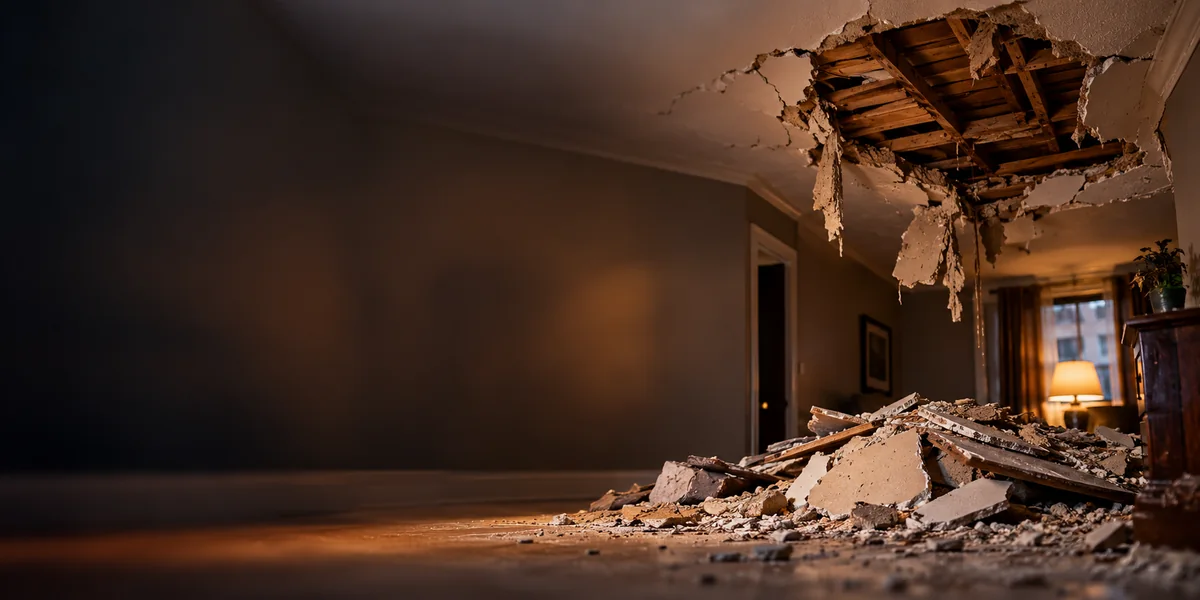
Yes, you can sue your landlord if your apartment ceiling collapses.
Ceilings do not cave in on their own—they collapse because a landlord ignored roof leaks, upstairs plumbing leaks, or sagging plaster/drywall. Depending on whether the falling ceiling physically hit you or missed you and ruined your room, you have two ways to recover money:
- If Debris Hit You or a Family Member ($25,000 to $500,000+ Insurance Settlements): Wet drywall and plaster weigh up to 200–350+ pounds per section. Even if you only feel sore or dizzy today, a personal injury lawyer can sue your landlord's commercial liability insurance policy at $0 upfront cost for ER and doctor bills, neck/back therapy, concussion care, lost wages, ruined belongings, and pain and suffering.
- If Nobody Was Hit ($2,500 to $15,000 in Small Claims Court — No Lawyer Needed): If you were in another room or at work when the ceiling crashed down, you can sue in Small Claims Court for a 50% to 100% rent refund while the room is unusable, emergency hotel stays, and 100% replacement value for your crushed or soaked bed, couch, clothes, and electronics.
The Main Points
- Never Text Your Landlord "I'm Okay!" Right After a Collapse: When 200 pounds of wet ceiling plaster crashes down, adrenaline masks neck disc injuries, shoulder tears, and mild concussions for 12 to 24 hours. Report the collapse in writing, do not say you are uninjured, and get checked at Urgent Care or the ER the same day.
- Photograph the BACK Side of the Fallen Drywall Before Anyone Cleans It Up: Landlords always claim "It was a sudden pipe burst with no warning." Flip over a chunk of fallen ceiling and photograph the dark brown water stains, black mold, rusted screws, or rotted wood beams inside the ceiling hole—that proves the leak was festering for weeks or months!
- You Don't Have to Be Hit by the Ceiling to Win Thousands in Small Claims Court: Even if the ceiling missed you by two feet, you do not owe full rent for an apartment with a gaping hole in the ceiling. You can recover 50% to 100% off your rent, hotel bills, and every ruined item in the room.
- Watch Out for Asbestos & Black Mold in Fallen Ceiling Dust: If your building was built before 1981 (especially with textured "popcorn" ceilings) or had a long-term water leak, the dust covering your bed, couch, and clothes often contains toxic mold or asbestos fibers—making porous belongings a 100% total replacement loss.
- Public Housing & City Tenants Have a Strict 90-Day Deadline: While renters with private landlords usually have 2 to 3 years to file an injury lawsuit, if you live in Public Housing (like NYCHA, CHA, or a city-owned building), you often must file a formal written Notice of Claim within 60 to 90 days of the collapse!
What to Do in the First 60 Minutes After a Ceiling Collapse (5 Steps That Make or Break Your Lawsuit)
When an apartment ceiling caves in, tenants are in shock. Dust fills the air, wet plaster and insulation cover the floor, and dirty water drips from above. Dishonest landlords move fast to clean up the mess and hide the evidence before you can document what happened.
Follow these five urgent steps during the first hour to protect your safety and preserve your legal claims under our master guide to tenant lawsuits:
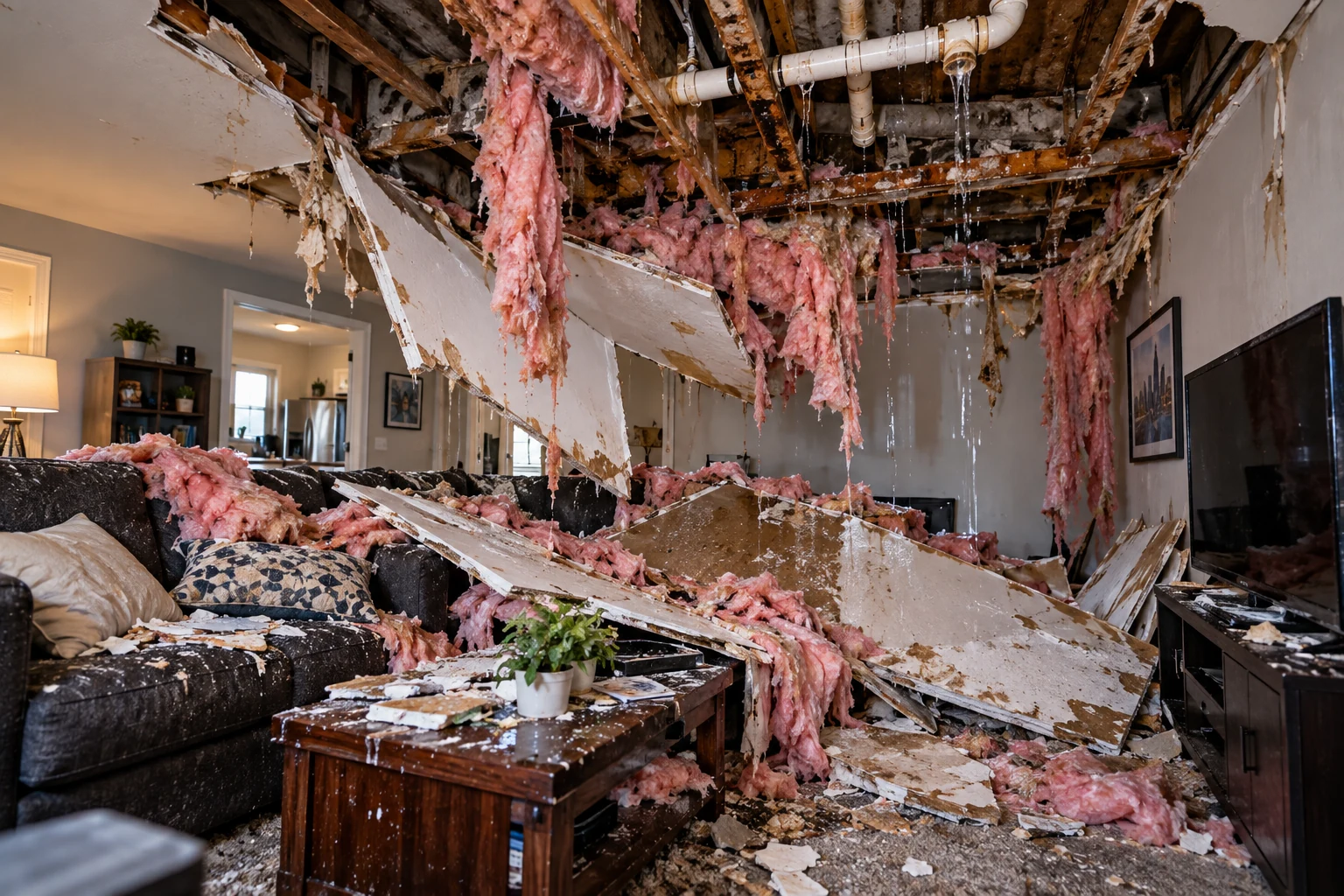
The 5-Step Ceiling Collapse Emergency Action Plan
1. Watch Out for Live Electrical Wires & Turn Off the Room Breaker
Ceiling collapses often rip down ceiling fans, chandeliers, and live 120V junction boxes straight into puddles of water on your floor. Never step into wet plaster barefoot. Locate your electrical breaker panel and shut off power to that room immediately.
2. Take the "3-Angle Forensic Photos" BEFORE Maintenance Cleans Up
Photograph the scene thoroughly before anyone touches the debris:
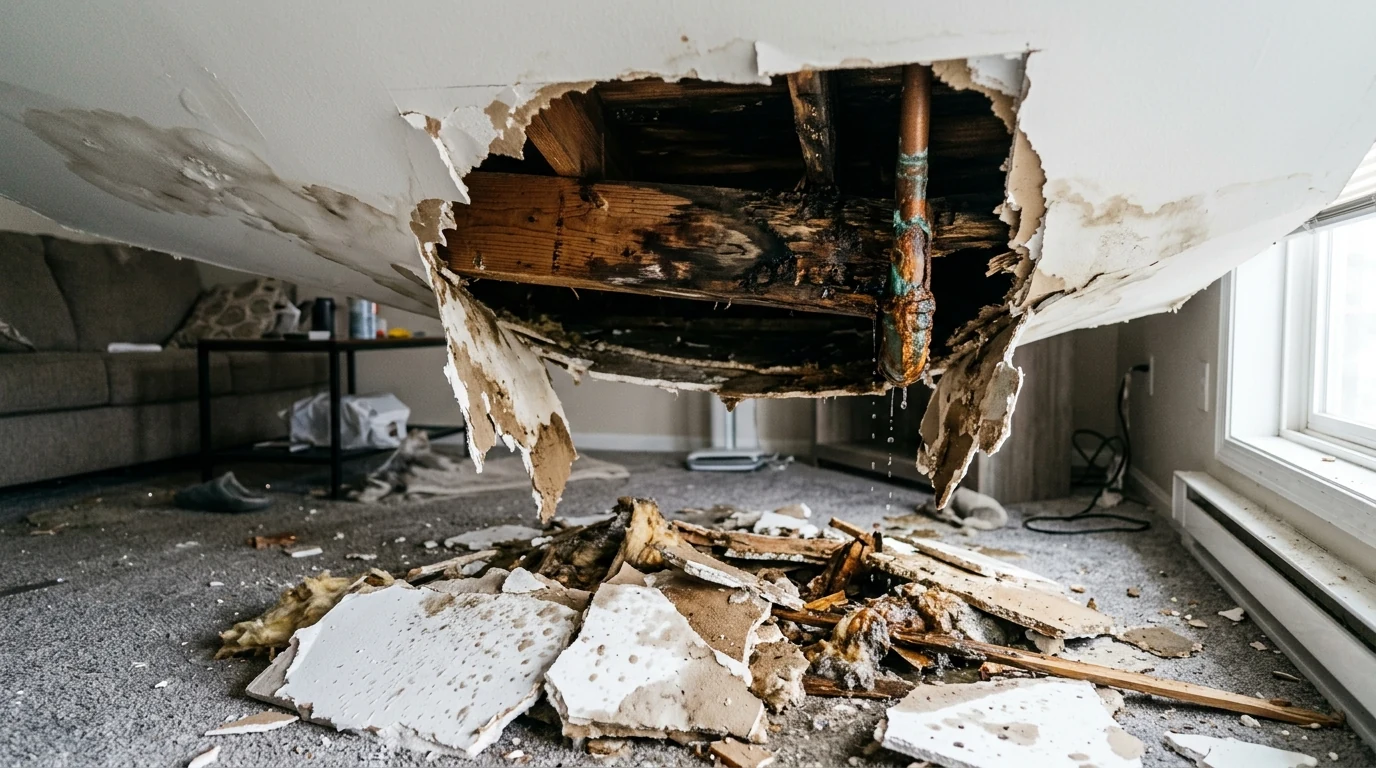
- Photo #1 (Look Up Into the Hole): Turn your camera flash ON and zoom in on the exposed ceiling cavity. Photograph the leaking plumbing pipe, rusted metal lath, black mold colonies, or rotted wood joists.
- Photo #2 (Flip Over a Fallen Chunk of Drywall): Photograph the back/top side of the fallen drywall sitting on your floor. Dark brown water rings, mold spots, or rusted screws prove water pooled there for weeks—defeating any claim that the leak was sudden.
- Photo #3 (The Debris on Your Bed/Furniture): Photograph the wet plaster, soggy fiberglass insulation, and dirty water sitting directly on your mattress, couch, computer, or clothing before moving anything.
3. Bag One Fist-Sized Chunk of Fallen Ceiling Material
Seal a small chunk of fallen drywall or plaster inside a clean Ziploc bag. This preserves physical proof of water saturation and mold in court. In pre-1981 buildings, an accredited lab can test this sample for $40 to prove toxic asbestos contamination.
4. Never Text "I'm Okay!" & Go to Urgent Care / ER the Same Day
If wet drywall or plaster grazed your head, neck, shoulder, or back—or if you inhaled heavy dust—seek medical care immediately. Adrenaline routinely masks concussions, cervical disc herniations, and soft tissue tears for 12 to 24 hours. Insurance adjusters seize on early "I'm fine" texts to deny injury claims.
5. Call 311 / City Department of Buildings (DOB) Immediately
Before your landlord sends an unlicensed worker with a broom and fresh drywall to cover up rotted joists, call 311 or your municipal building inspector. An official city inspector creates a certified public record and issues an immediate Hazardous Structural Violation against the property owner.
How to Win Even If You Never Texted the Landlord Before It Fell
When a ceiling falls, landlords almost always argue: "You never sent us a maintenance ticket warning us the ceiling was going to fall, so we had no notice and owe you nothing."
Under state premises liability law and our comprehensive framework for proving landlord negligence, that defense fails in court. Ceilings do not fall without warning—they collapse because water accumulated over time. You can prove fault through three distinct legal doctrines:
1. Prior Leaks in the Upstairs Apartment or Roof
Even if you never texted management, the landlord had notice if the upstairs tenant reported a leaking toilet, overflowing tub, or sweating radiator valve. If roofers patched shingles above your unit months earlier, the landlord knew water was entering the building. In an injury lawsuit, your attorney subpoenas all maintenance logs, work orders, and plumber invoices for the entire building.
2. Long-Term Rot & Water Rings ("Constructive Notice")
If you texted your landlord about a brown water stain, bubbling paint, or dripping ceiling before it fell, that is Actual Notice. Even if you never texted them, if the roof or upstairs pipes were slowly leaking inside the ceiling for weeks—leaving black mold, dark water rings, or rotted wood joists—the landlord is still liable because they should have discovered the condition during routine maintenance (Constructive Notice).
Furthermore, courts apply the doctrine of Res Ipsa Loquitur ("The Thing Speaks for Itself"): because ceilings do not collapse on their own without carelessness, and because the landlord controls the roof, plumbing, and structural framing, the collapse itself serves as circumstantial proof of landlord neglect.
3. Mandatory Safe Housing Codes
Under state habitability statutes (such as California Civil Code § 1941.1, the New York Housing Maintenance Code, and Chicago RLTO § 5-12-070), landlords have an affirmative, non-delegable duty to maintain roofs, floors, and ceilings in weather-tight, sound condition. When a ceiling falls, the landlord has breached the implied warranty of habitability as a matter of law.
What Is a Ceiling Collapse Lawsuit Worth? (Both Tracks Compared)
The financial value of a ceiling collapse claim depends entirely on whether falling debris physically struck an occupant or whether the collapse ruined your living space and personal belongings while you were out:
| Your Situation | Typical Payout Range | What You Can Recover | Who Pays & How You File |
|---|---|---|---|
| Track 1: Ceiling Hit You, Your Child, or a Guest (Personal Injury Claim) | $25,000 to $500,000+ (Depending on head, neck, and spinal trauma) |
• 100% of ER, MRI, Physical Therapy & Doctor Bills • Lost Wages & Missed Work • Pain, Suffering, Concussion/PTSD & Scarring • All Crushed/Soaked Property + Hotel Bills |
Paid by the Landlord's $1M+ Commercial Liability Insurance (plus $5,000–$10,000 No-Fault MedPay). Handled by a personal injury lawyer for $0 upfront. |
| Track 2: Ceiling Missed You, But Ruined Your Room & Belongings (Small Claims Track) | $2,500 to $15,000 (Up to state small claims limits) |
• 50% to 100% Rent Refund for every day the room/unit is unusable • 100% Replacement of Crushed/Soaked Bed, Couch, TV, Laptop & Clothes • Emergency Hotel Nights & Moving Costs (if breaking lease) |
File yourself in Small Claims Court for ~$35–$75 without needing a lawyer (or demand a direct settlement credit from the landlord). |
Don't Let the Landlord Just "Slap Up New Drywall" Over Wet Mold or Asbestos!
Following a collapse, landlords frequently rush to minimize costs by dispatching an unqualified handyman to patch the hole. Be alert to two hazardous shortcuts:
Shortcut #1: Drywalling Over Wet Joists & Active Leaks (Instant Black Mold Trap)
Cheap property managers often screw new drywall over the opening without fixing the underlying plumbing leak or drying out saturated wood joists. When wet fiberglass insulation and timber are sealed behind fresh drywall, fungal colonies proliferate rapidly.
Within 10 to 14 days, toxic black mold colonizes the ceiling cavity, releasing airborne mycotoxins into your bedroom. Review our guides on landlord water damage lawsuits and toxic black mold claims. Demand that management prove the source leak is repaired and verify with a pinless moisture meter that framing timber tests below 17% moisture content before any drywall is installed.
Shortcut #2: Dry-Sweeping Pre-1981 Popcorn Ceilings (Asbestos Danger)
If your building was constructed before 1981 and the collapsed ceiling featured acoustic texture ("popcorn ceiling") or old plaster lath, disturbing the debris creates an immediate airborne hazard. Sweeping or vacuuming with a residential vacuum pulverizes friable chrysotile asbestos into billions of microscopic fibers.
Read our detailed analysis on suing a landlord for asbestos exposure. When a pre-1981 ceiling falls onto mattresses, rugs, or upholstery, standard laundering cannot remove embedded mineral fibers. Bag a small sample for testing, seal the room, and treat porous furnishings as a total replacement loss.
Ready-to-Send Ceiling Collapse Demand, Hotel & Evidence Preservation Letter
Establish a strict paper trail immediately after a ceiling collapse to secure your financial rights and stop management from discarding crucial physical proof. Use the interactive tool below to generate, copy, or download your legal demand:
NOTICE OF CEILING COLLAPSE PERSONAL INJURY CLAIM, EVIDENCE PRESERVATION & INSURANCE DISCLOSURE DEMAND

Date: [Current Date]
Sent Via: Certified Mail (Tracking #: [Insert Tracking #]) & Email / Tenant Portal

TO:
Landlord / Property Management: [Landlord / Property Management Company Name]
Office Address: [Management Street Address]
City, State, Zip: [City, State, Zip]

FROM:
Tenant Name(s): [Your Full Name(s)]
Rental Premises: [Your Street Address, Unit/Apt Number]
Current Address: [Your Hotel or Temporary Address]
Phone: [Your Phone Number] | Email: [Your Email]

RE: FORMAL NOTICE OF STRUCTURAL CEILING COLLAPSE & INJURY ON [Date of Collapse]
    PREMISES: [Your Street Address & Apartment Number]
    MUNICIPAL 311 / DOB COMPLAINT #: [311 Report Number, if applicable]

Dear [Landlord / Property Manager Name],

Please accept this letter as formal statutory notification that on [Date of Collapse] at approximately [Time], a major structural section of the ceiling in the [Bedroom / Living Room / Kitchen] collapsed without warning, raining hundreds of pounds of saturated plaster, drywall, and wet insulation onto the occupants below.

1. NOTICE OF BODILY INJURY:
The falling debris violently struck [Your Name / Family Member Name], causing acute physical injuries including [head trauma / cervical neck sprain / disc herniation / shoulder injury / severe cuts and contusions]. Medical evaluation and emergency treatment were obtained at [Hospital / Urgent Care Facility Name].

2. STRICT LEGAL HOLD & ANTI-SPOLIATION NOTICE:
Management and its maintenance contractors are hereby placed on strict legal notice NOT to discard, alter, demolish, or spoliate the fallen ceiling material, water-logged insulation, or the exposed plumbing pipes and ceiling framing prior to independent forensic inspection. Discarding this evidence will be cited as intentional spoliation in court proceedings.

3. MANDATORY INSURANCE POLICY DISCLOSURE:
Under applicable state civil discovery rules, demand is hereby made for the legal name, claims address, and policy number of your Commercial General Liability (CGL) insurance carrier and No-Fault Medical Payments (MedPay) policy within FIVE (5) BUSINESS DAYS of receipt of this notice.

4. IMMEDIATE HOUSING ACCOMMODATION & RENT ABATEMENT:
Because the room is completely uninhabitable, demand is made for immediate payment or reimbursement of emergency hotel lodging and a 100% daily rent abatement until certified licensed contractors fully remediate all water leaks and structural hazards.

Govern yourself accordingly.

Sincerely,

_________________________________________
[Your Signature]

[Your Printed Name]
How Much Compensation Can You Recover for a Ceiling Collapse?
When taking your landlord to Small Claims Court or Housing Court, financial recovery is determined by statutory damages categories, proven out-of-pocket losses, and rent reduction formulas:
| Recovery Category | Calculation Standard | Statutory Authority & Limits |
|---|---|---|
| 1. Crushed Personal Property Replacement | Fair market value compensation for electronics, computers, furniture, and beds crushed by collapsing sheetrock or wet plaster. | Premises liability negligence damages. |
| 2. Emergency Hotel Lodging & Cleanout | 100% reimbursement for hotel stays while room is decontaminated and rebuilt, plus rent abatement. | Uninhabitable apartment doctrine. |
| 3. Bodily Injury / Concussion Damages | Emergency room care, imaging (CT/MRI), cervical spine therapy, and lost wages if debris struck a tenant. | Personal injury tort liability. |
Small Claims Filing Limits: Most tenants resolve these disputes without hiring an attorney in Small Claims Court. Maximum claim limits vary by state: for example, $12,500 in California (California Courts Self-Help), $10,000 in New York City (NY Courts Small Claims), and $20,000 in Texas (Texas Judicial Branch). If your total damages exceed small claims thresholds, you may file in standard civil district court.
Frequently Asked Questions
Can I sue my landlord if my ceiling collapsed, but it didn't hit me? +
Yes! While personal injury lawyers only take cases where someone was physically hurt, you do not need a lawyer to sue your landlord in Small Claims Court when a ceiling collapse ruins your room. You can win $2,500 to $15,000 for a 50%–100% rent refund, hotel nights, and 100% replacement of your soaked or crushed mattress, couch, clothes, and electronics.
Can MY landlord blame ME or keep my security deposit for a collapsed ceiling? +
No—never. Ceilings collapse from roof leaks, upstairs plumbing leaks, or aging plaster/drywall fasteners—all of which are 100% structural building systems controlled by the landlord. Any attempt to charge you or keep your security deposit for a collapsed ceiling is illegal and can trigger 2x to 3x bad-faith deposit penalties in court.
Does my landlord have to pay for a hotel room after my ceiling collapses? +
Yes—a bedroom or living room with a collapsed ceiling, wet insulation, exposed wiring, and falling plaster is legally uninhabitable. Under state habitability laws and municipal codes, the landlord must either pay for temporary hotel housing or provide a 100% daily rent refund while you stay elsewhere, and if the collapse resulted from deferred maintenance or ignored leaks, you can recover your full hotel receipts in Small Claims Court.
Can I break my lease immediately if my apartment ceiling caves in? +
Yes—a structural ceiling collapse is a severe breach of the Implied Warranty of Habitability. Especially if the landlord ignored prior leak warnings, refuses to properly remediate mold/asbestos dust, or leaves the ceiling open for days, you can call 311 / City Code Enforcement to document the violation, give written notice of Constructive Eviction, move out without penalty, and demand 100% of your security deposit and moving costs back.
How long do I have to file a ceiling collapse lawsuit against my landlord? +
For private landlords, most states give you 2 to 3 years from the date of the collapse to file a personal injury or property damage lawsuit—and up to 3 to 6 years for breach-of-lease rent refunds. However, if you live in Public Housing (like NYCHA) or a city/government-owned building, you often must file a formal written Notice of Claim within just 60 to 90 days of the accident, so act immediately.
SueLegal is an independent educational legal publisher, not a law firm or lawyer referral service. The information provided in this guide is for general informational and educational purposes only and does not constitute formal legal advice. Residential landlord-tenant laws, repair notice periods, and statutory remedies vary significantly across state and municipal jurisdictions. If you are facing eviction, severe uninhabitable conditions, or complex litigation, consult a licensed attorney in your jurisdiction or contact your local legal aid organization. For more details on our standards, read our Editorial Policy and Legal Research Methodology.