
The Short Answer
Yes, you can sue your landlord for negligence.
If your landlord's carelessness—such as ignoring a repair request, leaving stairs or walkways unsafe, hiring an unqualified handyman, or failing to maintain locks and lighting—causes you physical injury or property damage, they are legally responsible. Depending on what was harmed, your claim follows one of two tracks:
- If You or a Guest Were Physically Hurt (Commercial Liability Insurance Track): A personal injury lawyer can file a claim against your landlord's commercial property insurance policy at $0 upfront cost to you to pay for ER and doctor bills, physical therapy, missed paychecks, and pain and suffering.
- If Your Belongings Were Ruined or You Paid Out of Pocket (Small Claims Court Track): If nobody was physically hurt—for example, a rotted tree branch crushed your car in the apartment lot, or an ignored leak ruined your furniture—you can sue in Small Claims Court without a lawyer to recover 100% of your financial losses.
Your Key Rights & Responsibilities
- You Are Suing the Landlord's Insurance Company, Not Their Personal Wallet: Almost every landlord is required by their mortgage lender to carry $300,000 to $1,000,000+ in commercial liability insurance. That insurance company is who actually pays your injury settlement.
- Ask About "MedPay" Coverage for Fast, No-Fault Medical Money: Most landlord insurance policies include $5,000 to $10,000 in "Medical Payments" (MedPay) coverage, which pays a tenant's or guest's immediate ER and doctor bills after an apartment accident without even having to prove the landlord was at fault.
- You Don't Need a Prior Text Message If You Were Hurt in a Shared Area: If you fell on broken apartment stairs, slipped in a dark hallway, or tripped in a potholed parking lot, the landlord cannot excuse themselves by saying "Nobody texted me about it." Landlords have an automatic legal duty to inspect and maintain all shared areas.
- Building Code Violations Trigger "Automatic Fault": If a city inspector confirms the stair risers were uneven, a handrail was missing, wiring was unpermitted, or smoke/CO detectors were missing, the law treats that violation as automatic negligence (Negligence Per Se).
- Even If the Landlord Blames You for "Not Looking," You Can Still Win: Landlords always claim you were distracted or knew the hazard was there. In 46 states, even if a court decides you were 20% at fault and the landlord was 80% at fault, you still collect 80% of the settlement.
Did It Happen Inside Your Apartment or in a Shared Area? (Why Location Changes Everything)
Negligence simply means your landlord acted carelessly. Under common law principles and the Restatement (Second) of Torts § 358–362, a landlord is negligent when they knew (or should have known) about a dangerous condition on the premises, failed to fix it within a reasonable timeframe, and that failure directly caused you physical harm or ruined your personal property.
However, the single most critical factor in winning a landlord negligence claim is where the accident occurred. Because landlords have differing degrees of control over private apartments versus shared common areas, the legal burden of proof changes completely:
| Where the Accident Happened | Examples | Do You Need Proof You Warned Them First? | Why the Law Rules This Way |
|---|---|---|---|
| Inside Your Private Apartment | Leaking bathroom ceiling, loose kitchen floorboard, broken window latch, faulty stove. | Usually YES (Unless the defect was hidden there before you moved in, or created by landlord's workers). | Because landlords cannot enter your locked apartment unannounced, they are generally not liable for indoor defects until you deliver Actual Notice. |
| Shared "Common Areas" of Building | Stairs and railings, hallways, lobby, elevator, laundry room, courtyard, parking lots, sidewalks. | NO (Prior Warning Not Required!) | Landlords have an ongoing duty to inspect, illuminate, and maintain shared spaces. Under Constructive Notice, if a step rotted over months, they are liable because they should have spotted it. |
| Building Systems Behind the Walls | Main roof, main electrical panel, building boiler/furnace, sewer stack, ceiling joists. | NO (If Due to Lack of Maintenance or Code Violations) | Tenants cannot inspect structural rafters or plumbing stacks. The landlord retains exclusive control over core building systems 100% of the time. |
| Negligent Repair by Landlord or Handyman | Handyman crosses electrical wires causing shock or fire; sloppy plumbing job floods living room. | NO | Under the legal doctrine of Negligent Repair, once a landlord undertakes a repair, they owe a duty to complete it competently. Performing shoddy work creates immediate liability. |
For complete step-by-step procedures on bringing a small claims action against a property owner, see our master guide on suing your landlord.
The 4 Things You Need to Prove (And the "Building Code Shortcut")
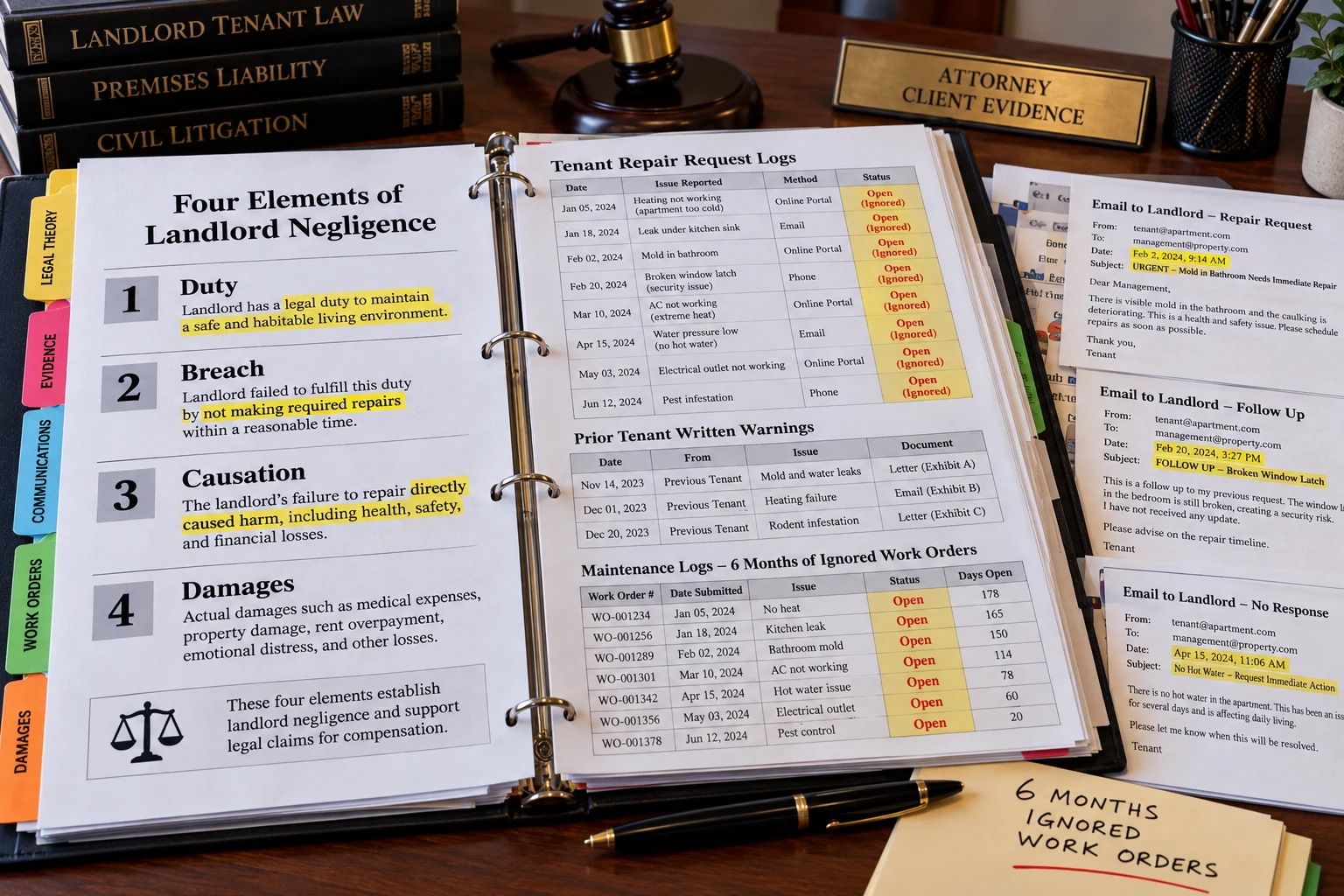
To win a civil negligence lawsuit against a landlord or their insurance carrier, you must establish four core legal elements:
- 1. Duty of Care: The landlord had an affirmative legal responsibility under state law, municipal housing codes, or the lease contract to maintain the area in a reasonably safe condition.
- 2. Breach of Duty: The landlord failed to meet that standard—either by failing to repair a defect they knew about or failing to conduct reasonable inspections of common areas.
- 3. Causation: The landlord's careless omission was the direct and proximate cause of the injury or property loss. You tripped because the stair tread snapped, not due to an unrelated medical event.
- 4. Measurable Damages: You suffered actual, quantifiable economic or physical harm (hospital bills, lost earnings, ruined electronics, or pain and suffering).
The "Automatic Negligence" Shortcut (Negligence Per Se)
In standard cases, proving that a landlord acted "unreasonably" can be debated by insurance defense attorneys. However, if your accident was caused by a violation of an established municipal safety statute—such as a staircase lacking a mandated handrail, irregular stair riser heights, missing smoke or carbon monoxide detectors, or unpermitted electrical work—the doctrine of Negligence Per Se applies.
Under Negligence Per Se, the violation of a public safety law automatically satisfies Duty and Breach as a matter of law. The landlord cannot argue that they acted reasonably; the court presumes fault, leaving only causation and dollar damages for determination.
How to Beat the Landlord's #1 Excuse ("You Knew the Step Was Broken!")
Following an accident, a landlord's insurance adjuster will contact you to request a recorded statement. They will ask: "Had you noticed that loose step or slippery puddle before you fell?" If you answer yes, they will argue: "Because you knew the condition was hazardous and walked there anyway, you assumed the risk and the accident is entirely your own fault."
Insurance companies use this tactic to intimidate unrepresented renters. In a court of law, this argument fails for two fundamental reasons:
1. The "No Alternative Route" Rule
Judges across the country recognize that a residential tenant cannot become a prisoner in their own apartment. If the only stairway, walkway, or hallway leading to your front door, mailbox, or parking stall contains a defect, carefully utilizing that path to travel to work or purchase food does not constitute assumption of risk. The landlord cannot escape liability by leaving tenants with no safe alternative.
2. How Comparative Negligence (Shared Blame) Protects You
In 46 states, personal injury claims are governed by comparative fault principles. Even if an insurance adjuster argues you were momentarily distracted or carrying groceries, you do not lose your lawsuit. The jury simply assigns a percentage of responsibility:
- Pure Comparative States (e.g., CA, NY, WA): You recover damages even if you are deemed partly responsible. If your claim is worth $50,000 and you are assigned 20% blame, you collect $40,000.
- Modified Comparative States (e.g., FL [under 2023 HB 837], TX, IL, PA, OH, GA): You recover damages as long as your fault is 50% or less (or 49% or less depending on the state).
- Strict Contributory States (AL, MD, NC, VA, DC): The only remaining jurisdictions that bar recovery if the plaintiff shares any degree of blame. In these states, establishing Negligence Per Se or total landlord control is essential.
How Landlord Insurance & "No-Fault MedPay" Pay Your Claim
When an accident occurs, negligent landlords often attempt to dissuade tenants by claiming: "I operate as an LLC and have no money to pay your hospital bills." Understanding how commercial property insurance operates demystifies the claims process:
Commercial General Liability (CGL) Coverage
Almost every residential property mortgage requires owners to maintain $300,000 to $1,000,000+ in premises liability coverage. When you serve a formal notice of claim, the landlord forwards the demand to their insurance carrier (such as Travelers, Liberty Mutual, State Farm, or Chubb). The insurer assigns an adjuster and defense counsel, and settlement payouts are funded directly by the insurer.
The "$5,000 to $10,000 No-Fault MedPay" Bucket
Standard commercial property policies contain a specialized coverage provision designated as Medical Payments to Others (MedPay), typically ranging from $5,000 to $10,000 per injured party. Crucially, MedPay is no-fault coverage. You do not need to prove negligence or engage in extensive litigation to claim MedPay funds; the insurer reimburses emergency room copays, ambulance invoices, and X-ray expenses immediately upon receipt of medical bills while liability discussions proceed.
Ready-to-Send Landlord Negligence & Insurance Disclosure Demand Letter
Prior to retaining counsel or filing in court, serving a formal demand letter triggers the landlord's contractual obligation to report the claim to their liability underwriter and establishes an evidentiary record that prevents the spoliation of physical evidence.
Select the appropriate template tab below. Deliver this notice via USPS Certified Mail (Return Receipt Requested) and electronic mail:
[TEMPLATE 1: NOTICE OF PERSONAL INJURY ACCIDENT, EVIDENCE PRESERVATION & INSURANCE DISCLOSURE DEMAND]
SENT VIA USPS CERTIFIED MAIL (RETURN RECEIPT REQUESTED) & ELECTRONIC MAIL

DATE: [Date]
CERTIFIED MAIL TRACKING NUMBER: [Certified Mail Tracking Number]

TO (LANDLORD / PROPERTY MANAGEMENT):
[Landlord or Property Management Entity Name]
[Management Office Address]
[City, State, ZIP Code]
[Management Email Address]

FROM (INJURED TENANT / GUEST):
[Your Full Legal Name(s)]
[Rental Address & Unit Number]
[City, State, ZIP Code]
[Your Phone Number & Email]

RE: NOTICE OF PREMISES LIABILITY CLAIM, DEMAND TO PRESERVE EVIDENCE & REQUEST FOR INSURANCE INFORMATION
DATE OF INCIDENT: [Date of Accident]
LOCATION OF INCIDENT: [Specific Location, e.g., Exterior East Stairwell Between 1st and 2nd Floor]

Dear [Landlord or Property Manager Name]:

Please take formal notice that on [Date of Accident] at approximately [Time of Accident], the undersigned sustained acute physical injuries as a direct result of an unaddressed hazardous condition on the premises at [Property Address].

1. DESCRIPTION OF INCIDENT & HAZARDOUS CONDITION:
While descending the exterior stairwell, the third wooden stair tread snapped beneath my foot due to advanced structural rot and uncorrected weathering. The stairwell lacked a continuous handrail and was insufficiently illuminated, in direct violation of municipal building codes.
• Immediate Injuries: Severe fracture of the right ankle, contusions, and soft tissue trauma.
• Emergency Treatment: Transported by EMS to [Hospital Name] Emergency Department (medical records and bills pending).

2. DEMAND FOR PRESERVATION OF EVIDENCE (SPOILATION WARNING):
You are legally required to preserve all physical and electronic evidence concerning this incident, including:
• The broken stair tread and structural stringer in their unaltered state (do not discard or destroy).
• All video surveillance footage recorded on the property between [Date 2 Days Before] and [Date 2 Days After].
• All maintenance work orders, inspection logs, and contractor invoices for the subject stairwell.
Destroying, altering, or discarding this evidence will result in adverse judicial spoliation sanctions in civil court.

3. DEMAND FOR LIABILITY INSURANCE POLICY INFORMATION:
Pursuant to state disclosure rules, please provide the following insurance details within seven (7) business days of receipt of this correspondence:
• Name and address of your Commercial General Liability (CGL) insurance carrier.
• Applicable policy number(s) and policy limits.
• Verification of Medical Payments to Others (MedPay) coverage for immediate medical bill submission.

Please transmit this notice immediately to your insurance underwriter. I expect written confirmation from your insurance claims adjuster within ten (10) business days.

Sincerely,

________________________________________
[Your Signature]
[Your Printed Full Legal Name]
Actual Notice vs. Constructive Notice: The Decisive Battle in Landlord Negligence
In residential premises liability, the single most litigated legal battle is whether the landlord had legal notice of the dangerous condition before the accident occurred. Under American tort law (Restatement (Second) of Torts §§ 358–360), a landlord cannot be held liable for negligence simply because a hazard existed; the tenant must prove the landlord had either Actual Notice or Constructive Notice, and failed to exercise ordinary care to repair it.
1. Actual Notice (Direct Knowledge)
Occurs when the landlord, property manager, or maintenance technician was directly informed of the specific defect. Proven through written text messages, maintenance portal tickets, certified letters, or prior inspection write-ups. Once actual notice is delivered, the clock begins ticking on the landlord's statutory repair deadline.
2. Constructive Notice ("Should Have Known")
Applies when a condition existed for such a duration that a reasonably prudent landlord conducting routine inspections would have discovered and remedied it. Particularly powerful for common areas (corridors, outdoor staircases, parking lots, roofs) where landlords retain continuous exclusive control.
How Long Is "Too Long" to Fix a Defect? Realistic Timelines by Severity
State housing statutes evaluate reasonableness based on hazard urgency. If a landlord fails to remediate within these standard judicial benchmarks, breach of duty is readily established:
| Severity Tier | Hazard Examples | Reasonable Response Deadline | Judicial Presumption |
|---|---|---|---|
| Emergency Hazards | Active natural gas leaks, sparking main electrical panels, raw sewage overflow, total lack of heat in winter, or loss of potable running water. | 24 Hours | Immediate breach of habitability; tenant may seek emergency relocation or repair-and-deduct. |
| Urgent Safety Defects | Broken entry door deadbolts, failing stair handrails, sagging water-damaged ceilings, non-functional air conditioning in extreme heat, or major active roof leaks. | 48 to 72 Hours | Failure to commence repairs creates strong presumption of negligence if an injury or collapse occurs. |
| Routine Habitability Issues | Dripping sink faucets, single cracked windowpane, minor plaster flaking, non-emergency appliance malfunctions, or cosmetic flooring gaps. | 14 to 30 Days | Standard statutory cure window under state landlord-tenant repair codes (e.g., Cal. Civ. Code § 1942; Tex. Prop. Code § 92.056). |
For detailed evidentiary strategies, review our guides on how to prove landlord negligence and how much compensation for landlord negligence.
How Much Compensation Can You Recover for Landlord Negligence?
In tort litigation, damages awarded against a negligent landlord or their commercial property insurance carrier are divided into four distinct legal categories:
| Damages Category | Qualifying Losses & Examples | Evidentiary Standard |
|---|---|---|
| 1. Economic / Special Damages | Direct financial expenditures: emergency room bills, physical therapy, diagnostic imaging, lost wages, and out-of-pocket prescription costs. | Invoices, medical billing ledgers, employer wage verification letters. |
| 2. Property Replacement Losses | Actual Cash Value (purchase price minus IRS MACRS depreciation) for destroyed furniture, rugs, laptops, and wardrobes ruined by leaks or fire. | Purchase receipts, photographic proof, fair market value appraisals. |
| 3. Non-Economic General Damages | Physical pain, emotional trauma, sleep disruption, permanent scarring, or loss of enjoyment of life caused by traumatic falls or fire injuries. | Medical narrative reports, psychological records, pain journals. |
| 4. Punitive / Statutory Damages | Exemplary damages awarded when a landlord acted with conscious disregard for human safety (e.g., actively padlocking emergency fire exits or ignoring severe gas leaks). | Clear and convincing proof of willful or wanton gross negligence. |
Where to File: Property losses under statutory limits are best resolved in Small Claims Court without legal fees ($12,500 limit in California via California Courts Self-Help; $10,000 in New York City via NY Courts Small Claims; $20,000 in Texas via Texas Judicial Branch). Substantial bodily injury claims exceeding small claims limits proceed through state Superior or District Courts with personal injury counsel operating on contingency.
Frequently Asked Questions
Yes—under state premises liability laws, a landlord owes the exact same duty of safe maintenance to your invited guests, family members, children, and delivery workers as they owe to you.
In almost every state, lease clauses that try to waive a landlord's liability for their own negligence in residential housing are void as against public policy—meaning a judge will throw that clause out of court.
Yes, under Negligent Security: if your landlord knew about broken front-gate locks, broken apartment door deadbolts, burned-out parking lot lights, or prior break-ins on the property and refused to fix the security measures, they can be held liable when a tenant is robbed or assaulted.
First, take photos and video of the hazard immediately before the landlord sends a worker to fix or hide it; second, go to Urgent Care or the ER the same day so a doctor documents the exact cause of your injury; third, never give a recorded voice statement to the landlord's insurance adjuster before speaking with a lawyer.
Every state sets a legal deadline called a Statute of Limitations, which is typically 2 to 3 years from the date of the accident for personal injuries—though it is only 1 year in states like Kentucky, Louisiana, and Tennessee, and longer in states like Maine or for injured children under age 18.
SueLegal is an independent educational legal publisher, not a law firm or lawyer referral service. The information provided in this guide is for general informational and educational purposes only and does not constitute formal legal advice. Residential landlord-tenant laws, repair notice periods, and statutory remedies vary significantly across state and municipal jurisdictions. If you are facing eviction, severe uninhabitable conditions, or complex litigation, consult a licensed attorney in your jurisdiction or contact your local legal aid organization. For more details on our standards, read our Editorial Policy and Legal Research Methodology.