

Yes, you can sue your landlord for entering without permission or proper 24-to-48-hour written notice. In many states and cities, you can collect automatic statutory cash fines up to one month's rent or $2,000 per illegal entry, even if nothing was damaged or stolen.
When you sign a lease and pay rent, your landlord transfers exclusive legal possession of the home to you. Landlords do not have an open-ended right to unlock your door whenever they choose. Depending on what occurred and where you live, you have three primary legal avenues to recover money and protect your safety:
- Statutory Per-Entry Cash Fines ($100 to 1 Month's Rent or $2,000 per Visit): Under state abuse-of-access laws (such as Oregon ORS 90.322, Chicago RLTO § 5-12-060, Virginia Code § 55.1-1229, and California Civil Code § 1940.2), courts penalize landlords with mandatory cash fines payable directly to the tenant, plus reimbursement of court filing fees and attorney expenses.
- Common Law Privacy & Distress Damages ($1,500 to $25,000+): If a landlord, property manager, or contractor entered while you were sleeping, in the shower, or undressed, or if they snooped through personal drawers or let a pet escape, you can sue in Small Claims or Civil Court for Intrusion Upon Seclusion, common-law trespass, and severe emotional distress.
- Penalty-Free Lease Termination (Constructive Eviction): Repeated unannounced entries breach the Covenant of Quiet Enjoyment and destroy your reasonable expectation of security. You can serve a written lease-exit notice, move out with zero lease-break penalties, and recover 100% of your security deposit plus relocation expenses.
Key Legal Points
- 24 to 48 Hours Written Notice Is Mandatory in Almost Every State: Unless there is an active life-safety emergency like a raging fire or burst water main, landlords must give 24 to 48 hours advance notice and enter only during reasonable daytime business hours.
- "Just Checking On Things" Is an Unlawful Excuse: Landlords cannot perform surprise walk-ins to snoop through closets, inspect housekeeping, or show the unit to buyers without scheduling an exact appointment in advance.
- Many Jurisdictions Mandate Automatic Cash Fines: In Oregon and Chicago, landlords must pay one full month's rent per unlawful entry. In California, bad-faith entries trigger civil penalties up to $2,000 each under Civil Code § 1940.2.
- Indoor Wi-Fi Cameras & Security Bars Are 100% Legal: You have an absolute legal right to place a plug-in security camera inside your apartment and use an under-doorknob jammer bar while you sleep or shower without landlord consent.
- Submitting a Maintenance Request Is Not an Unlimited Hall Pass: Requesting a sink repair does not allow a contractor to unlock your door two weeks later at 8:00 AM unannounced. Always specify "entry by 24-hour appointment only" on repair tickets.
State-by-State Landlord Notice Requirements and Cash Fines
When you sign a lease and pay rent, you do not merely rent the right to occupy a space alongside the landlord. You acquire exclusive legal possession of the real property. A landlord who unlocks your door without your explicit consent or statutory advance notice commits a civil violation and common-law trespass.
Across the United States, legislatures have passed strict "Abuse of Access" statutes designed to deter landlords from treating rented homes as their personal clubhouse. Many of these statutes include automatic statutory cash fines payable directly to the tenant:
| State / City | Notice Requirement | Statutory Legal Citation | Statutory Penalty / Cash Fine |
|---|---|---|---|
| California | 24 Hours Written Notice (Normal Business Hours) | Cal. Civ. Code § 1954 & § 1940.2 | Up to $2,000 civil penalty per bad-faith violation. |
| Oregon | 24 Hours Actual Notice (Written or Verbal) | ORS 90.322 | 1 month's periodic rent or actual damages, plus injunction. |
| Chicago / Cook County | 48 Hours Written Notice (via Email, Text, or Paper) | Chicago RLTO § 5-12-050 & § 5-12-060 | 1 month's rent or 2x actual damages + mandatory attorney fees. |
| Washington State | 48 Hours Notice (24 Hours for Prospective Buyers) | RCW 59.18.150 | $100 per unlawful entry + court costs & attorney fees. |
| Arizona / Virginia / URLTA | 48 to 72 Hours Advance Written Notice | A.R.S. § 33-1376 / Va. Code § 55.1-1229 | 1 month's rent, actual damages, and lease termination. |
| Florida | 24 Hours Notice (7:30 AM – 8:00 PM) | Fla. Stat. § 83.53 & § 83.67 | Up to 3x monthly rent for prohibited practices + attorney fees. |
| Massachusetts | 24 Hours Notice (Strict Lease Enumeration) | Mass. Gen. Laws c. 186, § 14 | 3 months' rent or actual damages + mandatory attorney fees. |
| New York / Texas / GA / PA | 24 Hours Notice Under Common Law & Standard Lease | Covenant of Quiet Enjoyment / Trespass | $500–$2,500 trespass damages, rent abatement & lease exit. |
In states like California, Oregon, and Illinois, statutory damages do not require you to prove that the landlord broke a lamp or stole personal jewelry. The unlawful entry itself triggers the fine. When landlords know they face an automatic penalty equal to a full month of rent, they stop making surprise visits.
If you live in a common-law state without a specific dollar penalty on the books, you still maintain powerful remedies under civil trespass and breach of the Covenant of Quiet Enjoyment. You can sue for retroactive rent abatement and terminate your lease without fees. For more on general landlord liabilities, review our comprehensive guide to suing your landlord.
The Only 4 Legal Reasons a Landlord Can Enter (And 6 Illegal Excuses)
Landlords often believe that because their name is on the deed, they can enter their rental property whenever they desire. Under property law, that belief is completely incorrect. Once a tenant signs a valid lease, the landlord surrenders possession. State statutes strictly limit entry to four narrow circumstances:
The 4 Only Legal Grounds for Landlord Entry
- Genuine Life-Safety Emergency: Active fire, water pouring through ceilings, smelling natural gas, or an unresponsive tenant suspected of medical distress.
- Agreed Repairs or Inspections with Statutory Notice: Entering during reasonable business hours after delivering written 24-to-48-hour advance notice specifying the day, approximate time window, and repair scope.
- Exhibiting the Unit to Prospective Buyers or Renters: Showing the apartment with statutory advance notice during reasonable daylight hours.
- Court Order or Lawful Abandonment: Entry permitted under an explicit judicial writ or where the tenant has clearly surrendered and vacated the premises.
Conversely, property managers and supers frequently invent excuses to justify popping in unannounced. Courts have repeatedly ruled the following six common landlord excuses completely illegal:
- "I was just doing a quick pop-in inspection": Random drop-ins violate statutory notice rules. Non-emergency inspections always require full advance written notice.
- "I needed to drop off your mail or Amazon package": Dropping off packages does not grant authority to turn the deadbolt and walk inside your apartment. Mail can be left at the exterior threshold.
- "I suspected you had an unauthorized pet or overnight guest": Investigating suspected lease violations still requires formal statutory notice. Suspicion of a pet does not constitute an emergency.
- "An interested buyer flew in from out of town and needed to see it today": An out-of-town buyer's schedule does not suspend your constitutional and statutory right to 24-to-48-hour privacy notice.
- "You submitted a maintenance request two weeks ago": Submitting an online ticket for a clogged drain does not give a maintenance technician open-ended permission to unlock your door unannounced weeks later.
- "It is my property, so I do not need permission": Legally false. Rented property belongs to the tenant's exclusive possession during the lease term. Entering without legal cause constitutes trespass.
When a landlord uses unlawful excuses to enter repeatedly, their conduct often crosses into constructive eviction or retaliation. Learn more about your options in our guide on suing a landlord for retaliation.
How to Catch and Physically Stop Unannounced Walk-Ins
When dealing with a landlord who ignores written rules, tenants need practical, physical safeguards to protect their privacy and gather irrefutable legal evidence. Here is how to secure your home without violating your lease:
The Tenant Home Security & Evidence Toolkit
- Deploy a $25 Plug-In Indoor Wi-Fi Motion Camera: Place a camera (such as a Wyze Cam, Blink Mini, or Ring Indoor Cam) on an entryway bookshelf pointed directly at your front door. Installing a plug-in camera inside your private residence is 100% legal in all 50 states and requires zero landlord consent because it causes no physical damage. Set it to send immediate push notifications and save cloud video clips.
- Use a $20 Removable Under-Doorknob Security Bar: While inside your apartment sleeping, showering, or resting, place an adjustable steel security bar (like a Master Lock Door Security Bar) wedged beneath your doorknob. This prevents any key from opening the door while you are home, leaves zero marks, and prevents terrifying surprise intrusions.
- Defeat the Maintenance Portal "Permission to Enter" Checkbox: When submitting an online repair request, property portals often pre-check a box granting "permission to enter anytime." Always uncheck that box and write in the notes: "Entry permitted by appointment only with 24 hours advance written confirmation of exact arrival window."
- Can You Change the Locks? Know Your State Rule: In most leases, replacing the deadbolt without providing a key is a technical lease violation. However, in states like Texas (Tex. Prop. Code § 92.153) and during active harassment disputes, tenants can rekey provided they notify management or face statutory cure rules. A door jammer provides the same physical protection while avoiding any lease breach.
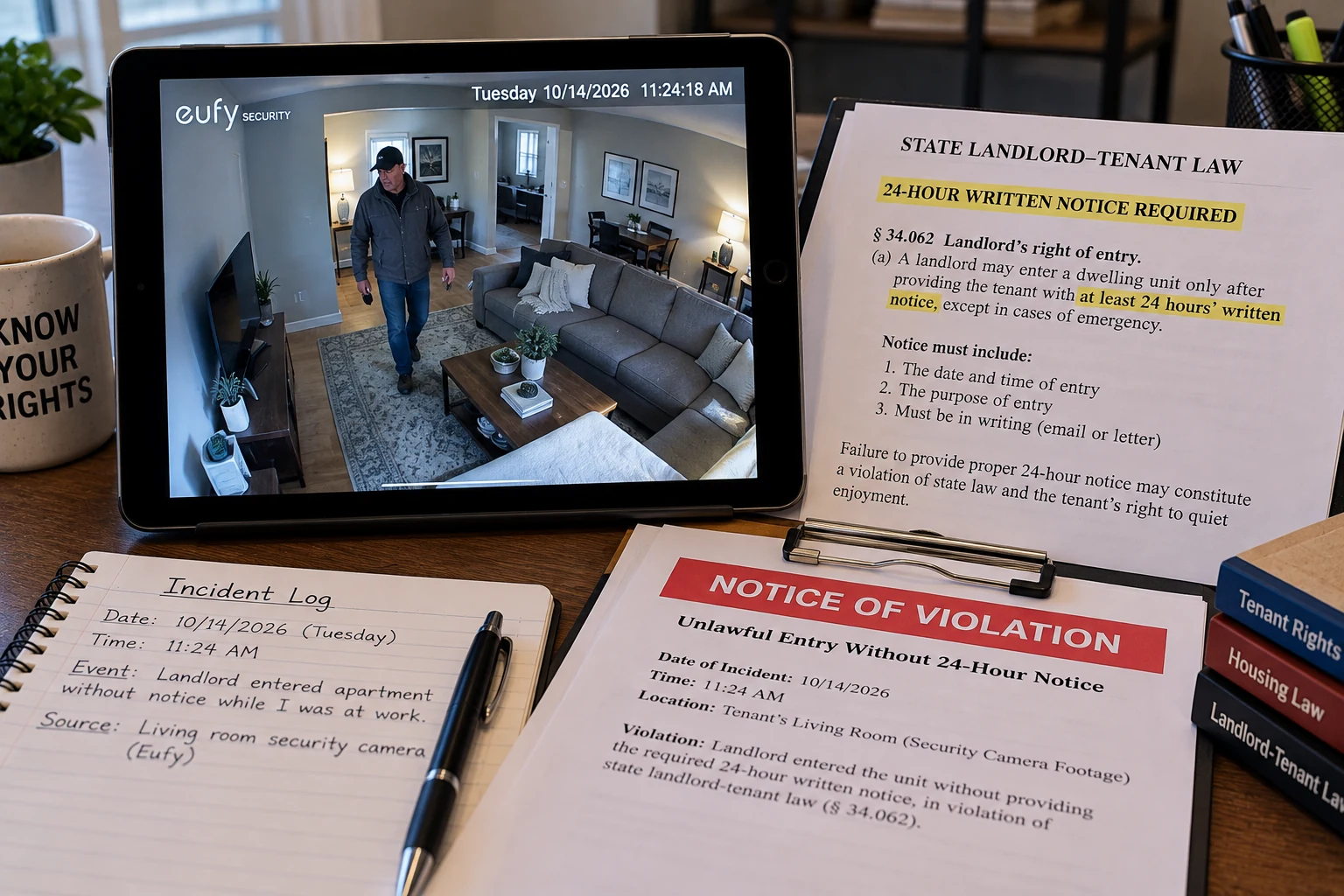
Timestamped video footage from an indoor security camera capturing a landlord unlocking your front door without prior notice serves as definitive proof in Small Claims Court. Once a judge sees video of a landlord stepping across the threshold unannounced, the landlord has no defense. If the landlord retaliates by threatening eviction or changing locks, review our resource on suing for illegal eviction.
Selling the House or Showing Your Apartment: 4 Realtor Privacy Rights
One of the most common triggers for unlawful entry occurs when a landlord decides to sell the building or begins marketing your unit to prospective tenants before you move out. Real estate agents and property managers routinely act as though putting a "For Sale" sign on the lawn eliminates tenant rights. In reality, your privacy protections remain fully intact:
| Tenant Privacy Right | Legal Standard & Rule | How to Enforce Your Protection |
|---|---|---|
| No Lockbox on Your Front Door | Landlords cannot place an electronic lockbox granting access to dozens of unvetted realtors without your explicit consent. | Demand immediate removal in writing; lockboxes breach security and quiet enjoyment. |
| Absolute Right to Remain Inside | You do NOT have to leave your home during showings, buyer tours, or appraisals. | You can comfortably stay in your living room or office during the entire walkthrough. |
| Right to Refuse Public Open Houses | Statutes authorize entry to exhibit to specific prospective buyers—not unrestricted public walkthroughs. | Refuse open houses; require individual scheduled appointments with 24-hr notice. |
| No Photos of Personal Items / MLS | Realtors cannot photograph family portraits, children's bedrooms, computers, or medications for online listings. | Prohibit interior photography of private belongings under invasion of privacy laws. |
If a real estate agent shows up unannounced with buyers and knocks on your door claiming they have an appointment, you have the absolute legal right to say: "I received no 24-hour written notice from my landlord. You may not enter today. Please coordinate with management for a properly noticed time." Then close and lock your door.
Do not allow realtors to intimidate you with claims that you are "interfering with a sale." The seller's failure to provide statutory advance notice is their own legal breach, not yours.
Walking In on Sleeping or Undressed Tenants and Escaped Pets
When an unauthorized entry catches a tenant in an intimate state or results in animal harm, lawsuit valuations escalate dramatically. Courts treat walking in on an undressed occupant or causing a cherished family pet to escape as severe tortious misconduct.
Intrusion Upon Seclusion (Restatement (Second) of Torts § 652B)
Under tort law, intentionally invading the physical solitude or seclusion of another person in a manner that would be highly offensive to a reasonable person constitutes Intrusion Upon Seclusion. A landlord or maintenance worker unlocking a door and walking into a bedroom or bathroom while a resident is sleeping, naked, or showering triggers immediate liability for substantial emotional distress damages ranging from $5,000 to $25,000+.
In cases where a male landlord or property manager enters repeatedly without notice while a female tenant is alone or in bed—or makes inappropriate comments regarding her appearance—the conduct crosses into predatory behavior. These actions support federal Fair Housing Act sexual harassment claims under 42 U.S.C. § 3604(b), where verdicts and settlements regularly range from $25,000 to $100,000+.
Another common scenario involves pets. When maintenance staff enters without notice, indoor cats and dogs frequently slip out open front doors into parking lots or busy streets. Landlords are strictly liable for damages caused by unannounced entries that permit animal escape, including:
- Emergency veterinary bills if the pet is struck by a vehicle or injured;
- Out-of-pocket costs for search flyers, microchip tracing, and professional pet-recovery services;
- Emotional distress damages for the trauma of a lost or injured companion animal.
For more on emotional trauma caused by intrusive landlord misconduct, see our detailed guide on suing for emotional distress and landlord harassment lawsuits.
Dual-Tab Legal Demand and Cease-and-Desist Notices
To establish statutory liability or prepare a Small Claims Court claim, deliver formal written notice to management immediately. Choose the appropriate notice below based on whether you are warning the landlord for an initial intrusion or demanding cash fines and lease exit for repeated violations:
How Much Can You Recover for Illegal Landlord Entry?
When taking legal action in Small Claims Court or Housing Court, financial recovery is calculated using established statutory remedies, documented out-of-pocket expenses, and rent reduction standards:
| Recovery Category | Calculation Standard | Statutory Authority & Limits |
|---|---|---|
| 1. Statutory Civil Fines per Unauthorized Entry | Many states award mandatory statutory fines (e.g., $100 to one month's rent per unlawful entry) when a landlord enters without 24-hour notice. | E.g., Cal. Civ. Code § 1954; Minn. Stat. § 504B.211. |
| 2. Breach of Quiet Enjoyment Abatement | Rent refunds and judicial injunctions preventing the landlord or property staff from entering the apartment without lawful advance notice. | Covenant of Quiet Enjoyment. |
| 3. Security Hardware & Camera Reimbursement | Reimbursement for tenant-purchased interior doorway security cameras, secondary chain latches, or authorized locksmith rekeying invoices. | Compensatory privacy protection damages. |
Small Claims Filing Limits: Most tenants resolve these matters pro se (without a lawyer) in Small Claims Court. Maximum claim limits vary by state: for example, $12,500 in California (California Courts Self-Help), $10,000 in New York City (NY Courts Small Claims), and $20,000 in Texas (Texas Judicial Branch). If damages exceed local small claims thresholds, lawsuits proceed to standard Civil Court.
Frequently Asked Questions About Landlord Unauthorized Entry
Yes. If your landlord or maintenance worker is inside your apartment right now without notice and refuses to leave—or keeps unlocking your door unannounced—call the police. Show the officer your lease and state that your landlord is entering without statutory notice in violation of your right to exclusive possession. Even if the officer treats it as a civil violation rather than arresting them on the spot, always get the Police Incident / CAD Report Number—that police report is gold in Small Claims Court.
In most states—including California, Florida, Oregon, New York, Texas (by lease/common law), Ohio, and Michigan—landlords must give at least 24 hours advance notice. In states and cities like Washington, Arizona, Illinois (Chicago/Cook County), Kentucky, Delaware, and Hawaii, landlords must give 48 hours (2 full days) advance notice, and in Vermont or for routine tenant-not-present maintenance in Virginia, they must give 48 to 72 hours notice.
No. While submitting an emergency repair ticket implies they can come fix a burst pipe right away, for routine repairs in states like California, Washington, and Illinois—or whenever you write "By Appointment / 24-Hour Notice Required" on the ticket—the landlord still cannot show up 2 weeks later at 8:00 AM unannounced. Always uncheck the "Permission to Enter" box on online portals and write that you require 24-hour advance notice of the specific day and time window.
If you rent an entire single-family house with exclusive use of the fenced yard, garage, and basement, the landlord must give the exact same 24-to-48-hour advance notice to enter the yard or garage as they do to enter the living room. However, if you live in a multi-unit apartment building or only rent a single private bedroom in a shared house, the landlord can enter shared common yards, driveways, and hallways without notice—though they still need 24-hour notice to enter your private bedroom.
Yes. Repeated unlawful entries violate the Implied Covenant of Quiet Enjoyment and state Abuse of Access statutes (such as A.R.S. § 33-1376, ORS 90.322, RCW 59.18.150, and Cal. Civ. Code § 1954). Save your indoor camera clips, send one written Cease-and-Desist warning, and if they do it again, you can serve a written Notice of Lease Termination, move out with zero penalty, and sue for your full security deposit plus statutory fines and moving costs.
Unlawful Entry Statutory Fine & Privacy Claim Calculator
Calculate your state statutory cash penalties, common-law privacy damages, and security reimbursement based on governing landlord-tenant entry laws.
*Illustrative educational estimate, not legal advice or an outcome prediction. Small claims limits, judge discretion, and state statutes vary.
SueLegal is an independent educational legal publisher, not a law firm or lawyer referral service. The information provided in this guide is for general informational and educational purposes only and does not constitute formal legal advice. Residential landlord-tenant laws, repair notice periods, and statutory remedies vary significantly across state and municipal jurisdictions. If you are facing eviction, severe uninhabitable conditions, or complex litigation, consult a licensed attorney in your jurisdiction or contact your local legal aid organization. For more details on our standards, read our Editorial Policy and Legal Research Methodology.