

What Matters Most
- Use the Magic Courtroom Words: "Annoyance and Discomfort Under Private Nuisance": If you tell a Small Claims judge you are suing for "Emotional Distress from a breach of lease," many judges will say contract law does not allow it. Ask instead for "Daily Annoyance and Discomfort Damages for Private Nuisance & Habitability Violations"—which is 100% legal in Small Claims Court without needing a doctor!
- Every Person in Your Home Gets Their Own Daily Payout: Rent refunds only pay back the rent once, but Annoyance, Discomfort, and Emotional Distress apply to each occupant. If you, your spouse, and two kids could not sleep because of rats or no heat for 60 days, each family member has a claim.
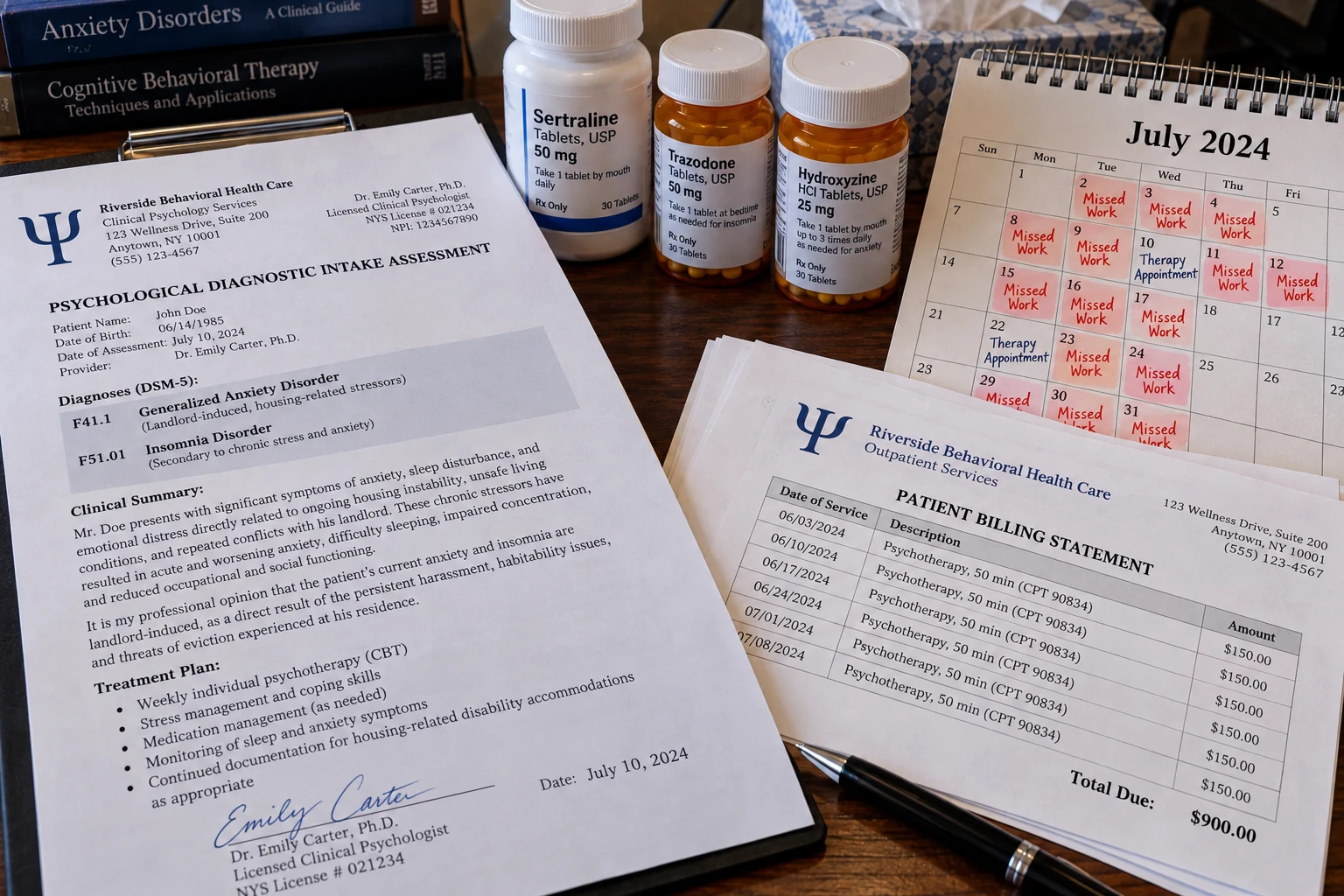
- You Don't Need a $300/Hour Psychiatrist to Prove It: A single visit to your regular primary-care doctor or Urgent Care noting insomnia, stress headaches, stomach upset, or elevated blood pressure from your housing situation—paired with a daily sleep log and a coworker's witness note—is powerful courtroom proof.
- Protect Your Therapy Records With the "Garden-Variety Distress" Rule: If you hire a lawyer for a big lawsuit, asking for "Garden-Variety Emotional Distress, Humiliation, and Loss of Sleep" (instead of claiming a formal psychiatric disorder) stops the landlord's lawyer from subpoenaing 10 years of your private therapy records.
- The Landlord's Insurance Often Pays the Settlement: Most commercial landlord insurance policies include "Personal Injury Coverage (Coverage B)" for wrongful eviction, wrongful entry, and invasion of a tenant's right of occupancy—meaning an insurance company writes the check, not just the landlord.
Emotional Distress, Daily Discomfort & Nuisance Lawsuit Calculator
Calculate your household's daily annoyance and discomfort damages, underlying rent refund, and tort settlement value under governing tenant nuisance standards.
The Courtroom Reality: Why "Annoyance and Discomfort" Wins When "Emotional Distress" Fails
Every day across America, tenants walk into Small Claims Court, tell the judge how stressed they were, ask for $5,000 in "Emotional Distress," and leave empty-handed. The judge does not dismiss their claim because they disbelieve their suffering. The claim fails because the tenant walked directly into the legal system's "Contract Rule" Trap.
Under American contract law, a residential lease is legally categorized as a contract. In almost every state, courts are strictly prohibited from awarding traditional emotional distress damages for a simple breach of contract. If you sue your landlord solely under contract law for failing to fix a heater or failing to exterminate pests, the judge can only award you economic losses—such as a percentage rent refund or the cost of a space heater.
The Legal Backdoor That Unlocks the Money: Private Nuisance
To recover substantial monetary compensation for your sleepless nights, anxiety, and household misery without being thrown out on contract grounds, you must anchor your lawsuit in tort law rather than contract law. When a landlord forces you to live with rats in the walls, bed bugs crawling on your mattress, raw sewage backups, persistent ceiling leaks, toxic black mold, or freezing winter drafts, they are committing the civil tort of Private Nuisance.
Under the landmark appellate ruling in Stoiber v. Honeychuck (1980) 101 Cal.App.3d 903, California landlord emotional distress laws established that tenants subjected to persistent habitability defects are entitled to a distinct category of non-economic tort damages: "Damages for Annoyance, Discomfort, and Mental Anguish." This doctrine allows renters to recover general damages for living with severe defects without submitting medical bills or proving psychiatric injury.
Conversely, jurisdictions such as Texas take an exceptionally strict view of emotional distress claims. If you are asking, "Can you sue your landlord for emotional distress in Texas?", the answer under Boyles v. Kerr is that Texas law does not recognize an independent tort for negligent infliction of emotional distress; instead, Texas renters must anchor non-economic suffering to intentional torts, statutory utility shutoff penalties, or illegal lockout damages under Texas Property Code Chapter 92.
Why "Annoyance & Discomfort" Changes Everything for Renters
Unlike clinical "Emotional Distress"—where aggressive defense lawyers demand formal psychiatric diagnoses, medical bills, and DSM-5 criteria—Annoyance and Discomfort damages require zero medical bills or therapist visits. Under nuisance doctrine, the physical discomfort of boiling pots of water to bathe, breathing mold spores, shaking shoes for roaches, and losing sleep because of scratching rodents is self-evident. A judge or jury can award between $25 and $150 per day based purely on your testimony, photographs, and daily logs.
For an overarching guide on structuring your court filings, start with our master guide on how to sue your landlord. If your distress stems from unannounced intrusions, see our dedicated guide on entering without permission.
The 5 Situations Where Courts Award Substantial Compensation (With Payout Table)
Not every landlord conflict qualifies for non-economic damages. Courts strictly differentiate between minor residential inconveniences (such as a squeaky door or an unpainted baseboard) and actionable tortious interference. The table below outlines the five primary scenarios where American courts award substantial emotional distress and nuisance damages:
| What the Landlord Did | Legal Claim to File | Physical Injury Required? | Typical Payout Range |
|---|---|---|---|
| 1. Left You With Bed Bugs, Rats, Roaches, Sewage, Mold, or No Winter Heat | Private Nuisance & Tortious Habitability Breach (Annoyance & Discomfort) | NO | $2,000 to $15,000 in Small Claims ($25–$100/day per occupant) or $25,000–$100,000+ in civil lawsuits. |
| 2. Locked You Out, Shut Off Utilities, or Dumped Your Belongings | Intentional Infliction of Emotional Distress (IIED) & Wrongful Eviction | NO | $5,000 to $50,000+ (plus 2x–3x rent or $100/day statutory penalties and mandatory attorney fees). |
| 3. Stalked You, Walked Into Your Bedroom Unannounced, or Placed Hidden Cameras | Invasion of Privacy (Intrusion Upon Seclusion) & Harassment | NO | $3,000 to $25,000 for unannounced walk-ins; $50,000 to $500,000+ for hidden indoor cameras. |
| 4. Ceiling Collapsed, Apartment Caught Fire, or Carbon Monoxide Leaked | Negligent Infliction of Emotional Distress (NIED) & "Zone of Danger" | Physical Impact OR Near-Miss Zone of Danger | $15,000 to $250,000+ paid under the landlord's commercial liability insurance policy. See our ceiling collapse guide. |
| 5. Sexual Harassment, Racial Discrimination, or Refusal of Disability / ESA Dog | Federal Fair Housing Act (42 U.S.C. § 3604) & State Civil Rights Laws | NO (Humiliation is presumed under federal civil rights law) | $10,000 to $150,000+ via HUD civil complaint or federal court (with 100% of attorney fees paid by landlord). |
How State Laws Alter Landlord Distress Liabilities
While the underlying tort principles of nuisance and outrageous conduct apply across North America, statutory remedies and evidentiary thresholds vary substantially depending on where your rental unit is located:
- Florida (The Impact Rule & Statutory Penalties): Under long-standing Florida jurisprudence (*Rowell v. Holt*), courts enforce the rigid "Impact Rule," which bars emotional distress damages for simple negligence unless accompanied by physical trauma. However, under Florida laws on suing a landlord for emotional distress, intentional misconduct and self-help evictions are fully exempt from the Impact Rule, where Fla. Stat. § 83.67 awards an automatic penalty of three months' periodic rent plus attorney's fees for utility cutoffs or lockouts.
- Illinois (Abuse of Authority & Chicago CRLTO): Illinois courts recognize that a landlord occupies a position of power over a tenant. Under the *McGrath v. Fahey* doctrine, a landlord's abusive or coercive conduct constitutes actionable IIED. When exploring Illinois landlord emotional distress legal options, tenants protected by the Chicago Residential Landlord and Tenant Ordinance (CRLTO) can recover two months' rent in statutory damages, full rent abatements, and mandatory legal fees for unlawful lockouts or winter heat cutoffs.
- New Jersey (Anti-Eviction Act & Treble Damages): When evaluating Emotional distress claims against landlords in New Jersey, the strict provisions of the New Jersey Anti-Eviction Act (N.J.S.A. § 2A:18-61.1) provide powerful leverage: extrajudicial self-help evictions and utility tampering are disorderly persons criminal offenses under N.J.S.A. 2C:33-11.1, empowering renters to pursue treble damages, temporary restraining orders, and rent withholdings under *Marini v. Ireland*.
- New York (Warranty of Habitability & Housing Court HP Actions): Under New York Real Property Law § 235-b, habitability failures entitle tenants to rent abatements. When assessing New York landlord emotional distress claims involving deliberate harassment or winter freeze emergencies, tenants can initiate expedited "HP Actions" in Housing Court, where NYC Administrative Code § 27-2004 authorizes judges to impose civil harassment penalties between $2,000 and $10,000.
- Arizona (Desert Heat Emergencies & Statutory Liquidated Damages): In hot climates, severe cooling failures present immediate health hazards. Under Arizona laws on landlord-related emotional distress and statutory habitability (A.R.S. § 33-1324 and § 33-1367), air conditioning failures must be addressed within five days of written notice, and unlawful utility shutoffs entitle tenants to recover two months' rent or twice actual damages under *Thomas v. Goudreault*.
- Pennsylvania (Habitability Escrow vs. Kazatsky Medical Verification): Pennsylvania established modern residential habitability in *Pugh v. Holmes*, authorizing rent withholding into escrow. However, as examined in our guide on Pennsylvania landlord emotional distress claims, Pennsylvania courts applying the *Kazatsky* standard require objective medical verification if mental anguish is asserted as an independent intentional tort rather than a contractual rent abatement.
How to Prove Emotional Suffering Without Expensive Doctor Bills
A frequent misconception prevents tenants from pursuing valid claims: the belief that winning emotional distress requires months of expensive psychiatric therapy bills. In landlord-tenant litigation, courts recognize that renters facing housing emergencies rarely have the disposable income to pay $300 an hour for clinical psychology.
In Canadian jurisprudence, the Supreme Court of Canada decisively resolved this evidentiary barrier in Saadati v. Moorhead [2017] 1 SCR 543, ruling that plaintiffs are not legally required to demonstrate a recognized psychiatric illness to recover mental distress damages. Under Canadian landlord emotional distress laws, credible lay testimony demonstrating serious, prolonged disturbance to normal mental tranquility is legally sufficient to support an award.
Similarly, when Suing a landlord for emotional distress in Ontario, tenants do not need to navigate complex civil court rules or hire expensive solicitors; they can file a Form T2 application directly with the Landlord and Tenant Board (LTB), which possesses statutory authority under Section 31 of the Residential Tenancies Act to award substantial rent abatements and general compensation up to $35,000 without requiring formal expert psychiatric evidence.
Judges and insurance adjusters evaluate practical, verifiable changes in your daily physical and mental well-being. Assemble this four-piece proof kit to substantiate your claim:
1. One Visit to Your Primary-Care Doctor or Urgent Care ($25–$50 Copay)
Schedule an appointment with your family physician, an Urgent Care clinic, or a certified telehealth provider. Explain clearly how the housing hazard is physically affecting you:
Request a copy of your After-Visit Summary. Having an objective medical chart noting stress-induced insomnia, tension headaches, elevated blood pressure, or a prescription for non-habit-forming sleep aids or anti-anxiety medication provides rock-solid courtroom corroboration.
2. The Household "Per-Person Impact" Log (Especially Children)
Under American tort law, emotional distress and annoyance damages belong to each human occupant individually. If you rent an apartment with a spouse and two children, all four individuals suffer separate distress.
Maintain a dated 14-to-30-day symptom diary documenting:
- Children waking up crying from rodent noises or terrified to enter their bedrooms.
- Family members forced to sleep together on a living room sofa away from damp walls or pest infestations.
- Missed school days, missed work shifts, or arriving at work exhausted from unlivable temperatures.
3. Two Short Before-and-After Witness Statements
Judges place immense weight on observations from neutral third parties who have no financial stake in your lawsuit. Obtain brief four-sentence signed declarations from coworkers, supervisors, or close friends:
4. Receipts for "Stress & Survival Mitigation"
Keep an organized folder containing receipts for every expense incurred to survive the situation:
- Over-the-counter sleep aids (melatonin, Unisom), pain relievers, or stomach remedies.
- Heavy-duty plastic storage bins purchased to protect clothing and food from rats or bed bug infestation.
- Portable security door jammer bars or door alarms bought after unannounced intrusions.
- Emergency hotel invoices paid simply to take a hot shower or get a peaceful night of sleep.
Protecting Your Medical Privacy: The "Garden-Variety Distress" Rule
If your case involves severe landlord misconduct and you hire an attorney to file a formal civil lawsuit, you must be aware of an aggressive defense tactic employed by insurance defense lawyers.
The Defense Attorney's Medical Subpoena Trap
If a tenant's legal complaint claims that the landlord's conduct caused a severe, permanent psychiatric disorder (such as Clinical Major Depressive Disorder or DSM-5 Post-Traumatic Stress Disorder), the defense lawyer will immediately file a discovery motion demanding complete access to the last 10 years of your confidential medical and mental health records.
Insurance lawyers will scour old therapy notes, past marriage counseling records, or prescriptions from years prior to argue: "The tenant's anxiety was not caused by our landlord's roof leak—it was caused by their prior divorce, childhood trauma, or job stress!"
How to Keep Your Past Records 100% Confidential
To shield your personal medical history from invasive discovery, instruct your attorney to confine your emotional claim to "Garden-Variety Emotional Distress" alongside statutory "Annoyance, Discomfort, Humiliation, and Loss of Sleep."
Under federal procedural precedent and state discovery rules (such as California and New York civil practice standards), a plaintiff who asserts garden-variety emotional distress—meaning the ordinary, temporary mental anguish, grief, anxiety, and sleeplessness that any normal human being would experience when subjected to housing violations—does not waive the psychotherapist-patient privilege. The court will deny the defense's attempt to subpoena your private medical background, keeping your past strictly confidential while preserving your right to substantial damages.
What If the Landlord Rejected Your Emotional Support Animal (ESA) or Disability Request?
A significant portion of emotional distress disputes arise when a landlord unlawfully rejects an assistance animal or targets a tenant who requires an accommodation for a mental health condition.
Under the Federal Fair Housing Act (42 U.S.C. § 3604(f)(3)(B)) and Department of Housing and Urban Development (HUD) regulations, an Emotional Support Animal (ESA) is legally classified as an assistance animal, not a pet. If you provide a legitimate verification letter from a licensed healthcare professional (such as a physician, therapist, psychologist, or clinical social worker) confirming that an animal alleviates symptoms of a mental or emotional disability:
- The landlord must grant a reasonable accommodation and waive any "No Pets" policy.
- The landlord cannot charge monthly pet rent, a pet deposit, or an application fee for an assistance animal.
- The landlord cannot impose arbitrary breed, weight, or species bans against legitimate assistance animals unless the specific animal poses a documented direct threat to others.
If your landlord denies your ESA letter, threatens eviction, assesses bogus pet fines, or interrogates you about your medical diagnosis, you can file an immediate, free complaint with the U.S. Department of Housing and Urban Development (HUD) or your state civil rights commission. HUD routinely negotiates or awards $10,000 to $50,000+ in emotional distress compensation for emotional humiliation, and federal courts assess mandatory attorney fees against offending landlords.
Sample Tenant Demand Letter for Unlivable Conditions and Harassment
Before filing in Small Claims Court or retaining litigation counsel, deliver a comprehensive written demand letter via certified mail with return receipt requested. Formally placing the landlord on notice of nuisance liabilities and insurance exposure frequently generates settlement discussions.
How Much Can You Recover for Emotional Distress Claims?
When taking your landlord to Small Claims Court or Housing Court, financial recovery is determined by statutory damages categories, proven out-of-pocket losses, and rent reduction formulas:
| Recovery Category | Calculation Standard | Statutory Authority & Limits |
|---|---|---|
| 1. Intentional Infliction (IIED) Damages | Compensatory damages when a landlord engages in extreme, outrageous conduct exceeding all reasonable bounds of decency in civilized society. | Restatement (Second) of Torts § 46. |
| 2. Medical & Psychological Expenses | Paid therapy bills, psychiatric evaluations, counseling invoices, and prescription medications documenting severe clinical distress. | Compensatory special tort damages. |
| 3. Statutory Harassment Multipliers | Civil penalties where emotional distress was caused by illegal lockouts, stalking, or utility shutoffs. | See harassment guide. |
Small Claims Monetary Ceilings and Procedural Forums
The vast majority of residential emotional distress and nuisance disputes are resolved in Small Claims Court without retaining private counsel. Small claims courts offer filing fees between $30 and $100 and simplified evidentiary rules, making them an accessible forum for recovering out-of-pocket expenses, rent reductions, and daily non-economic annoyance damages.
However, tenants must structure their settlement demands within their court's statutory ceiling:
- Texas Justice Courts: Claims up to $20,000, allowing room to combine Chapter 92 statutory lockout penalties with deposit and habitability refunds.
- California Small Claims: Individuals can file claims up to $12,500 for habitability nuisance and civil code penalties.
- Pennsylvania Magisterial Courts: Capped at $12,000 ($15,000 in Philadelphia Municipal Court).
- New York Small Claims: Capped at $10,000 in NYC Civil Court ($3,000 to $5,000 in Town and Village courts).
- Arizona Justice Courts: Capped at $10,000 for residential habitability breaches and lockout damages.
- Florida Small Claims: Capped at $8,000, with mandatory pre-trial mediation before a judicial hearing.
- New Jersey Special Civil Part: Small Claims division capped at $5,000 (disputes up to $20,000 heard in regular Special Civil Part).
- Ontario Landlord and Tenant Board: Administrative tribunal ceiling of $35,000 for Form T2 tenant remedy applications.
If proven medical expenses, permanent property loss, or statutory treble damages exceed your local small claims ceiling, consult a licensed tenant rights attorney regarding formal litigation in county Circuit or Superior Court, where damages are uncapped and statutory fee-shifting provisions may require the landlord to cover your attorney's fees.
Frequently Asked Questions
Yes—especially if you phrase it the right way. Never sue in Small Claims Court only for abstract "emotional distress." Always pair it with your financial claims (such as a rent refund, security deposit, or ruined property) and ask the judge for "Damages for Daily Annoyance, Discomfort, and Mental Anguish under Private Nuisance and Tortious Breach of Habitability" alongside state statutory harassment/lockout fines.
Yes. For Private Nuisance ("Annoyance and Discomfort"), Invasion of Privacy, Illegal Lockouts, and Fair Housing Discrimination claims, courts do not require psychiatric or therapy bills. Testimony about lost sleep, humiliation, and daily disruption—backed up by photos of the apartment hazard, a witness statement from a coworker/friend, or a single primary-care doctor visit—is enough to win thousands of dollars.
Courts usually use one of two methods: (1) The Daily ("Per Diem") Method, multiplying a daily dollar rate—typically $25 to $100+ per day per occupant—by the number of days the landlord left you in unlivable or harassing conditions; or (2) The Multiplier Method, multiplying your underlying rent refund and medical/out-of-pocket bills by 1.5x to 4x depending on how outrageous the landlord's conduct was.
IIED (Intentional Infliction of Emotional Distress) means the landlord acted on purpose or recklessly with "extreme and outrageous" behavior—like shutting off your heat in winter, locking you out, or stalking you. NIED (Negligent Infliction of Emotional Distress) means the landlord's careless failure to maintain the building caused a terrifying physical incident or near-miss—like a water-logged ceiling collapsing onto your bed or an electrical fire breaking out in your wall.
Often, yes. While landlords try to claim insurance only covers slip-and-falls, most Commercial General Liability (CGL) apartment policies include "Coverage B — Personal and Advertising Injury", which covers claims for wrongful eviction, wrongful entry, and invasion of the right of private occupancy—as well as bodily/mental injury resulting from physical habitability hazards like mold, carbon monoxide, ceiling collapses, and bed bugs.
SueLegal is an independent educational legal publisher, not a law firm or lawyer referral service. The information provided in this guide is for general informational and educational purposes only and does not constitute formal legal advice. Residential landlord-tenant laws, repair notice periods, and statutory remedies vary significantly across state and municipal jurisdictions. If you are facing eviction, severe uninhabitable conditions, or complex litigation, consult a licensed attorney in your jurisdiction or contact your local legal aid organization. For more details on our standards, read our Editorial Policy and Legal Research Methodology.