

Yes, you can sue your landlord for harassment—and get a court order forcing them to stay away from you.
While a landlord is allowed to collect rent and inspect the property with proper advance notice, they break the law (Breach of Quiet Enjoyment and state Anti-Harassment Statutes) when they engage in a pattern of threats, unannounced drop-ins, late-night calls, fake violation notices, or bullying to force you out. Depending on the type of harassment, you can recover money in two ways:
- Small Claims / Housing Court ($2,000 to $25,000): You can sue for state statutory fines (such as up to $2,000 per incident in California, 1x to 3x your monthly rent in Massachusetts and Chicago, or $2,000–$10,000 in NYC), a 25% to 50% rent refund for lost peace and quiet, security camera and lock costs, and moving expenses if you break your lease.
- Civil Rights & Severe Emotional Distress Lawsuits ($25,000 to $150,000+ With a Lawyer): If the harassment involves sexual harassment, racial/disability discrimination, threats to call immigration (ICE), physical intimidation, or severe documented anxiety/PTSD, a tenant lawyer can sue under the federal Fair Housing Act and state civil rights laws with 100% of your lawyer fees paid by the landlord.
Before You Take Action
- Many States Pay You Per Incident ($1,000 to $2,000+ Every Time They Do It): In states like California (
Cal. Civ. Code § 1940.2), Massachusetts (M.G.L. c. 186 § 14), Illinois/Chicago, and New York, you don't just sue for out-of-pocket bills—you can claim automatic statutory money penalties for each documented act of illegal entry, threat, or coercion. - You Can Get a Restraining Order Against Your Own Landlord: Owning the building does not give a landlord the right to stalk, corner, or scream at you. A judge can issue a Civil Harassment Restraining Order banning the landlord from coming within 100 feet of you or your door and forcing them to communicate only in writing.
- Know How to Record Your Landlord Legally (1-Party vs. 2-Party States): In 38 states (like NY and TX), you can secretly record any conversation you are part of. In the 12 "Two-Party Consent" states (like CA, FL, IL, PA, MA, and WA), simply hold your phone up and say "I am recording this video for my safety"—or put a small "Video Recording in Progress" sticker on your front door so your indoor security camera is 100% legal in court!
- Sexual Harassment & Immigration Threats Trigger Massive Payouts: If a landlord or maintenance worker makes unwanted sexual advances—or threatens to report you to immigration authorities (which carries 6x to 12x monthly rent penalties in states like California)—you have a high-value civil rights lawsuit.
- Turn Every "Fake Violation Notice" Against Them: Harassing landlords love to tape bogus 3-day violation notices to your door (falsely claiming noise, pets, or unpaid rent). Reply in writing the same day with photo/receipt proof that the claim is false—stacking 3 or 4 disproven notices proves a malicious pattern of harassment to a judge.
What Legally Counts as Landlord Harassment? (Business vs. Harassment)
When you lease an apartment, you purchase the exclusive right of possession. The law protects this through the Covenant of Quiet Enjoyment, an implied covenant embedded in every residential lease across all fifty states.
While a landlord possesses a legitimate business right to collect rent, perform maintenance, and issue formal lease notices, they cross into illegal conduct when their actions constitute a pattern of coercion, intimidation, or intentional interference. Review this side-by-side comparison:
| Interaction Category | Permissible Landlord Business | Illegal Landlord Harassment (Actionable) |
|---|---|---|
| Entering Your Apartment | Providing 24 to 48 hours advance written notice to inspect plumbing or complete repairs during regular business hours. | Unlocking your door without notice, peeping through windows, entering late at night, or scheduling excessive inspections to invade privacy. |
| Collecting Late Rent | Delivering a formal statutory 3-day or 5-day notice to pay or quit through certified mail or personal service. | Calling or texting dozens of times at midnight, banging violently on doors, contacting employers, or posting public shaming notices in hallways. |
| Enforcing Lease Terms | Issuing polite written warnings regarding verified lease violations, such as unauthorized pets or verified excessive noise. | Fabricating non-existent violations, serving repetitive groundless notices, or falsely claiming rent checks were never received when cashed. |
| Inquiring About Move-Out | Sending standard lease renewal inquiries 60 days before expiration, or extending an initial written voluntary buyout proposal. | Cornering tenants in common areas, threatening eviction if a buyout is rejected, or demanding immediate surrender of rent-regulated units. |
| Building Renovations | Executing permitted repairs during permitted municipal hours while maintaining clean corridors and continuous utilities. | Conducting unpermitted demolition at dawn, filling hallways with hazardous dust, cutting off water or heat, or dismantling stairs to force vacancy. |
| Interpersonal Conduct | Maintaining professional, courteous communication regarding property operations via standard written channels. | Profanity, physical intimidation, unwanted romantic or sexual advances, threats to notify immigration agencies, or stealing mail. |
When harassment involves physical intrusion or self-help measures, consult our master guide on suing your landlord, as well as our specific guides on entering without permission, illegal utility shutoffs, and illegal evictions.
State & City Landlord Harassment Laws ($1,000 to $10,000 Per Violation)
Many state legislatures and municipal councils have enacted specialized tenant protection statutes that impose substantial statutory damages on landlords. Unlike general negligence claims requiring massive medical bills, these laws grant automatic monetary awards for each documented act of coercion:
| Jurisdiction | Governing Anti-Harassment Statute | Statutory Penalties & Tenant Remedies |
|---|---|---|
| California (Statewide) | Cal. Civ. Code § 1940.2 (Menace & Coercion) & § 1942.5 (Retaliation) | Up to $2,000 in statutory damages per separate incident, actual damages, attorney fees. Under § 1940.35, immigration threats trigger 6x to 12x monthly rent penalties. |
| Los Angeles, San Francisco, Oakland & West Coast Cities | Tenant Anti-Harassment Ordinances (TAHO) (e.g., LA LAMC Art. 5.3; SF Admin. Code § 37.10B) | $2,000 to $10,000 per violation, plus additional $5,000 penalties if the tenant is disabled or age 65+. Triple (3x) actual damages in San Francisco and Oakland. |
| New York City & New York State | NYC Local Law 7 (Admin. Code § 27-2005(d)) & NY Real Prop. Law § 223-b | $2,000 to $10,000 civil penalty payable to the city in Housing Court (HP Action), mandatory $1,000 minimum compensatory damages to tenant, attorney fees. |
| Massachusetts | Mass. Gen. Laws c. 186, § 14 (Quiet Enjoyment) & c. 93A | Triple (3x) monthly rent or actual damages, whichever is greater, plus mandatory 100% attorney fees. Criminal penalties up to 6 months imprisonment for willful acts. |
| Illinois (Chicago & Cook County) | Chicago RLTO § 5-12-060 (Abuse of Access) & § 5-12-150 (Retaliation) | One month\'s rent or 2x actual damages for each unlawful entry or harassing demand, two months\' rent for retaliatory conduct, plus attorney fees. |
| Florida & Texas | Fla. Stat. § 83.67 & Tex. Prop. Code § 92.331 | Three months\' rent in Florida for prohibited self-help; one month\'s rent plus $500 to $1,000 statutory civil penalty in Texas, plus quiet enjoyment damages. |
If you suspect your landlord\'s conduct is retaliation for reporting housing code violations, read our guide on suing a landlord for retaliation.
How to Record Your Harassing Landlord (1-Party vs. 2-Party States)
When facing legal action, harassing landlords routinely deny all verbal threats, telling the judge: "The tenant is completely fabricating these accusations." Audio and video recordings provide undeniable evidence. However, you must comply with state wiretapping laws to ensure recordings are fully admissible in court:
Rule 1: In the 38 One-Party Consent States (NY, TX, NJ, GA, NC, VA, OH, IN, etc.)
In thirty-eight states and under federal wiretap law (18 U.S.C. § 2511), you only need the consent of one person participating in the conversation. Because you are a party to the conversation, you can record phone calls or in-person interactions without informing the landlord. The recording is fully lawful and admissible in court proceedings.
Rule 2: In the 12 Two-Party (All-Party) Consent States (CA, FL, IL, PA, MA, WA, etc.)
In two-party consent jurisdictions, secretly recording a confidential communication without all parties\' consent can violate state penal codes. To secure valid evidence legally, follow these three proven methods:
- The Open Verbal Announcement: When your landlord confronts you or knocks on your door, hold your smartphone up in plain view, start recording video, and announce clearly: "I am recording this interaction for my personal safety." If the landlord continues speaking after notice, they have legally consented to the recording.
- Common Area Interactions Lacking Privacy Expectations: If a landlord is screaming or creating a disturbance in a public hallway, exterior walkway, or parking lot within earshot of neighbors, courts recognize no reasonable expectation of privacy.
- Indoor Security Camera with a Door Notice: You have an absolute legal right to place an interior security camera inside your apartment pointed at your front entryway. In two-party states, affix a small warning decal near the doorbell stating: "Video and Audio Recording in Progress." Crossing the threshold past this notice constitutes legal consent.
Rule 3: Establish a Written Confirmation Trail
Cease engaging in unrecorded telephone debates. Route all communication through email, tenant portals, or written letters. When an in-person incident occurs, send an immediate confirming email: "This confirms our conversation today at 4:15 PM where you entered without advance notice and threatened to lock me out." If the landlord fails to dispute the summary, their silence functions as an evidentiary admission.
Civil Restraining Orders, Sexual Harassment & Immigration Threats
When landlord harassment involves threats of violence, stalking, sexual coercion, or immigration intimidation, standard housing court remedies are insufficient. Tenants can immediately invoke criminal and civil rights protections:
1. Obtaining a Civil Harassment Restraining Order Against Your Landlord
Owning real property gives an individual zero license to threaten or stalk residents. You can petition your local county superior or district court for a Temporary Restraining Order (TRO) against your landlord or property manager.
Upon issuance, the court order typically prohibits the landlord from coming within 50 to 100 yards of you, your vehicle, and your apartment door. The order compels the landlord to direct all necessary maintenance through a third-party management agent and communicate solely via written correspondence. If the landlord breaches the perimeter, law enforcement officers will make an immediate arrest for criminal contempt of court.
2. Sexual Harassment Under the Federal Fair Housing Act
Under the Federal Fair Housing Act (42 U.S.C. § 3604(b)), sexual harassment in housing constitutes unlawful sex discrimination. The law recognizes two actionable forms:
- Quid Pro Quo Harassment: A landlord, property manager, or maintenance employee conditions housing benefits—such as rent reductions, waived late fees, or essential repairs—on romantic dates or sexual acts.
- Hostile Housing Environment: Unwelcome sexual commentary, unsolicited graphic text messages, or unauthorized intrusions into bedrooms and bathrooms that create an intimidating, hostile living environment.
Federal fair housing settlements regularly yield $25,000 to $250,000+, accompanied by mandatory attorney fee-shifting paid by the defendant. Complaints can be filed directly with the U.S. Department of Justice or HUD.
3. Threats Involving Immigration and Law Enforcement
Threatening to contact immigration authorities (ICE) to intimidate a tenant or silence repair requests is unlawful. States including California (Civ. Code § 1940.35), New York (RPL § 235-bb), Illinois, and Washington impose severe statutory civil fines—often 6 to 12 times the monthly rent. State civil discovery rules strictly prohibit landlords from inquiring into a tenant\'s immigration status during court proceedings.
Explore broader emotional distress damages in our detailed guide on suing a landlord for emotional distress.
How to Build an Evidentiary Harassment Log for Court
Judges evaluate harassment claims based on objective patterns of behavior, not emotional descriptions. A meticulously maintained harassment log transforms casual disputes into an indisputable legal record.
The 4-Column Harassment Incident Log Protocol
Column 1: Precise Date & Exact Timestamp
Record the exact day, date, and minute of each incident (e.g., Thursday, October 15, 2026 at 11:14 PM). Exact timestamps prove a deliberate pattern of nocturnal harassment.
Column 2: Objective Factual Description of the Conduct
Detail exactly what transpired without editorial commentary. Note specific verbatim statements: "Landlord knocked repeatedly for 5 minutes, yelled 'I will throw your belongings out,' and sent 7 text messages demanding surrender of the lease."
Column 3: Cross-Referenced Documentary Exhibits
Link each entry directly to physical proof: "Exhibit A (Doorbell camera clip 11:14 PM); Exhibit B (Printout of text thread); Exhibit C (Witness declaration from neighbor in Unit 3B)."
Column 4: Tangible Household Impact & Economic Costs
Document how the conduct impaired daily living: "Missed 3 hours of work; purchased $30 portable security door lock (Receipt Exhibit D); consulted physician for acute sleep anxiety."
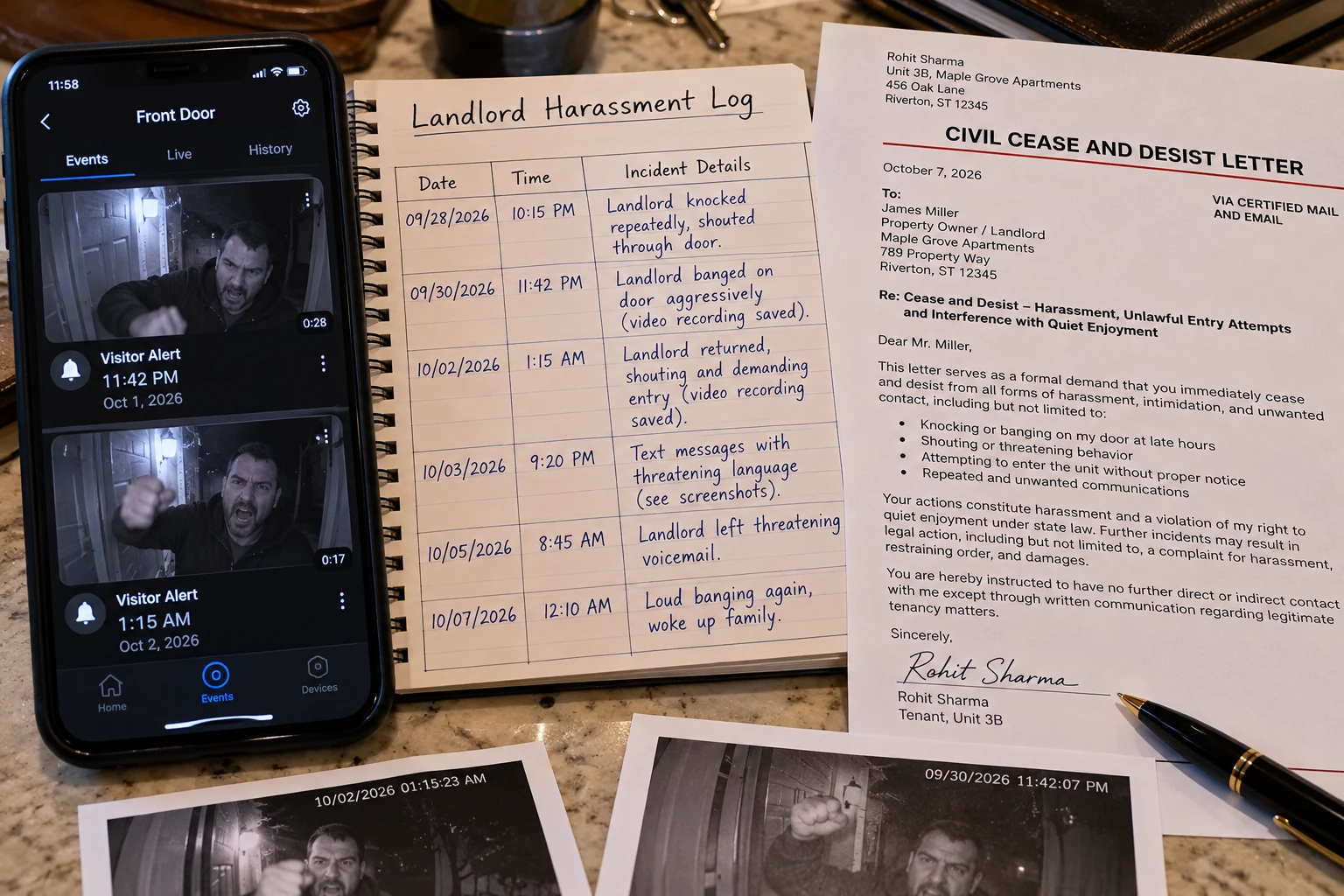
Whenever a landlord threatens physical violence, trespasses, or creates a disturbance, request a police dispatch. Even if officers decline to file criminal charges citing a civil dispute, politely request the officer\'s business card and the Police CAD / Incident Report Number. Submitting official police incident numbers in court confirms you experienced genuine distress.
Ready-to-Send Landlord Harassment Cease-and-Desist & Demand Letters
Deliver formal legal notice to immediately halt predatory behavior and establish documentation for statutory penalties. Select the appropriate notice template below, then copy or download the text:
FORMAL CEASE-AND-DESIST NOTICE REGARDING UNLAWFUL HARASSMENT & INVASION OF PRIVACY

Date: [Current Date]
Sent Via: Certified Mail (Tracking #: [Insert Tracking #]) & Written Tenant Portal

TO:
Landlord / Property Management: [Landlord / Management Company Name]
Office Address: [Management Street Address]
City, State, Zip: [City, State, Zip]

FROM:
Tenant Name(s): [Your Full Legal Name(s)]
Rental Premises: [Your Street Address, Unit/Apt Number]
Phone: [Your Phone Number] | Email: [Your Email Address]

RE: CEASE-AND-DESIST HARASSING CONDUCT & BREACH OF QUIET ENJOYMENT
    PREMISES: [Your Street Address, Apartment #]

Dear [Landlord / Property Manager Name],

Please accept this letter as formal statutory notification to IMMEDIATELY CEASE AND DESIST all harassing, intimidating, and non-essential invasive conduct directed toward the occupants of the premises designated above.

Over the preceding [Number] weeks, you or your agents have repeatedly engaged in prohibited activities, including:
[ ] Unannounced, non-emergency entries without statutory 24/48-hour written notice.
[ ] Persistent late-night phone calls, text messages, and aggressive verbal confrontations.
[ ] Issuance of baseless, disproven lease violation notices and threats of eviction.
[ ] Unlawful pressure to accept buyout terms or surrender leased premises.

1. FORMAL INVOCATION OF COVENANT OF QUIET ENJOYMENT:
Under state law and the covenants of the residential lease, the tenant has the absolute legal right to peace, privacy, and quiet enjoyment. Your repeated conduct constitutes intentional interference with tenancy and actionable harassment.

2. REVOCATION OF PERMISSION FOR NON-WRITTEN COMMUNICATION:
Effective immediately, permission to contact the undersigned via unscheduled telephone calls or impromptu in-person visits is hereby REVOKED. All future communications regarding property operations, tenancy matters, or scheduled repairs must be conducted EXCLUSIVELY IN WRITING via email or certified postal mail.

3. NOTICE OF STATUTORY REMEDIES:
Be advised that any further unannounced drop-ins, verbal intimidation, or unlawful entries will immediately result in legal proceedings, including petitioning the court for an emergency Civil Harassment Restraining Order, filing formal complaints with municipal housing oversight agencies, and seeking maximum statutory damages under state anti-harassment laws.

Govern your conduct accordingly.

Sincerely,

_________________________________________
[Your Signature]

[Your Printed Name]
Frequently Asked Questions About Landlord Harassment Lawsuits
Can I break my lease without a penalty if my landlord is harassing me?
Yes. Under the doctrines of Constructive Eviction and Breach of the Covenant of Quiet Enjoyment, if a landlord\'s repeated threats, unlawful entries, utility interruptions, or coercive demands make living in the rental intolerable or hazardous, the landlord has breached the lease contract. Document the incidents with timestamps and photos, deliver a formal written notice, and you can vacate without liability for future rent while suing for your full deposit refund and moving expenses.
How much can you sue a landlord for harassment?
In Small Claims or Housing Court, tenants routinely recover $2,000 to $15,000 by combining a 25% to 50% retroactive rent refund with out-of-pocket costs and statutory penalties—such as California\'s $2,000 per violation or Massachusetts/Florida\'s triple monthly rent awards. In high-stakes cases involving sexual harassment, discrimination, immigration threats, or severe emotional distress, settlements and jury awards regularly range between $25,000 and $150,000+ with mandatory attorney fee recovery.
Can I put a security camera or portable lock inside my apartment to stop a harassing landlord?
Yes. Installing a plug-in Wi-Fi security camera on a shelf or table inside your apartment is completely lawful across all fifty states and requires no landlord authorization because it does not alter or damage the premises. Furthermore, utilizing a temporary, non-damaging inside door security bar or portable travel lock while you are home prevents unexpected, unlawful intrusions by landlords or maintenance staff.
What if the person harassing me is the building super, property manager, or maintenance man—not the owner?
You name the property owner and management company as defendants. Under the legal doctrine of respondeat superior and housing agency laws, a building owner is legally responsible for the tortious actions of their hired employees and property managers. Once notified in writing of employee harassment, the owner possesses an affirmative legal obligation to stop the conduct or bear full liability in court.
Can I sue my landlord for emotional distress from harassment even if I wasn't physically touched?
Yes. While courts do not award damages for minor disputes, a sustained pattern of intentional harassment—such as stalking, nocturnal threats, repeated unauthorized entries, or retaliatory intimidation—supports tort claims for Intentional Infliction of Emotional Distress. Substantiating your claim with an incident log, police event numbers, or clinical documentation from a physician or licensed therapist substantially enhances your recovery.
SueLegal is an independent educational legal publisher, not a law firm or lawyer referral service. The information provided in this guide is for general informational and educational purposes only and does not constitute formal legal advice. Residential landlord-tenant laws, repair notice periods, and statutory remedies vary significantly across state and municipal jurisdictions. If you are facing eviction, severe uninhabitable conditions, or complex litigation, consult a licensed attorney in your jurisdiction or contact your local legal aid organization. For more details on our standards, read our Editorial Policy and Legal Research Methodology.