
Yes, you can sue your landlord for retaliation—and also use it to stop a retaliatory eviction or rent hike in its tracks.
In over 45 states and under federal Fair Housing laws, it is strictly illegal for a landlord to punish you because you complained about unsafe living conditions, called a 311 city building inspector, or joined a tenant group. If your landlord hits you with an eviction notice, lease non-renewal, sudden rent increase, or service cut within 90 to 365 days of your complaint, you can:
- Sue for Automatic State Cash Penalties ($2,000 to $15,000+): Recover state statutory fines—including up to $2,000 per retaliatory act (in California), 1 month's rent + $500 + moving costs (in Texas), 1x to 3x your monthly rent (in Massachusetts), or 2x your monthly rent (in Chicago/Illinois, Arizona, Oregon, and URLTA states)—plus 100% of your lawyer's fees.
- Get the Eviction, Non-Renewal, or Rent Hike Thrown Out of Court: Because the law creates an automatic presumption of illegal retaliation during the protected window, the judge can cancel the landlord's eviction or rent increase and let you stay in your home at your normal rent.
Your Key Rights & Responsibilities
- The Calendar Proves Your Case Automatically (The 90-to-365-Day Rule): You don't need a recording of your landlord admitting they are mad at you. If they raise your rent or try to kick you out within 6 months (in CA, TX, MA, AZ) or 1 full year (in NY, IL/Chicago) of your repair complaint or city inspection, the court automatically presumes it is illegal retaliation.
- "Refusing to Renew Your Lease" Is Just as Illegal as Evicting You: Landlords often think they can wait until your lease expires and simply send a "Notice of Non-Renewal." In almost every state, refusing to renew a lease to punish a tenant who asked for repairs is illegal retaliation!
- Taking Away Parking, Laundry, or Storage Counts Too: Retaliation isn't just eviction. If your landlord revokes your parking spot, locks the laundry room, tows your car, or invents bogus "lease violation fees" right after you complained about mold or heat, you can sue for every act.
- Keep Your Rent Paid on Time So You Don't Lose Your Shield: In most states, the automatic retaliation law only protects you if you are current on your rent (or legally deposited rent into a court/statutory escrow account). Paying rent on time leaves the landlord with zero legal excuse in court!
- Pair Your Retaliation Claim With Your Original Repair Refund: When you sue a landlord for retaliating against your repair complaints, you can sue for both the state retaliation penalty AND a 25%–75% retroactive rent refund for the unfixed repairs they ignored in the first place.
What Counts as Illegal Landlord Retaliation? (The "Cause & Effect" Formula)
When you sign a residential lease, you do not surrender your legal rights as a citizen. Under federal, state, and municipal housing codes, every tenant has the protected right to demand basic repairs, report code violations to government agencies, and organize with fellow renters.
Landlord retaliation happens when a property owner or management company punishes you for exercising those lawful rights. Instead of fixing a broken heater, repairing leaking plumbing, or addressing issues where a landlord is refusing to make repairs, the landlord lashes out by trying to force you out of your home or making your living conditions unbearable.
In court, every successful retaliation claim follows a simple three-part cause-and-effect timeline. If you can show these three links, you have an actionable legal case:
The 3-Part Retaliation Timeline Formula
You sent a written repair request for unsafe living conditions, called 311 or the municipal Health Department, requested an Emotional Support Animal (ESA) or ramp accommodation under the Fair Housing Act, formed a building tenant association, or lawfully withheld rent into a certified escrow account.
The landlord served a Notice to Vacate, initiated an illegal eviction lawsuit, refused to renew an expiring lease, imposed an unjustified rent hike, revoked assigned parking or laundry privileges, or engaged in targeted landlord harassment.
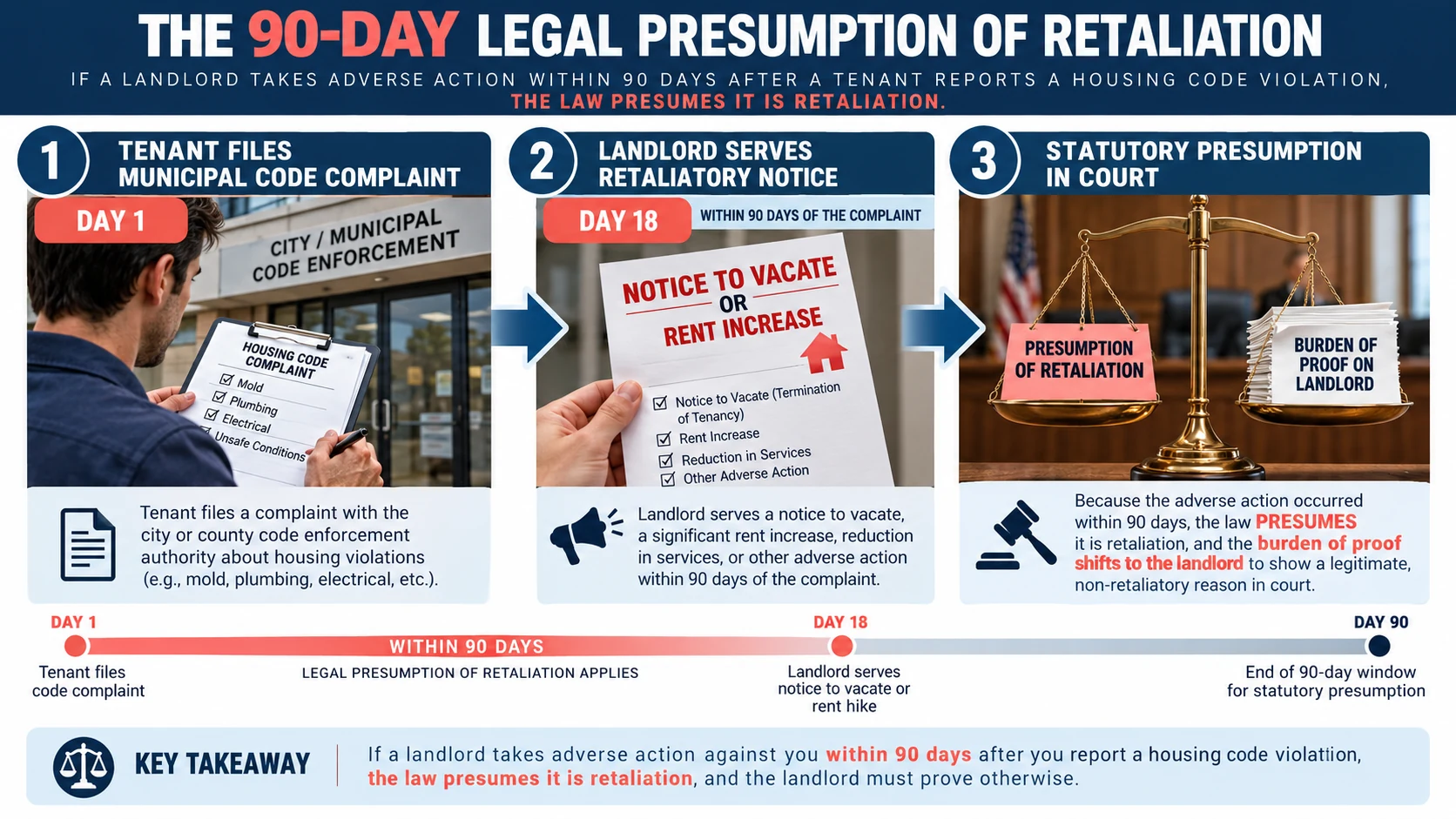
Because property owners rarely put their retaliatory intent into writing, state laws establish an automatic presumption window lasting 90, 180, or 365 days. If the punishment occurred within this window, the law presumes revenge and forces the landlord to prove otherwise.
You do not need to show that the landlord admitted their anger. The chronological proximity between your protected request and their retaliatory action provides sufficient legal grounds to halt court proceedings and secure substantial damages.
State-by-State Retaliation Clocks & Statutory Payouts
Anti-retaliation protections vary by state statute and municipal code. Over 45 states have codified explicit presumption windows and statutory penalties to discourage property managers from silencing tenant repair requests.
Review this state statutory guide to identify your local legal clock, available cash penalties, and fee-shifting provisions before drafting your demand or court response:
| State / Jurisdiction | Automatic Presumption Window | Automatic Cash Penalties in Court | Governing Statute |
|---|---|---|---|
| California | 180 Days (6 Months) | Up to $2,000 punitive damages PER retaliatory act + all actual damages + 100% tenant attorney fees. Eviction dismissed. | Cal. Civ. Code § 1942.5 |
| Texas | 6 Months (180 Days) | 1 Month's Rent + $500 fine + moving costs + actual damages + court costs and attorney fees. | Tex. Prop. Code §§ 92.331 & 92.333 |
| New York (Statewide & NYC) | 1 Full Year (365 Days) | Court order mandating 1-year lease renewal at reasonable terms, actual damages, legal fees, plus up to $10,000 NYC harassment fines. | NY Real Prop. Law § 223-b |
| Massachusetts | 6 Months (180 Days) | 1 to 3 Months' Rent (or actual damages, whichever is greater) + mandatory 100% attorney fee shifting. | Mass. Gen. Laws c. 186, § 18 |
| Illinois (Chicago & Statewide) | 1 Full Year (365 Days) | 2 Months' Rent OR 2x Actual Damages + full attorney fees + eviction quash or lease reinstatement. | Chicago RLTO § 5-12-150 & 765 ILCS 721/ |
| Arizona & Oregon | 6 Months (AZ) / Reasonable Proximity (OR) | Up to 2 Months' Rent OR 2x Actual Damages + attorney fees + complete dismissal of retaliatory notices. | A.R.S. § 33-1381 & ORS 90.385 |
| Washington State | 90 Days (Presumed) | Actual damages, court costs, mandatory attorney fees, and complete quashing of eviction or rent hike orders. | RCW 59.18.240 & § 59.18.250 |
| FL, VA, KY, OH, NC & URLTA | 6 Months to 1 Year | Actual damages, 1x to 3x monthly rent under Uniform Residential Landlord and Tenant Act remedies, and attorney fee awards. | Fla. Stat. § 83.64, Va. Code § 55.1-1258, KRS § 383.705 |
When a dispute reaches the courtroom, judges strictly enforce these statutory timelines. If your landlord served an eviction summons or rent increase within the protected window, the legal presumption shifts the burden of proof, requiring the property owner to prove a non-retaliatory motive through verifiable records.
Refusing to Renew Your Lease or Slapping You With a Rent Hike
Landlords aware of retaliation laws often avoid serving immediate 3-day eviction notices right after an inspection. Instead, they try a passive approach: waiting until your fixed lease approaches expiration, or issuing a 30-day or 60-day Notice of Non-Renewal on a month-to-month tenancy.
The landlord typically claims: "We are not evicting you. Your lease term simply expired, and management decided not to offer a renewal." Alternatively, they issue a $500 monthly rent increase calculated to force your family to leave voluntarily.
Under modern landlord-tenant jurisprudence, this tactic fails. In nearly every state with tenant protections—including California, New York, Texas, Massachusetts, Illinois, and Washington—state statutes explicitly define refusal to renew a tenancy and discriminatory rent increases as illegal retaliatory acts when timed following protected repair complaints.
How to Prove a Retaliatory Rent Hike in 30 Seconds
Check with two or three neighbors in your building regarding their recent lease renewal letters. If your neighbors received standard 3% increases ($60/month) while you received an abrupt 22% increase ($450/month) weeks after reporting a leak or calling 311, that side-by-side comparison provides compelling evidence of retaliatory animus. Judges routinely invalidate disparate rent hikes and penalize landlords for bad faith.
If you receive a retaliatory non-renewal or rent hike notice, do not surrender possession immediately. Delivering a formal statutory objection citing your state's presumption timeline often compels the property owner to retract the demand before litigation commences.
The #1 Mistake That Ruins a Retaliation Lawsuit (And How to Avoid It)
While anti-retaliation statutes offer strong protections for residential tenants, landlords possess a major defense written directly into state codes: the unpaid rent exemption.
Under almost every state anti-retaliation statute—including California Civil Code § 1942.5 and Texas Property Code § 92.332—a landlord can legally evict a tenant who is delinquent on rent at the time the notice is served, even if the tenant submitted valid habitability complaints. Withholding rent informally without complying with statutory escrow procedures forfeits your automatic retaliation shield.
The 3-Step Protection Checklist Before Filing Complaints
- Maintain Flawless Rent Payment Records: Pay your full monthly rent on or before the due date using traceable payment methods (online portal receipts, cashier's checks, or money orders). Retain stamped receipts to refute false claims of nonpayment.
- Adhere Strictly to Lease Rules During the Dispute: Avoid giving the landlord alternative grounds for lease termination. Comply with designated parking spots, quiet hours, trash disposal rules, and pet policies to keep your defense clear.
- Establish an Immutable Written Timestamp BEFORE Adverse Action Occurs: Submit repair requests via certified mail, official property management portals, or dated text messages. When calling 311 or municipal inspectors, record the reference case number immediately.
If you intend to withhold rent due to severe unlivable conditions such as illegal utility shutoffs or unaddressed structural defects, consult state-specific escrow rules first. Depositing rent funds into an authorized court registry preserves both your habitability claim and your retaliation immunity.
Using Retaliation as a Shield (Staying) or a Sword (Moving Out)
Tenants confronted with retaliatory actions generally fall into two categories: those who wish to maintain their home, and those who choose to relocate and seek monetary compensation. Anti-retaliation statutes function effectively in both scenarios.
Option A: Using Retaliation as a "Shield" (Staying in Your Home)
If you want to remain in your rental unit, continue paying regular rent and decline to vacate based on an unlawful retaliatory notice.
- File an Affirmative Defense of Retaliation in housing court.
- Attach your complaint timeline showing adverse action occurred within the statutory window.
- Obtain a court dismissal, an order renewing your tenancy, and an award for statutory penalties and legal fees.
Option B: Using Retaliation as a "Sword" (Moving Out & Suing)
If the landlord's hostile conduct makes staying intolerable, you can relocate to a safe residence and initiate legal action for complete financial recovery.
- Sue for statutory retaliation fines ($2,000 per act or 1x to 3x monthly rent).
- Recover 100% of moving truck costs, storage fees, and security deposit transfers.
- Demand retroactive rent refunds for the months the landlord ignored underlying habitability defects.
Whether you choose the defensive shield or the proactive lawsuit, the central pillar of your case remains the statutory timeline. If you intend to pursue a full damage claim, review our comprehensive legal overview at Can I Sue My Landlord? Master Legal Guide.
Ready-to-Send Retaliation Demand Letters
Before proceeding with court filings or formal hearings, sending a comprehensive written legal demand can resolve the dispute quickly. Landlords and their insurers recognize that statutory retaliation claims involve mandatory fee-shifting provisions, making protracted litigation financially hazardous for property owners.
Select the appropriate scenario below, customize the bracketed placeholders to reflect your facts, and copy the letter directly to your clipboard:
How Much Can You Recover for Landlord Retaliation?
When taking legal action in Small Claims Court or Housing Court, financial recovery is calculated using established statutory remedies, documented out-of-pocket expenses, and rent reduction standards:
| Recovery Category | Calculation Standard | Statutory Authority & Limits |
|---|---|---|
| 1. Statutory Retaliation Penalties | Mandatory civil penalties (e.g., 1 to 3 months' rent or $500 to $2,000 per violation) awarded under state anti-retaliation codes. | Cal. Civ. Code § 1942.5; Tex. Prop. Code § 92.331. |
| 2. Eviction Dismissal & Injunctive Relief | Court order dismissing retaliatory eviction actions and barring rent hikes or lease terminations during statutory presumption windows. | Uniform Residential Landlord and Tenant Act (URLTA). |
| 3. Attorney's Fees & Filing Costs | Full statutory recovery of reasonable legal fees for proving unlawful landlord retaliatory intent. | Statutory anti-retaliation fee shifting. |
Small Claims Filing Limits: Most tenants resolve these matters pro se (without a lawyer) in Small Claims Court. Maximum claim limits vary by state: for example, $12,500 in California (California Courts Self-Help), $10,000 in New York City (NY Courts Small Claims), and $20,000 in Texas (Texas Judicial Branch). If damages exceed local small claims thresholds, lawsuits proceed to standard Civil Court.
Frequently Asked Questions
No. In almost every state with residential tenant protections—including California, New York, Texas, Florida, Illinois, Massachusetts, Washington, and Arizona—refusing to renew a lease or terminating a month-to-month tenancy within 90 to 365 days after a tenant reports unsafe conditions in good faith or calls Code Enforcement constitutes illegal retaliatory eviction. Courts routinely invalidate retaliatory non-renewal notices and award statutory financial damages.
You do not have to prove what was inside your landlord's head—the calendar proves it for you. If the landlord's rent hike, eviction notice, or lease non-renewal happens within your state's 90-to-365-day statutory window after your written repair request or 311 inspection, the court automatically presumes the landlord is retaliating. The landlord then bears the heavy burden of proving with independent documents that they had a legitimate, non-retaliatory business justification that existed prior to your complaint.
In the vast majority of states—such as California (Civ. Code § 1942.5), New York (RPL § 223-b), Washington (RCW 59.18.240), Illinois (765 ILCS 721), Massachusetts, and Florida—complaining directly to your landlord in writing in good faith about repairs or habitability issues is 100% protected, even if you have not contacted municipal authorities. However, calling 311 or City Code Enforcement provides an independent government record that strengthens your timeline.
State anti-retaliation laws do not just ban retaliatory evictions—they also strictly prohibit decreasing housing services or imposing discriminatory rules. If your landlord revokes your parking space, cuts off laundry or storage access, or invents new lease violation charges after you request repairs, each individual act constitutes an illegal retaliatory violation that you can sue for in Small Claims or Housing Court.
Often, yes. Because almost every state's landlord-retaliation statute includes mandatory attorney fee-shifting—meaning a landlord who loses must pay 100% of the tenant's legal bills on top of statutory penalties—many tenant-rights attorneys and legal aid organizations accept strong retaliation cases on contingency or statutory fee recovery without requiring upfront retainer payments.
Landlord Retaliation Presumption Clock & Statutory Payout Calculator
Check whether your landlord's adverse action falls inside your state's automatic legal protection window and calculate state cash fines, moving costs, and retroactive repair refunds.
SueLegal is an independent educational legal publisher, not a law firm or lawyer referral service. The information provided in this guide is for general informational and educational purposes only and does not constitute formal legal advice. Residential landlord-tenant laws, repair notice periods, and statutory remedies vary significantly across state and municipal jurisdictions. If you are facing eviction, severe uninhabitable conditions, or complex litigation, consult a licensed attorney in your jurisdiction or contact your local legal aid organization. For more details on our standards, read our Editorial Policy and Legal Research Methodology.