

Key Legal Points
- In New York, Application Fees Are Strictly Capped at $20 Max (
RPL § 238-a): Landlords in NY cannot charge background check fees exceeding the actual cost of the background check up to a hard statutory maximum of $20. - In California & Washington, Landlords Must Give You Itemized Screening Invoices & Unspent Refunds: If a landlord charges you a $50 screening fee in CA or WA and doesn’t run a credit check—or runs it and has money left over—they must refund the unused balance or face statutory penalties up to $1,000 (in CA)!
- Holding Deposits Must Be Returned Immediately If You Cancel Before Signing: Unless you signed a clear written Holding Agreement stating the deposit is non-refundable under specific conditions, keeping your holding deposit when you decline the apartment is illegal Conversion.
- Any Monthly Fee Not in Your Signed Lease Is Void: If management tacks on a $45 "Resident Benefits Package" to your online payment portal that isn’t in your written lease, you can refuse it and sue for a full refund.
- Audit Your Late Fees—Many States Cap Them at $50 or Ban Them Entirely: In New York, Colorado, and Oregon, late fees are capped at $50 or 5%; in Massachusetts, you cannot be charged a late fee until rent is 30 days late.
Calculate Your Illegal Rental Fee Refund & Statutory Penalties
Estimate your total cash recovery for predatory application charges, wrongfully kept holding deposits, portal junk fees, and bad-faith statutory multipliers.
Select the fee category to determine the applicable statutory enforcement rules.
Total predatory fees paid across application, holding deposit, portal junk fees, or late fees.
Number of monthly billing cycles or application instances.
Statutory multiplier or bad-faith penalty under applicable state law.
100% reimbursement of all unauthorized fees collected.
Statutory damage awards, treble damages, or bad-faith penalties.
Small claims filing fees ($65), service costs, and prejudgment interest.
The 5 Most Common Predatory Rental Fees (And Which Ones Are 100% Illegal)
In residential leasing, landlords and corporate property management companies increasingly rely on auxiliary fees to generate revenue beyond agreed monthly contract rent. Software platforms automate the assessment of charges that appear official on tenant billing statements. However, under state property codes, contract integration rules, and unfair trade practices acts, charging fees that lack statutory authorization or contract assent is unlawful. You possess the legal right to challenge these charges and recover 100% of your money.
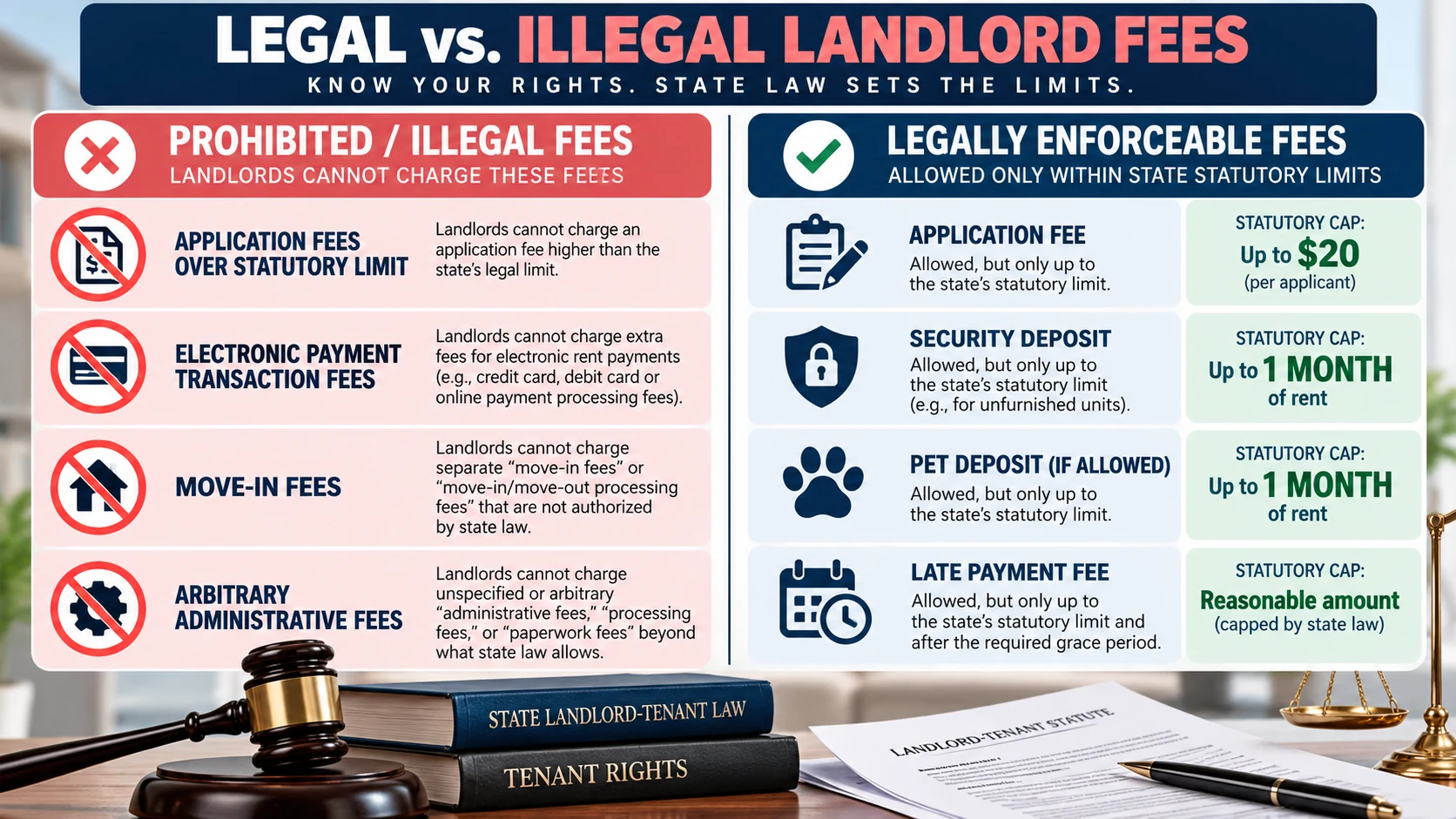
| Type of Rental Fee | When It Is Legal | When It Is 100% Illegal | What You Win in Small Claims Court |
|---|---|---|---|
| 1. Application & Screening Fees | When capped at actual screening costs or statutory maximums (e.g., $20 in NY) and substantiated with an itemized receipt. | Charging $75+ without running a check, pocketing excess screening funds, or failing to refund unspent balances in California or Washington. | 100% fee refund + $1,000 statutory penalty in California (Civ. Code § 1950.6) or $100 penalty in Washington (RCW 59.18.257). |
| 2. Holding Deposits | Only lawful if the applicant executed a written Holding Agreement detailing explicit, bilateral non-refundable forfeiture terms. | Landlord keeps a $300 to $1,500 holding deposit when an applicant withdraws before lease signing without a signed forfeiture agreement. | 100% Immediate Holding Deposit Refund via an action for civil Conversion (unlawful retention of personal property) plus court costs. |
| 3. Online Portal & "Resident Benefits" Junk Fees | Only lawful if explicitly itemized and agreed upon within the signed lease contract or signed addendum. | Inserting mandatory monthly portal surcharges, air filter delivery fees, or "resident packages" mid-lease without the tenant’s signature. | 100% refund of all uncontracted monthly fees plus statutory consumer protection damages in states like NJ, TX, MA, and NY. |
| 4. Unlawful Late Fees | When strictly within state caps (e.g., $50 max or 5% in NY and CO) and assessed after mandatory statutory grace periods (4–7 days). | Charging flat $150 penalties, daily recurring compounding fees, or charging late fees before 30 days elapse in Massachusetts. | 100% refund of illegal late fees + statutory penalties (such as two months’ rent under Chicago RLTO, or $150–$1,000 in Colorado). |
| 5. Move-In / Move-Out Elevator & Key Deposits | When structured as a fully refundable deposit held to cover actual verifiable damage during elevator usage or key return. | Charging non-refundable "move-in fees" that exceed actual administrative expenses, or converting refundable deposits into permanent revenue. | 100% refund of non-refundable move-in fees, key surcharges, and improper deposit deductions. |
When evaluating the legality of a rental charge, remember that housing providers cannot create enforceable financial duties through software billing entries. If a fee is not explicitly agreed upon in your signed lease or violates a statutory ceiling, it cannot be legally enforced. For comprehensive guidance on tenant rights, visit our landlord tenant lawsuit guide, or review our analysis on suing a landlord for overcharging rent.
State-by-State Application & Screening Fee Laws (CA, WA, NY & More)
Prospective tenants routinely expend hundreds of dollars submitting applications for rental properties. Recognizing predatory practices where landlords treat application fees as profit centers without conducting background screening, multiple state legislatures have enacted strict statutory limits:
California (Civil Code § 1950.6)
California enforces comprehensive statutory limits on residential tenant screening fees:
- Statutory Ceiling: The application screening fee cannot exceed the landlord’s actual out-of-pocket costs of obtaining a credit report and checking references, subject to an annually adjusted statutory ceiling (currently $59.08).
- Mandatory Itemized Receipt: The landlord must provide each applicant with a written itemized receipt stating the out-of-pocket expenses and personal time spent on screening.
- Mandatory Refund of Unspent Money: If the landlord does not perform a background check (for example, if an earlier applicant is selected), the landlord must refund the entire fee.
- $1,000 Statutory Penalty: If a landlord or agent acts in bad faith by failing to refund unused screening fees or retaining fees without conducting screening, they are liable for the applicant’s actual damages plus a statutory penalty of up to $1,000.
Washington State (RCW 59.18.257)
Washington property law mandates full transparency before any screening funds can be collected:
- Prior Written Disclosure: Landlords must provide written notice of what screening information will be accessed, the criteria that may result in denial, and the name and contact info of the consumer reporting agency prior to accepting any screening fee.
- Mandatory Copy of Screening Report: The landlord cannot charge more than the actual custom cost of the screening service and must provide a copy of the screening report upon request.
- Statutory Penalty: Charging a screening fee without providing required disclosures or failing to refund unspent fees subjects the landlord to statutory damages of $100 plus 100% of the fee and attorney fees.
New York (Real Property Law § 238-a)
Under the Housing Stability and Tenant Protection Act (HSTPA):
- Strict $20 Cap Statewide: A landlord, lessor, sublessor, or agent cannot demand or collect any application or background check fee exceeding $20 total.
- Waiver if Tenant Provides Report: If the prospective tenant provides a copy of a background check or credit report conducted within the past 30 days, the fee must be waived completely.
- Copy of Background Check: The landlord must furnish the applicant with a copy of the background check and invoice from the reporting agency. Any fee collected above $20 is an illegal overcharge subject to administrative penalties and civil recovery.
In jurisdictions like Massachusetts and Chicago, excessive or duplicative application screening charges violate state consumer protection statutes (e.g., Massachusetts General Laws Chapter 93A). If an applicant submits fees to multiple properties managed by the same corporate owner, charging separate full-price screening fees without conducting separate inquiries constitutes an actionable deceptive trade practice.
How to Recover a Wrongfully Kept "Holding Deposit" (Stopping the "We Sold It to Someone Else" Scam)
One of the most frequent rental fee abuses involves holding deposits. An applicant views a property, expresses interest, and the property manager requests a deposit—frequently ranging from $300 to $1,500—to "hold the apartment" while paperwork is processed. If the applicant later declines the lease or the landlord rents the unit to another party, management often claims the deposit is entirely non-refundable. From a legal standpoint, this claim is generally baseless.
The Legal Nature of a Holding Deposit
Under contract law, money transferred to an owner as a holding deposit remains the personal property of the prospective tenant until a binding bilateral contract is executed. It is held in trust to take the unit off the market temporarily. It does not become the landlord’s unencumbered property unless a signed, enforceable agreement explicitly dictates forfeiture.
Why Withholding the Deposit Without a Written Agreement Is Illegal Conversion
In all 50 states, for a landlord to lawfully retain a holding deposit upon an applicant’s withdrawal, the parties must have executed a contemporaneous, written Holding Agreement that clearly specifies:
- The exact sum deposited and the precise time window during which the unit will be held off the market.
- The specific conditions under which the applicant forfeits the funds.
- A reasonable calculation of actual liquidated damages reflecting the owner’s real out-of-pocket advertising and vacancy losses.
If you paid a holding deposit via Zelle, Venmo, check, or online portal without signing a clear written holding contract containing an explicit forfeiture clause, the landlord’s refusal to return the money constitutes tortious conversion (the civil equivalent of theft). Courts will not permit a housing provider to retain hundreds of dollars as an arbitrary windfall. When confronted with our formal demand letter, property managers routinely refund the money rather than defend a conversion claim in Small Claims Court.
Audit Your Online Payment Portal for Illegal Monthly "Junk Fees"
Modern property management companies frequently deploy third-party software including AppFolio, Yardi, RealPage, Buildium, and RentCafe to automate billing. Landlords often program these systems to introduce uncontracted ancillary surcharges mid-tenancy, effectively executing a backdoor rent increase without serving statutory notice. Tenants should regularly audit their itemized ledgers for the following unauthorized entries:
1. "Resident Benefits Package" (RBP)
Assessing mandatory $35 to $60 monthly fees for unrequested HVAC air filter mailings, identity theft monitoring, or portal access. Unless explicitly contracted in your signed lease, this charge is completely unenforceable.
2. Payment Convenience & ACH Surcharges
Charging tenants $5 to $20 transaction fees for paying rent electronically while eliminating fee-free check alternatives. Banned by statute in California (Civ. Code § 1947.3) and New York (RPL § 235-g).
3. Compounding / Pyramiding Late Fees
Applying a monthly rent payment first toward an unpaid disputed fee, creating a cascading cycle of late fees. Pyramiding late fees violates federal FTC rules (16 C.F.R. § 444.4) and state consumer protection laws.
When uncontracted charges appear on your ledger, do not ignore them. Paying them without comment can lead landlords to argue you acquiesced to a modified lease. Mark any forced portal payment as "Paid Strictly Under Protest" and deliver written notice demanding immediate removal of the uncontracted line items from your account.
How to File a Small Claims Lawsuit for Predatory Rental Fees ($50 to $75 Filing Fee)
Small Claims Court is designed to provide ordinary consumers and renters with an efficient, low-cost forum to resolve monetary disputes without hiring an attorney. If a landlord refuses to return illegal application fees, wrongfully keeps a holding deposit, or demands uncontracted portal surcharges, Small Claims Court provides an accessible path to restitution.
Step 1: Organize Your Documentary Evidence
Judges in Small Claims Court rely heavily on documentary evidence. Assemble a neat evidence binder containing three printed copies of:
- Your Signed Lease Agreement: Highlight that the disputed fee does not appear in the four corners of the lease or any signed addendum.
- Payment Receipts & Bank Statements: Print portal transaction histories, cancelled checks, or bank statements proving the exact dollar amounts deducted.
- Written Communications: Include emails, portal messages, or text threads where you requested a refund or disputed the fees, establishing the housing provider’s refusal to cooperate.
Step 2: Serve a Formal Pre-Suit Demand Letter (10-Day Cure Window)
Before filing your claim, statutory rules in many jurisdictions require serving a formal written Demand Letter. Providing the landlord with 10 business days to reconcile the ledger or return the money demonstrates good faith to the judge. Over 50% of corporate management companies resolve the dispute upon receiving a formal legal notice to avoid the public exposure and expense of litigation.
Step 3: File Your Statement of Claim
Visit your local municipal or county court website. Fill out a standard Small Claims Statement of Claim naming the property owner and management entity. State filing fees typically range between $30 and $75, and if you prevail, the court automatically adds the filing fee and service costs to your final judgment.
If your landlord responds to your fee dispute with threats of eviction or refuses to renew your lease, learn about your rights under our guides to illegal eviction and landlord lease breach. Furthermore, if you vacate and the landlord attempts to retain your security deposit to cover contested fees or fabricated move-out turnover costs, consult our comprehensive guides on recovering improperly withheld security deposits and suing for unlawful painting charges.
Ready-to-Send Illegal Rental Fee Refund Demand Letter (With Copy Button)
Serving a formal written demand letter establishes an undeniable paper trail for Small Claims Court. Select the appropriate tab below to generate your customized demand, copy the text directly to your clipboard, or download a pre-formatted text file.
How Much Can You Recover for Illegal Landlord Fees?
When taking legal action in Small Claims Court or Housing Court, financial recovery is calculated using established statutory remedies, documented out-of-pocket expenses, and rent reduction standards:
| Recovery Category | Calculation Standard | Statutory Authority & Limits |
|---|---|---|
| 1. 100% Refund of Unlawful Charges | Complete repayment of late fees exceeding statutory percentage caps, inflated lease break fees, and illegal administrative charges. | State fee regulation statutes. |
| 2. Consumer Protection Multipliers | Double or treble statutory damages under state unfair trade practices acts for deceptive or unconscionable fee structures. | State consumer protection acts. |
| 3. Attorney's Fees & Small Claims Costs | Reimbursement of court filing fees and reasonable attorney fees under statutory fee-shifting laws. | Statutory fee recovery. |
Small Claims Filing Limits: Most tenants resolve these matters pro se (without a lawyer) in Small Claims Court. Maximum claim limits vary by state: for example, $12,500 in California (California Courts Self-Help), $10,000 in New York City (NY Courts Small Claims), and $20,000 in Texas (Texas Judicial Branch). If damages exceed local small claims thresholds, lawsuits proceed to standard Civil Court.
Frequently Asked Questions About Suing for Illegal Rental Fees
SueLegal is an independent educational legal publisher, not a law firm or lawyer referral service. The information provided in this guide is for general informational and educational purposes only and does not constitute formal legal advice. Residential landlord-tenant laws, repair notice periods, and statutory remedies vary significantly across state and municipal jurisdictions. If you are facing eviction, severe uninhabitable conditions, or complex litigation, consult a licensed attorney in your jurisdiction or contact your local legal aid organization. For more details on our standards, read our Editorial Policy and Legal Research Methodology.