

Important Legal Information
- Your Signed Lease Always Beats the Online Payment Portal: If your lease says
$1,900/monthand the online portal demands$1,980, screenshot both! A landlord cannot use software settings to sneak in mandatory mid-lease fees you never signed for. - In Rent-Cap States (NY, CA, OR, NJ, D.C.), Overcharges Multiply by 3x: In Oregon (
ORS 90.323), an illegal rent hike automatically pays you 3 months’ rent PLUS the overcharge; in New York (RSL § 26-516) and California (LA / SF / Oakland / Consumer Fraud), willful rent overcharges pay 3x Treble Damages + mandatory lawyer fees! - Check If Your Landlord Missed the 30 / 60 / 90-Day Notice Clock: Even in states without rent control, a rent increase is 100% invalid if the landlord gave you less than the required advance written notice (
60 daysin GA, FL [Miami-Dade/Broward], WA, CO, DE, VT;60–90 daysin NY and CA;90 daysin OR). - Audit Your Late Fees—Over 20 States Strictly Cap Them at 4%–5% (Or $50!): If your landlord charged you a
$150late fee or$20/daylate fee, check our State Late-Fee Cap Table below—in New York, Colorado, and Oregon, any late fee over $50 (or 5%) is illegal, and in California punitive flat late fees are void! - Never Just Stop Paying Base Rent—Pay "Under Written Protest" & Sue for the Refund: So your landlord cannot file a quick eviction against you over a
$100dispute, pay your undisputed base rent on time, email them that any disputed overcharge is "Paid Strictly Under Protest," and file a $50 Small Claims Court claim to force a cash refund plus statutory penalties!
Calculate Your Rent Overcharge & 3x Penalty Refund
Estimate your potential recovery for unlawful rent increases, payment portal junk fees, excessive late charges, and statutory treble damages.
Select your regulatory track to apply the corresponding statutory damages multiplier.
Monthly dollar difference between what the landlord billed and your lawful contract rent.
Lookback windows typically span 2 to 6+ years depending on state fraud exceptions.
Cumulative uncontracted fees, portal processing surcharges, or excessive late penalties.
100% reimbursement of all excess monthly rent collected.
Direct refund of uncontracted portal surcharges & capped fees.
Statutory multiples (2x–3x) and mandatory prejudgment interest.
The 6 Ways Landlords Illegally Overcharge Rent (And What You Can Sue For in Each)
Rent overcharges are not confined to historic rent-stabilized brownstones in New York City or San Francisco. In reality, landlords and corporate property management companies across all 50 states routinely overbill tenants through uncontracted payment portal surcharges, defective rent increase notices, inflated late penalties, and illicit voucher kickbacks. When a landlord collects more than either the signed lease contract or governing municipal and state laws permit, the tenant possesses an actionable claim for complete financial restitution and substantial statutory penalties.
| Type of Illegal Rent Overcharge | How Landlords Pull It Off | Why It Breaks the Law | What You Win in Court / Rent Board |
|---|---|---|---|
| 1. Exceeding State or City Rent Control Caps | Raising rent above the annual statutory cap (3%–10%) or fabricating individual apartment improvement (IAI) renovation costs to falsely deregulate units between tenancies. | Violates the New York Rent Stabilization Law (RSL § 26-516), California Tenant Protection Act (AB 1482), Oregon Statewide Rent Cap (ORS 90.323), and municipal rent stabilization ordinances across NJ, WA, MD, and D.C. |
100% Refund of Excess Rent + Up to 3x Treble Damages (or 3x Monthly Rent in Oregon) + Mandatory Rent Rollback + 100% Attorney Fees. |
| 2. Online Portal "Ledger Creep" & Uncontracted Junk Fees | Signing a lease for $1,800 per month, then programming the online management portal (AppFolio, Yardi, RealPage) to demand $1,885 by inserting mandatory line items for "Resident Benefits," "Valet Trash," or "Portal Surcharges." | Under the basic contract doctrine in all 50 states, the written lease represents the entire agreement between the parties. Landlords cannot unilaterally modify payment obligations mid-lease. | 100% Refund of All Uncontracted Fees + Statutory Unfair and Deceptive Acts and Practices (UDAP) Consumer Protection penalties (2x–3x damages in NJ, MA, TX, PA, and NY). |
| 3. Raising Rent Without Required 30 / 60 / 90-Day Written Notice | Sending an email or text message two weeks before lease renewal announcing a $200 rent hike, or imposing a mid-lease increase during an ongoing fixed-term lease. | State statutes mandate formal advance written notice served via statutory methods (generally 30 to 90 days). An improper or late notice is legally void. | 100% Refund of Every Dollar Collected Under the Defective Notice until a legally compliant written notice expires. |
| 4. Charging Illegal Late Fees Above State Caps | Assessing exorbitant $150 late fees or daily recurring compounding penalties ($20 per day) that exceed statutory maximums or occur before statutory grace periods end. | Violates state late-fee limitation statutes (e.g., NY RPL § 238-a, MA c. 186 § 15B, CO C.R.S. § 38-12-105) and unlawful liquidated damages doctrines (CA Civ. Code § 1671). |
100% Restitution of All Unlawful Late Fees + Statutory Penalties (e.g., 2 Months’ Rent under Chicago RLTO, or $150–$1,000 per violation in Colorado). |
| 5. Section 8 / Voucher "Under-the-Table" Side Payments | Executing an official Housing Assistance Payments (HAP) contract specifying a $350 tenant share, but secretly forcing the voucher holder to pay an additional $250 cash or Venmo each month. | Constitutes federal program fraud under 24 C.F.R. § 982.451 and violates the Federal False Claims Act (31 U.S.C. § 3729). The HAP contract strictly limits the owner’s total compensation. |
100% Restitution of All Illicit Side Payments + Treble Damages + Civil Penalties and immediate debarment of the landlord from federal housing programs. |
| 6. Master Tenant Overcharging a Subtenant or Roommate | A named leaseholder on a $2,200 two-bedroom apartment sublets the second bedroom to a subtenant for $1,600 per month to subsidize their own living expenses. | Strictly prohibited under municipal rent stabilization codes including NYC Rent Stabilization Code (RSC § 2525.6), San Francisco Rent Ordinance (§ 6.15C), and Los Angeles RSO. Subtenants cannot be charged more than their proportional share. |
Subtenant recovers 100% of the Excess Rent Paid + Up to 3x Treble Damages directly from the master tenant in civil court or through the municipal rent board. |
To determine the viability of a lawsuit, tenants must examine the mechanism through which the overcharge occurred. In market-rate rentals, the signed lease document controls: landlords cannot introduce auxiliary charges or accelerate payments without explicit contractual authorization. For units subject to local or statewide rent caps, statutory enforcement frameworks supersede any lease provisions that attempt to waive tenant protections.
When confronted with an illegal overcharge, tenants should avoid unilaterally stopping rent payments altogether, which creates exposure to summary non-payment eviction proceedings. Instead, tenants protect their standing by paying undisputed rent on time, delivering written notice specifying that disputed sums are "Paid Strictly Under Protest," and initiating a recovery proceeding through landlord small claims court, housing conciliation boards, or a lawsuit for landlord breach of lease.
State-by-State Rent Cap Laws, Notice Clocks & Overcharge Penalties (2026 Lookup Table)
Landlords frequently assume that in jurisdictions lacking municipal rent control boards, they possess unfettered discretion to elevate rent prices at will. However, statutory notice periods, state-level rent stabilization statutes, and common-law unconscionability standards impose strict boundaries on when and how rent may increase.
| State / City | Annual Rent Increase Cap (2026) | Mandatory Written Notice Before Rent Can Go Up | Penalty If Landlord Overcharges You |
|---|---|---|---|
| California | 5% + Local CPI (Max 10% Statewide) under AB 1482 (Civil Code § 1947.12); strictly 3% to 4% in municipal rent-controlled units (Los Angeles, San Francisco, Oakland, Berkeley, Santa Monica). |
30 Days Written Notice for increases equal to or below 10%; 90 Days Written Notice for increases exceeding 10% in exempt properties. | 100% Refund of Excess Rent + Rent Rollback + Up to 3x Treble Damages & Attorney Fees under municipal rent stabilization ordinances (SF Admin Code § 37.10B, LAMC § 151.10). |
| New York | RGB Annual Guidelines (approx. 2.75%–5.25%) for Rent Stabilized units; 5% + Local CPI (Capped at 10%) benchmark under the New York Good Cause Eviction Law. | 30 Days (tenancy under 1 year); 60 Days (tenancy between 1 and 2 years); 90 Days Written Notice (tenancies of 2+ years) statewide under RPL § 226-c. |
Mandatory 3x Treble Damages on willful overcharges under RSL § 26-516 (with up to 6-year lookback under HSTPA, 9% annual interest, and mandatory attorney fees); complete invalidation of late-notice rent increases. |
| Oregon | 7% + Western Region CPI (Strictly Capped at 10% Maximum Statewide) under ORS 90.323 for residential buildings 15+ years old. No increases permitted during the first full year of occupancy. |
90 Days Advance Written Notice served via personal delivery or first-class mail, explicitly stating the dollar increase, new monthly rent, and statutory compliance facts. | 3 Times the Monthly Rent PLUS 100% of the Actual Overcharge collected, plus mandatory statutory attorney fees under ORS 90.323(6). |
| New Jersey | 2% to 5% (or CPI-indexed) governed by over 100 municipal rent control boards (Newark, Jersey City, Hoboken, Fort Lee). Statewide prohibition on "Unconscionable" increases (Fromet Properties v. Buel). | 30 to 60 Days Written Notice. The landlord must formally terminate the prior tenancy and tender a new lease agreement with reasonable terms. | 100% Restitution of Excess Rent + Mandatory 3x Treble Damages & Attorney Fees under the New Jersey Consumer Fraud Act (N.J.S.A. 56:8-19). |
| Washington State | Market-rate statewide; stringent local relocation and notice thresholds in Seattle, Tacoma, Kenmore, and Bellingham. | 60 Days Written Notice statewide under RCW 59.18.140; 180 Days Written Notice in Seattle (SMC 7.24.030) and Tacoma for residential tenancies. |
100% Refund of All Additional Rent Paid prior to the expiration of the full 60-day or 180-day clock, plus statutory damages for constructive eviction or retaliation. |
| Maryland, Washington D.C. & Maine | 3% to 6% CPI-linked rent increase caps in Washington D.C., Montgomery County, Prince George’s County, and Portland, Maine. | 60 to 90 Days Advance Written Notice (90 days required in Maryland counties and Portland, ME). | Up to 3x Treble Damages under D.C. Code § 42-3509.01, mandatory rent rollback to lawful registered baseline, and attorney fee awards. |
| Florida, Georgia, Colorado, Delaware & Other Market States | 0% Mid-Lease Increase during an active fixed-term lease. Market-rate upon expiration, subject to statutory advance notice requirements. | 60 Days Written Notice in Georgia (O.C.G.A. § 44-7-7), Colorado (C.R.S. § 38-12-701), Delaware, and Florida municipal codes (Miami-Dade, Broward); 60 to 90 Days in VT and NH. |
100% Refund of Uncontracted Mid-Lease Increases, Late-Notice Hikes, and Disputed Portal Surcharges via Small Claims Court or summary rent offset. |
A critical rule governs every jurisdiction: a rent increase cannot take effect in the middle of a fixed-term lease unless the signed lease document contains an explicit, bilateral cost-adjustment clause. If you hold a 12-month lease at $2,000 per month running from January 1 to December 31, your landlord cannot raise the rent to $2,150 on July 1, regardless of local inflation or rising property taxes. Attempting to enforce a mid-lease increase without mutual contract modification constitutes an actionable breach of contract.
Furthermore, when landlords fail to comply with statutory notice windows—such as delivering a 30-day notice in a jurisdiction that requires 60 or 90 days—the notice is legally defective. In court, judges routinely hold that defective rent increase notices do not take effect after 30 days; rather, they are void ab initio (entirely invalid from the beginning), meaning the tenant owes the original rent until the landlord serves a completely new, valid written notice.
How to Beat the "Online Payment Portal Junk-Fee Scam" (AppFolio, Yardi, RealPage & RUBS)
Over the past three years, the most widespread mechanism for illegal rent overcharging has shifted away from overt rent hikes to automated payment portal manipulation. National real estate investment trusts and regional property managers utilize software systems such as AppFolio, Yardi Voyager, RealPage, and Buildium to systematically introduce uncontracted ancillary fees directly onto tenant billing ledgers.
The Typical Anatomy of Payment Portal Junk-Fee Creep
A tenant signs a 12-month residential lease establishing base rent at exactly $1,750 per month. Two months into the tenancy, management updates its portal configurations. When the tenant logs in to pay their first-of-the-month obligation, the balance displayed is $1,850:
- $45.00 / month: "Resident Benefits Package" (covering automated HVAC filter shipments and third-party credit-bureau reporting).
- $30.00 / month: "Mandatory Valet Trash Service" (often billed even when the hallway collection service is suspended or sporadic).
- $15.00 / month: "Administrative Common Area / Pest Surcharge" (invented mid-tenancy).
- $10.00 / month: "Online Portal Processing Fee" (locking out fee-free ACH or paper check submissions).
When tenants discover these inflated balances, property managers often claim that these fees are non-negotiable building policies. From a legal standpoint, this assertion is completely false. Tenants possess three powerful legal doctrines to defeat online portal junk-fee creep:
1. The "Four Corners of the Lease" Doctrine
Under the parol evidence rule and standard contract integration principles across all 50 states, the signed lease agreement constitutes the total, binding contract between the parties. Unless an ancillary fee is explicitly itemized in the body of the signed lease or incorporated through a signed addendum, a landlord has zero legal authority to add mandatory charges during the lease term. The landlord cannot alter financial covenants through a portal software update or a unilateral email announcement.
2. Statutory Bans on Electronic Payment Surcharges ("Pay-to-Pay" Fees)
State legislatures have cracked down aggressively on landlords who close leasing offices to cash or paper checks and then bill fees for electronic portal payments:
- California (Civil Code § 1947.3): Landlords cannot require an online portal as the sole method of rent payment and cannot penalize tenants who pay by check or statutory alternatives.
- New York (Real Property Law § 235-g): Strictly prohibits landlords from charging any transaction fee, processing surcharge, or administrative fee for rent paid electronically.
- Colorado (C.R.S. § 38-12-801): Forbids housing providers from assessing any fee on a tenant simply for paying rent through a designated portal or electronic clearinghouse.
3. Ratio Utility Billing Systems (RUBS) Auditing & Statutory Penalties
Many landlords pass shared commercial water, sewer, gas, or trash invoices down to tenants via Ratio Utility Billing Systems (RUBS), frequently administered through third-party billing vendors like Conservice or Minol. Under standard utility regulations, landlords are legally prohibited from turning utility sub-metering or allocation into an uncontracted profit center.
In states like Texas, the statutory remedies are extraordinary. Under Texas Water Code § 13.505 and Public Utility Commission (PUC) procedural rules, if a landlord overcharges a tenant for water or wastewater, fails to provide required sub-metering allocation math, or charges administrative processing surcharges on utility bills, the tenant is entitled to recover three times the amount of the overcharge, plus one month’s rent, reasonable attorney fees, and court costs.
Did Your Landlord Overcharge You on Late Fees? (Check Your State’s Strict Legal Cap!)
Another prevalent form of unlawful rent overcharging occurs through predatory late-fee policies. Leases drafted by landlords frequently incorporate draconian terms, such as imposing a flat $150 penalty on the second day of the month followed by daily accruing fees of $25 per day. In over 20 states and major metropolitan centers, such provisions violate clear statutory ceilings or established liquidated damages case law.
| State / City | Maximum Legal Late Fee Allowed by Law | Mandatory Grace Period | What Happens If Landlord Overcharges You? |
|---|---|---|---|
| New York (Statewide) | $50 OR 5% of Monthly Rent (Whichever Is LESS) under RPL § 238-a(2). On a $3,000 apartment, the absolute legal maximum is $50. |
5 Days | Any late fee above $50 is 100% illegal and void. Landlords must refund or credit the overage; charging excessive fees violates state housing laws. |
| Massachusetts | Landlords Cannot Charge ANY Late Fee Until Rent Is 30 Full Days Past Due! under M.G.L. c. 186, § 15B(1)(c). |
30 Days | Imposing a late fee on the 5th, 10th, or 15th of the month violates the Massachusetts Consumer Protection Act (Chapter 93A), entitling tenants to up to 3x damages plus legal fees. |
| California | Must reflect the landlord’s actual administrative out-of-pocket costs (typically 3%–5%). Flat punitive fees ($100+) or daily penalties are VOID under Civ. Code § 1671. |
Determined by lease (commonly 3–5 days). | Under the binding precedent Orozco v. Casimiro (2004), arbitrary or compounding late fees are illegal liquidated damages penalties. Tenants recover 100% of illegal late fees paid. |
| Colorado & Oregon | $50 OR 5% of Past-Due Rent (whichever is greater in CO under C.R.S. § 38-12-105; regulated limit in OR under ORS 90.260). |
7 Days in Colorado; 4 Days in Oregon. |
In Colorado, assessing an unlawful late fee subjects the landlord to statutory penalties of $150 to $1,000 per violation payable to the tenant, plus reasonable attorney fees. |
| North Carolina, Maryland & Maine | 4% Maximum in Maine (14 M.R.S. § 6028); 5% Maximum in Maryland (Real Prop. § 8-208) and North Carolina (G.S. § 42-46: $15 or 5%). |
5 Days (MD & NC); 15 Days (Maine). |
Late fees exceeding statutory limits cannot be collected, and demanding them exposes landlords to statutory liability under Unfair Debt Collection statutes. |
| Illinois (Chicago & Cook County) | $10 per month on first $500 of rent + 5% on the balance under Chicago Residential Landlord and Tenant Ordinance (RLTO § 5-12-140(h)). |
5 Days | Including or enforcing an unlawful late fee provision in a lease subjects the landlord to a statutory penalty of Two Months’ Rent plus 100% attorney fees. |
| Washington D.C., New Jersey & Connecticut | 5% Maximum in Washington D.C.; 9-day statutory grace period in Connecticut (C.G.S. § 47a-15a); 5-day grace period for NJ senior citizens. |
5 to 9 Days | Tenants recover all excess fees paid; landlords are legally prohibited from initiating eviction proceedings premised solely on unpaid late fees. |
If your payment ledger reveals that you were charged late fees that violated your state's statutory percentage caps or were assessed prior to the expiration of the statutory grace period, you are entitled to a full cash refund. Furthermore, many corporate landlords engage in the unlawful practice of "pyramiding late fees"—deducting an unpaid $50 late fee from next month's rent check and then claiming that the new rent is short $50, triggering another cascade of late fees. Pyramiding late fees is specifically outlawed by the Federal Trade Commission (FTC Credit Practices Rule, 16 C.F.R. § 444.4) and state consumer protection acts.
How to Check Your Official Apartment "Rent History" (And Catch Section 8 Side-Payment Fraud)
To establish a winning rent overcharge lawsuit, tenants need concrete documentary proof establishing the lawful base rent. Depending on whether you reside in a rent-regulated jurisdiction or participate in a federal housing assistance voucher program, two rigorous auditing methods uncover hidden overcharges:
Audit #1: Pulling Your Official "Certified Rent History" (New York, California, NJ, DC)
In cities governed by rent stabilization frameworks, the legal regulated rent is not whatever amount the landlord chooses to print on your current lease—it is the registered figure on file with the municipal or state housing authority:
- In New York City & ETPA Counties: Visit the official state portal at
portal.hcr.ny.govor contact New York State Homes and Community Renewal (HCR) at 718-739-6400. Request a free Certified Apartment Rent History delivered directly to your address. - Analyze the Year-by-Year Registrations: Review the historical rent progression. Did the registered rent suddenly escalate from $1,250 to $2,800 between vacancies? Under the Housing Stability and Tenant Protection Act (HSTPA of 2019), landlords claiming major Individual Apartment Improvement (IAI) rent bumps must possess detailed architect plans, invoices, and cancelled checks proving actual capital expenditures. If the landlord claimed a $60,000 renovation that was never performed, the deregulation was fraudulent.
- In Los Angeles, San Francisco, Oakland, Berkeley & D.C.: Contact your municipal Rent Board or access the online Maximum Allowable Rent (MAR) registry. Compare the rent recorded with the board against the dollar figure appearing on your monthly rent statement. If the landlord billed even $40 more per month than the registered MAR ceiling, you are entitled to full restitution plus statutory treble damages.
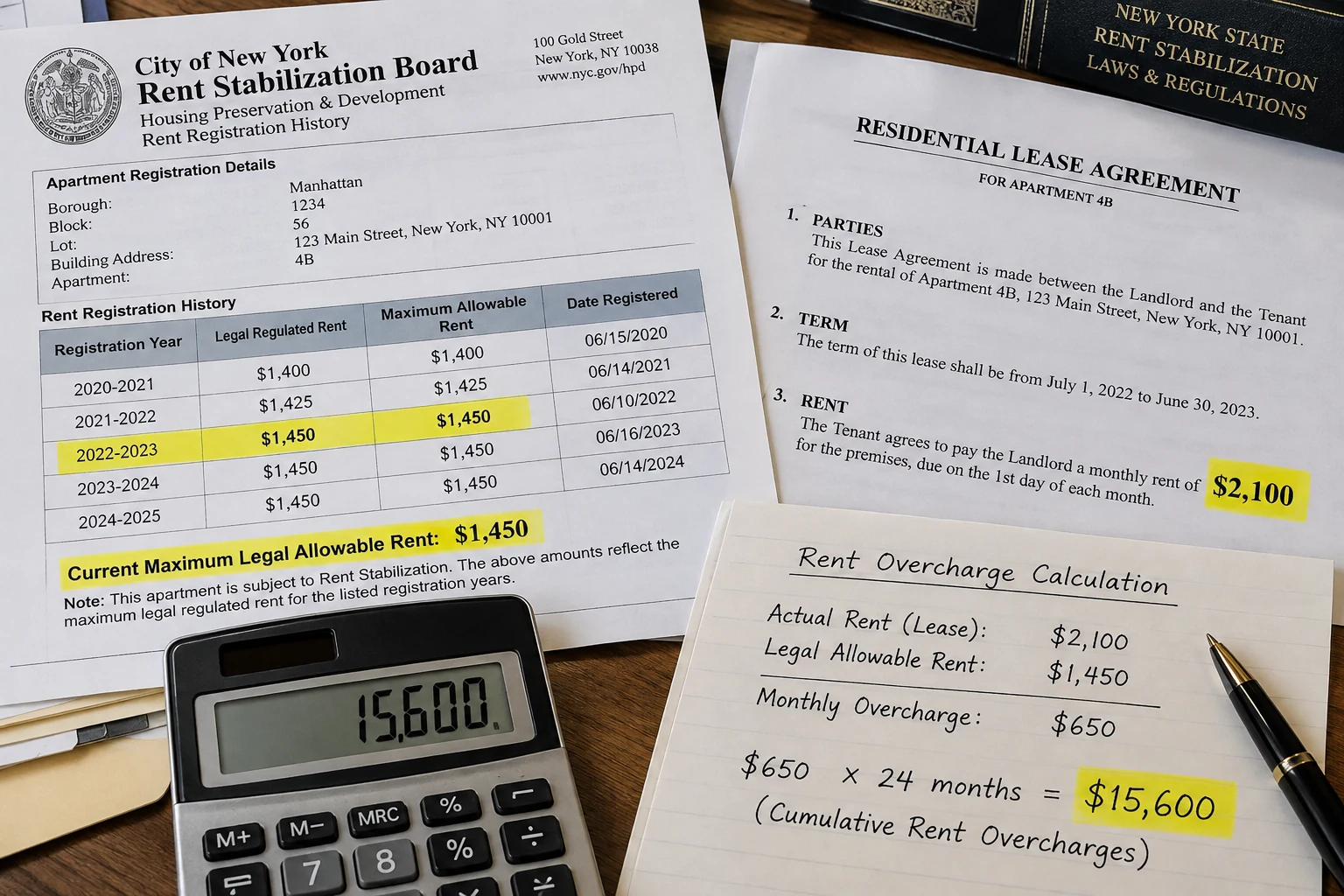
Audit #2: Auditing Section 8 Voucher "Under-the-Table" Side Payments
Under federal law governing the Housing Choice Voucher program (24 C.F.R. § 982.451), a participating property owner enters into a legally binding Housing Assistance Payments (HAP) contract with the local Public Housing Authority (PHA). The contract establishes two fundamental legal rules:
- The total rent established in the HAP contract is the absolute maximum compensation the landlord may receive for the rental unit.
- The landlord is strictly prohibited from charging or accepting any additional rent, side payments, utility surcharges, or undisclosed fees from the tenant beyond the exact tenant-share authorized in writing by the PHA.
If your landlord tells you, "The Housing Authority only pays $1,500 and your share is $300, but the market rate is $2,100, so you must pay me an extra $300 in cash or Zelle each month," the landlord is committing federal civil and criminal fraud. Maintain complete documentation of all text messages, emails, bank withdrawals, and payment receipts. Voucher holders can sue in civil court to recover 100% of these side payments plus up to 3x Treble Damages under the Federal False Claims Act (31 U.S.C. § 3729) and state deceptive trade practice statutes, while filing a formal fraud referral with the HUD Office of Inspector General (HUD OIG).
Armed with this documentation, tenants can challenge both historical and ongoing overcharges. Often, landlords who overcharge rent also engage in other tenant rights violations, such as withholding security deposits, charging for normal wear-and-tear painting, or taking illegal retaliatory actions when confronted. If your landlord threatens non-renewal or eviction after you point out an overcharge, you have grounds to pursue a claim for landlord retaliation. Furthermore, if the overcharge stems from an unpermitted basement or converted garage, consult our guide on suing for an illegal apartment to recover 100% of all rent paid.
Ready-to-Send Rent Overcharge Refund, Portal Fee & Rent-Rollback Demand Letters (With Copy Button)
Before initiating legal proceedings in Small Claims Court, Housing Court, or before a municipal rent board, serving a formal written Demand Letter is essential. A comprehensive, legally grounded demand letter establishes your paper trail, triggers formal statutory cure clocks, and frequently compels corporate management companies to immediately purge invalid portal fees and refund overpayments to avoid public litigation and mandatory attorney fee-shifting.
How Much Can I Recover for Illegal Rent Overcharges?
When pursuing a legal claim against your landlord in Small Claims Court or Housing Court, financial recovery is determined by statutory damages categories, proven out-of-pocket losses, and rent reduction formulas:
| Recovery Category | Calculation Standard | Statutory Authority & Limits |
|---|---|---|
| 1. Full Overcharge Refund | 100% refund of all monthly amounts collected in excess of the legally allowable maximum rent or rent ceiling. | Local Municipal Rent Stabilization Ordinances (e.g., NYC RGB, LA RSO, SF Rent Board). |
| 2. Statutory Treble (Triple) Damages | In jurisdictions like New York (HSTPA 2019) and California, willful rent overcharges trigger automatic treble damages. | E.g., NYC Admin. Code § 26-516; Cal. Civ. Code § 1947.12. |
| 3. Mandatory Attorney Fees & Costs | Prevailing tenants are statutorily entitled to full recovery of legal costs and attorney fees. | Statutory fee-shifting provisions. |
Small Claims Filing Limits: Most tenants resolve these disputes without hiring an attorney in Small Claims Court. Maximum claim limits vary by state: for example, $12,500 in California (California Courts Self-Help), $10,000 in New York City (NY Courts Small Claims), and $20,000 in Texas (Texas Judicial Branch). If your total damages exceed small claims thresholds, you may file in standard civil district court.
Frequently Asked Questions About Suing for Rent Overcharges
SueLegal is an independent educational legal publisher, not a law firm or lawyer referral service. The information provided in this guide is for general informational and educational purposes only and does not constitute formal legal advice. Residential landlord-tenant laws, repair notice periods, and statutory remedies vary significantly across state and municipal jurisdictions. If you are facing eviction, severe uninhabitable conditions, or complex litigation, consult a licensed attorney in your jurisdiction or contact your local legal aid organization. For more details on our standards, read our Editorial Policy and Legal Research Methodology.