

The Short Answer
In standard states, a landlord can usually decline to renew an expiring lease—EXCEPT in 4 major situations where refusing to renew is 100% illegal and you CAN sue:
- You Live in a "Just Cause / Good Cause" State or City: If you live in California, New York, New Jersey, Washington, Oregon, Colorado, New Hampshire, or Washington D.C. (or a rent-controlled city), your landlord cannot refuse to renew your lease without a specific legal reason—and for "no-fault" reasons, they often owe you 1 to 3+ months' rent in mandatory relocation cash!
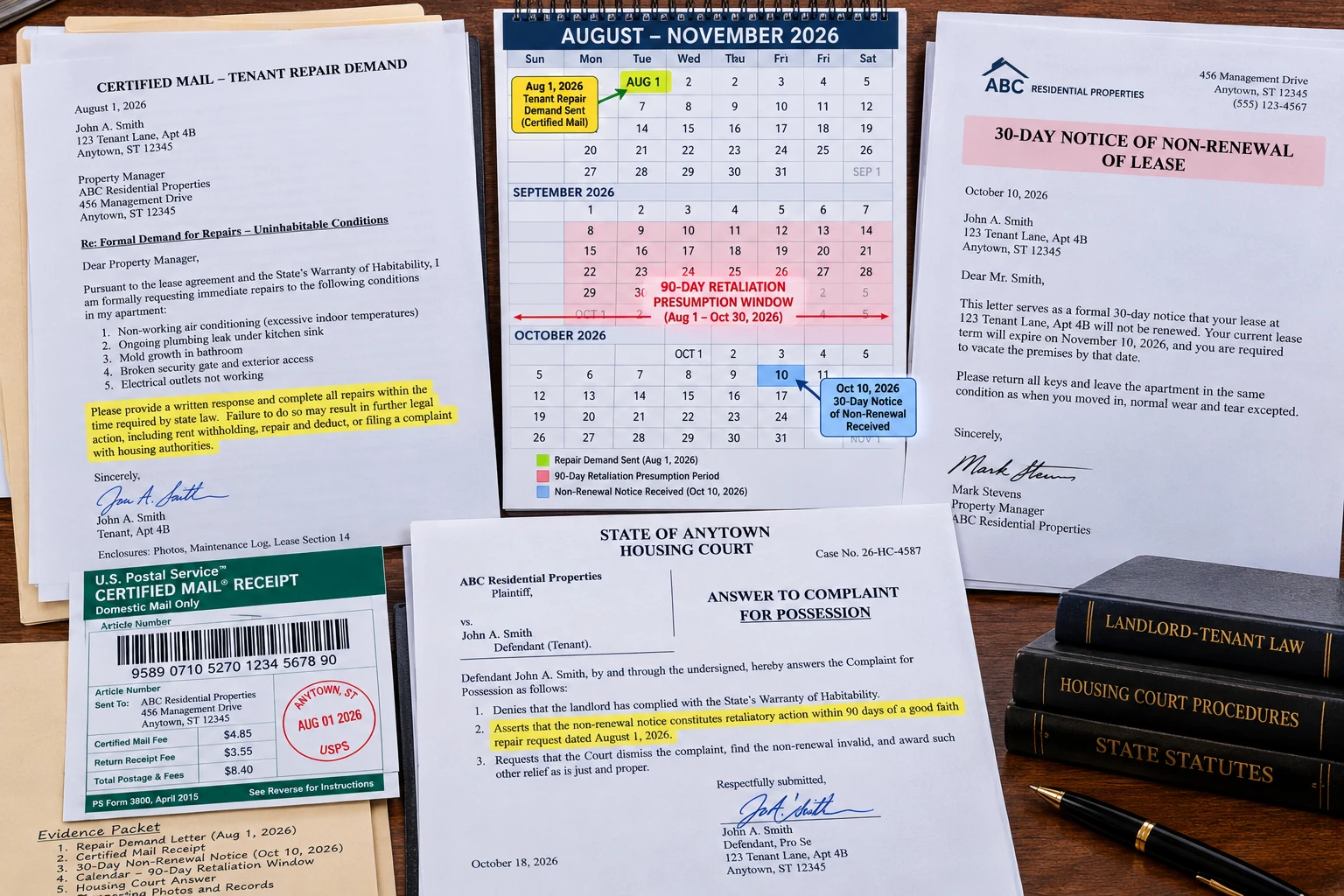
- Retaliatory Non-Renewal (In Almost All 50 States): If your landlord refused to renew within 90 to 365 days after you reported repairs, mold, or pests, called a 311 building inspector, or exercised a legal right, you can sue for 1x to 3x your monthly rent (or $2,000+ in statutory fines) and force a lease renewal.
- Discriminatory Non-Renewal (All 50 States Under the Fair Housing Act): It is a federal civil rights violation (worth $10,000 to $100,000+) to refuse lease renewal because you had a baby / got pregnant, requested an Emotional Support Animal (ESA) or disability accommodation, or because of your race, religion, sex, or (in 20+ states) Section 8 voucher.
- The Landlord Missed the 30/60/90-Day Notice Deadline (or lied about an "Owner Move-In"): Giving late notice invalidates the non-renewal, and lying about a relative moving in to re-rent your unit at a higher price triggers 3x Triple Damages ($15,000 to $150,000+)!
Important Steps to Take
- Check If Your State Bans "No-Reason" Non-Renewals: Millions of renters don't know that New Jersey, California (after 12 months), Oregon (after 12 months), Washington, Colorado (after 12 months), New York (Good Cause / Rent Stabilized), and D.C. require landlords to renew leases automatically unless they prove a statutory "Just Cause."
- Did You Ask for Repairs or Call 311 in the Last 6 to 12 Months?: Landlords love to wait until your lease ends to get back at you for complaining about a leak or broken heater. In over 40 states, a non-renewal inside that 90-to-365-day window is automatically presumed to be illegal retaliation!
- Having a Baby or Getting an Emotional Support Animal Is Protected in All 50 States: If your landlord suddenly decides "not to renew" shortly after you announce a pregnancy, adopt a child, or hand them a doctor's letter for an Emotional Support Animal (ESA), they are violating the Federal Fair Housing Act (
42 U.S.C. § 3604). - Count the Days on Your Notice—Late Notice Buys You Extra Months: If your lease or state law requires 60 or 90 days' written notice before the lease ends, and your landlord texts you only 25 days before the end of the lease, you do NOT have to move out on the 31st—their late notice resets the legal clock!
- Watch Zillow If They Claim "Owner Move-In" or "Renovation": In Just-Cause states, if a landlord refuses to renew claiming they are moving in or doing major renovations, and then lists your apartment on Zillow for higher rent 60 days later, you can sue for 3x your monthly rent plus all moving and rent-difference costs.
The 5 Exceptions Where Refusing to Renew Your Lease Is 100% Illegal
Property management blogs routinely tell renters that landlords have the absolute right to decline lease renewal at the end of a 12-month term for any reason. That statement is flatly outdated. Across the country, modern tenant-protection statutes, municipal good-cause ordinances, and federal civil rights laws severely restrict when a landlord can refuse to offer a renewal lease. For broader legal remedies across all housing disputes, review our comprehensive guide on suing your landlord for tenant rights violations.
If you pay your rent on time and follow your lease terms, refusing to renew your tenancy is unlawful in five major scenarios. If your situation falls into any of the categories below, your landlord's notice of non-renewal may be legally void, allowing you to remain in your home or pursue substantial financial compensation in court.
| Legal Exception | Where It Applies | When Non-Renewal Is Illegal | Your Legal Remedy |
|---|---|---|---|
| 1. "Just Cause / Good Cause" Lease Renewal Laws | CA, NY, NJ, WA, OR, CO, NH, D.C. + dozens of cities (after 6–12 months residency). | Whenever the landlord refuses to renew without a specific statutory reason (or fails to pay mandatory relocation cash). | Notice is void—you stay in your home, or sue for 1x to 3x rent relocation cash plus 3x treble damages if they fabricated the reason. |
| 2. Retaliatory Non-Renewal | 45+ States Nationwide | Notice arrives within 90 to 365 days after you asked for repairs, called 311/Code Enforcement, or joined a tenant association. | Defeat eviction in court or sue for $2,000 fines (CA), 1x rent + $500 (TX), or 2x–3x rent (MA/IL/AZ/OR) plus attorney fees. |
|
3. Fair Housing Discrimination (Baby, Pregnancy, ESA, Disability, Voucher) |
All 50 States (42 U.S.C. § 3604) + 20+ Source-of-Income protection states.
|
Landlord refuses renewal after you have a baby, get pregnant, request an Emotional Support Animal (ESA), or use Section 8 vouchers. | File a free HUD / Civil Rights complaint or federal lawsuit for $10,000 to $100,000+ in damages and lease reinstatement. |
| 4. Late or Defective Written Notice | All 50 States (By Lease Contract or State Notice Statute). | Landlord misses the mandatory 30, 60, or 90-day advance notice deadline (or texts when the lease requires Certified Mail). | Notice is legally ineffective—your lease automatically renews or converts to month-to-month until a proper notice window runs. |
| 5. Section 8 & Subsidized Housing (LIHTC) | All 50 States (Federal HUD / IRS Program Mandates). | Housing providers in Low-Income Housing Tax Credit (LIHTC) buildings or voucher programs refuse renewal without statutory good cause. | Demand an informal Housing Authority hearing and have Housing Court dismiss any unauthorized non-renewal eviction. |
Do You Live in a "Just Cause / Good Cause" State? (Where Landlords MUST Renew Your Lease)
One of the most consequential developments in residential tenant law is the rapid expansion of statewide "Just Cause" and "Good Cause" eviction protections. In jurisdictions with these statutes, the common law rule allowing arbitrary non-renewals no longer exists. Once you reside in a qualifying home past the initial statutory threshold, the landlord is legally mandated to offer you a renewal lease unless they prove an allowable cause.
Statutory grounds generally divide into At-Fault Causes (such as nonpayment of rent or documented lease breaches) and No-Fault Causes (such as an owner move-in or substantial building demolition). Crucially, when an owner invokes a no-fault non-renewal, state law requires them to pay thousands of dollars in direct relocation assistance before you vacate.
| State | Governing Statute | Who Is Protected | Statutory Renewal & Relocation Mandate |
|---|---|---|---|
| California | Tenant Protection ActAB 1482 / Cal. Civ. Code § 1946.2 |
Tenants occupying property for 12+ months in multi-unit buildings 15+ years old or corporate rentals. | Landlord must renew your lease. For no-fault exits, landlord must pay 1 month's rent within 15 days or notice is void (up to $10,000–$25,000+ in LA/SF/Oakland). |
| New York | Good Cause Eviction LawNY RPL Art. 6-A & Rent Stabilization |
Rent-stabilized units and market-rate tenants in covered multi-family buildings. | Landlord must offer a renewal lease at capped rent increases. Non-renewals without proven statutory good cause are dismissed in Housing Court. |
| New Jersey | NJ Anti-Eviction ActN.J.S.A. 2A:18-61.1 |
Virtually all residential tenants (except owner-occupied 2–3 family buildings). | Leases renew automatically forever. Landlords can never end a lease simply because the term expired, and fraudulent non-renewal carries 3x Triple Damages (§ 2A:18-61.6). |
| Washington | WA Just Cause Eviction LawRCW 59.18.650 |
All month-to-month tenancies and expiring term leases converting under state rules. | Landlord must state an enumerated statutory cause with 60–120 days' notice. Lying about owner move-in triggers 3x rent + actual damages + lawyer fees (RCW 59.18.650(4)). |
| Oregon | Statewide Just Cause LawORS 90.427 |
Tenants residing in dwelling for more than 12 months. | Landlords cannot refuse renewal after Year 1 without a qualifying reason. Landlord must give 90 days' notice + 1 month's rent relocation cash (penalty of 3x rent if violated). |
| Colorado | For Cause Eviction LawHB 24-1098 / C.R.S. § 38-12-1303 |
Tenants with 12+ months of tenancy in multi-unit properties. | Landlord cannot refuse lease renewal without proving statutory cause, and no-fault non-renewals require 90 days' formal notice. |
| New Hampshire & D.C. | N.H. RSA § 540:2 &D.C. Code § 42-3505.01 |
All covered residential rental dwellings. | Expiration of the lease term is not a lawful ground for non-renewal. Tenancies automatically roll forward into month-to-month tenancies protected by good cause. |
For related contract principles governing enforceable residential agreements, explore our analysis on suing your landlord for breach of lease.
The "Late Notice Clock Reset" Trick (How a Missed Deadline Buys You 1 to 3 Extra Months—Or Auto-Renews Your Lease!)
Even if you live in a state without statewide just-cause protections (such as Texas, Florida, Georgia, or Arizona), property owners frequently lose their right to remove you on the lease end date by miscounting the calendar. Procedural precision is strictly enforced in landlord-tenant law.
When an owner delivers a non-renewal notice late or through an unauthorized communication channel, you can deploy three legal mechanisms to protect your tenancy:
1. Audit the Notice Window in Your Signed Lease
Standard residential agreements frequently include reciprocal notice clauses requiring 60 days of advance written notice before the end date to prevent automatic extension. For example, if your lease term terminates on July 31st and the contract mandates 60 days' written notice, the landlord was required to serve that notice on or before June 1st.
If management delivers the letter on June 15th, they have committed an express contractual breach. Depending on lease drafting, this failure either resets your departure deadline by an additional 60 days or triggers the contract's automatic renewal clause for another full 12-month term.
2. Enforce Mandatory Statutory Notice Tiers Based on Residency
Many state legislatures have enacted graduated notice timelines that override shorter lease clauses based on tenure length:
- New York (
NY RPL § 226-c): Requires 30 days for tenancy under 1 year, 60 days for 1 to 2 years, and 90 days' written notice for tenants residing 2 or more years. - California (
Cal. Civ. Code § 1946.1): Mandates 60 days' written notice for all tenancies exceeding 12 months (30 days if under one year). - Oregon & Colorado: Require 90 days' notice for residential tenancies extending past one year.
- Georgia (
O.C.G.A. § 44-7-7) & Florida: Require 60 days' statutory notice from landlords in applicable periodic tenancies.
3. The "Cashed Rent Payment" Waiver
If your lease expires on May 31st following a non-renewal notice, and the landlord's online portal or accounting office accepts and deposits your full June rent payment on June 1st without qualification, the landlord has legally waived the notice of non-renewal in most jurisdictions. Accepting rent for a subsequent rental period creates an implied tenancy-at-will or month-to-month agreement that requires a brand new notice to terminate.
If your landlord reacts to your notice objection by attempting to change deadbolts or shut off electricity, read our comprehensive guide on how to sue your landlord for an illegal eviction and lockout fines.
Did Your Landlord Refuse to Renew Because You Had a Baby, Got an ESA Dog, or Asked for Repairs?
When property owners cannot legally evict a tenant immediately, they often employ passive non-renewal as a pretext to eliminate renters who exercised legal rights. In all 50 states, cloaking retaliation or civil rights discrimination behind a standard non-renewal notice creates significant financial liability.
1. Retaliatory Non-Renewal Within 90 to 365 Days
Landlords mistakenly assume that waiting until a 12-month lease expires shields them from retaliation claims. In over 45 states, anti-retaliation statutes explicitly prohibit non-renewals triggered by protected tenant activities:
- Submitting written repair complaints regarding plumbing, heating, leaks, mold, or structural defects.
- Contacting municipal code enforcement officers or 311 health inspectors.
- Participating in a tenant union or neighborhood advocacy organization.
Under statutory frameworks such as Texas Property Code § 92.331, California Civil Code § 1942.5, New York RPL § 223-b, and Florida Statutes § 83.64, courts apply a legal presumption of retaliation if the non-renewal notice occurs within 90 to 365 days of your complaint. The burden of proof shifts entirely to the landlord to demonstrate a legitimate, non-retaliatory purpose. Successful tenants can recover statutory penalties of 1x to 3x monthly rent, moving expenses, and attorney fees.
For more details on proving retaliatory intent, see our specialized guide on suing your landlord for retaliation.
2. Familial Status Discrimination (Pregnancy or Having Children)
A frequent non-renewal abuse involves small multi-family owners who refuse to renew leases once a couple welcomes a newborn child or adopts a toddler. Landlords may suggest that the unit is too compact or that child noise will disturb neighboring tenants.
Under the Federal Fair Housing Act (42 U.S.C. § 3604(a)–(b)), discrimination based on familial status is illegal across all 50 states. Refusing to renew a lease because a tenant became pregnant or brought a minor child into the household violates federal civil rights law, subjecting owners to mandatory emotional distress damages, civil penalties, and attorney fees.
3. Disability Accommodations and Emotional Support Animals (ESAs)
If you requested a reasonable accommodation—such as requesting an assistance animal with documentation from a licensed mental health professional—and the landlord responded by issuing a non-renewal notice, federal courts treat this conduct as unlawful retaliation under 42 U.S.C. § 3617.
Landlords cannot evade disability accommodation laws by declining renewal. Filing a complaint with the U.S. Department of Housing and Urban Development (HUD) or state civil rights divisions regularly results in substantial financial settlements and lease enforcement.
If your landlord also engaged in intrusive surveillance or verbal intimidation before non-renewal, review our legal breakdown on suing your landlord for harassment.
What If You Already Moved Out—And Caught the Landlord Lying About an "Owner Move-In" or "Renovation"?
In states with strict just-cause protections, landlords seeking to charge market-rate rents frequently fabricate no-fault justifications. The most common deceptive tactic is claiming that an immediate family member plans to occupy the residence, or asserting that comprehensive structural renovations require total vacancy.
When renters vacate under these pretenses only to find the unit listed online weeks later, state statutes provide severe statutory damage multipliers to punish bad-faith dispossession:
How to Build an Evidentiary File Against a Bad-Faith Landlord
- Preserve the Non-Renewal Notice: Ensure you keep the formal document specifying the owner-move-in (OMI) or capital-improvement justification.
- Set Up Automated Rental Alerts: Establish automated search alerts on Zillow, Redfin, Apartments.com, and Craigslist for your prior address.
- Capture Listing Evidence Immediately: Take timestamped full-page screenshots of any public advertisement showing the property offered to the general public at an increased monthly rent.
- Verify Occupancy with Neighbors: Confirm whether a third-party tenant moved into the residence rather than the landlord's qualifying relative.
Statutory Multipliers for Fraudulent Non-Renewals
State courts treat fraudulent owner move-in dispossessions as severe constructive evictions:
- Washington State (
RCW 59.18.650(4)): If an owner fails to substantially comply with the stated no-fault reason, the displaced tenant is entitled to three times the monthly rent, actual moving damages, court costs, and reasonable attorney fees. - Oregon (
ORS 90.427(9)): Displaced tenants can recover statutory damages equal to three months' rent plus actual damages. - New Jersey (
N.J.S.A. 2A:18-61.6): Landlords who misrepresent owner-occupancy or fail to occupy the unit for at least six months face triple damages (3x all moving, housing, and personal losses) and legal fees. - California Municipalities (Los Angeles, San Francisco, Oakland): Local rent ordinances provide for 3x treble damages on the multi-year difference between your former rent and new housing costs, yielding five- and six-figure settlements.
If the landlord also unlawfully withheld your deposit after your departure, consult our guide on how to sue your landlord for withholding your deposit.
Ready-to-Send Notice Challenging Illegal Lease Non-Renewal & Demand Letter (With Copy Button)
Serving an immediate formal response via certified mail creates an essential evidentiary record if the landlord proceeds to court or if you negotiate a cash settlement. Select the appropriate notice template below based on your goals.
How Much Can You Recover for Retaliatory Non-Renewal?
When taking legal action in Small Claims Court or Housing Court, financial recovery is calculated using established statutory remedies, documented out-of-pocket expenses, and rent reduction standards:
| Recovery Category | Calculation Standard | Statutory Authority & Limits |
|---|---|---|
| 1. Compulsory Lease Renewal Order | Court injunction under "Good Cause" eviction laws compelling the landlord to tender a lawful lease renewal. | State and local Just Cause eviction laws. |
| 2. Statutory Relocation Assistance | Mandatory landlord payment of statutory relocation allowances (typically 2 to 3 months' fair market rent) where required by municipal law. | Municipal tenant protection statutes. |
| 3. Retaliation & Discrimination Damages | Statutory fines, emotional distress damages, and attorney's fees if non-renewal was triggered by repair complaints or bias. | Anti-retaliation & Fair Housing statutes. |
Small Claims Filing Limits: Most tenants resolve these matters pro se (without a lawyer) in Small Claims Court. Maximum claim limits vary by state: for example, $12,500 in California (California Courts Self-Help), $10,000 in New York City (NY Courts Small Claims), and $20,000 in Texas (Texas Judicial Branch). If damages exceed local small claims thresholds, lawsuits proceed to standard Civil Court.
Frequently Asked Questions
It depends entirely on the state and municipality where you live. In approximately 40 states, a residential landlord can decline to renew an expiring fixed-term lease without stating a reason, provided their underlying motivation is not illegal retaliation or discrimination. However, if you reside in a "Just Cause / Good Cause" state or city—including California, New York, New Jersey, Washington, Oregon, Colorado, New Hampshire, or Washington D.C.—your landlord cannot refuse to renew your lease without proving a specific statutory ground allowed by state law.
Yes—in almost all 50 states. Under state anti-retaliation statutes, if your landlord issues a Notice of Non-Renewal within 90 to 365 days after you submitted a good-faith repair complaint or contacted city code enforcement, the court automatically presumes the non-renewal is illegal retaliation. You can utilize that statutory presumption to defeat an eviction in court or sue the landlord for 1x to 3x your monthly rent plus moving costs and attorney fees.
If your lease agreement or state statute requires 30, 60, or 90 days' advance written notice before lease expiration, and your landlord provides late notice (such as 20 days), their notice is legally defective and cannot dispossess you on the scheduled lease end date. Depending on lease terms and local statutes, a late notice either extends your required move-out date by a full statutory window from when proper notice is delivered, or triggers an automatic lease renewal clause.
In "Just Cause" states and municipalities—including all of California (AB 1482) and Oregon (ORS 90.427) for tenants of 12+ months, as well as cities like Los Angeles, San Francisco, Oakland, Seattle, and Portland—if an owner declines renewal for a "no-fault" reason like relative move-in or remodel, they are legally mandated to pay 1 to 3+ months' rent (or $4,500 to $25,000+ in rent-controlled cities) in relocation cash. In other states, you can recover moving expenses if the non-renewal constituted illegal retaliation or discrimination.
No—that is strictly illegal in all 50 states. Under the Federal Fair Housing Act (42 U.S.C. § 3604 & § 3617), a property owner cannot decline renewal because of pregnancy or children (Familial Status) or because a tenant requested a reasonable accommodation for a disability or Emotional Support Animal (ESA). Aggrieved tenants can submit a free complaint to HUD (hud.gov) or file a federal lawsuit seeking $10,000 to $100,000+ in civil rights and emotional distress damages.
SueLegal is an independent educational legal publisher, not a law firm or lawyer referral service. The information provided in this guide is for general informational and educational purposes only and does not constitute formal legal advice. Residential landlord-tenant laws, repair notice periods, and statutory remedies vary significantly across state and municipal jurisdictions. If you are facing eviction, severe uninhabitable conditions, or complex litigation, consult a licensed attorney in your jurisdiction or contact your local legal aid organization. For more details on our standards, read our Editorial Policy and Legal Research Methodology.