
The Short Answer
Yes, you can sue your landlord for renting you an illegal or unpermitted apartment—and your lease is legally unenforceable against you.
If your landlord rented you a basement, cellar, converted garage ("bootleg ADU"), or subdivided apartment that lacks a municipal Certificate of Occupancy (C of O), the landlord broke the law. Depending on your state and city, you have four powerful financial rights:
- Break Your Lease Instantly for $0 & Pay $0 in Unpaid Back Rent: Because a lease for an unpermitted dwelling is a void contract, you can move out anytime with zero penalty. In states like California, New York (MDL § 302), New Jersey, Connecticut, and Maryland, an owner of an unpermitted unit cannot legally sue you to collect unpaid back rent!
-
Mandatory Relocation Cash ($2,000 to $25,000+): Many jurisdictions mandate landlord-funded relocation assistance—including 6 times your monthly rent in New Jersey (
N.J.S.A. 2A:18-61.1h), 3 times your monthly rent (minimum $2,000) in Washington State (RCW 59.18.085), and $10,000 to $25,000+ in Los Angeles, San Francisco, Oakland, and other California cities. - Sue for Past Rent Refunds & Shared Utility Bills: While courts do not always refund 100% of past rent automatically for paperwork errors alone, you can sue to recover 30% to 100% of past rent for Fraudulent Misrepresentation, unsafe code violations (dampness, mold, missing egress windows, low ceilings), and 100% of shared electric/gas/water bills!
- 100% Return of Your Security Deposit (Plus 2x–3x Penalties): A property owner cannot retain a security deposit on an unpermitted unit for early termination or unpaid rent.
What to Know Before You Act
- Your Landlord Cannot Sue You for Breaking an Illegal Lease: If your landlord threatens to retain your deposit or sue you for vacating an unpermitted basement or garage early, they have no legal standing. No court will enforce a residential lease for an illegal dwelling against a tenant.
- In NJ, WA & California Cities, the Landlord Must Pay You Thousands to Move Out: Under New Jersey law (
N.J.S.A. 2A:18-61.1g/h), the landlord owes you 6 months' rent in relocation cash; under Washington law (RCW 59.18.085), they owe 3 months' rent within 7 days; and in LA, SF, and Oakland, statutory relocation fees frequently range between $10,000 and $22,000+. - Check for the "Shared Utility Meter" Payout (Found in 90% of Illegal Units): Because utility companies refuse to install separate electric or gas meters without municipal permits, almost every unpermitted basement or garage apartment has an illegal shared meter—entitling you to sue for 100% of the utility bills you paid!
- How to Win Back Past Rent You Already Paid: Do not enter court alleging only a missing permit. Combine your illegal-unit claim with Fraudulent Inducement (advertising an unpermitted space as a legal apartment) and Habitability Violations (no bedroom escape window, ceilings under 7 feet, lack of heating controls, or mold) to recover 30% to 100% of past rent plus up to 3x Consumer Fraud damages.
- Read This Before Calling 311 on Yourself: If your unpermitted basement or attic has a severe fire hazard (such as barred windows and an exit adjacent to an unshielded boiler), a municipal inspector can issue an Emergency Vacate Order (Red-Tag) giving you only 24 to 72 hours to leave. Verify your permit records online and organize your relocation before calling code enforcement!
State-by-State Illegal Apartment Laws: Relocation Cash & Unpaid Rent Bars
When you discover that your basement, converted garage, attic unit, or subdivided living space was constructed without municipal building permits or an official Certificate of Occupancy, the legal balance changes dramatically in your favor. In almost every state, renting an unpermitted unit constitutes an illegal business practice.
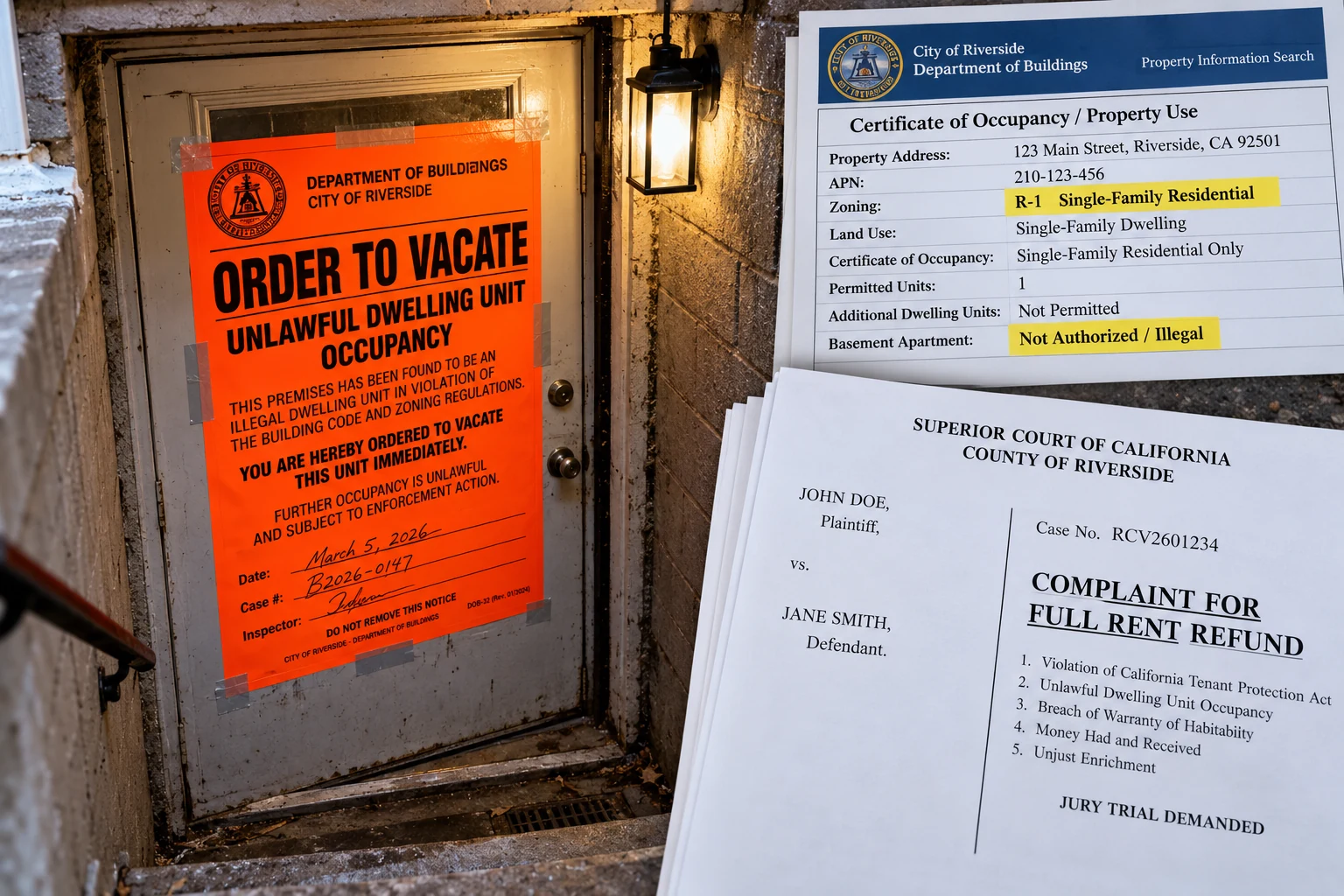
Courts treat residential leases for illegal dwellings as void contracts from their inception. Because the underlying transaction violates local health, fire-safety, and zoning codes, a property owner cannot enforce contractual penalties against you, and several key jurisdictions strictly prohibit the landlord from recovering unpaid back rent.
For additional protections regarding contract enforcement, review our comprehensive guides on Tenant Rights Master Directory and suing your landlord for misrepresenting the rental property.
How to Check If Your Apartment Is Illegal in 3 Minutes
Before initiating contact with property management or calling municipal authorities, you can verify whether your dwelling unit is legally registered. Landlords frequently rely on tenant unfamiliarity with building records, but municipal permit databases are public records accessible online.
5 Obvious Warning Signs of an Unpermitted Unit
- Your Address Fails USPS and 911 Database Verification: If online delivery portals, utility companies, or voter registration records state that your apartment or unit letter does not exist—and the landlord instructs you to use the main house address or handwrite "Basement" on parcels—the municipality has never approved a separate legal unit on that parcel.
- Only One Electric or Gas Meter Servicing Multiple Households: Check the exterior walls of the property. If the property houses two or three independent families but displays only a single electric meter and gas meter, the additional living spaces are almost certainly bootleg conversions constructed without electrical permits.
- Low Ceilings (Under 7 Feet) or Missing Fire Egress Windows: Building and residential codes universally require habitable rooms to maintain ceiling heights of at least 7 feet (frequently 7 feet 6 inches in municipal codes). Furthermore, every bedroom must feature at least one emergency escape window providing a minimum net clear opening of 5.7 square feet with a maximum sill height of 44 inches. Windowless rooms or small ground-level awning vents are illegal.
- Lack of Independent Climate and Heating Controls: State habitability standards mandate that independent residential dwellings provide dedicated thermostat controls. Relying on an upstairs landlord to activate the central furnace violates heating and habitability ordinances nationwide.
- Online Department of Buildings (DOB) Records Show Different Legal Use: Access your city or county property portal (such as NYC DOB BIS, Los Angeles ZIMAS, or your local County Property Appraiser). Search by property address and review the "Legal Use" or "Permitted Number of Dwelling Units." If official records classify the structure as a single-family residence, an extra basement or garage apartment is legally unpermitted.
Official Municipal Certificate of Occupancy (C of O) Look-Up Guide
How to search your local Department of Buildings public records in under 3 minutesDo not take your landlord's verbal claims at face value. You can pull the exact permitted dwelling unit count directly from municipal government databases free of charge:
Search "[Your City / County Name] Department of Buildings Property Search" or "County Property Appraiser".
Click on the "Permits", "C of O", or "Building Profile" tab (e.g., NYC DOB BIS / DOB NOW, LA ZIMAS, Chicago Building Data).
If the C of O lists "1-Family Dwelling" or "Storage / Cellar Use Only" and you reside in a basement or garage, the unit is legally illegal and unpermitted.
Can You Sue to Get Past Rent Back? The Real Courtroom Rules
There is substantial misinformation regarding rent refunds in unpermitted units. While some online forums claim that finding a missing permit automatically entitles a tenant to a 100% refund of all rent paid over multiple years, courtroom realities require a more strategic approach.
Judicial outcomes distinguish sharply between unpaid future rent and rent already paid to the landlord:
Rule 1: Unpaid Rent — The Landlord Recovers $0
In jurisdictions including New York (Multiple Dwelling Law § 302), California (Gruzen v. Henry), New Jersey, and Connecticut (C.G.S. § 47a-5), landlords are statutory barred from utilizing the judicial system to collect unpaid rent for an unpermitted dwelling. If you stop paying rent while arranging relocation, the court will dismiss the landlord's monetary claim for back rent.
Rule 2: Recovering Rent Already Paid — 3 Winning Legal Causes of Action
If a tenant occupied the unit without severe physical defects and seeks a complete refund solely due to a missing administrative permit, courts in several states (such as New York under Chazon LLC v. Maugenest) hold that voluntary payments for actual occupancy cannot be refunded 100% on paperwork grounds alone. However, tenants routinely recover 30% to 100% of past rent by pleading three distinct legal claims:
- Fraudulent Inducement & Deceptive Trade Practices (UDAP): The landlord knowingly misrepresented an unpermitted space as a lawful dwelling to induce lease execution, triggering statutory damage multipliers and restitution under consumer protection statutes.
- Breach of the Implied Warranty of Habitability: Unpermitted basements and garages routinely feature severe safety defects, including dampness, mold, lack of secondary fire egress, and inadequate ventilation, entitling tenants to 35% to 75% rent abatement. Explore our guide on suing for unsafe living conditions.
- Unlawful Shared Utility Metering: If an unpermitted unit shares an electric or gas meter with other occupants without statutory disclosures, tenants can recover 100% of all utility expenses paid.
Calculate Your Illegal Apartment Relocation & Refund Claim
Estimate your statutory relocation assistance, rent refunds for habitability defects, and deposit recovery.
Relocation assistance statutes in NJ, WA, and California cities impose mandatory lump-sum payouts.
Your monthly rent determines statutory relocation multipliers and past rent recovery formulas.
Combining unpermitted status with physical code violations significantly elevates court recovery.
Your security deposit plus moving truck bills and any shared utility bills you paid.
Read This Before Calling 311: The Immediate Vacate Order Risk
Contacting municipal code enforcement without preparing your housing situation can lead to unintended consequences. When a building inspector or municipal fire marshal inspects an unpermitted cellar, basement, or garage and observes acute life-safety hazards—such as an exit obstructed by a heating furnace or bedrooms lacking required escape windows—they do not provide a standard 30-day compliance window.
Instead, the municipality may issue an Emergency Order to Vacate (commonly called a Red-Tag), mandating that occupants vacate the premises within 24 to 72 hours. If you are unprepared, you risk emergency displacement.
The Recommended 3-Step Strategic Playbook
- Step 1: Secure Replacement Housing & Withhold Rent Safely: Before notifying municipal inspectors, organize your personal belongings, gather essential identification records, and secure alternative housing options. In states where unpaid rent cannot be collected on unpermitted units, withholding upcoming rent allows you to accumulate moving capital.
- Step 2: Deliver a Formal Pre-Inspection Settlement Demand: Property owners face municipal penalties ranging from $2,500 to $25,000+ alongside mandatory demolition costs when cited for unpermitted rentals. Delivering our formal demand letter gives the landlord an opportunity to provide immediate relocation compensation and return your deposit in exchange for a quiet, voluntary move-out.
- Step 3: Involve Code Enforcement to Lock In Statutory Relocation Cash: If the landlord refuses voluntary settlement and resides in a jurisdiction with mandatory relocation legislation (such as New Jersey's 6x rent mandate or Washington's 3x rent statute), contact municipal code enforcement. An official municipal violation order triggers the property owner's mandatory statutory relocation payment obligations.
If your landlord responds with harassment or locks you out, consult our legal guides on suing for illegal eviction and breach of lease remedies.
Landlord Threats: Early Termination Fees & Withheld Security Deposits
When informed that a tenant plans to vacate an unpermitted apartment, landlords frequently make unfounded legal threats. Understanding your legal rights provides complete protection against these tactics:
- Zero Liability for Early Termination Penalties: Because the underlying lease contract is void under public policy, you have the absolute legal right to surrender possession at any time without incurring lease-break fees, liquidated damages, or future rent obligations.
- Mandatory 100% Security Deposit Return: The landlord has no legal authority to withhold security deposit funds for lease cancellation or unpaid rent on an unpermitted dwelling. Improper retention of deposits triggers statutory bad-faith penalties of two to three times the deposit amount under state deposit legislation. Review our instructions on recovering your security deposit.
- Self-Help Evictions Are Illegal and Actionable: A property owner cannot change deadbolt locks, remove entrance doors, or terminate electric, gas, or water utilities to force a tenant out of an unpermitted apartment. Even in an unpermitted unit, self-help lockouts constitute illegal eviction, subjecting the landlord to substantial civil damages and emergency injunctive relief.
Formal Demand Letters: Void Lease & Pre-Lawsuit Restitution (Copy Ready)
Select the appropriate formal notice below. Tab 1 is designed for current tenants demanding relocation cash and deposit return prior to municipal inspection. Tab 2 serves as a formal Small Claims pre-lawsuit demand for tenants who have vacated and seek financial recovery.
How Much Rent Can You Recover for an Illegal Apartment?
When taking legal action in Small Claims Court or Housing Court, financial recovery is calculated using established statutory remedies, documented out-of-pocket expenses, and rent reduction standards:
| Recovery Category | Calculation Standard | Statutory Authority & Limits |
|---|---|---|
| 1. 100% Refund of All Rent Ever Paid | Complete disgorgement and repayment of every month of rent paid for living in an unpermitted unit lacking a Certificate of Occupancy. | E.g., Cal. Civ. Code § 1942; NY Multiple Dwelling Law § 301. |
| 2. Court-Ordered Relocation Assistance | Mandatory landlord payment for moving expenses, replacement apartment security deposit, and emergency temporary housing. | Municipal code compliance relocation codes. |
| 3. Void Lease & Full Deposit Return | Judicial declaration that the lease contract is void and unenforceable as against public policy, with prompt return of all deposits. | Contract illegality doctrine. |
Small Claims Filing Limits: Most tenants resolve these matters pro se (without a lawyer) in Small Claims Court. Maximum claim limits vary by state: for example, $12,500 in California (California Courts Self-Help), $10,000 in New York City (NY Courts Small Claims), and $20,000 in Texas (Texas Judicial Branch). If damages exceed local small claims thresholds, lawsuits proceed to standard Civil Court.
Frequently Asked Questions
In states including New York (Multiple Dwelling Law § 302), California (Gruzen v. Henry), New Jersey, Connecticut (C.G.S. § 47a-5), and Maryland, a landlord who rents an apartment without a required Certificate of Occupancy is legally barred from collecting unpaid rent in court. While the property owner can initiate court proceedings to regain physical possession so they can resolve zoning violations, they cannot obtain a money judgment against you for unpaid rent, allowing you to preserve those financial resources to relocate into a code-compliant dwelling.
Yes, in all 50 states. A lease contract executed for an illegal, unpermitted apartment violates public safety and municipal zoning statutes, rendering the contract void and unenforceable against the tenant. You have the legal right to vacate at any time without incurring early-termination fees or ongoing lease liability, and the landlord remains obligated to return 100% of your security deposit.
Relocation payments vary based on state and municipal statutes: in New Jersey (N.J.S.A. 2A:18-61.1h), landlords must pay 6 times the monthly contract rent; in Washington State (RCW 59.18.085), the landlord must pay 3 times monthly rent or $2,000 (whichever is greater) plus deposits within 7 days; and in California cities with rent ordinances (such as Los Angeles, San Francisco, Oakland, Santa Monica, and Berkeley), statutory relocation assistance ranges between $10,000 and $25,000+. In jurisdictions without specific statutory multipliers, tenants can recover moving, hotel, and reliance expenses through Small Claims Court under Fraudulent Inducement.
No, never. Unless the municipal Fire Marshal or Department of Buildings posts an official Emergency Order to Vacate due to imminent life-safety dangers, a landlord is strictly prohibited from executing a self-help lockout or shutting off utility services. Even when a dwelling is unpermitted, landlords must follow statutory court procedures and provide required relocation assistance prior to recovering possession.
Yes. Because utility providers will not establish separate meters for unpermitted residential units, landlords often connect the entire building to a single meter or impose arbitrary monthly utility splits. Tenants can request a formal Shared Meter Investigation from their utility provider and pursue Small Claims litigation to compel 100% reimbursement of all utility payments made under unlawful shared metering arrangements.
SueLegal is an independent educational legal publisher, not a law firm or lawyer referral service. The information provided in this guide is for general informational and educational purposes only and does not constitute formal legal advice. Residential landlord-tenant laws, repair notice periods, and statutory remedies vary significantly across state and municipal jurisdictions. If you are facing eviction, severe uninhabitable conditions, or complex litigation, consult a licensed attorney in your jurisdiction or contact your local legal aid organization. For more details on our standards, read our Editorial Policy and Legal Research Methodology.