
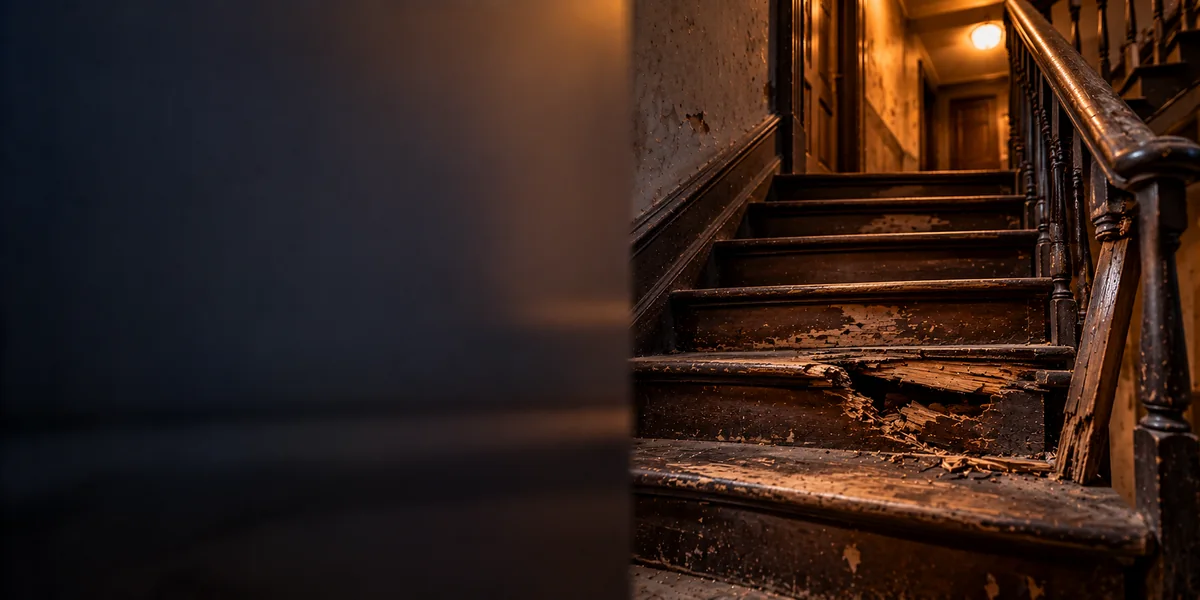
Yes, you can sue your landlord for broken stairs or a broken handrail.
Landlords have a strict legal duty under state housing laws and city building codes to keep all interior and exterior stairs, handrails, stair carpets, and stairwell lights safe. Depending on whether someone already fell and got hurt or you are trying to force repairs before an accident happens, you have two ways to take legal action:
- If You, a Family Member, or a Guest Fell ($25,000 to $500,000+ Insurance Settlements): Stairway falls cause some of the worst injuries in landlord-tenant law—including broken ankles/wrists, torn ligaments, herniated back discs, and concussions. A personal injury lawyer can sue your landlord's commercial liability insurance policy at $0 upfront cost for ER and surgery bills, physical therapy, missed paychecks, and pain and suffering (plus $5,000–$10,000 in immediate no-fault MedPay).
- If Nobody Has Fallen Yet, But the Landlord Won't Fix Unsafe Stairs ($1,500 to $10,000 in Small Claims / Housing Court): You do not have to wait until someone breaks a leg. You can call 311 / City Building Inspectors to force emergency repairs, sue in Small Claims Court for a 20% to 50% rent refund while entry/access is unsafe, or break your lease penalty-free.
Important Steps to Take
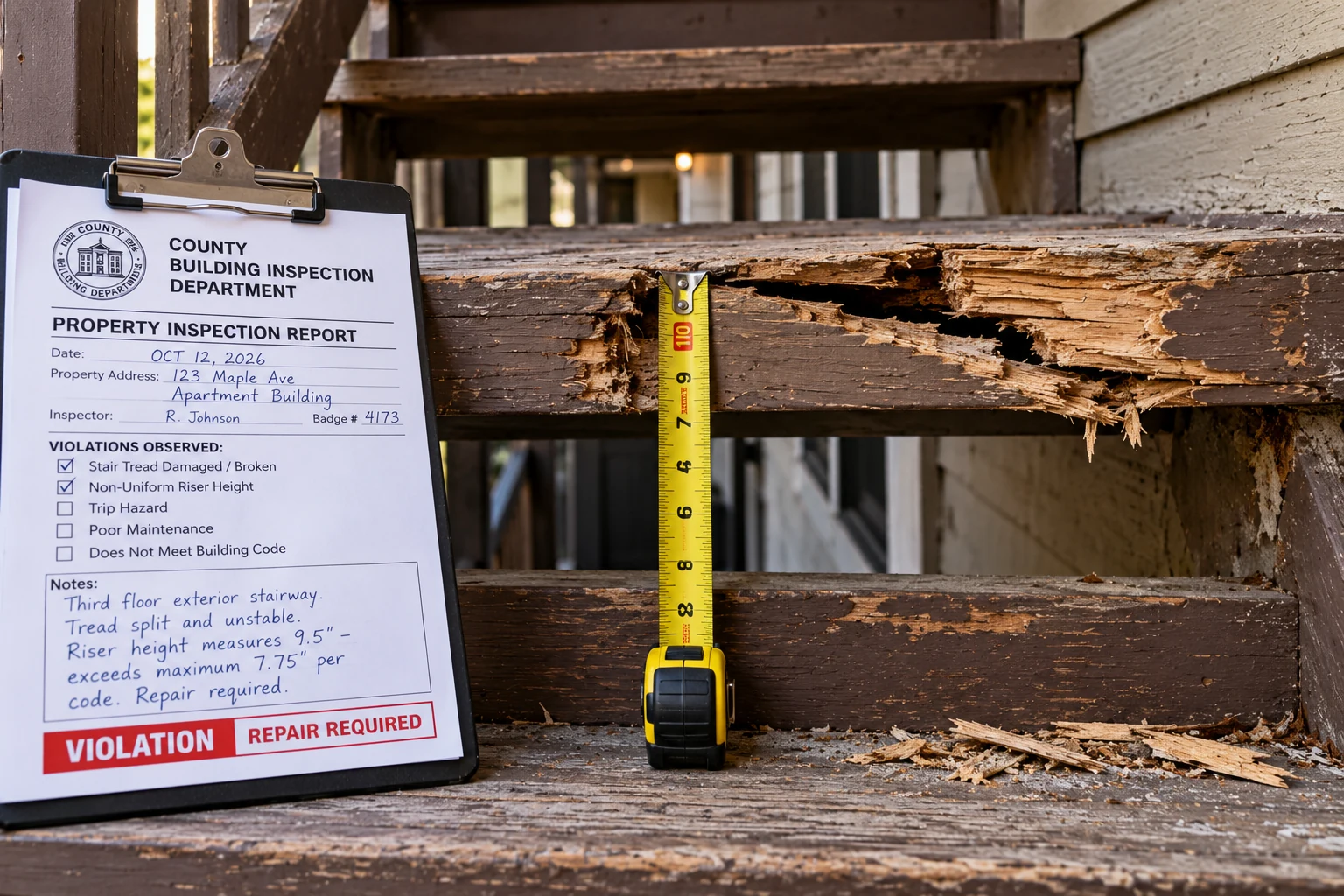
- Take a Photo With a Tape Measure Before the Landlord Fixes the Step: The morning after a fall, landlords almost always rush a maintenance worker over with screws, wood filler, or new carpet to cover up the broken step. Photograph the broken tread, loose handrail, and burned-out lights immediately—holding a tape measure next to the defect!
- A 3/8-Inch Difference in Step Height Violates Building Codes Automatically: Under the International Building Code, if one step in a staircase is even 3/8 of an inch (0.375") taller or shorter than the rest—or if a handrail is missing or below 34 inches—the staircase is illegal, triggering automatic landlord negligence.
- You Don't Need a Prior Complaint for Shared Stairwells or Porch Steps: Because landlords control shared hallways, outdoor wooden porches, and exterior concrete steps, the law requires them to inspect for wood rot, loose bolts, and worn carpet on their own.
- Don't Let the Insurance Adjuster Blame You for "Knowing the Step Was Loose": If the broken staircase is the only path to your apartment door, bedroom, or laundry room, courts rule that you had no choice but to use it—defeating the landlord's claim that you "assumed the risk."
- Guests, Kids & Delivery Drivers Have the Exact Same Right to Sue: If your visiting friend, child, parent, or an Amazon/DoorDash driver falls through a rotted porch step at your rental, the landlord's insurance policy covers their injuries too.
The 5 Staircase Building Code Rules You Can Check With a Tape Measure
Insurance adjusters fold quickly when a tenant proves a staircase broke city building codes. Under both the International Building Code (IBC § 1011) for commercial apartment complexes and the International Residential Code (IRC R311.7) for one- and two-family rental dwellings, stairs must adhere to rigid geometric and safety standards.
When a landlord violates any of these dimensional mandates, courts apply the doctrine of negligence per se. That legal rule means the landlord is considered automatically negligent as a matter of law. Instead of debating whether the landlord was careless, the legal inquiry focuses directly on proving that the violation caused your fall and evaluating the extent of your bodily damages.
| Staircase Part | Official Building Code Requirement | What Makes It Illegal | How to Photograph It for Court |
|---|---|---|---|
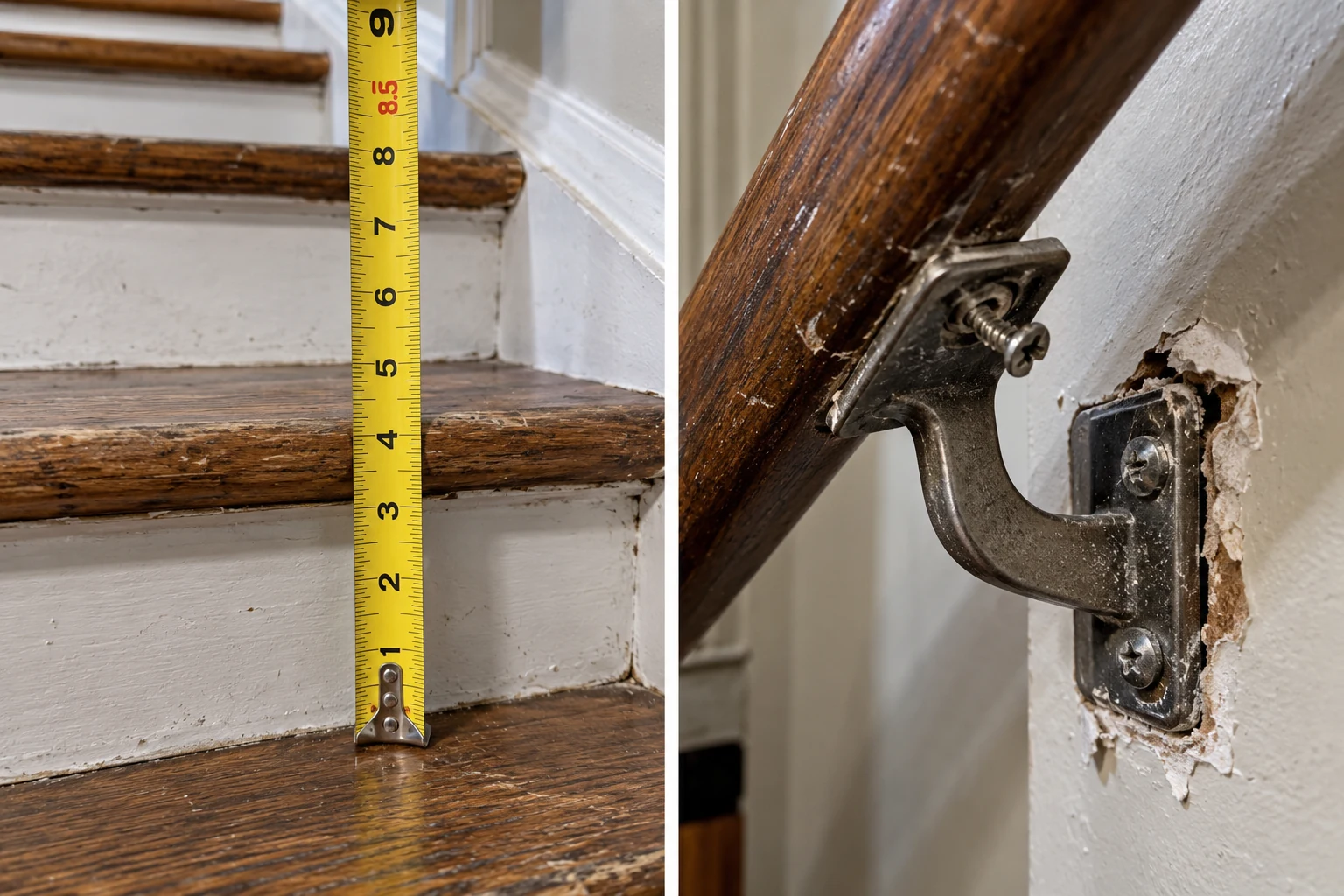
| 1. Step Height ("Riser Height") | Steps must be no taller than 7 inches in apartment buildings (IBC § 1011.5.2) or 7.75 inches in 1–2 family homes (IRC R311.7.5.1). | Steps measuring 8 to 10+ inches tall, common in aging basements, unpermitted conversions, and homemade rear porches. | Stand a metal tape measure vertically from the tread surface of one step to the tread surface of the next step. Snap an eye-level close-up showing the measurement markings. |
| 2. The "3/8-Inch Variance Rule" (Most Common Fall Cause) | The greatest riser height within any flight of stairs cannot exceed the smallest by more than 3/8 of an inch (0.375"). | A bottom or top step that is 1/2 inch to 2 inches taller or shorter than adjacent steps. Human stride relies on muscle memory; uneven steps trigger abrupt trips. | Measure and photograph the bottom step, a middle step, and the top step with the tape measure extended. Show side-by-side photos contrasting the conflicting heights. |
| 3. Step Depth ("Tread Depth") & Slope | Each tread must provide at least 11 inches of depth in multi-unit buildings (IBC) or 10 inches in private houses (IRC), with a maximum 2% drainage slope. | Narrow 7-to-9-inch treads forcing your heels over the nosing, or sagging porch steps that pitch steeply downward toward the yard. | Lay a tape measure flat from the back riser to the leading nosing edge. Place a circular coin or marble on the tread to record video of it rolling down a steep forward slope. |
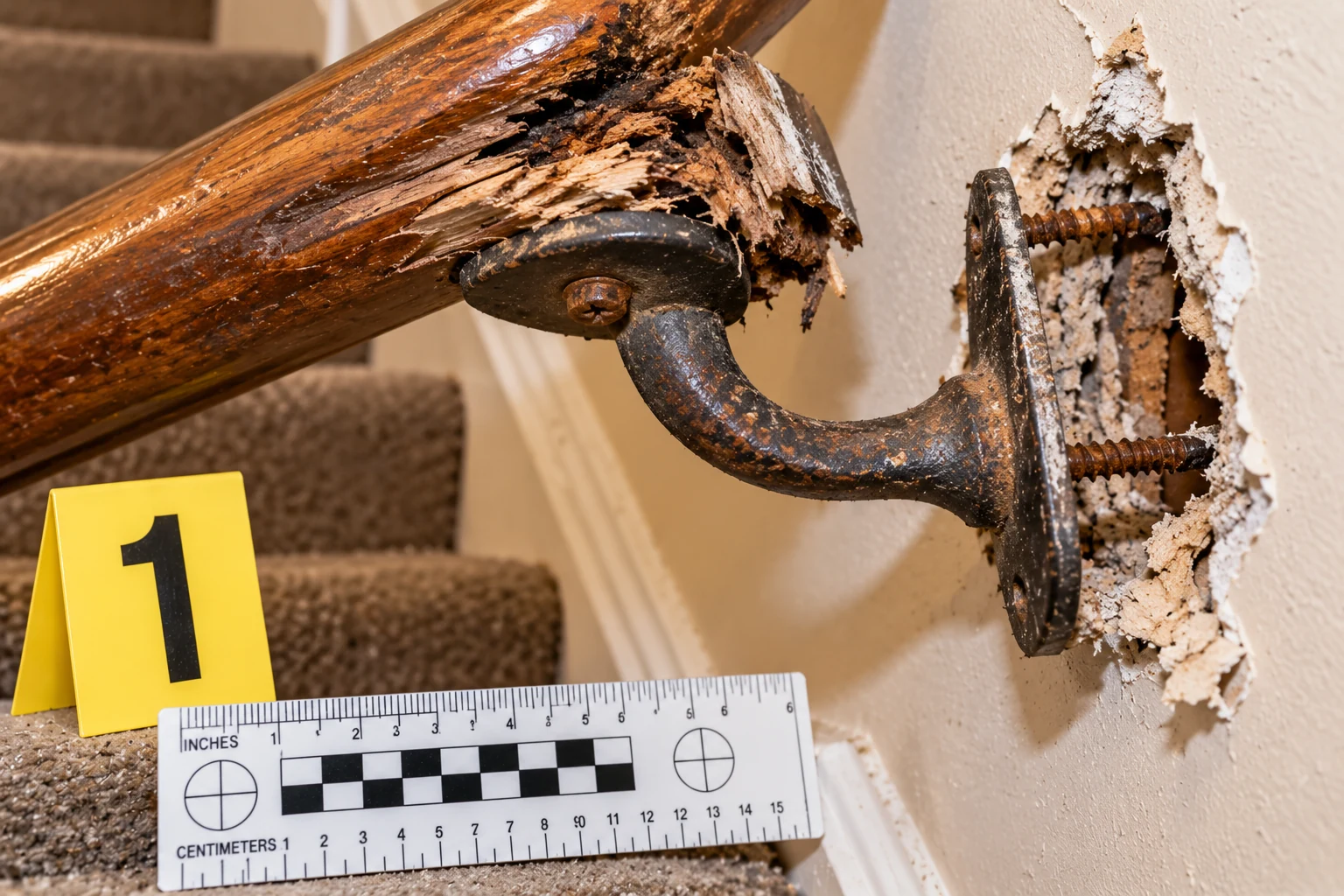
| 4. Handrails & Guardrails | Mandatory on any stair run with 4 or more risers. Must stand between 34 and 38 inches high, offer continuous graspable profile, and withstand 200 lbs of load. | No handrail installed, a railing terminating prematurely before the final step, wide 2x6 timber you cannot grip, or loose brackets pulling free from drywall. | Measure from the step nosing up to the handrail top. Record a brief video shaking the railing with two fingers to show loose anchors, missing lag bolts, and wall wobble. |
| 5. Stairwell Lighting (IPMC § 402.2) | Common interior stairwells must provide continuous illumination producing at least 1 foot-candle (11 lux) of light across all tread surfaces 24 hours a day. | Burned-out bulbs left unreplaced for weeks, broken motion detectors, or pitch-black outdoor steps lacking exterior floodlighting. | Take photos and videos with your smartphone\'s Night Mode and flash turned OFF. This preserves true ambient darkness without digital artificial brightening. |
When negotiating with insurance adjusters, citing these code provisions removes subjective argument. For deeper analysis on premises maintenance duties, consult our master guide on suing your landlord, our comprehensive guide on suing a landlord for slip and fall accidents, and our overview of landlord negligence claims.
Did You Fall on Shared Apartment Stairs or Inside a Rented House?
A frequent misunderstanding among tenants is assuming that slip and fall lawsuits follow the same legal rules regardless of where the stairs are located. In real estate litigation, the location of the defective staircase determines your burden of proof.
Scenario A: Shared Common Stairwells, Outdoor Porches & Fire Escapes
If the staircase serves multiple apartments or connects public walkways, parking lots, and building entryways, it constitutes a Common Area. Under premises liability doctrine across all fifty states, landlords exercise non-delegable control over common areas.
This legal principle means landlords bear an active, ongoing obligation to routinely inspect, identify, and repair wear and tear. You do not need to prove you sent a text message or formal email about the cracked step prior to your fall. If the step rotted, concrete crumbled, or handrail bolts loosened over time, the landlord is charged with constructive notice because reasonable property management would have detected the hazard.
Scenario B: Interior Stairs Inside a Rented Single-Family House or Townhouse
When you lease an entire private home or multi-level townhouse, the landlord transfers exclusive possession of the interior to you. Some tenant blogs mistakenly claim that renters injured on private interior stairs can never sue. That assertion is legally inaccurate.
You can hold your landlord legally responsible for private interior stairway injuries if any of these four criteria apply:
- Prior Written Notice: You previously notified the landlord in writing that a step squeaked, cracked, felt spongy, or had a wobbly handrail, and the landlord neglected repairs beyond statutory cure deadlines.
- Pre-Existing Code Violation at Move-In: The staircase violated local building codes on the day you signed the lease—such as missing an essential handrail or featuring illegal 9-inch risers. A landlord cannot rent an illegal condition and escape liability.
- Latent Structural Rot or Hidden Insect Damage: The structural timber stringers supporting the staircase decayed from hidden roof leaks or termite activity beneath the treads, collapsing under regular foot traffic without visual warning.
- Negligent Handyman Repair: The landlord or an unlicensed maintenance worker attempted to secure a loose step with drywall screws or cheap adhesive, creating a false sense of security before the shoddy patch failed.
Review our guide on suing a landlord for refusing to make repairs to evaluate statutory cure notice timelines in your jurisdiction.
What to Do in the First 24 Hours After Falling on Broken Stairs
Property management companies understand their exposure after a stairway fall. The morning following a reported injury, landlords frequently dispatch handymen to replace broken wooden treads, nail down carpets, or tighten handrail brackets before an attorney can inspect the scene.
Protect your physical recovery and legal rights by taking these four immediate steps within the first twenty-four hours:
Actionable 24-Hour Evidence Checklist
1. Capture Tape-Measure & Angle Photos Before Repairs Begin
Before notifying maintenance or while awaiting medical transportation, take high-resolution photos and wide-angle video of the exact stair defect. Position a tape measure or dollar bill adjacent to the broken tread, gap, or loose handrail bracket to establish physical scale.
2. Bag and Preserve the Exact Footwear You Were Wearing
Insurance defense attorneys routinely attempt to shift blame by claiming injured tenants wore slippery, damaged, or improper footwear. Place the exact shoes worn during the fall into a sealed plastic bag. Do not clean them, wear them, or discard them; intact rubber soles rebut claims of comparative fault.
3. Seek Urgent Medical Evaluation and Specify the Fall Mechanism
Visit an Emergency Department or Urgent Care facility immediately. Adrenaline frequently obscures herniated discs, hairline fractures, and concussions. Explicitly inform the attending triage physician that you fell down apartment stairs due to a collapsed step or loose handrail so the causative mechanism appears in official clinical records.
4. Request Security and Video Preservation Within 48 Hours
Hallway CCTV cameras, apartment lobby systems, and neighbor video doorbells commonly overwrite recorded footage every 72 to 168 hours. Dispatch a formal written preservation notice demanding that management preserve all digital video files depicting the staircase and entryway.
What If Nobody Has Fallen Yet, But the Landlord Refuses Repairs?
You do not have to endure severe bodily harm before exercising your statutory rights. When a landlord ignores broken steps, detached railings, or crumbling concrete, tenants can deploy municipal and legal mechanisms to compel emergency repairs and secure financial compensation.
Step 1: Contact Municipal Code Enforcement (Call 311)
Unlike hidden plumbing leaks behind drywall, stairway structural failures and absent handrails are readily observable. When you file a complaint with municipal code enforcement or the local department of buildings, an inspector conducts an onsite examination.
If the stairs violate the International Property Maintenance Code (IPMC) or local municipal ordinances, the inspector issues an official Notice of Violation. This citation establishes an immutable public record of neglect, subjects the landlord to recurring municipal fines, and eliminates any defense that the landlord was unaware of the danger.
Step 2: Fair Housing Act Protections for Disabled and Elderly Occupants
When broken exterior porch stairs, missing access ramps, or out-of-service elevators trap a mobility-impaired or elderly tenant, the failure transcends common maintenance neglect. Under the Federal Fair Housing Act (FHA, 42 U.S.C. § 3604), landlords must afford reasonable accommodations to ensure equal enjoyment of the dwelling.
Denying safe ingress and egress to an occupant using a wheelchair, walker, or cane constitutes unlawful housing discrimination. In severe cases, the landlord can be mandated to cover temporary accessible hotel accommodations while repairs proceed. Explore additional protections in our article on suing for unsafe living conditions.
Step 3: Small Claims Rent Abatement & Lease Rescission
Safe entryway access represents an indivisible pillar of the implied warranty of habitability. If the primary staircase remains dangerous for weeks, tenants are legally entitled to retroactive rent abatement reflecting the reduced rental value of the property.
Depending on jurisdictional statutes, tenants may also exercise repair-and-deduct remedies by hiring a licensed carpenter after providing written notice, or terminate the lease agreement without penalty under the doctrine of constructive eviction.
Ready-to-Send Broken Stairs Demand & Evidence Preservation Notice
Establishing an enforceable legal paper trail preserves critical evidence and accelerates insurance settlements. Choose between the post-injury legal notice or the pre-injury repair demand below, then copy or download the template:
NOTICE OF STAIRWAY FALL PERSONAL INJURY CLAIM, EVIDENCE PRESERVATION & INSURANCE DISCLOSURE DEMAND

Date: [Current Date]
Sent Via: Certified Mail (Tracking #: [Insert Tracking #]) & Written Tenant Portal

TO:
Landlord / Property Management: [Landlord / Management Company Name]
Office Address: [Management Street Address]
City, State, Zip: [City, State, Zip]

FROM:
Injured Claimant: [Your Full Legal Name]
Tenant Address: [Your Rental Street Address, Unit #]
Phone: [Your Phone Number] | Email: [Your Email Address]

RE: FORMAL NOTICE OF PREMISES LIABILITY INJURY & SPOLIATION WARNING
    INCIDENT LOCATION: [Describe Staircase, e.g., Exterior Front Porch Steps / 2nd Floor Hallway Stairs]
    DATE & TIME OF FALL: [Date of Fall] at approximately [Time of Fall]

Dear Property Manager / Landlord,

Please accept this letter as formal statutory notification that on [Date of Fall], the undersigned was severely injured while attempting to navigate the staircase at [Exact Location]. Specifically, the fall occurred as a direct result of [a rotted/collapsed wooden step / detached handrail / uneven riser heights exceeding 3/8-inch code limits / unlit stairway].

1. NOTICE OF BODILY INJURY & ECONOMIC DAMAGES:
As a result of this hazardous defect, [Your Name] suffered acute injuries including [fractured ankle / wrist fracture / torn ligaments / lumbar herniation / head trauma], requiring emergency transportation and clinical evaluation at [Hospital / Medical Facility Name]. Substantial medical liabilities, ongoing physical rehabilitation, and loss of employment income have resulted.

2. STRICT LEGAL HOLD & ANTI-SPOLIATION NOTICE:
You are hereby instructed under civil litigation preservation rules NOT to demolish, discard, alter, or repair the subject staircase, defective tread, fasteners, or railing hardware without allowing independent forensic inspection and documentation. Furthermore, you must immediately preserve all digital surveillance recordings capturing the stairwell, entryway, and common areas recorded between [Date of Incident - 2 Days] and [Date of Incident + 2 Days]. Destroying physical hardware or overwriting video files will be presented as intentional evidentiary spoliation.

3. MANDATORY INSURANCE POLICY DISCLOSURE:
In accordance with applicable premises liability laws, demand is hereby made for the legal identity, claims administrator, policy number, and coverage limits of your Commercial General Liability (CGL) insurer and No-Fault Medical Payments (MedPay) policy within FIVE (5) BUSINESS DAYS of this notice.

Promptly forward this document to your legal counsel and insurance underwriting carrier.

Sincerely,

_________________________________________
[Your Signature]

[Your Printed Legal Name]
Frequently Asked Questions About Broken Stairs Lawsuits
Can I sue my landlord if I fell down the stairs inside my rented house or duplex?
Yes. While landlords are not automatically liable for every slip inside a private home, they are legally liable if you previously notified them that the step or handrail was loose, if the stairs violated municipal building codes—such as lacking a required handrail or having uneven step heights—or if the step collapsed from hidden timber rot or a substandard handyman repair.
What if the landlord repairs the broken step the day after I fall—does that ruin my lawsuit?
If you documented the broken step with photos or video before the repair—or if neighbors, first responders, or post-repair photos show fresh replacement timber and screws at the accident location—you can still prevail. While evidentiary rules prevent using subsequent repairs as an admission of fault, attorneys use immediate repairs to demonstrate landlord control and impeach property managers who falsely claim the step was never broken.
How much is a broken stairs injury lawsuit against a landlord worth?
A minor sprain or contusion case with a single urgent care visit typically settles between $5,000 and $15,000. Fractured ankles, wrist fractures, torn knee ligaments, or herniated lumbar discs frequently settle between $35,000 and $150,000+. Severe stairway falls requiring orthopedic surgery—such as plates, screws, pins, or spinal fusion—frequently resolve between $150,000 and $500,000+ under the landlord's commercial property liability insurance.
Can I still win if I wasn't holding the handrail or was carrying groceries/laundry when the step broke?
Yes. Carrying groceries, laundry baskets, or children up and down residential stairwells represents ordinary, foreseeable tenant activity. Moreover, if the structural tread broke beneath your foot or if no code-compliant handrail was available to grasp upon slipping, the landlord bears primary legal liability under comparative negligence standards.
Can my guest or an Amazon/food delivery driver sue my landlord if they fall on our broken porch steps?
Yes. Under premises liability jurisprudence, property owners owe an affirmative legal duty to maintain safe ingress pathways for all lawful visitors, including personal guests, parcel couriers, and emergency responders. Any injury claim filed by a visitor proceeds directly against the landlord's commercial property insurance, not against the tenant.
SueLegal is an independent educational legal publisher, not a law firm or lawyer referral service. The information provided in this guide is for general informational and educational purposes only and does not constitute formal legal advice. Residential landlord-tenant laws, repair notice periods, and statutory remedies vary significantly across state and municipal jurisdictions. If you are facing eviction, severe uninhabitable conditions, or complex litigation, consult a licensed attorney in your jurisdiction or contact your local legal aid organization. For more details on our standards, read our Editorial Policy and Legal Research Methodology.