

Yes, you can sue your landlord for a slip-and-fall injury—and your claim is paid by the landlord’s commercial building insurance policy, not out of the landlord’s pocket.
Under Premises Liability and state habitability laws, landlords have a strict duty to keep shared areas (lobbies, laundry rooms, walkways, parking lots, and icy entrances) safe, and to promptly fix leaks and flooring hazards inside your apartment. Depending on how bad your injury is, you have two ways to recover money:
- Full Personal Injury Insurance Settlements ($20,000 to $500,000+): If you broke a bone, tore a knee/shoulder ligament, herniated a back disc, or suffered a concussion because the landlord ignored a water leak, un-salted black ice, a mopped floor with no warning sign, or a sidewalk crack over ½ inch high, a personal injury lawyer can sue the landlord’s insurance policy at $0 upfront cost for all medical bills, lost wages, and pain and suffering.
-
Instant "No-Fault MedPay" + Small Claims Recovery ($1,500 to $10,000): Even for a minor sprain where fault is disputed, you can demand the landlord’s "No-Fault Medical Payments (
MedPay)" insurance coverage (which pays $5,000 to $10,000 toward your ER/doctor bills with zero proof of fault required), plus sue in Small Claims Court for a rent refund if an unfixed apartment leak caused your fall!
What Tenants Should Know
- Ask for the Landlord’s "$5,000–$10,000 No-Fault MedPay" Coverage Today: Most renters have no idea that commercial apartment insurance policies carry Coverage C (
MedPay), which reimburses your immediate ER copays, X-rays, and ambulance bills regardless of who was at fault—and collecting MedPay does not waive your right to a full settlement! - Slipped on Winter Ice? Look Up at the Roof Gutters & Snowplow Piles: If the landlord’s insurance adjuster claims "We aren’t liable for natural snow or ice," take a photo of water dripping from a broken overhead gutter, awning, or downspout onto the sidewalk, or snow piled by the landlord’s plow that melted and refroze across the path. Courts rule that "Unnatural / Artificial Ice Accumulation" makes the landlord 100% liable in all 50 states!
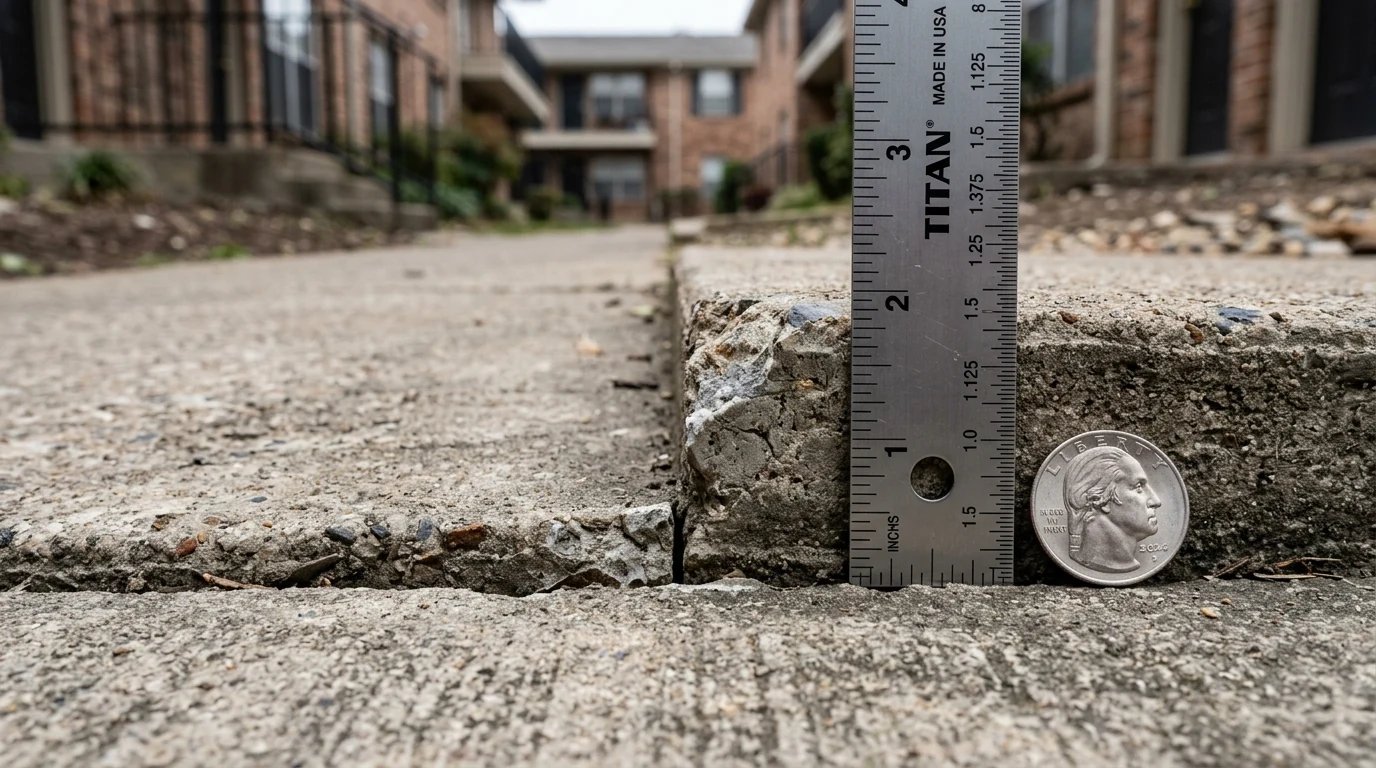
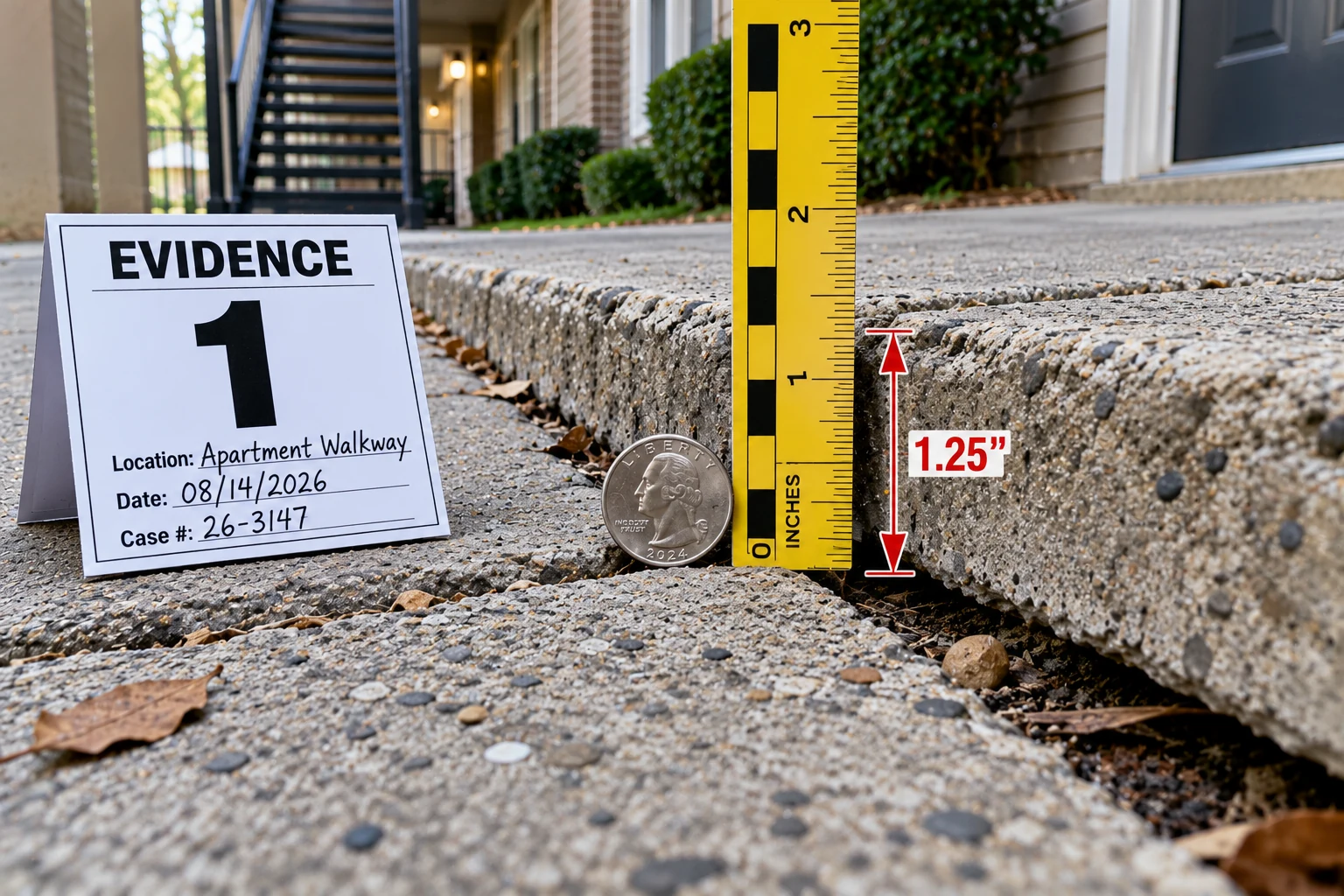
- Measure Sidewalk Cracks & Potholes With a Coin (Over ½ Inch = Code Violation): Under ADA and
IPMC § 302.3safety standards, any raised concrete lip, pothole edge, or curled lobby floor mat over ½ inch high (about the width of your pinky finger or half a quarter) is an actionable trip hazard. - Slipped on a Ceiling or Plumbing Leak Inside Your Apartment? Screenshot Your Old Texts: For a fall inside your private apartment, your golden ticket is proving you already texted, emailed, or submitted a maintenance ticket about the leaking bathroom ceiling, dripping AC, or soft bathroom floor before you fell!
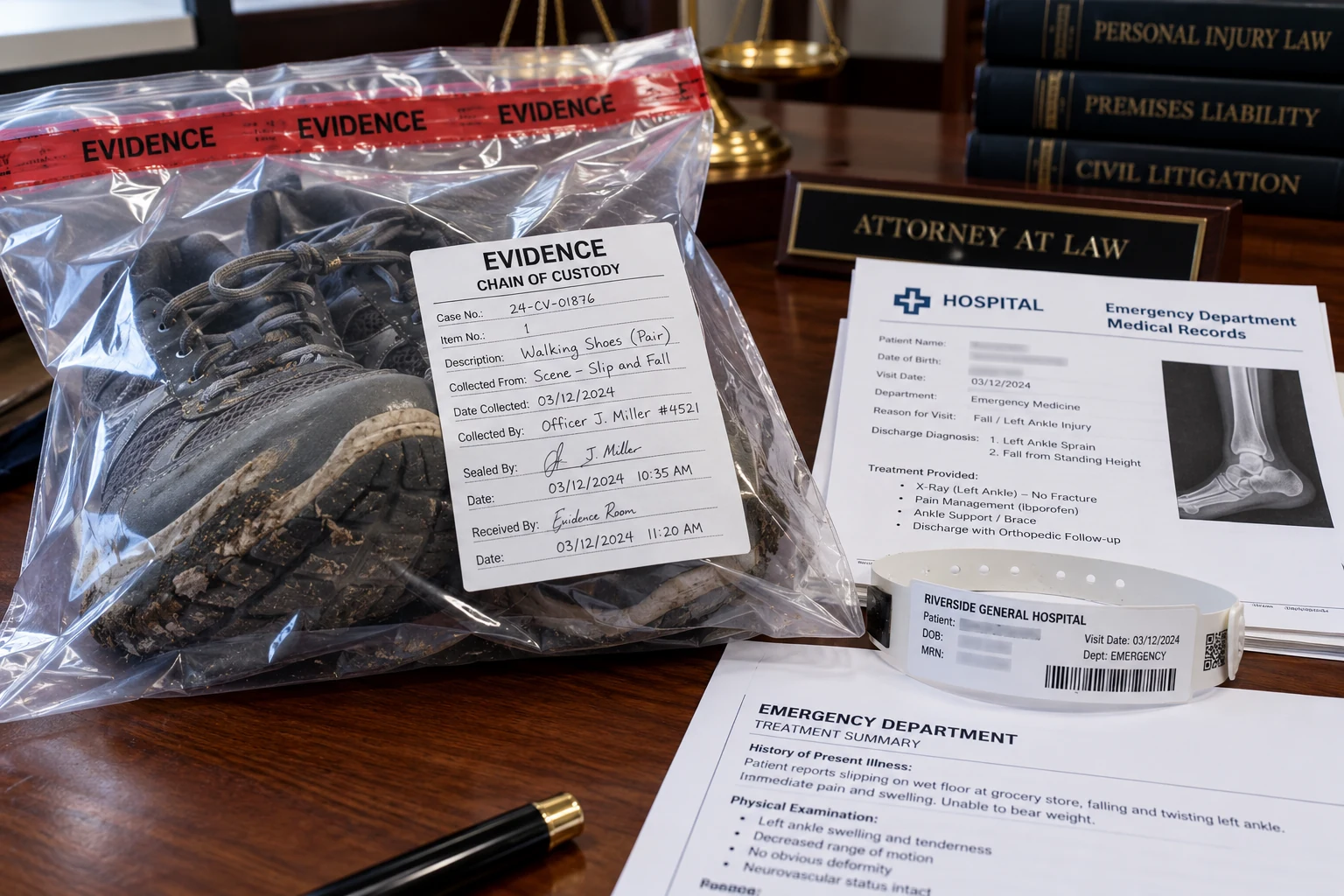
- Put the Shoes You Wore in a Closet Bag & Demand Camera Video Within 48 Hours: Never throw away or keep wearing the shoes you had on when you fell (insurers inspect the rubber tread to prove you wore safe footwear!), and send our 48-Hour Video Hold Notice below before the building’s security cameras overwrite the footage of your fall.
Falling Inside Your Apartment vs. Falling in a Shared Common Area (The 2 Different Legal Rules)
Courts apply distinct legal rules depending on whether you slipped or tripped inside your private rented unit or outside in a shared building space. In both situations, the landlord can be held financially liable, but the specific legal evidence required to win shifts.
Under premises liability principles, landlords owe an affirmative duty of care to inspect and maintain shared passages. Inside a private apartment, liability focuses on whether management ignored reported defects under the Implied Warranty of Habitability. For an overview of tenant rights against property management, review our cornerstone guide on Can I Sue My Landlord? and our analysis of suing for landlord negligence. If you fell specifically on defective or unlit stairs, see our specialized guide to suing for broken stairs.
| Where You Fell | Common Examples | What You Must Prove | Strongest Piece of Evidence |
|---|---|---|---|
| 1. Inside Your Private Apartment | Slipping on water from a leaking bathroom ceiling, radiator, toilet, AC unit, or refrigerator, or a rotten soft bathroom subfloor giving way. | Actual Notice: Because landlords cannot enter without permission, you show you already reported the leak or bad floor and management failed to cure it promptly. | Screenshots of prior texts, emails, or portal maintenance tickets reporting the leak days or weeks before your fall. |
| 2. Shared Indoor Common Areas | Slipping on a freshly mopped lobby or hallway floor with no "Wet Floor" cone, laundry room washer floods, stairwell roof leaks, or tripping on curled lobby mats or torn carpet. | Direct Creation OR Constructive Notice: Either the landlord’s cleaning staff created the slick surface, or the hazard sat unaddressed long enough that routine inspection would have revealed it. | Lobby security camera footage and photos showing zero yellow "Wet Floor" warning cones at the time of your fall. |
| 3. Outdoor Walkways, Steps & Parking Lots | Slipping on black ice, wet algae on shady walkways, or tripping on a cracked sidewalk lip (> ½ inch), parking lot pothole, or unlit curb at night. | Building Code Violation (IPMC § 302.3 / ADA § 303.2) OR Unnatural Ice: Sidewalk lips over ½ inch, burned-out lighting, or ice from a dripping gutter. |
A photo holding a quarter or ruler next to the > ½-inch crack, a nighttime photo (flash off) showing the dark lot, or photos of the leaky roof gutter above the ice! |
If the water on your floor leaked from an overhead ceiling collapse or serious structural plumbing defect, explore our dedicated guides on ceiling collapse lawsuits and water damage landlord liability.
How to Beat the Insurance Company’s 2 Favorite Excuses ("Natural Snow & Ice" and "Open & Obvious")
When you report a slip-and-fall to an apartment complex’s insurance carrier, the insurance adjuster is trained to cite two specific legal doctrines to deny your claim. Knowing how to dismantle these defenses establishes strong settlement leverage:
Excuse #1: "We Aren’t Responsible for Winter Ice Under the Natural Accumulation Rule!"
In many cold-weather states (including Illinois, Ohio, New York, Pennsylvania, Massachusetts, and Michigan), landlords attempt to invoke the traditional common-law rule that property owners are not liable for snow or ice that accumulates naturally during an active winter storm. You can defeat this defense in three distinct ways:
- 1. The Leaky Gutter & Unnatural Accumulation Rule: Did snow melt on the roof and drip down from a clogged gutter, sagging eave, broken downspout, or entryway awning onto the sidewalk, where it refroze into a patch of black ice? In all 50 states, ice formed by water dripping from a structural defect constitutes an "Unnatural or Artificial Accumulation." The landlord is 100% liable because building negligence created the sheet of ice.
- 2. The Melt-and-Refreeze Snowplow Pile: Did the landlord’s snow contractor pile snowbanks on the uphill side of the parking lot or walkway, allowing daytime sunshine to melt the pile across pedestrian walkways before it refroze into ice at nightfall? Plowing snow in a manner that creates an artificial downhill runoff constitutes active negligence.
-
3. Municipal Sidewalk Clearing Ordinances: Most cities enforce strict post-storm clearance deadlines. For instance, New York City (
Admin. Code § 16-123) mandates snow clearing within 4 daylight hours after snow ends; Chicago requires clearing by 10:00 PM for day snow or 10:00 AM for night snow; and Boston enforces a 3-hour window. Furthermore, in leading jurisdictions like Massachusetts (Papadopoulos v. Target Corp., 457 Mass. 368), courts have formally abolished the natural accumulation defense, requiring landlords to exercise reasonable care under all winter conditions.
Excuse #2: "You Saw the Puddle or Ice—It Was 'Open and Obvious,' So It’s Your Own Fault!"
Insurance adjusters frequently argue that if a puddle or ice patch was visible, the injured renter should have avoided it. In residential rental properties, courts firmly reject this excuse under the Restatement (Second) of Torts § 343A ("The Inevitable Encounter Rule"):
The Inevitable Encounter & No Safe Alternative Rule
A landlord cannot claim a hazard was "open and obvious" when a tenant has no reasonable alternative path. If a leaking bathroom ceiling leaves a puddle on the floor, or if black ice coats the sole walkway leading to your apartment entryway, you are forced to encounter the condition to access your living quarters. Under state habitability laws and premises liability, the landlord remains legally accountable.
If the complex was plagued by chronic maintenance neglect or unsafe shared areas, read our guide on suing for unsafe living conditions.
The "$5,000–$10,000 No-Fault MedPay" Secret (Get Your ER Bills Paid Right Now Without a Lawsuit!)
If you suffered a sprain, hairline fracture, or required stitches, you may face immediate emergency room and diagnostic copays ranging from $1,500 to $8,000. Many injured tenants hesitate to seek legal help because they believe obtaining insurance compensation requires months of complex litigation.
Almost every Commercial General Liability (CGL) insurance policy carried by multifamily apartment owners contains a little-known provision that pays medical bills immediately:
Coverage A: Bodily Injury Liability ($1M–$5M)
Covers major financial damages—including past and future medical care, lost paychecks, long-term disability, and pain and suffering. To recover under Coverage A, you must prove the landlord was negligent, and settlement negotiations typically take several months.
Coverage C: Medical Payments ("MedPay" — $5,000 to $10,000)
Provides 100% No-Fault Medical Reimbursement for emergency room visits, ambulance transportation, diagnostic X-rays/MRIs, and doctor bills incurred on the premises within one year. Zero proof of landlord negligence is required.
Why MedPay Is a Critical Tenant Advantage:
- Immediate Out-of-Pocket Relief: Submitting itemized medical receipts directly to the landlord’s insurance adjuster under Coverage C pays off urgent hospital accounts before they enter debt collection.
- Preserves Your Full Lawsuit Rights: Collecting no-fault MedPay does not require you to sign a general liability release. If diagnostic imaging later reveals a torn ACL, rotator cuff tear, or herniated lumbar disc requiring surgery, you can still pursue a full Coverage A personal injury settlement.
The 5-Step "First 48 Hours" Proof Checklist (Before the Mop Dries or the Ice Melts!)
Unlike a structural ceiling crack or broken staircase, transient slip-and-fall hazards can vanish in hours: a mopped hallway tile dries in 45 minutes, and outdoor black ice melts by noon. Securing objective physical evidence in the immediate aftermath protects your claim against subsequent landlord denials.
Step 1: Photograph the Hazard & Measure With a Coin
Capture 10 clear photos and a continuous video before alerting management.
- Capture the puddle, ice patch, algae slick, or sidewalk crack from multiple angles.
- Photograph the source: zoom in on leaking ceiling pipes, overflowing AC pans, or clogged roof downspouts.
- Capture the wide-angle view showing zero yellow "Wet Floor" warning cones.
- For sidewalk cracks or potholes, insert a U.S. quarter (roughly 1 inch tall) or ruler. Under
IPMC § 302.3andADA § 303.2, vertical edges exceeding ½ inch constitute code violations.
Step 2: Bag the Shoes You Were Wearing
Defense adjusters routinely claim victims wore worn-out, slippery, or inappropriate footwear.
- Take photographs of the rubber tread and soles of your shoes.
- Place the shoes into a sealed plastic Ziploc or closet bag immediately.
- Do not continue wearing them to preserve the exact physical condition of the tread.
Step 3: Issue a 48-Hour CCTV Video Preservation Hold
Multifamily surveillance systems overwrite camera footage on automatic 7-to-30-day loops.
- Send our formal spoliation hold notice below via certified mail and tenant portal.
- Demand preservation of lobby, elevator, courtyard, and parking lot camera archives.
- Covering 24 hours prior to the fall proves how long the puddle or ice sat untouched.
Step 4: Obtain Urgent Medical Care Within 24 Hours
Delaying medical evaluation gives insurance adjusters an opening to challenge injury causation.
- Visit an emergency department or urgent care facility on the same day.
- Report the exact mechanism of the fall so it is recorded in clinical notes.
- Obtain diagnostic imaging (X-rays, CT, or MRI) to identify fractures and tears.
Real Apartment Slip-and-Fall Settlement Benchmarks (By Injury Type)
Slip-and-fall lawsuit payouts are governed by the permanence of physical impairment, objective diagnostic findings (such as MRI scans confirming ligament tears or herniated spinal discs), and whether surgery was required.
| Injury Category | Typical Medical Treatment & Diagnostic Proof | Average Settlement Range |
|---|---|---|
| 1. Severe Sprains, Soft-Tissue Tears, or Tailbone Contusion | ER X-rays, supportive brace or orthopedic boot, 4 to 8 weeks of physical therapy or chiropractic management. | $10,000 to $30,000 + $5,000–$10,000 instant MedPay |
| 2. Non-Surgical Fractures & Concussions | Closed fracture of the wrist (Colles fracture), ankle, collarbone, or ribs; fiberglass casting; 2 to 6 weeks missed work. | $35,000 to $85,000 |
| 3. Traumatic Brain Injury (TBI) & Post-Concussion Syndrome | Head CT/MRI, neurological evaluation, lingering cognitive impairment, vertigo, chronic headaches, and light sensitivity. | $50,000 to $200,000+ |
| 4. Torn Knee Ligaments or Shoulder Tears | MRI confirming torn ACL, meniscus, or rotator cuff; arthroscopic surgical repair; 4 to 6 months of active rehabilitation. | $85,000 to $250,000+ |
| 5. Hip Fractures, Complex Ankle Surgery, or Spinal Discectomy | Open reduction internal fixation (ORIF) with titanium screws/plates, lumbar laminectomy or spinal fusion, permanent mobility restriction. | $175,000 to $500,000+ |
Ready-to-Send Slip-and-Fall Video Hold, Insurance & MedPay Demand Letter
Select the legal notice tailored to your situation below. Copy the text or download the pre-formatted .txt file to deliver via certified mail and your landlord’s resident online portal.
Frequently Asked Questions (FAQ)
Calculate Your Apartment Slip-and-Fall Settlement Value
Estimate your financial recovery for emergency trauma care, surgery, physical therapy, pain and suffering, and instant no-fault MedPay benefits under commercial landlord insurance policies.
SueLegal is an independent educational legal publisher, not a law firm or lawyer referral service. The information provided in this guide is for general informational and educational purposes only and does not constitute formal legal advice. Residential landlord-tenant laws, repair notice periods, and statutory remedies vary significantly across state and municipal jurisdictions. If you are facing eviction, severe uninhabitable conditions, or complex litigation, consult a licensed attorney in your jurisdiction or contact your local legal aid organization. For more details on our standards, read our Editorial Policy and Legal Research Methodology.