

The Short Answer
Yes, you can sue your landlord for excessive noise if it violates municipal sound ordinances or building rules and management refuses to take enforcement action after receiving written notice.
Under the legal Covenant of Quiet Enjoyment built into every residential lease, landlords are legally required to manage their property so you can sleep, work, and live in reasonable peace. If severe noise from an upstairs neighbor, barking dog, downstairs commercial tenant, or landlord construction makes your home intolerable, you have two primary legal options:
- Staying in the Apartment & Suing in Small Claims Court ($1,500 to $12,500+): You can sue your landlord for a 20% to 50% retroactive rent refund for every month they ignored your complaints. You can also recover out-of-pocket costs for hotel rooms, soundproofing curtains, white noise machines, and medical bills for sleep deprivation. No attorney is required.
- Breaking Your Lease Penalty-Free (Constructive Eviction or FHA Medical Transfer): When sleep-depriving noise continues after repeated written warnings and police or decibel documentation, the law treats you as forced out. You can terminate your lease immediately with zero termination penalty, recover your 100% security deposit, and collect moving costs.
The Main Points
- The Covenant of Quiet Enjoyment Is an Automatic Legal Right: Every lease includes an implied promise that your home is reasonably quiet and habitable. When management ignores loud tenants or broken machinery, they violate the lease contract.
- Landlords Must Control Tenants in Their Own Building: Your landlord is legally responsible for enforcing lease noise clauses, quiet hours, and 80% carpet rules against other renters in the complex, as established under Blackett v. Olanoff.
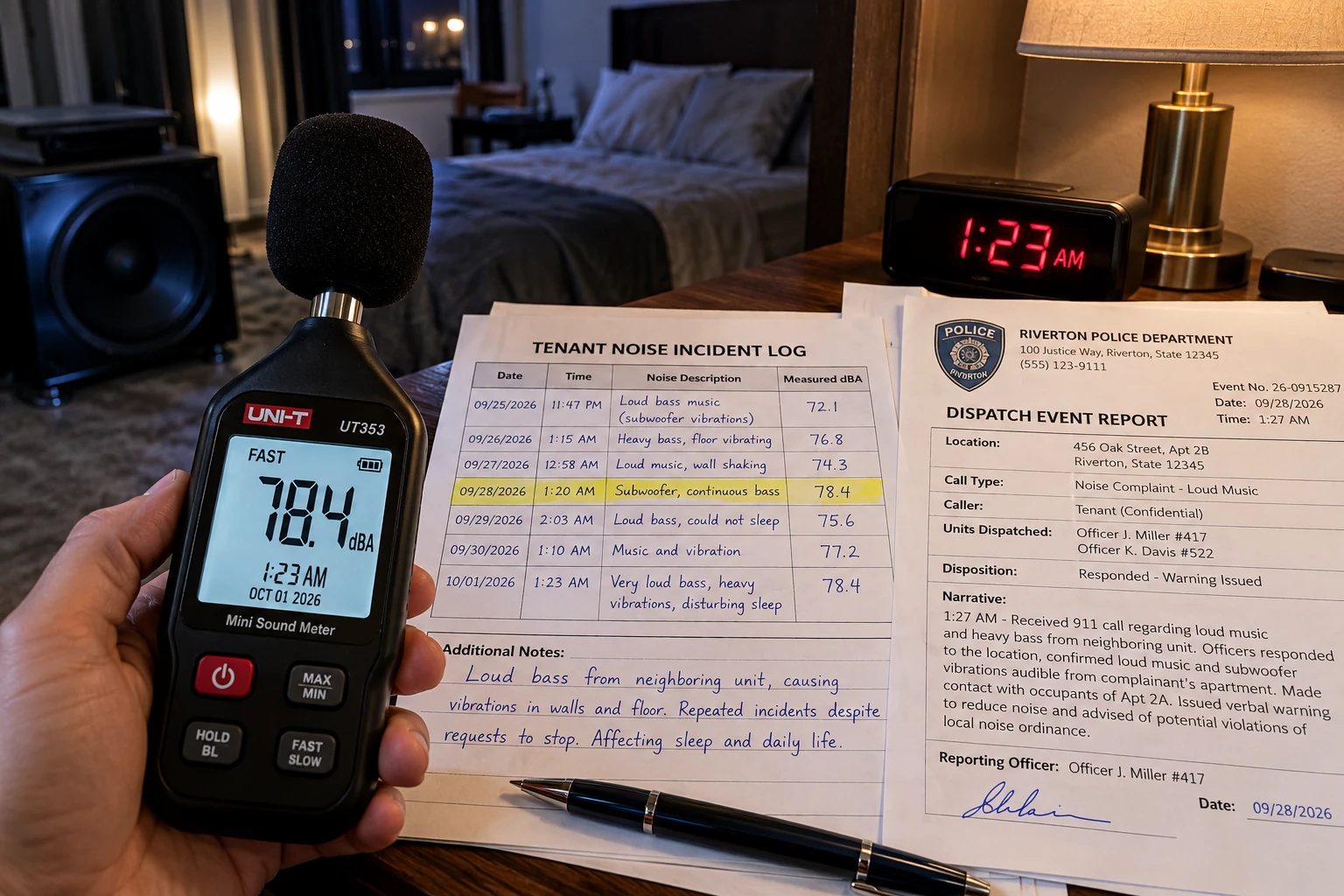
- Objective Decibel Evidence Wins in Small Claims Court: Raw phone recordings often fail in court because phones automatically compress volume. Pairing a $20 calibrated decibel meter with a 14-day noise log and police incident numbers creates solid proof.
- The "80% Carpet Rule" Gives You Direct Legal Leverage: Most multi-family leases require upstairs tenants to cover 80% of hardwood or laminate floors with rugs. If your landlord fails to inspect and enforce that clause, they breach your agreement.
- Doctors' Notes Unlock Fair Housing Act (FHA) Protections: If chronic noise aggravates documented PTSD, migraine disorders, sensory processing, or severe insomnia, an FHA Reasonable Accommodation request legally requires management to offer a top-floor unit transfer or let you exit penalty-free.
Who Can You Sue for Apartment Noise? Landlord vs. Neighbor vs. Commercial Tenant
When chronic noise destroys your sleep, the first legal question is identifying the correct defendant. Many tenants assume they can only sue the noisy person making the sound. In reality, landlords hold substantial legal responsibility because they own the real property and control the terms of occupancy through lease contracts.
Under the landmark precedent Blackett v. Olanoff, courts established that when a landlord has the legal right to prevent a disturbance and fails to act after notice, the landlord is directly liable for breach of the Covenant of Quiet Enjoyment. Understanding where the noise originates dictates your exact legal strategy:
| Noise Source | Who Has Legal Control? | Primary Legal Remedy | Typical Payout / Outcome |
|---|---|---|---|
| Neighbor in Same Building | Landlord controls tenant lease terms and quiet-hours covenants. | Sue landlord for breach of quiet enjoyment; demand landlord issue 3-day notice to cure or quit. | 20%–40% rent refund or penalty-free lease cancellation. |
| Upstairs Heavy Stomping | Landlord enforces the lease's 80% rug clause and floor soundproofing. | Demand formal carpet audit; sue for breach of contract and unpadded floor vibration. | Mandatory rug installation or $2,000–$6,000 rent abatement. |
| Downstairs Commercial Bar / Gym | Landlord leases ground-floor space and controls commercial operating limits. | Sue landlord under Blackett; commercial operations cannot destroy residential habitability. | 40%–75% rent reduction, lease termination, or acoustic retrofit. |
| Neighbor in Separate Next-Door House | Landlord has no ownership or control over separate private property. | File a direct Private Nuisance lawsuit against the neighbor in Small Claims Court. | $2,500–$10,000 judgment against neighbor + police citations. |
When the noise originates from within your building, your legal battle is with the landlord. Property managers frequently try to deflect responsibility by telling tenants to call the police or knock on the neighbor's door. The law rejects this excuse. Because the landlord drafted the lease rules and collects monthly rent, they have an affirmative legal duty to enforce those covenants against violators.
If you live next to a noisy separate building, suing your landlord will result in dismissal because they possess no authority to evict someone on an adjacent lot. In that scenario, your direct legal remedy is serving the neighbor with a Small Claims Court summons for Private Nuisance. You can learn more about related housing duties in our overview of tenant rights against landlords.
Legal Decibel (dBA) Limits and "Quiet Hours" by City
Judges and hearing officers do not make decisions based on subjective complaints. To win a rent abatement lawsuit, you must anchor your claim to established municipal noise codes. Every major U.S. city sets strict maximum permissible decibel thresholds separating normal urban living from unlawful noise.
Sound is primarily measured using the A-weighting scale (dBA), which reflects human ear sensitivity to mid-range and high frequencies like voices, barking, and TV dialogue. However, subwoofers and heavy footsteps generate low-frequency vibration measured on the C-weighting scale (dBC). Low-frequency bass passes through concrete and drywall easily. Even if a bass beat measures only 48 dBA, it can register a disruptive 68 dBC that vibrates bedroom walls.
| Jurisdiction / City | Statutory Municipal Code | Nighttime Interior Limit (Quiet Hours) | Daytime Interior Limit |
|---|---|---|---|
| Typical U.S. Standard | Model Municipal Environmental Code | 45 dBA (10:00 PM – 7:00 AM) | 55 dBA (7:00 AM – 10:00 PM) |
| New York City | NYC Admin. Code § 24-218 (Local Law 113) | 42 dBA indoors (or +7 dBC bass over ambient) | 45 dBA interior dwelling |
| Los Angeles | LAMC § 111.02 & § 112.01 | 40 dBA interior residential | 50 dBA interior residential |
| Chicago | Municipal Code of Chicago § 8-32-080 | 55 dBA (10:00 PM – 8:00 AM) | 65 dBA exterior / 55 interior |
| Seattle | Seattle Municipal Code (SMC) § 25.08.410 | 45 dBA interior residential | 55 dBA interior residential |
In addition to decibel codes, residential building standards require floor and ceiling assemblies to meet an Impact Insulation Class (IIC) of at least 50 and a Sound Transmission Class (STC) of 50 under International Building Code (IBC) Section 1206. If your landlord removed wall-to-wall carpeting and replaced it with cheap vinyl plank flooring without installing an acoustic underlayment, the floor assembly fails municipal building codes.
When footstep impact sounds register 60 to 75 dBA in your bedroom below, the landlord cannot claim it is standard living sound. That level of floor transmission constitutes an unaddressed architectural defect violating the Implied Warranty of Habitability.
How to Prove Excessive Noise in Court: The 4-Step Evidence Stack
The single biggest mistake renters make when suing over noise is walking into court with only raw cell phone audio clips. Modern smartphones use automatic gain control and background noise cancellation chips. These features automatically reduce loud peaks and boost soft whispers, making a deafening 80 dBA bass burst sound like a faint hum on playback.
To secure a multi-thousand-dollar judgment or justify breaking your lease, you need objective, unimpeachable evidence. Follow this four-step protocol to build a court-ready dossier:
The 4-Step Noise Evidence Protocol
- Deploy a Calibrated Decibel Meter with Two-Device Video: Purchase an inexpensive Type 2 digital sound level meter ($20 to $35 online). Use your smartphone to record a video that clearly shows the digital decibel meter display alongside a clock showing the date and time, with the apartment windows closed.
- Maintain a Rigorous 14-Day Sleep and Noise Diary: Record every disturbance in a spreadsheet with columns for Date, Start Time, End Time, Peak Decibel (dBA and dBC), Description of Noise (bass vibration, stomping, dog barking), and Physical Impact (awakened from deep sleep, heart racing, unable to work).
- Call Non-Emergency Police and Request CAD Dispatch Numbers: When noise persists past midnight, call your local police non-emergency dispatch line. Even if officers do not issue a physical citation, always ask the dispatcher for the CAD (Computer Aided Dispatch) Incident Number. That government record establishes that public safety was summoned to your address.
- Deliver Formal Written Breach Notices via Certified Mail: Text messages and verbal conversations disappear or get denied in court. Send written notices via Certified Mail with Return Receipt Requested and post them through the landlord's online tenant portal, citing the specific lease quiet-hours clause.
Judges appreciate structured data. Presenting a neat two-week log showing twelve separate incidents between 11:30 PM and 3:45 AM measuring 62 to 74 dBA—accompanied by two police dispatch logs and certified letters—eliminates any landlord defense that you are merely sensitive. This documentation also establishes claims for intentional infliction of emotional distress when combined with landlord harassment or landlord retaliation.
Excessive Noise Rent Abatement & Small Claims Calculator
Calculate your Quiet Enjoyment rent refund, documented out-of-pocket expenses, and penalty-free lease exit recovery based on municipal decibel limits and landlord response history.
*Illustrative educational estimate, not legal advice or an outcome prediction. Small claims limits, judge discretion, and state statutes vary.
How to Use the "80% Carpet Clause" and FHA Medical Accommodations
Two often-overlooked legal mechanisms provide tremendous leverage when dealing with uncooperative property managers: the contractual 80% carpet clause and federal disability protections under the Fair Housing Act.
Most standard multi-family residential leases in multi-story buildings contain an explicit provision known as the "80% Carpet / Floor Covering Rule". This clause requires tenants on upper floors to cover at least 75% to 80% of all walking surfaces (excluding kitchens and bathrooms) with padded rugs or carpeting to dampen structural footfall impacts.
How the 80% Rug Rule Creates Direct Landlord Breach
If you notify management that an upstairs tenant is walking on bare hardwood or luxury vinyl planks without rugs, your landlord cannot ignore it. The landlord has a contractual right to inspect the upstairs unit and enforce compliance. If the landlord refuses to perform an inspection or enforce their own lease rules, they breach their contract with you—entitling you to rent abatement.
The second powerful tool is the Fair Housing Act (42 U.S.C. § 3604). If you or a family member suffers from a documented medical condition aggravated by chronic sleep deprivation—such as Post-Traumatic Stress Disorder (PTSD), migraine disorders, autism spectrum disorder, generalized anxiety disorder, or severe chronic insomnia—you have the legal right to request a Reasonable Accommodation.
Obtain a letter from your physician, therapist, or psychiatrist stating that unceasing noise in your current unit aggravates your medical condition. Demand that the landlord provide a reasonable accommodation by either:
- Transferring you to an equivalent top-floor or quieter unit at no cost and with no lease restart; or
- Allowing you to terminate your lease immediately with zero early termination penalties and a full return of your security deposit.
Under federal regulations, landlords must respond promptly to reasonable accommodation requests. Ignoring or denying an FHA accommodation letter without engaging in an interactive process is a federal fair housing violation that exposes the landlord to administrative fines up to $21,663 for a first offense, in addition to civil damages. For related medical concerns, review our guide on suing a landlord for emotional distress.
How Much Is an Excessive Noise Lawsuit Worth? Payout Ranges and Small Claims Math
When you file a lawsuit against your landlord for noise, the recovery is calculated based on three primary elements: retroactive rent abatement, out-of-pocket mitigation expenses, and statutory bad-faith damages. The value reflects the drop in rental value during the disturbance.
| Severity Level | Typical Noise Conditions | Rent Abatement Range | Sample 4-Month Recovery ($2,400 Rent) |
|---|---|---|---|
| Moderate / Intermittent | Barking dog during afternoons, loud TV conversations, or footsteps without rugs. | 15% to 25% Refund | $1,440 – $2,400 + expenses |
| Severe / Nighttime | Chronic midnight music, heavy bass rattles, 60–75 dBA peaks after 10 PM. | 30% to 50% Refund | $2,880 – $4,800 + expenses |
| Uninhabitable / Commercial | Ground floor bar/club, 6:00 AM jackhammers, uninsulated mechanical HVAC vibration. | 50% to 75% Refund | $4,800 – $7,200 + relocation |
Beyond rent abatement, courts award 100% reimbursement for reasonable out-of-pocket mitigation expenses incurred to preserve your health and sleep. These include:
- Emergency hotel stays during nights when noise prevented sleep (save your receipts and decibel videos from those evenings);
- Soundproofing supplies, white-noise sound conditioners, and active noise-canceling headphones;
- Medical copays and prescription costs for sleep aids or anxiety medication;
- Moving truck rentals, packing materials, and utility transfer fees if forced to relocate under constructive eviction.
Every state has a Small Claims Court limit where you can sue without an attorney. These limits range from $5,000 to $10,000 in states like New York, Texas, and Florida, and up to $12,500 in California. Because the filing fee is typically under $80 and landlords must appear in person, filing a Small Claims action almost always forces an uncooperative management company to settle quickly. If you are dealing with smoke infiltration alongside noise, see our guide on secondhand smoke lawsuits.
Dual-Tab Legal Demand and Lease-Exit Notices
Before filing in court, you must serve formal written notice on your landlord. This notice establishes legal bad faith if management fails to act. Select the appropriate notice below based on whether you plan to stay and demand enforcement or terminate your lease immediately:
How Much Rent Abatement Can You Recover for Excessive Noise?
When taking legal action in Small Claims Court or Housing Court, financial recovery is calculated using established statutory remedies, documented out-of-pocket expenses, and rent reduction standards:
| Recovery Category | Calculation Standard | Statutory Authority & Limits |
|---|---|---|
| 1. Retroactive Rent Abatement for Noise Pollution | Refund of 15% to 40% of rent for every month constant unaddressed barking, loud stereos, or late-night maintenance destroyed normal sleep. | Covenant of Quiet Enjoyment. |
| 2. Penalty-Free Lease Cancellation | Judicial declaration of constructive eviction allowing immediate departure with zero lease-break penalties and 100% deposit return. | Constructive eviction doctrine. |
| 3. Soundproofing & Hotel Relief Costs | Out-of-pocket costs for heavy acoustic door sweeps, white-noise machines, and emergency hotel stays during unbearable weekend noise incidents. | Incidental mitigation damages. |
Small Claims Filing Limits: Most tenants resolve these matters pro se (without a lawyer) in Small Claims Court. Maximum claim limits vary by state: for example, $12,500 in California (California Courts Self-Help), $10,000 in New York City (NY Courts Small Claims), and $20,000 in Texas (Texas Judicial Branch). If damages exceed local small claims thresholds, lawsuits proceed to standard Civil Court.
Frequently Asked Questions About Suing for Apartment Noise
Yes—if you follow the right steps first. You cannot just walk out after one loud weekend party. However, if you report chronic, sleep-depriving noise to your landlord in writing multiple times, back it up with a 14-day decibel/incident log and police/311 reports, and your landlord refuses to warn or evict the noisy tenant after a final written deadline, you can legally break your lease under Constructive Eviction and Breach of Quiet Enjoyment without owing future rent or lease-break fees.
Normal daytime footsteps and children playing during daytime hours are considered part of apartment living—and landlords cannot discriminate against families with kids under the Fair Housing Act. However, you CAN hold your landlord liable if the noise happens during late-night quiet hours (after 10:00 PM), OR if the landlord refuses to enforce the lease's 80% carpet/rug rule, OR if the landlord renovated the upstairs floor with cheap vinyl/hardwood without installing code-required acoustic soundproofing padding.
Uncontrolled dog barking for hours is a violation of both city animal-nuisance ordinances and every apartment lease's pet policy. Record a video showing your digital decibel meter (60–75+ dBA) alongside a clock showing the dog barking continuously for 30+ minutes, report it to 311 / Animal Control, and demand in writing that your landlord enforce the building's pet-nuisance lease clause or grant you a rent reduction.
Be very careful: in most states, withholding rent on your own for noise is risky because traditional rent-withholding statutes usually apply to physical health hazards like no heat or roof leaks. Instead of withholding rent and risking an eviction filing, the safest winning move is to keep paying rent and sue your landlord in Small Claims Court for a 20% to 50% retroactive rent refund—or use a written notice to break your lease cleanly.
Yes! In fact, suing the noisy neighbor directly in Small Claims Court for Private Nuisance (for $2,500 to $10,000) is your #1 best option if the noisy person owns their condo/house next door, or if you love your apartment and want the neighbor to quiet down immediately. Nothing makes a rude neighbor unplug their 2:00 AM subwoofer faster than being served with a $5,000 Small Claims Court summons!
SueLegal is an independent educational legal publisher, not a law firm or lawyer referral service. The information provided in this guide is for general informational and educational purposes only and does not constitute formal legal advice. Residential landlord-tenant laws, repair notice periods, and statutory remedies vary significantly across state and municipal jurisdictions. If you are facing eviction, severe uninhabitable conditions, or complex litigation, consult a licensed attorney in your jurisdiction or contact your local legal aid organization. For more details on our standards, read our Editorial Policy and Legal Research Methodology.