

The Short Answer
Yes, you can sue your landlord for refusing a Service Animal or Emotional Support Animal (ESA)—or for charging you a single dollar in Pet Rent or Pet Deposits.
Under the Federal Fair Housing Act (42 U.S.C. § 3604) and state civil rights laws, landlords must allow both task-trained Service Dogs and healthcare-recommended Emotional Support Animals (ESAs) even in strict "No-Pets" buildings. If your landlord denies your animal, bans its breed/size, threatens eviction, or forces you to pay pet fees, you can recover:
- 100% Refund of Illegal Pet Deposits, Pet Fees & Monthly Pet Rent: Every dollar the landlord charged you for your assistance animal, plus boarding, moving, or replacement rent costs.
- Emotional Distress & Civil Rights Settlements ($10,000 to $75,000+): Federal and state Fair Housing laws automatically award money for humiliation, anxiety, emotional distress, and loss of housing opportunity when a landlord illegally denies an assistance animal.
- Heavy Government Civil Fines & 100% Paid Lawyer Fees: HUD can fine a landlord up to $25,597 for a first violation (and $63,000+ for repeat violations), and if you sue in court, the landlord is forced to pay 100% of your attorney's fees.
Key Legal Points
- For a Trained Service Dog, Your Landlord Can ONLY Ask Two Questions (No Doctor's Note Needed!): Under HUD rules (
FHEO-2020-01), if you have a task-trained Service Dog, the landlord may only ask: (1) Is the animal required because of a disability? and (2) What work or task has the dog been trained to perform? They cannot demand a doctor's letter, medical records, or a "service dog registration ID." - For an Emotional Support Animal (
ESA), a Simple Healthcare Letter Is 100% Enough: If you have an ESA (dog, cat, etc.) and your disability isn't obvious, you only need a short letter from a doctor, therapist, psychiatrist, nurse practitioner, or social worker stating you have a disability and that the animal helps alleviate your symptoms. The landlord cannot demand to know your exact diagnosis or see your medical charts! - Breed & Weight Restrictions Are 100% Illegal for Service Animals and ESAs: A landlord cannot reject your Service Dog or ESA because the building has a "25-pound weight limit" or "no Pit Bulls, German Shepherds, or Huskies." They can only deny an animal if that specific individual animal has proven aggressive behavior.
- Already Paid a "Pet Deposit" or "Pet Rent"? Sue to Get Every Penny Back: If your landlord bullied you into paying a $400 pet fee and $50/month pet rent after you gave them your Service Dog info or ESA letter, you can sue in Small Claims Court (or file with HUD) for a 100% refund.
- You Can File a Request After Moving In (Or Even After Getting a Lease Violation Notice): Federal law explicitly states that a tenant can request a Service Animal or ESA accommodation at any time—before applying, six months into the lease, or even after the landlord serves a "Cure or Quit" notice for having an unauthorized animal!
Trained Service Dog vs. Emotional Support Animal (ESA)—Your Exact Legal Rights in Rental Housing
Rental property managers frequently confuse the Americans with Disabilities Act (ADA) public-access rules with residential tenancy laws. While the ADA applies to commercial stores and restaurants—limiting public access strictly to trained dogs—the Federal Fair Housing Act (42 U.S.C. § 3604(f)(3)(B)) governs all housing providers.
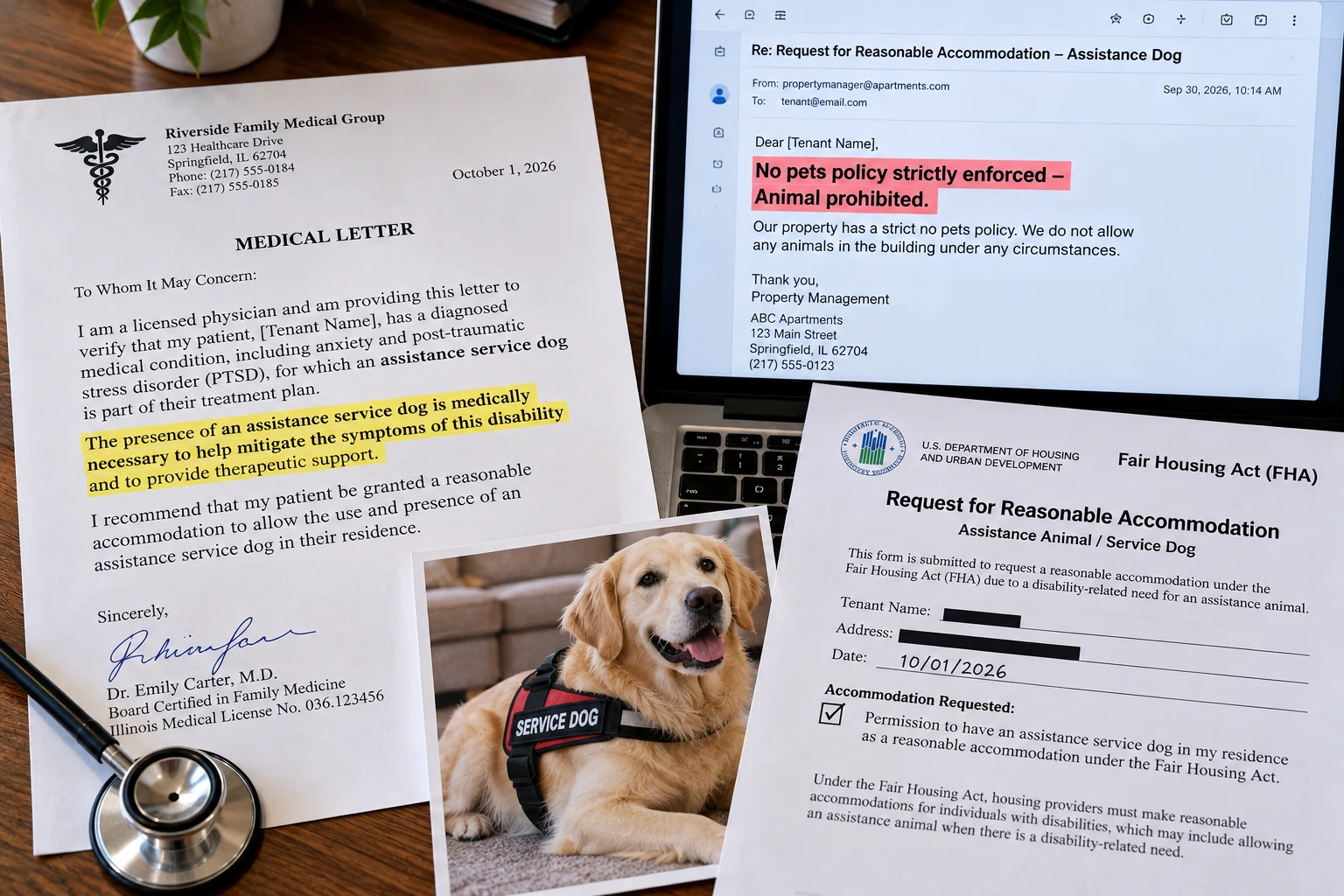
Under the Fair Housing Act and official HUD Guidance (Notice FHEO-2020-01), housing providers must accommodate two distinct categories of Assistance Animals: task-trained Service Dogs and healthcare-recommended Emotional Support Animals (ESAs). Both categories are legally exempt from pet rules and fees:
| Rule in Rental Housing | Task-Trained Service Dog | Emotional Support Animal (ESA) | Regular Household Pet |
|---|---|---|---|
| Protected by Fair Housing Act (42 U.S.C. § 3604)? |
YES (100%) Waives all "No Pets" rules |
YES (100%) Waives all "No Pets" rules |
NO Subject to landlord discretion |
| Can Landlord Charge "Pet Rent" or a "Pet Deposit"? |
NO — $0 Allowed Any fee is unlawful |
NO — $0 Allowed Any fee is unlawful |
Yes (Subject to state security deposit ceilings) |
| Can Landlord Enforce Breed or Weight Bans? |
NO — 100% Illegal No size/breed restrictions |
NO — 100% Illegal No size/breed restrictions |
Yes (Landlords can ban breeds or enforce weight caps) |
| What Documentation Can the Landlord Request? | NO Doctor's Note Allowed. Landlord may ask only the 2 HUD Questions. | 1 Short Letter from a licensed healthcare professional confirming disability-related need. | Pet application, license tags, and vaccination verification. |
| Eligible Animal Species | Dogs (and trained miniature horses). | Dogs, cats, small birds, rabbits, hamsters, guinea pigs, fish, turtles. | Restricted by lease agreement terms. |
An assistance animal is legally classified as an auxiliary aid—identical in legal status to a wheelchair, oxygen tank, or prescription medication. A landlord who attempts to classify an assistance animal as an ordinary pet to justify restrictions commits actionable housing discrimination. When a landlord issues notices to quit over an authorized animal, review our analysis on suing a landlord for retaliation.
6 Illegal Excuses Landlords Use to Reject Service Animals & ESAs (And How to Beat Every One)
When property owners seek to deny a Service Dog or Emotional Support Animal, they routinely deploy one of six unauthorized defenses. Federal courts and HUD administrative law judges have consistently rejected each argument:
Excuse 1: "Our Building Insurance Policy Excludes Aggressive Breeds"
Building management often claims their commercial liability policy excludes Pit Bulls, German Shepherds, Rottweilers, Dobermans, or Huskies. Under HUD's official 2006 Insurance Policy Memorandum and Notice FHEO-2020-01, a landlord cannot rely on an insurer's general breed list without first requesting a Reasonable Accommodation Waiver from their carrier.
The overwhelming majority of commercial property insurers routinely grant written exceptions for verified assistance animals. Even if a specialty insurer refuses, HUD mandates that the housing provider investigate comparable insurance carriers before claiming an "undue financial and administrative burden." Denying an animal without exhausting these steps constitutes intentional discrimination.
Excuse 2: "You Must Register on PetScreening.com and Sign Our Medical Release Form"
Property management companies increasingly force tenants to use third-party screening platforms or demand that treating physicians complete intrusive multi-page questionnaires under penalty of perjury. On page 14 of HUD Notice FHEO-2020-01, federal regulators explicitly forbid this practice:
"Housing providers may not require a health care professional to use a specific form (including this document), to provide notarized statements, to make statements under penalty of perjury, or to provide an individual's diagnosis or other detailed information about a person's physical or mental impairments."
If you have supplied a legitimate verification letter from your healthcare provider, conditioning accommodation on additional administrative forms or fee-based portal registrations violates federal law.
Excuse 3: "You Marked 'No Pets' on Your Application, So You Committed Lease Fraud"
Landlords sometimes issue lease violation notices alleging the tenant lied during pre-lease screening. Under federal law, this claim fails on two grounds: first, an assistance animal is not a pet, meaning answering "No Pets" on an application is factually accurate. Second, federal regulations explicitly permit occupants to request a reasonable accommodation at any juncture during tenancy—even after receiving a notice to quit.
Excuse 4: "Your Dog Lacks an Official Service Dog Vest or Government ID Card"
No government agency maintains a registry of certified Service Animals or ESAs. Websites selling credentials, badges, or metallic certificates operate as commercial ventures with zero legal authority. Assistance animals are not legally required to wear vests, badges, or special harnesses in residential housing.
Excuse 5: "A Neighbor Has Severe Dog Allergies or Phobias"
HUD guidance establishes that generalized allergies or neighbor apprehension cannot override a tenant's statutory civil right to an assistance animal. Unless a neighbor demonstrates acute, life-threatening airborne anaphylaxis requiring structural air mitigation, property management must accommodate both parties through administrative separation, such as assigning separate stairwells or elevator transit schedules.
Excuse 6: "We Only Permit One Assistance Animal per Household"
Blanket numerical limits on assistance animals violate federal law. A tenant may maintain multiple assistance animals provided each animal addresses a distinct disability-related need (such as a trained seizure-alert dog and an emotional support cat), or assists separate disabled family members residing in the same dwelling.
What About the "Mrs. Murphy" Small-Landlord Exemption? (Why 90% of Landlords Don't Qualify)
Small landlords operating single-family rentals or small multi-unit properties often claim immunity under the federal "Mrs. Murphy Exemption" (42 U.S.C. § 3603(b)). Under federal law, single-family homes sold or rented without a broker, and owner-occupied buildings with four or fewer units, are partially exempt from specific Fair Housing Act mandates.
However, the vast majority of small landlords who assert this defense do not legally qualify. Three legal rules eliminate the exemption:
1. Utilization of a Real Estate Agent, Broker, or Management Firm
Under 42 U.S.C. § 3603(b)(1), a single-family homeowner is exempt only if the rental was transacted entirely without the assistance of a licensed real estate broker, leasing agent, or property management service. If the landlord hired an agent to list the property, show units, conduct background checks, or collect rent, the federal Fair Housing Act applies in full.
2. Discriminatory Advertising & Corporate Ownership
The Fair Housing Act's prohibition against discriminatory advertising (42 U.S.C. § 3604(c)) contains zero exemptions. A landlord who publishes a listing stating "No Pets, No Exceptions" or "No Service Animals" violates federal law regardless of building size. Furthermore, owners of more than three single-family properties, or landlords holding property inside corporate entities (such as an LLC or partnership), forfeit small-owner exemptions.
3. State Civil Rights Statutes Eliminate Small-Landlord Exemptions
Even where federal exemptions apply, state civil rights statutes enforce significantly broader protections:
- California (FEHA — Gov. Code § 12955 & Civ. Code § 54.1): Covers virtually all residential housing, exempting only an owner who rents a single room inside the single-family home they personally occupy.
- New York (Executive Law § 296): Eliminates the four-unit threshold, applying anti-discrimination rules to all rentals except two-family owner-occupied dwellings.
- New Jersey (LAD), Washington (RCW 49.60), and Massachusetts (M.G.L. c. 151B): Enforce comprehensive disability protections across small residential properties that supersede federal exemptions.
When landlords issue retaliatory non-renewal notices after discovering an assistance animal, examine your rights under our guide on suing a landlord for refusing to renew a lease.
Calculate Your Service Animal or ESA Discrimination Claim
Estimate your refund for unlawful pet fees, out-of-pocket boarding/moving costs, and statutory emotional distress damages.
Warning on "Instant Online ESA Mill Websites" (How to Make Your ESA Letter Bulletproof)
Commercial websites selling instant ESA certificates, badges, and registries for $79 undermine tenant protections. Under HUD Notice FHEO-2020-01, commercial registry numbers or certificates obtained through superficial online questionnaires without authentic clinical interaction do not establish legitimate verification.
The "30-Day Clinical Relationship Rule"
Multiple states have enacted strict consumer protection legislation targeting commercial ESA mills. In California (AB 468 — Health & Safety Code § 122318), Arkansas, Iowa, Louisiana, and Montana, state law mandates that a healthcare provider issuing an Emotional Support Animal recommendation must:
- Hold an active, valid professional license in the state where the client resides;
- Conduct a comprehensive clinical evaluation; and
- Establish a legitimate client-provider treatment relationship for at least 30 days prior to issuing an ESA verification letter.
This 30-day prerequisite applies exclusively to Emotional Support Animals; it does not restrict task-trained physical or psychiatric Service Dogs.
Core Requirements for a Bulletproof Healthcare Letter
To ensure your accommodation request withstands scrutiny across all fifty states, secure documentation from an authentic treating practitioner (such as a primary care physician, psychiatrist, psychologist, LCSW, LMFT, or nurse practitioner) containing three essential statements:
- Confirmation that the individual has a physical or mental impairment that substantially limits one or more major life activities under the Fair Housing Act;
- Confirmation that the designated assistance animal is necessary to alleviate one or more identified symptoms or effects of the disability; and
- The provider's active professional license number, licensing state, professional letterhead, contact details, date, and signature.
The practitioner is never required to reveal your confidential psychiatric diagnosis or clinical medical records. If landlord harassment persists after submitting compliant documentation, see our guide on suing a landlord for harassment.
How to Sue Your Landlord (And Win $2,000 to $75,000+ Without Upfront Legal Costs)
When a property owner unlawfully refuses an assistance animal or imposes unauthorized pet fees, tenants have three primary legal pathways for financial recovery and injunctive relief:
Path 1: File a Free Federal Complaint with HUD or State Civil Rights Agencies
Tenants can file a formal complaint with HUD's Office of Fair Housing and Equal Opportunity (FHEO) online at hud.gov or via telephone within one year of the discriminatory act. Filing incurs zero expense.
Upon acceptance, federal investigators contact the property owner. Landlords face civil penalties of up to $25,597 for an initial offense and over $63,000 for recurring infractions, alongside liability for tenant actual damages. Consequently, most landlords execute conciliation agreements paying monetary settlements ($2,500 to $25,000+) and approving the animal immediately upon notification of federal investigation.
Path 2: Small Claims Court Action for Pet Fee and Deposit Disgorgement
If a landlord collected illegal pet deposits, non-refundable pet fees, or ongoing monthly pet rent after receiving assistance animal documentation, tenants can initiate a Small Claims action without legal representation.
Present HUD Notice FHEO-2020-01 confirming that housing providers are barred from assessing fees or deposits for assistance animals. Courts award 100% reimbursement of all unlawful charges. Furthermore, if the landlord retained the funds from your move-out security deposit, you can seek statutory bad-faith penalties, as detailed in our guide on suing for security deposit withholding.
Path 3: Retain a Contingency Civil Rights Attorney
When a landlord initiates eviction proceedings, refuses lease execution, or forces an occupant to surrender an animal, statutory damages escalate significantly. Private Fair Housing attorneys handle meritorious claims on a contingency basis ($0 upfront).
Under the Fair Housing Act's fee-shifting provision (42 U.S.C. § 3613(c)(2)), prevailing tenants recover 100% of reasonable attorney fees from the landlord. In jurisdictions like California, the Unruh Civil Rights Act (Civ. Code § 52) and Disabled Persons Act (Civ. Code § 54.3) mandate minimum statutory damages of $1,000 to $4,000 per violation or three times actual damages. Tenants also recover substantial emotional distress awards, as detailed in our guide on suing for emotional distress.
For a broad review of judicial procedures and evidence rules, consult our master guide to suing your landlord.
Ready-to-Send Reasonable Accommodation & Fee Refund Demand Notice
Establish formal statutory notice to compel accommodation approval or recover unlawfully collected pet charges. Select the applicable notice below, then copy or download the text:
FORMAL REQUEST FOR REASONABLE ACCOMMODATION UNDER THE FAIR HOUSING ACT
(ASSISTANCE ANIMAL / SERVICE ANIMAL / EMOTIONAL SUPPORT ANIMAL)

Date: [Current Date]
Sent Via: Certified Mail (Tracking #: [Insert Tracking #]) & Written Tenant Portal

TO:
Property Management / Landlord: [Landlord / Company Name]
Management Address: [Office Street Address]
City, State, Zip: [City, State, Zip]

FROM:
Tenant Name(s): [Your Full Legal Name(s)]
Rental Premises: [Your Address, Unit/Apartment Number]
Phone: [Your Phone Number] | Email: [Your Email Address]

RE: REASONABLE ACCOMMODATION REQUEST PURSUANT TO 42 U.S.C. § 3604(f)(3)(B) & HUD NOTICE FHEO-2020-01
    ANIMAL IDENTIFIER: [Animal Name, Species, Breed]

Dear Property Management,

Please accept this letter as formal statutory notification that the undersigned tenant is requesting a Reasonable Accommodation under the Federal Fair Housing Act (42 U.S.C. § 3604) and state civil rights statutes for an assistance animal residing in the above-referenced rental dwelling.

1. ANIMAL CLASSIFICATION & STATUTORY QUALIFICATION:
[SELECT OPTION A OR B:]
[OPTION A - TASK-TRAINED SERVICE DOG:]
The animal is a dog individually trained to perform work or tasks for the benefit of an individual with a disability. Pursuant to HUD Notice FHEO-2020-01, the animal is required because of a disability, and the specific tasks performed include [Insert e.g., mobility balance assistance / medical alert / psychiatric interruption]. Under federal law, no additional medical letters or third-party registration forms are required.

[OPTION B - EMOTIONAL SUPPORT ANIMAL (ESA):]
The animal is an Emotional Support Animal prescribed by a licensed healthcare professional to alleviate symptoms associated with a physical or mental impairment. Attached hereto is documentation from a licensed provider verifying the disability-related need for this assistance animal.

2. WAIVER OF PET POLICIES, BREED BANS & PET FEES:
Under established HUD regulations and federal case law, an assistance animal is an auxiliary aid, not a pet. Consequently:
a) All "No Pets" covenants or restrictions are waived.
b) All breed, size, or weight restrictions are inapplicable.
c) Management is prohibited from charging pet deposits, non-refundable pet fees, monthly pet rent, or third-party portal screening fees.

Please deliver written confirmation that this accommodation is approved within TEN (10) BUSINESS DAYS of receipt.

Sincerely,

_________________________________________
[Your Signature]

[Your Printed Name]
How Much Can You Recover for Service Animal Discrimination?
When taking legal action in Small Claims Court or Housing Court, financial recovery is calculated using established statutory remedies, documented out-of-pocket expenses, and rent reduction standards:
| Recovery Category | Calculation Standard | Statutory Authority & Limits |
|---|---|---|
| 1. 100% Refund of Unlawful Pet Fees & Pet Rent | Complete repayment of all improperly assessed pet deposits, monthly pet rent surcharges, and non-refundable animal fees. | Fair Housing Act Assistance Animal Rules. |
| 2. Statutory Civil Rights Damages | Emotional distress damages and statutory penalties for unlawful denial of an assistance animal or emotional support animal. | 42 U.S.C. § 3604(f)(3)(B). |
| 3. Mandatory Injunction & Attorney's Fees | Court order forcing immediate accommodation of the service animal plus mandatory payment of tenant's legal fees. | ADA & FHA enforcement remedies. |
Small Claims Filing Limits: Most tenants resolve these matters pro se (without a lawyer) in Small Claims Court. Maximum claim limits vary by state: for example, $12,500 in California (California Courts Self-Help), $10,000 in New York City (NY Courts Small Claims), and $20,000 in Texas (Texas Judicial Branch). If damages exceed local small claims thresholds, lawsuits proceed to standard Civil Court.
Frequently Asked Questions
No. Under the Federal Fair Housing Act (42 U.S.C. § 3604), both trained Service Dogs and Emotional Support Animals (ESAs) are legally classified as "Assistance Animals"—not pets. Even if a building, condo HOA, or single-family lease has a strict "No Pets Allowed" policy, the landlord is legally required to grant a Reasonable Accommodation and waive the no-pets rule unless the specific animal poses a proven, direct physical threat.
No—breed, size, and weight limits are 100% illegal for Service Animals and ESAs. Under HUD Notice FHEO-2020-01, a landlord cannot apply a "25-pound weight limit" or a "restricted breed list" to an assistance animal. A landlord can only deny an animal based on that specific animal's actual past behavior—never based on stereotypes about its breed or size.
No—never. Federal law strictly forbids landlords from charging a Pet Deposit, non-refundable Pet Fee, monthly Pet Rent, or a third-party PetScreening processing fee for a Service Animal or Emotional Support Animal. While you are still financially responsible at move-out if your animal actually chews up a door or ruins a carpet beyond normal wear and tear, the landlord cannot charge upfront pet deposits or monthly pet fees. If you already paid them, you can sue in Small Claims Court for a 100% refund!
Legally, you have the right to do either! However, because dishonest landlords sometimes see a Service Dog or ESA on an application and quietly invent a fake excuse to pick another applicant, HUD Notice FHEO-2020-01 explicitly confirms that you are 100% allowed to wait until AFTER your lease is signed (or after you move in) to submit your Reasonable Accommodation request—that way, if they try to back out or evict you, it is an open-and-shut case of illegal discrimination!
Assuming the landlord isn't an exempt live-in owner of a 1-to-4 unit building, a landlord can only legally reject a valid Service Animal or ESA if: (1) that specific individual animal poses a direct threat to the health or safety of others—such as a documented history of biting or attacking people/dogs—that cannot be solved by muzzling or leashing; (2) the animal causes substantial physical damage to the property that you refuse to control; or (3) for an ESA, you refuse to provide a basic letter from a licensed healthcare provider when your disability isn't obvious.
SueLegal is an independent educational legal publisher, not a law firm or lawyer referral service. The information provided in this guide is for general informational and educational purposes only and does not constitute formal legal advice. Residential landlord-tenant laws, repair notice periods, and statutory remedies vary significantly across state and municipal jurisdictions. If you are facing eviction, severe uninhabitable conditions, or complex litigation, consult a licensed attorney in your jurisdiction or contact your local legal aid organization. For more details on our standards, read our Editorial Policy and Legal Research Methodology.