

Yes, you can sue your landlord for an unsafe or broken elevator.
Landlords are legally required by state building codes, elevator safety laws (ASME A17.1), and your lease to keep passenger elevators safe, inspected, and running. Depending on whether the elevator hurt or trapped you or has been out of service for weeks, you have two distinct ways to win money:
- If the Elevator Dropped, Jolted, Misleveled, Slammed Doors, or Trapped You ($15,000 to $500,000+ Insurance Settlements): If a malfunctioning elevator injured your back, neck, knees, or limbs—or trapped you inside a dark, hot cab causing panic attacks, claustrophobia, or a 911 Fire Department rescue—a personal injury lawyer can sue both your landlord's insurance policy AND the elevator maintenance company at $0 upfront cost.
- If the Elevator Is Out of Service for Weeks ($1,500 to $15,000 in Small Claims / Housing Court): If you live on an upper floor and your landlord leaves the elevator broken, you can sue for a 20% to 75%+ rent refund, grocery/laundry delivery fees, moving costs to break your lease, and—if you have a disability, injury, or mobility condition—force the landlord to pay for a hotel room with a working elevator.
What You Should Know
- Your Landlord Cannot Blame the Elevator Repair Company: Landlords always try to dodge responsibility by pointing at their third-party service company (like Otis, Schindler, or KONE). Under the legal rule of Non-Delegable Duty, your landlord is 100% responsible to you on the front line—and your lawyer can sue both insurance policies at once!
- Disabled, Elderly, or Recovering From Surgery? The Landlord Owes for a Hotel: If a broken elevator traps you in your apartment because you use a wheelchair, walker, cane, or have a medical condition that prevents climbing stairs, hand your landlord a doctor's note requesting a Fair Housing Act (
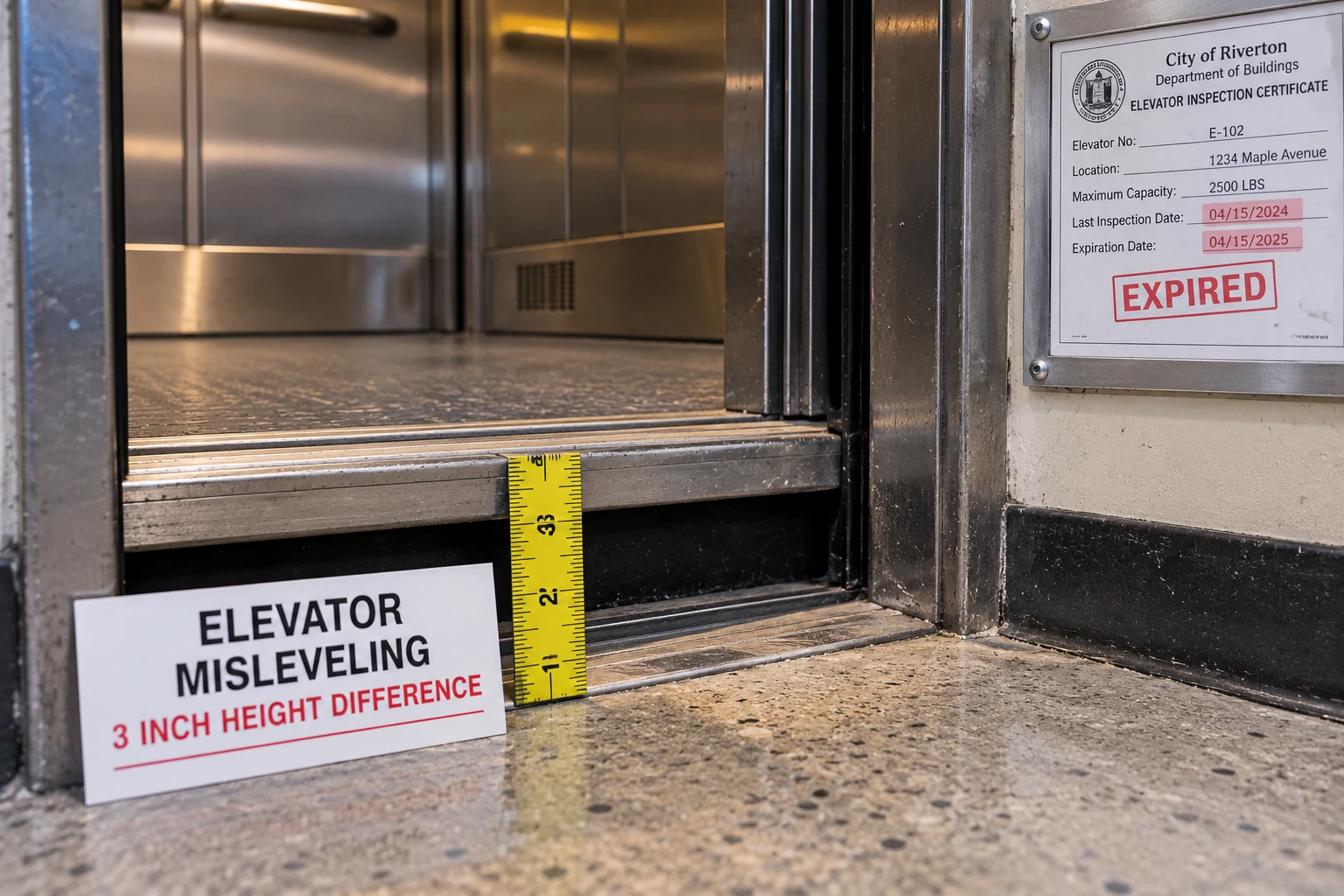
FHA) Emergency Accommodation (such as a landlord-paid accessible hotel room). - "Misleveling" (Stopping 2+ Inches Above or Below the Floor) Is an Automatic Code Violation: If you tripped entering or exiting an elevator because the cab floor didn't line up flat with the hallway floor, photograph the gap immediately with a ruler or coin—that proves an instant violation of
ASME A17.1elevator safety standards. - "Waiting on a Backordered Part" Does Not Excuse Charging Full Rent: Even if a specialized elevator part takes 4 weeks to ship, your landlord cannot charge you 100% elevator-building rent while forcing you to live in a high-rise walk-up.
- Your Rent Refund Goes Up the Higher Your Floor Is: Courts calculate broken-elevator rent refunds based on how many flights of stairs you are forced to climb: a 3rd-floor tenant typically gets 15%–25% off rent, while an 8th- or 12th-floor tenant (or a parent hauling a baby stroller) can win 45% to 75%+ off rent.
The 4 Types of Unsafe Elevator Accidents (And ASME A17.1 Safety Codes)
Elevator claims rest on established national and municipal safety codes. In the United States, passenger elevators are governed by the American Society of Mechanical Engineers Safety Code for Elevators and Escalators (ASME A17.1), adopted by municipal building departments across all fifty states.
When an elevator malfunctions, proving an ASME code breach demonstrates that the property owner and elevator maintenance company failed their statutory duties. Review the primary mechanical failures that trigger legal liability:
| Elevator Malfunction | What Causes It | Safety Code Violated | Typical Injury & Legal Claim |
|---|---|---|---|
|
1. "Misleveling" (Cab stops 2 to 8 inches above or below the floor) |
Worn brake shoes, faulty leveling sensors, or stretched hoist cables and low hydraulic fluid. |
ASME A17.1 Leveling Rule Elevator must stop flush within ±½ inch of the hallway landing. |
Riders step out looking ahead and violently trip headfirst—breaking wrists, knees, ankles, hips, or teeth. |
| 2. Sudden Drops, Jolts & Abrupt Stops | Failing hydraulic valves, worn traction sheaves, or skipped governor maintenance. |
Common Carrier / Maintenance Duty Strict duty to maintain cables, brakes, and hydraulic governors. |
Compression fractures, herniated neck and lumbar discs, torn meniscus, and severe whiplash. |
| 3. Doors Slamming Shut on Riders | Broken photoelectric light ray, damaged infrared door curtain, or closing force set above 30 lbf. |
ASME A17.1 § 2.13 Doors must automatically reverse before striking a passenger or child. |
Crushed shoulders, broken arms/wrists, knocked-down elderly tenants, and injured children or pets. |
| 4. Long Entrapments with Dead Intercom / No Air | Failure to connect the cab emergency phone line or ignoring repeated electrical stalls. |
ASME A17.1 § 2.27 & IBC § 3001 Requires live 24/7 two-way voice communication and working ventilation fan. |
Heat exhaustion, fainting, panic attacks, claustrophobia / PTSD, and extraction injuries. |
When an elevator stops more than half an inch off from the landing, building owners frequently argue that the tenant should have watched their step. Courts reject this defense: passenger elevators are automated transport devices, and occupants have a right to assume the walking surface is level with the landing. If an out-of-level stop caused you to stumble, that hazard is legally actionable in the same manner as a defect covered under our guide on suing for broken stairs.
Who Do You Sue After an Elevator Accident—The Landlord or the Elevator Company? (Answer: BOTH!)
Following an elevator mishap, property owners routinely point fingers at their service contractors: "We pay Otis, Schindler, KONE, or TK Elevator to service the machinery; you must file your claim against them."
Under state premises liability statutes, this argument fails. Injured tenants can pursue both commercial insurance policies under distinct legal doctrines:
1. The Landlord's Non-Delegable Duty
In nearly every jurisdiction, property owners hold a non-delegable duty to maintain common areas, vertical transportation, and mechanical systems in a reasonably safe condition. While a landlord may hire an independent elevator company to perform grease, cable, and motor work, the landlord cannot assign away their fundamental duty of care to tenants. If the elevator malfunctions, the owner remains directly liable to the tenant.
Furthermore, many states—including California, Illinois, and Georgia—classify passenger elevators as Common Carriers. Common carriers are held not merely to ordinary care, but to the highest standard of care, vigilance, and foresight for passenger safety. When a landlord disregards documented complaints, their inaction constitutes a clear breach of this heightened standard, as detailed in our guide on suing a landlord for negligence.
2. The Elevator Contractor's Direct Liability
Attorneys representing injured riders issue preservation demands and subpoenas for the Elevator Machine Room Maintenance Logs. Those service logs often expose two critical findings:
- Contractor Negligence: The maintenance technician skipped scheduled quarterly lubrication, failed to test the governor, or performed substandard adjustments, triggering direct claims against the service provider's multi-million-dollar commercial policy.
- Landlord Refusal of Safety Repairs: The technician noted that brake shoes, packing seals, or selector sensors required immediate replacement, but building management refused the written repair proposal to reduce operating costs. In that scenario, the landlord faces severe exposure, including punitive damages.
By naming both parties in the action, your legal counsel prevents the landlord and service company from escaping liability through mutual finger-pointing.
Elevator Broken for Weeks? How Much Rent Refund You Can Win (By Floor Level & Disability Status)
When an apartment elevator remains out of service for weeks, tenants residing on upper floors endure daily physical strain and logistical hardship. Courts evaluate broken-elevator rent reductions based on the loss of usable square footage and diminished residential value:
| Floor Location / Household Profile | Typical Monthly Rent Refund | Reimbursable Out-of-Pocket Expenses |
|---|---|---|
| 2nd or 3rd Floor (Able-Bodied Adults) | 15% to 20% off monthly rent | Grocery and bottled water delivery fees; laundry service surcharges. |
| 4th to 6th Floor (Able-Bodied Adults) | 25% to 40% off monthly rent | Delivery fees; luggage and parcel porter assistance; gym shower costs. |
| 7th Floor or Higher (High-Rise Walk-Up) | 45% to 75% off monthly rent | Hotel stays during acute exhaustion days; lease termination moving expenses. |
| Parents With Strollers or Pregnant Tenants | 40% to 65% off monthly rent | Stroller carrier costs; storage fees; grocery and formula delivery. |
| Disabled, Wheelchair Users, or Medical Patients | 75% to 100% off rent + FHA Remedies | 100% hotel reimbursement; temporary ground-floor unit transfer; ambulance/stair transit. |
Why "Waiting on a Backordered Part" Is No Defense
Landlords commonly present a tracking number or manufacturer email stating that an electronic relay or hoist motor is delayed. While supply chain hurdles may establish that the landlord is not intentionally stalling repairs, they do not authorize the property owner to collect full contractual rent for a property stripped of vital amenities.
Under state habitability doctrines and common law contract principles, a tenant who pays for an elevator-accessible home cannot be forced to absorb the financial loss of an unplanned walk-up conversion. If your landlord ignores requests to lower rent during an outage, consider filing a claim under our framework for suing for breach of lease or taking formal action when landlords refuse to make repairs.
Trapped Upstairs by a Broken Elevator? Use the Federal Fair Housing Act (FHA) "Hotel & Transfer Rule"
For a healthy tenant, climbing stairs is an exhausting chore. For an individual who uses a wheelchair, walker, or cane—or who manages cardiovascular conditions, severe asthma, or orthopedic limitations—a broken elevator represents unlawful confinement.
Under the Federal Fair Housing Act (42 U.S.C. § 3604(f)(3)(B)), housing providers are mandated to provide reasonable accommodations in rules, policies, practices, or services when necessary to afford disabled occupants equal opportunity to use and enjoy a dwelling.
How to Trigger Immediate FHA Accommodations
To establish formal statutory protections during an elevator outage, complete these three sequential steps:
- Secure Medical Verification: Obtain a concise note from your physician stating that your mobility or medical condition precludes climbing stairs. The letter does not need to disclose confidential diagnoses; it must simply confirm that elevator transit is functionally mandatory.
- Deliver a Formal Written Accommodation Request: Submit a written demand citing 42 U.S.C. § 3604 demanding that management provide an immediate emergency reasonable accommodation.
-
Specify the Required Remedy at Landlord Expense: Demand that management fund one of three specific remedies:
- Option A: Direct payment for an accessible, elevator-equipped hotel room or ground-floor apartment until the lift is certified.
- Option B: Professional emergency stair-chair transit assistance for vital medical appointments and essential supply deliveries.
- Option C: Immediate, penalty-free lease cancellation with full security deposit refund and relocation reimbursement.
When landlords disregard FHA demands during active outages, tenants can file an emergency complaint with the U.S. Department of Housing and Urban Development (HUD) or state civil rights commissions. Regulatory penalties routinely reach tens of thousands of dollars in statutory fines and emotional distress damages. Read our guide on suing for unsafe living conditions.
How to Check If Your Elevator Is Operating Illegally & Preserve the "Black Box" Fault Logs
Winning both personal injury actions and rent abatement cases requires objective physical and digital proof. Two investigative steps can confirm liability within days of an incident:
1. Inspect the Certificate of Operation Inside the Cab
Every passenger elevator must undergo an annual mechanical inspection by certified municipal or state inspectors. Look at the framed inspection certificate mounted inside the cab or request it from the property office:
- Expired Inspection Date: Operating an elevator past its inspection expiration date violates local municipal codes. Take a clear, timestamped photograph of the expired certificate.
- Empty Frame or Missing Permit: If the frame is empty, look up the building address on your municipal Department of Buildings (DOB) or State Elevator Safety Board online portal. Many municipal databases record outstanding open violations and stop-work orders.
- "Conditional" or "Defective" Tags: If inspectors previously noted leveling defects or door sensor failures and granted thirty days for remediation, the landlord cannot claim they were unaware of the hazard.
2. Preserve the Machine Room Electronic Controller Fault Logs
Modern traction and hydraulic elevators rely on computerized microprocessor controllers located in the penthouse or basement machine room. These controllers function like an aircraft's flight recorder:
- Timestamped Event Recording: Every leveling variance exceeding half an inch, door safety light curtain interruption, door reopening cycle, and sudden deceleration is assigned a specific digital fault code.
- The 7-Day to 30-Day Overwrite Risk: Many electronic controllers store a limited memory queue. If routine maintenance is performed or memory cycles roll over, crucial digital records can be erased.
- Formal Anti-Spoliation Notice: Deliver our written preservation demand within forty-eight hours of an accident. Once a property owner receives written notice of impending claims, destroying or overwriting electronic logs allows a trial judge to issue an adverse inference instruction against the defense.
For comprehensive strategies on holding building owners accountable for systemic neglect, review our master resource on suing your landlord.
Ready-to-Send Broken Elevator Demand & FHA Accommodation Notice
Deliver formal statutory notice to accelerate mechanical repairs and establish documentation for insurance or small claims recovery. Select the appropriate notice template below, then copy or download the text:
DEMAND FOR IMMEDIATE ELEVATOR RESTORATION, RENT ABATEMENT & FHA REASONABLE ACCOMMODATION

Date: [Current Date]
Sent Via: Certified Mail (Tracking #: [Insert Tracking #]) & Written Tenant Portal

TO:
Property Management / Landlord: [Landlord / Company Name]
Management Address: [Office Street Address]
City, State, Zip: [City, State, Zip]

FROM:
Tenant Name(s): [Your Full Legal Name(s)]
Rental Premises: [Your Address, Unit/Apartment Number, Floor #]
Phone: [Your Phone Number] | Email: [Your Email Address]

RE: CHRONIC ELEVATOR OUTAGE AT [Property Address] & DEMAND FOR REMEDY
    OUTAGE COMMENCEMENT DATE: [Date Elevator Broke Down]
    MUNICIPAL 311 / DOB ELEVATOR COMPLAINT #: [311 Complaint #, if applicable]

Dear Property Management,

Please accept this letter as formal statutory notification that the passenger elevator servicing the above property has been continuously out of service since [Date]. As an occupant residing on the [Insert Floor Number] floor, this mechanical failure constitutes a material breach of the lease agreement, a violation of the implied warranty of habitability, and an impermissible reduction of essential leased services.

1. DEMAND FOR RETROACTIVE & ONGOING RENT ABATEMENT:
Under state landlord-tenant jurisprudence, tenants leasing apartments in elevator-equipped buildings cannot be charged full rental value when forced to climb multiple flights of stairs daily. Notice is hereby served demanding a [Insert Percentage, e.g., 35%] monthly rent reduction, totaling $[Insert Amount] per month from [Start Date] until full elevator certification.

2. FEDERAL FAIR HOUSING ACT (FHA) EMERGENCY ACCOMMODATION DEMAND:
[INCLUDE IF APPLICABLE: A member of this household has an existing physical disability / medical condition that severely impairs stair navigation. Under the Federal Fair Housing Act (42 U.S.C. § 3604), demand is formally made for immediate reasonable accommodation. Specifically, management must provide and fund temporary accessible hotel lodging equipped with operative elevator access within 48 HOURS of this notice until building elevator service is verified.]

3. NOTICE OF INTENDED LEGAL & MUNICIPAL ACTION:
If certified elevator repair technicians are not actively engaged to restore service within SEVEN (7) DAYS of receipt, the undersigned will exercise all statutory remedies, including filing complaints with the Municipal Elevator Inspection Division, initiating proceedings before local housing boards, and seeking damages in Small Claims Court.

Prompt confirmation of your remediation schedule is expected.

Sincerely,

_________________________________________
[Your Signature]

[Your Printed Name]
How Much Compensation Can You Recover for Unsafe Elevator Accidents?
When taking legal action in Small Claims Court or Housing Court, financial recovery is calculated using established statutory remedies, documented out-of-pocket expenses, and rent reduction standards:
| Recovery Category | Calculation Standard | Statutory Authority & Limits |
|---|---|---|
| 1. Emergency Medical & Orthopedic Expenses | Emergency trauma care, lumbar/cervical imaging, knee/ankle surgery, and physical rehabilitation caused by sudden car drops or misleveling trips. | Premises liability special damages. |
| 2. Traumatic Entrapment & Psychological Care | Therapy invoices, psychiatric evaluations, and medication expenses following severe panic attacks during prolonged elevator stall entrapments. | Compensatory emotional distress torts. |
| 3. Mobility Disability Rent Abatement | Substantial rent reductions for wheelchair users or mobility-impaired tenants trapped on upper floors when the building elevator was inoperable. | Fair Housing Act & ADA standards. |
Small Claims Filing Limits: Most tenants resolve these matters pro se (without a lawyer) in Small Claims Court. Maximum claim limits vary by state: for example, $12,500 in California (California Courts Self-Help), $10,000 in New York City (NY Courts Small Claims), and $20,000 in Texas (Texas Judicial Branch). If damages exceed local small claims thresholds, lawsuits proceed to standard Civil Court.
Frequently Asked Questions
If you were stuck for 15 minutes with working air and lights and walked out completely unharmed, courts consider that a non-lawsuit inconvenience. However, you CAN sue if the elevator dropped or jolted and hurt your back/neck, if you were injured while firefighters pried you out, OR if you were trapped for an extended period in a hot, dark cab with a dead emergency intercom and suffered documented panic attacks, claustrophobia, PTSD, or heat exhaustion—especially if the landlord knew the elevator broke down repeatedly.
Even if a specialized elevator circuit board or hydraulic cylinder truly takes weeks to arrive, your landlord cannot charge you 100% luxury elevator-building rent while forcing you to live in a 7th-floor walk-up. Under state habitability and contract laws, you are entitled to a pro-rated rent reduction (typically 20% to 75% depending on your floor) for every week the elevator is out, regardless of whether the part is backordered.
Every passenger elevator is regulated by your city's Department of Buildings (Elevator Division)—available via 311 in cities like NYC, Chicago, Boston, LA, and Seattle—or your State Department of Labor & Industries / State Elevator Safety Board. If the inspection certificate inside the cab is expired, the doors slam shut, the cab stops unevenly with the floor, or the emergency call button is dead, an elevator inspector can cite the landlord within 24 to 72 hours.
Yes—if you live on an upper floor, or if anyone in your household has a medical condition, disability, or stroller that makes climbing stairs unsafe or impossible, a chronically broken elevator constitutes Constructive Eviction and a breach of essential leased services. Document the outage with dated photos of the "Out of Order" sign, call 311 for an official city violation record, and send a final written notice to terminate your lease penalty-free.
First, take a photo of the elevator cab number, the expired inspection certificate, and—if you tripped—hold a ruler or coin next to the uneven floor gap before the elevator moves again; second, if the Fire Department rescued you, get the 911 Fire Incident Report Number; third, go to Urgent Care or the ER the same day so your neck, back, or knee injury is documented in medical records; and fourth, send a written demand ordering the landlord to save the elevator security camera video and electronic fault logs before they are erased after 7 days.
Calculate Your Unsafe or Broken Elevator Claim
Estimate your floor-adjusted rent refund, out-of-pocket costs, and personal injury or Fair Housing Act damages.
SueLegal is an independent educational legal publisher, not a law firm or lawyer referral service. The information provided in this guide is for general informational and educational purposes only and does not constitute formal legal advice. Residential landlord-tenant laws, repair notice periods, and statutory remedies vary significantly across state and municipal jurisdictions. If you are facing eviction, severe uninhabitable conditions, or complex litigation, consult a licensed attorney in your jurisdiction or contact your local legal aid organization. For more details on our standards, read our Editorial Policy and Legal Research Methodology.