

The Short Answer
Yes, you can sue your landlord for refusing—or ignoring—a Reasonable Accommodation or Modification for a disability.
Under the Federal Fair Housing Act (42 U.S.C. § 3604(f)(3)) and state civil rights laws, landlords are legally required to grant reasonable exceptions to their rules and allow physical accessibility upgrades when needed for a physical or mental health disability. If your landlord denies your request, demands your private medical charts, charges an illegal fee, or ghosts you for weeks, you can recover:
- 100% Refund of Illegal Fees & Out-of-Pocket Losses: Every dollar charged for SSDI/SSI late-rent fees, unit-transfer fees, parking fees, early lease-break penalties, hotel/moving costs, or medical bills if you were injured (for example, falling on stairs after they denied a 1st-floor transfer).
- Emotional Distress & Civil Rights Settlements ($10,000 to $100,000+): Federal and state Fair Housing laws automatically award compensation for humiliation, anxiety, emotional distress, and lost housing opportunities—plus minimum statutory penalties of $1,000 to $4,000+ (or 3x damages) in states like California.
-
Free Government Prosecution or $0-Upfront Legal Representation: You can file a free federal complaint with HUD (
hud.gov)—where landlords face up to $25,597 in civil fines—or hire a Fair Housing attorney whose fees must be paid 100% by the landlord when you win.
The Main Points
- Accommodations Cover Way More Than Just Wheelchairs & Service Dogs: You have the legal right to request a reserved parking space closest to your entrance, a rent due-date shift to match when your SSDI/SSI disability check arrives (with $0 late fees!), a free transfer to a ground-floor or quieter apartment, a live-in caregiver, or a penalty-free medical lease break.
- Your Landlord Can NEVER Charge a "Fee" for a Policy Accommodation: It is 100% illegal for a landlord to say "Sure, you can have a reserved handicap parking spot for $75/month" or "You can move to the 1st-floor unit if you pay a $1,500 transfer fee." Rule exceptions must be granted for $0.
- Ignoring Your Request for Weeks Counts as an Illegal Denial: A landlord cannot leave your accommodation request sitting on their desk for a month while continuing to charge you late fees or tow your car. Under HUD rules, an unreasonable delay is a "Constructive Denial" that lets you sue immediately.
- If Your Disability Is Obvious, They Cannot Even Ask for a Doctor's Note: If you use a wheelchair, walker, cane, oxygen tank, or have a visible mobility impairment and ask for a closer parking spot or 1st-floor unit, the landlord is forbidden from asking for medical documentation. Even for invisible disabilities, a short 3-sentence doctor/therapist note is enough—they can never demand your medical records!
- What If You Fall & Get Hurt After They Denied Your Request?: If you asked for a grab bar, ramp, or 1st-floor unit transfer with a doctor's note, and the landlord said no—and you subsequently fell on the stairs or in the shower—their Fair Housing violation turns your fall into a $50,000 to $500,000+ premises liability and civil rights lawsuit!
The 7 Most Common Reasonable Accommodations Landlords Must Grant for $0
Federal disability rights in housing extend far beyond wheelchair ramps. Under the Federal Fair Housing Act (42 U.S.C. § 3604(f)(3)(B)), a reasonable accommodation is any change, exception, or adjustment to a rule, policy, practice, or service necessary to afford an individual with a disability equal opportunity to use and enjoy a residential dwelling.
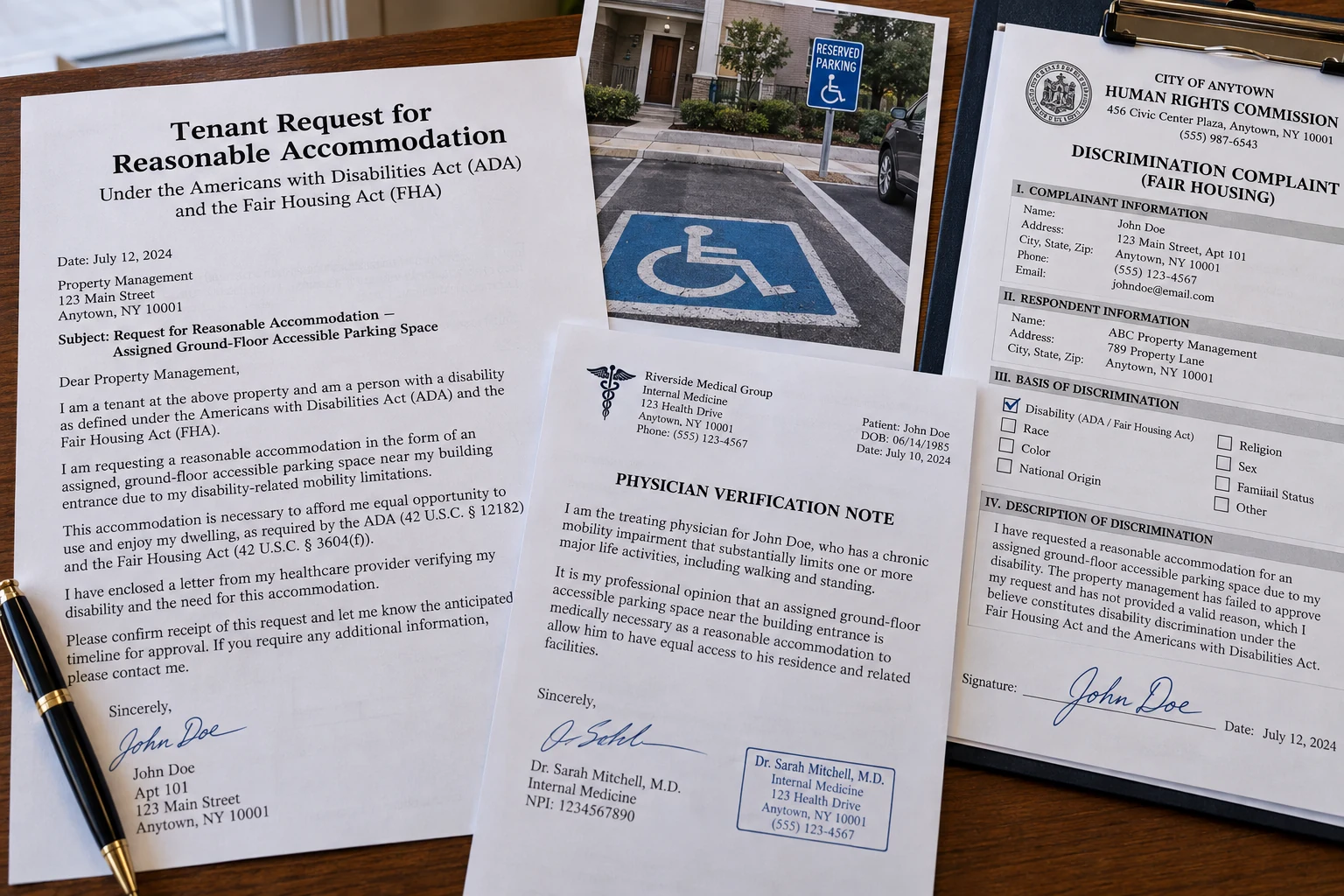
A housing provider is strictly prohibited from assessing surcharge fees, administrative surcharges, or extra deposits when granting policy adjustments. Review the seven most common accommodations landlords are legally required to grant:
| Accommodation Requested | Why the Landlord Must Grant It (42 U.S.C. § 3604) | Can Landlord Charge a Fee? | Recovery If Denied |
|---|---|---|---|
| 1. Reserved Parking Space Closest to Entry Door | Even where parking is first-come, first-served, assigning a designated space closest to the accessible entrance is mandatory for mobility, cardiovascular, or pain impairments. |
NO — $0 Allowed Owner must pay signage costs |
$5,000 to $35,000+ FHA damages, towing refunds, and premises liability if injured walking across the lot. |
| 2. Adjusting Rent Due Date for SSDI/SSI Check Dates | Social Security Disability checks arrive on the 2nd, 3rd, or 4th Wednesday. Moving the rent due date to accommodate fixed benefit disbursement schedules costs management zero. |
NO — $0 Late Fees Late charges illegal |
100% refund of all late fees ever collected, dismissal of eviction actions, and civil rights penalties. |
| 3. Ground-Floor Unit Transfer (Or Quieter Top Floor for PTSD) | When stairs become dangerous due to orthopedic deterioration, heart failure, or persistent elevator outages, management must permit priority transfer to a vacant accessible unit. |
NO Transfer Fee Zero administrative penalty |
30% to 75% rent diminution, hotel reimbursement during elevator outages, and fall injury compensation. |
| 4. Authorizing a Live-In Caregiver / Home Health Aide | Occupants needing daily assistance can add a caregiver without that individual being screened as a financial guarantor or assessed rent surcharges. |
NO Extra Occupant Fee Aide is not a tenant |
Emergency restraining orders against unauthorized occupant notices and emotional distress damages. |
| 5. Penalty-Free Early Lease Break for Medical Reasons | When a rental becomes physically inaccessible or health necessitates moving to assisted living or family care, enforcing lease termination penalties violates federal law. |
NO Lease-Break Fee Zero ongoing liability |
Full security deposit return and defense against unlawful collection actions under our guide to breaking a lease. |
| 6. Additional Time to Cure Lease Violations | Where clutter, housekeeping, or noise disruptions stem from documented mental illness or medical events, management must stay eviction while social workers remediate. | NO Administrative Surcharges | Dismissal of summary eviction proceedings and attorney fee assessments against the landlord. |
| 7. Service Animals & Emotional Support Animals | Waiving "No Pets" covenants, weight ceilings, and breed bans for task-trained service dogs and healthcare-prescribed assistance animals. |
NO Pet Deposit or Rent $0 pet charges |
100% pet fee refunds plus $10,000 to $75,000+ under our guide to service animal discrimination. |
"Reasonable Accommodation" vs. "Reasonable Modification" (Who Has to Pay for Grab Bars & Ramps?)
Disputes frequently arise concerning who shoulders the financial expense of disability access. Federal jurisprudence draws a strict distinction between policy adjustments and structural alterations:
Policy Accommodations: The Landlord Always Pays 100% ($0 to the Tenant)
Under 42 U.S.C. § 3604(f)(3)(B), changing a rule, policy, or operational practice—such as reassigning a parking space, waiving transfer fees, modifying due dates, or permitting an assistance animal—is a Reasonable Accommodation. Joint HUD and Department of Justice guidance establishes that a housing provider cannot impose any fee, deposit, or administrative surcharge for executing a policy accommodation.
Physical Modifications: Determining Financial Responsibility
Under 42 U.S.C. § 3604(f)(3)(A), physical structural adjustments—such as installing bathroom grab bars, doorway threshold ramps, roll-in shower benches, lever hardware, or strobe doorbells—are Reasonable Modifications. Who pays depends upon building characteristics:
-
Federally Subsidized Housing (Section 8 Project-Based, Public Housing, HUD-Assisted): Under Section 504 of the Rehabilitation Act (
29 U.S.C. § 794), housing providers receiving federal financial assistance must pay 100% of the cost for reasonable structural modifications unless doing so creates an undue financial hardship. -
Multifamily Buildings Constructed After March 13, 1991: Under
42 U.S.C. § 3604(f)(3)(C), all ground-floor units (and all units in elevator buildings) with four or more units designed for first occupancy after March 1991 were legally required to include reinforced bathroom walls for grab bars, usable wheelchair routes, and accessible environmental controls. If the original construction omitted these features, the property owner can be compelled to install them at owner expense. - Private, Unsubsidized Housing: In older, unsubsidized private rentals, the tenant covers the initial direct installation cost for private modifications. However, the landlord cannot refuse permission, cannot charge an additional modification deposit, and cannot require restoration at move-out if the alteration (such as grab bars or wider doors) does not impair future residential use. In states such as New York (Executive Law § 296), landlords must fund reasonable common-area modifications unless doing so represents an undue burden.
What If the Landlord Just Ghosts You or Drags Their Feet? ("Constructive Denial" & The Interactive Process)
In practice, landlords rarely issue an outright written rejection. Instead, property managers frequently leave requests unanswered for months, claim corporate approval is pending, or repeatedly demand redundant medical letters while enforcing disputed rules.
Why Inordinate Delay Equals Constructive Denial
Federal courts have firmly established that an indeterminate delay in granting an accommodation request constitutes an unlawful Constructive Denial. Under HUD enforcement standards, housing providers must respond promptly—ordinarily within 10 to 14 calendar days.
If management delays action without articulating a legitimate reason while continuing to assess late fees, issue warning notices, or subject an occupant to inaccessible barriers, the tenant is not required to wait indefinitely. You may immediately file a formal HUD complaint or civil rights lawsuit.
The Mandatory "Interactive Process" Requirement
If a landlord determines that a specific requested remedy is not feasible (for instance, all ground-floor apartments are occupied under active multi-year leases), the landlord cannot terminate communication with a summary rejection.
Federal law mandates that the landlord initiate a good-faith Interactive Process with the tenant to explore alternative accommodations that satisfy the disability-related need. Potential alternatives include prioritizing the tenant on an internal vacancy transfer list, installing an exterior ramp or stairlift, or releasing the tenant from their lease without penalties. Refusing to participate in this interactive dialogue constitutes an independent violation of the Fair Housing Act.
Calculate Your Reasonable Accommodation Lawsuit Payout
Estimate your compensation for diminished rental value, illegal fees, out-of-pocket expenses, and statutory civil rights damages.
How to Write a Bulletproof Accommodation Request (And Stop Illegal Medical Snooping!)
Building owners frequently attempt to deter accommodation requests by demanding decades of clinical records, hospital discharge summaries, or physician depositions. These intrusive demands directly violate federal privacy standards.
When the Disability and Need Are Obvious: Zero Medical Proof Required
Under Joint HUD/DOJ Guidance, if an individual's disability and disability-related need are readily apparent—such as an individual using a wheelchair, walker, guide cane, or oxygen unit requesting an accessible parking space or entry ramp—the housing provider may not demand any medical verification whatsoever. Inquiring into obvious impairments constitutes unlawful harassment.
Non-Obvious Impairments: The 3-Sentence Healthcare Verification
Where an impairment is not visible (such as cardiovascular disease, multiple sclerosis, severe asthma, chronic pain, or psychiatric conditions), the landlord may request verification from a licensed professional (physician, physician assistant, nurse practitioner, physical therapist, psychologist, or clinical social worker) confirming only two facts:
- The individual has a physical or mental impairment that substantially limits one or more major life activities (such as walking, breathing, performing manual tasks, sleeping, or working); and
- The requested accommodation or modification is necessary to afford the individual equal opportunity to use and enjoy the dwelling by mitigating specific symptoms of the disability.
A housing provider has no legal authority to demand diagnostic codes, complete medical histories, independent medical examinations, or direct telephone consultations with your doctor.
What If You Were Physically Hurt Because the Landlord Refused Your Accommodation?
When a landlord refuses an accessibility accommodation and an occupant subsequently sustains bodily harm, the character of the litigation transforms from an administrative civil rights dispute into a high-exposure premises liability action.
Consider a common scenario: a tenant with degenerative disc disease or recent orthopedic surgery requests an immediate ground-floor transfer or grab bar installation, accompanied by physician verification warning of fall risks. The landlord ignores the request or demands exorbitant transfer fees. Three weeks later, the tenant suffers a catastrophic fall on structural stairwells, fracturing an ankle or herniating spinal discs.
In this context, the landlord's refusal establishes constructive notice and bad-faith breach of statutory duties under both the Fair Housing Act and premises liability jurisprudence. Injured occupants can pursue recovery across two tracks:
- Premises Liability Damages: Recovery against the property owner's commercial liability carrier for emergency room expenses, surgery liabilities, physical therapy costs, lost income, and physical pain and suffering, as addressed in our guide on stairway injury lawsuits.
-
Civil Rights Emotional Distress & Fee-Shifting: Separate federal statutory damages for humiliation, distress, and mandatory attorney fees under
42 U.S.C. § 3613(c)(2), as detailed in our guide on emotional distress claims.
For systemic guidance on lawsuit thresholds and evidence collection, consult our comprehensive guide on suing your landlord.
Ready-to-Send Reasonable Accommodation Request & Pre-Lawsuit Demand Notice
Submit formal statutory documentation to initiate the 10-day response timeline or demand financial disgorgement following an unlawful refusal. Select the appropriate template below, then copy or download:
FORMAL REQUEST FOR REASONABLE ACCOMMODATION / MODIFICATION
PURSUANT TO THE FEDERAL FAIR HOUSING ACT (42 U.S.C. § 3604(f)(3))

Date: [Current Date]
Sent Via: Certified Mail (Tracking #: [Insert Tracking #]) & Written Tenant Portal

TO:
Property Management / Landlord: [Landlord / Company Name]
Management Address: [Office Street Address]
City, State, Zip: [City, State, Zip]

FROM:
Tenant Name(s): [Your Full Legal Name(s)]
Rental Premises: [Your Address, Unit/Apartment Number]
Phone: [Your Phone Number] | Email: [Your Email Address]

RE: FORMAL DISABILITY REASONABLE ACCOMMODATION / MODIFICATION REQUEST

Dear Property Management,

Please accept this letter as a formal statutory request for a Reasonable Accommodation / Modification under the Federal Fair Housing Act (42 U.S.C. § 3604(f)(3)), the Americans with Disabilities Act, and applicable state civil rights laws.

1. DISABILITY STATUS & NEXUS:
The undersigned occupant (or a member of the household) has a physical or mental impairment that substantially limits one or more major life activities. To afford equal opportunity to use and enjoy the rental dwelling, the following adjustment is necessary:

[SELECT APPLICABLE REMEDY:]
- A designated accessible parking space located closest to the unit's accessible entrance, marked with appropriate reserved signage at $0 fee.
- An immediate fee-free transfer to a ground-floor or wheelchair-accessible unit.
- An adjustment of the monthly rent due date from the 1st to the [Insert Date, e.g., 5th or 3rd Wednesday] to coincide with Social Security Disability (SSDI/SSI) benefit disbursement schedules, with waiver of all late charges.
- Written authorization to install physical modifications, including [Insert e.g., bathroom grab bars / doorway threshold ramps / lever door handles].
- Release from the current residential lease agreement without early termination penalties due to medical necessity.

2. STATUTORY FEE PROHIBITIONS:
Pursuant to Joint HUD/DOJ Guidance, housing providers are strictly prohibited from assessing fees, surcharges, or additional security deposits in connection with granting a reasonable accommodation.

Please confirm in writing within TEN (10) BUSINESS DAYS that this accommodation is approved, or contact the undersigned to initiate the interactive process.

Sincerely,

_________________________________________
[Your Signature]

[Your Printed Name]
How Much Can You Recover for Refusal of Reasonable Accommodation?
When taking legal action in Small Claims Court or Housing Court, financial recovery is calculated using established statutory remedies, documented out-of-pocket expenses, and rent reduction standards:
| Recovery Category | Calculation Standard | Statutory Authority & Limits |
|---|---|---|
| 1. Federal Fair Housing Act Damages & Penalties | Statutory compensation, civil penalties up to statutory ceilings, and emotional distress damages for illegal refusal of accommodations. | Fair Housing Act, 42 U.S.C. § 3604(f)(3)(B). |
| 2. Mandatory Attorney's Fees & Filing Costs | Full statutory recovery of legal fees, administrative filing fees, and expert medical witness testimony costs for prevailing tenants. | 42 U.S.C. § 3613(c)(2). |
| 3. Emergency Injunctive Enforcement & Rent Abatement | Court injunction ordering immediate assignment of accessible parking, ramp modifications, or assistance animal access, plus rent refunds. | Judicial civil rights injunctive relief. |
Small Claims Filing Limits: Most tenants resolve these matters pro se (without a lawyer) in Small Claims Court. Maximum claim limits vary by state: for example, $12,500 in California (California Courts Self-Help), $10,000 in New York City (NY Courts Small Claims), and $20,000 in Texas (Texas Judicial Branch). If damages exceed local small claims thresholds, lawsuits proceed to standard Civil Court.
Frequently Asked Questions
Under the Federal Fair Housing Act, a landlord can only deny a disability-related accommodation request in two very rare situations: (1) if granting it would cause an "undue financial and administrative burden" on the landlord—which almost never applies to rule changes like reserved parking, SSDI due-date shifts, unit transfers, or lease breaks; or (2) if it would "fundamentally alter the nature of the landlord's operations"—like asking the landlord to drive you to doctor appointments or cook your meals. Even then, the landlord must first talk with you in the Interactive Process to find an alternative that works.
Yes! This is one of the most well-settled rules in Fair Housing law. Even if every other tenant in the complex has to fight for unassigned parking spaces—and even if your lease says parking is first-come, first-served—if you have a mobility, heart, lung, or pain disability, the landlord MUST reserve a parking space closest to your unit's door exclusively for you and put up a reserved sign at $0 cost to you.
No—if you request a Reasonable Accommodation to change your rent due date. Because the Social Security Administration pays SSDI checks on the 2nd, 3rd, or 4th Wednesday of the month based on your birthday, disabled tenants have no control over when their check arrives. Requesting in writing that your rent due date be moved to the day after your SSDI/SSI check arrives is a legally protected Reasonable Accommodation—and a landlord who refuses and keeps charging you monthly late fees can be sued for a 100% refund plus civil rights damages.
While the Fair Housing Act doesn't set an exact hour count, HUD and federal courts rule that landlords must respond "promptly"—typically within 10 to 14 days. If a landlord ignores your written request for weeks, demands unnecessary medical records to stall you, or keeps enforcing the rule against you while "thinking about it," the law treats their delay as an illegal Constructive Denial—allowing you to file a HUD complaint or lawsuit immediately.
Technically, federal law even protects verbal requests—but you should ALWAYS make your request in writing by email, text, or Certified Mail so the landlord cannot lie in court and claim you never asked. Use our copy-paste template above so your request includes the exact legal magic words "Reasonable Accommodation under the Fair Housing Act" and starts the 10-day response clock.
SueLegal is an independent educational legal publisher, not a law firm or lawyer referral service. The information provided in this guide is for general informational and educational purposes only and does not constitute formal legal advice. Residential landlord-tenant laws, repair notice periods, and statutory remedies vary significantly across state and municipal jurisdictions. If you are facing eviction, severe uninhabitable conditions, or complex litigation, consult a licensed attorney in your jurisdiction or contact your local legal aid organization. For more details on our standards, read our Editorial Policy and Legal Research Methodology.