
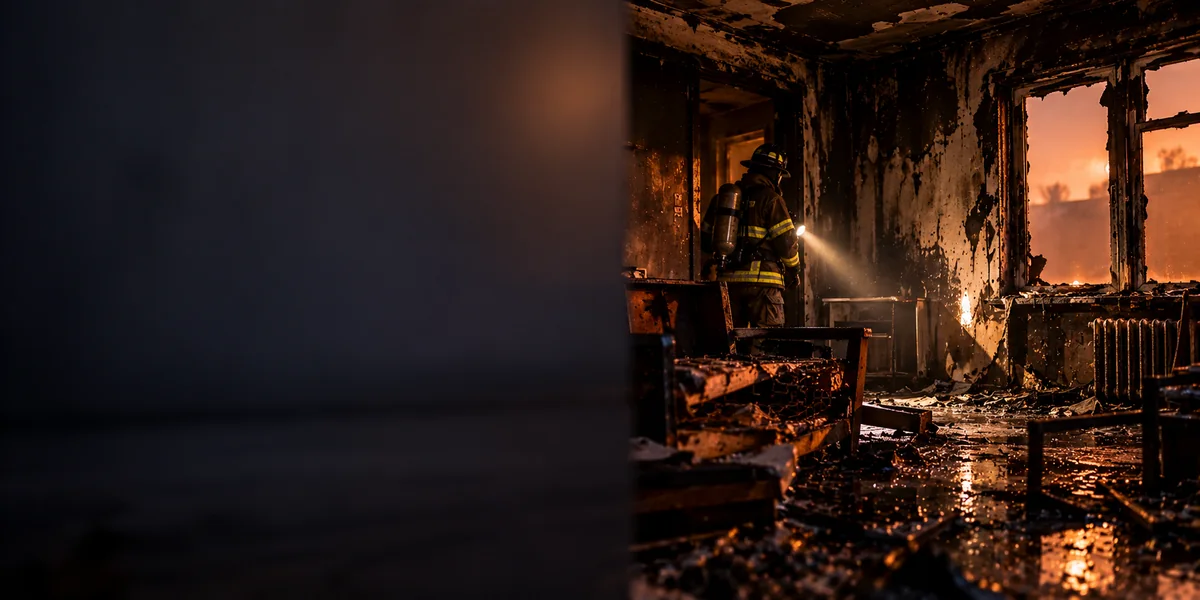
Yes, you can sue your landlord after an apartment fire—and you always have immediate rights to your rent and deposit back.
Your legal recovery after an apartment fire works on two levels:
- Guaranteed Rights After ANY Fire (Even If It Was an Accident): If a fire, heavy smoke, or firefighter water damage makes your apartment unlivable (and you didn't cause the fire), your duty to pay rent stops immediately. You can end your lease with zero penalty and sue in Small Claims Court if your landlord refuses to immediately refund 100% of your security deposit and any unused days of rent you already paid for the month.
- Full Lawsuit Against the Landlord ($5,000 to $1,000,000+ If Landlord Negligence Caused or Worsened the Fire): If the fire started from faulty building wiring, an old furnace/appliance, or unfixed hazards—OR if missing smoke alarms, broken fire doors, or blocked exits prevented you from escaping safely—you can sue the landlord's insurance policy for 100% of your destroyed furniture, clothes, and electronics, hotel and moving bills, and burn or smoke-inhalation medical settlements.
At a Glance
- Never Keep Paying Rent on a Burned or Smoke-Ruined Apartment: In nearly all 50 states, if a fire makes your unit uninhabitable, your lease obligation stops the day of the fire. Your landlord must refund any pre-paid rent for the rest of the month plus 100% of your security deposit.
- You Can Still Sue Even If a Neighbor Started the Fire: Landlords always blame the tenant where the fire started. However, if a neighbor's fire spread into your apartment or trapped you because hallway smoke detectors were missing, self-closing fire doors were broken, or fire escapes were blocked, your landlord is still legally liable!
- Smoke, Black Soot, and Firefighter Water Damage Count 100%: Flames don't have to touch your apartment to ruin everything you own. If a fire upstairs or next door filled your unit with toxic chemical soot or flooded your ceiling with fire-hose water, your mattresses, couches, and clothes are a recoverable loss.
- Even Without Renters Insurance, a Negligent Landlord Must Pay: Landlords love to say "Too bad you didn't have renters insurance." If the Fire Marshal's report shows the fire started from faulty building wiring or landlord negligence, the landlord's $1M+ commercial liability insurance has to pay for your ruined belongings.
- Request the Fire Marshal's "Origin and Cause Report" Immediately: Within days of any apartment fire, the Fire Department Investigator writes an official report stating where and how the fire started. That single public record is the #1 piece of proof that wins apartment fire lawsuits.
Who Pays After an Apartment Fire? 4 Common Scenarios Compared
When displaced renters stand outside a burning building, landlords and property managers almost always repeat the same rehearsed line: "My insurance only covers the physical building. You have to pay for your own hotel, and if you didn't have renters insurance, your ruined furniture is your problem."
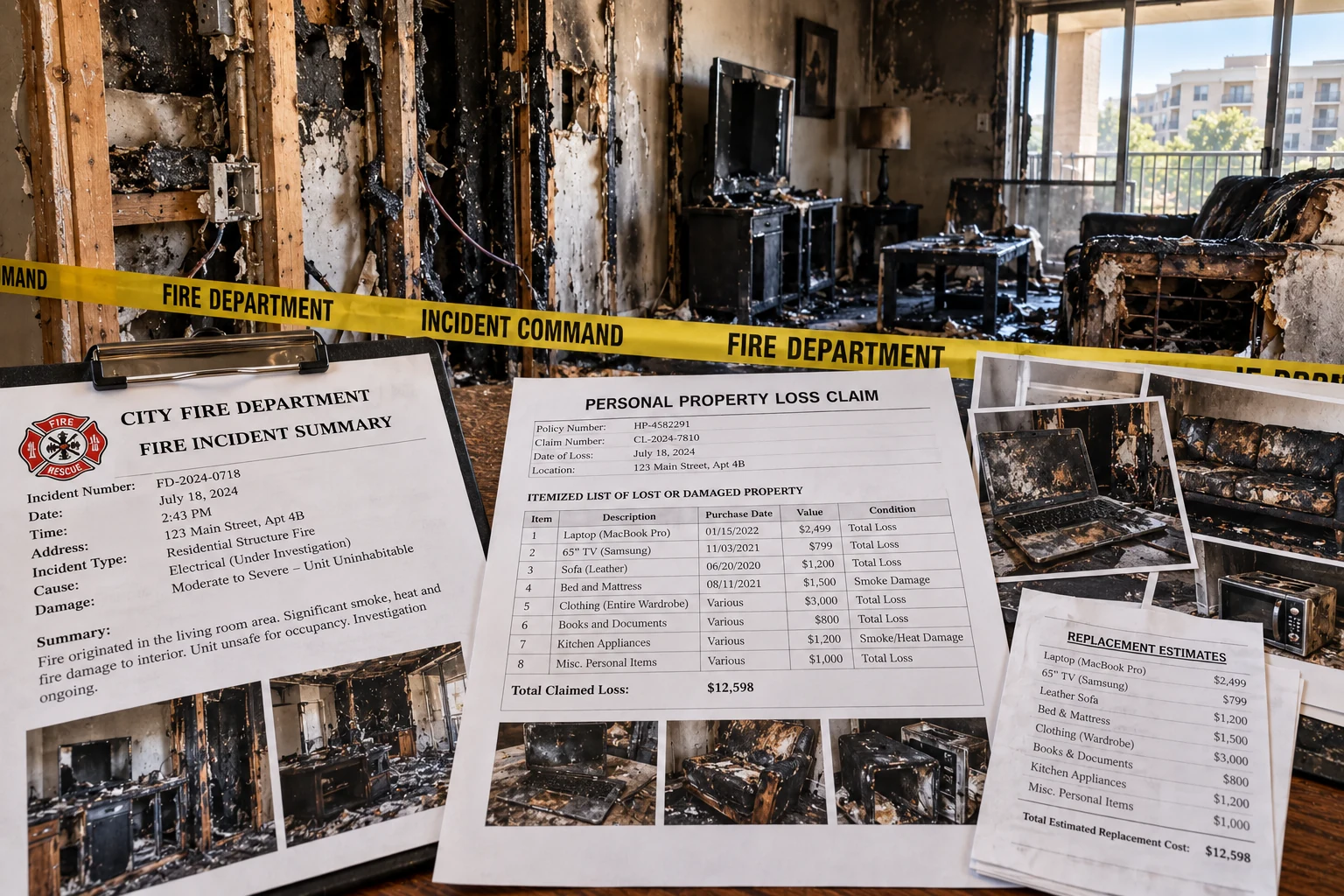
In most cases, that statement is legally false. If lightning strikes the roof, the landlord isn't at fault for your couch. However, if the fire started because of faulty building wiring, a bad furnace/stove, rodents chewing wires, or a sloppy handyman—OR if the fire spread and hurt you because smoke alarms were missing or fire doors were broken—the landlord and their commercial insurance policy are 100% legally liable for your losses. You can read our detailed guide on proving landlord negligence and our comprehensive overview of tenant lawsuits across all 50 states.
Even if the fire was a pure accident and nobody's fault, state laws across the U.S. say that once a fire makes your apartment unlivable, you stop owing rent immediately. You can cancel the lease on the spot, and the landlord must refund your full security deposit plus any unused rent you already paid for that month.
The comparison table below details who must pay for your deposit, your ruined belongings, and your medical care across four common apartment fire situations:
| How the Fire Happened | Must Landlord Refund Your Deposit & Unused Monthly Rent? | Must Landlord Pay for Your Ruined Furniture, Clothes & Hotel? | Can You Sue for Smoke Inhalation or Burn Injuries? |
|---|---|---|---|
| 1. Fire Started in Building Wiring, Boiler, Heater, or Landlord Appliance | YES (100% Immediate Refund) | YES (100%) — Landlord's negligence caused the blaze; they owe for all uninsured property + your insurance deductible + hotel/moving costs. | YES ($25,000 to $1M+) against the landlord's commercial liability insurance. |
| 2. A Neighbor Started the Fire, BUT Smoke Alarms Were Dead or Fire Doors/Exits Failed | YES (100% Immediate Refund) | YES (Shared Liability) — If missing alarms, broken self-closing doors, or code violations let the fire/smoke spread into your unit, the landlord is liable. | YES — Failing to provide working alarms or clear exits makes the landlord liable for your injuries. |
| 3. Arson or Fire Started by Squatters in an Unlocked Vacant Unit / Basement | YES (100% Immediate Refund) | YES (If Landlord Ignored Security Warnings) — Under Negligent Security, landlords must lock vacant units and utility rooms. | YES — Foreseeable fires resulting from negligent building security create full tort liability. |
| 4. Pure Accident (Lightning Strike) With Working Alarms & Zero Code Violations | YES (100% Immediate Refund) — You never pay rent for a burned apartment! | No (Covered by your own Renters Insurance policy or Red Cross assistance). | No (Unless a building code violation worsened your escape). |
Your Immediate Financial Rights in the First 72 Hours (Rent, Deposit & Hotel Rules)
The first three days after an apartment fire are overwhelming. While landlords frequently pressure tenants to keep paying rent or sign lease transfers, state property codes across the nation provide powerful protections that take effect the moment flames or smoke ruin a rental home:
The 4 Core Post-Fire Tenant Survival Rights
1. Your Rent Stops the Day of the Fire (And You Get Unused Days Refunded)
If a fire happens on the 5th of the month after you already paid $2,100 on the 1st, the landlord cannot keep the remaining 25 days of rent ($1,750). In nearly every state (such as California Civil Code § 1933(4), New York Real Property Law § 227, Texas Property Code § 92.054, and Florida Stat. § 83.63), a fire that makes your unit unlivable lets you terminate the lease immediately and entitles you to a pro-rated refund of every unused day of rent.
2. The Landlord Cannot Keep Your Security Deposit for Fire Damage
Unless the Fire Marshal proves you negligently started the fire, fire, smoke, and firefighter water damage are 100% forbidden from being deducted from your security deposit. If a landlord tries to hold your deposit after a fire, you can sue in Small Claims Court for 2x to 3x bad-faith deposit penalties!
3. What If the Landlord Offers to Move You to Another Unit, But You Want Out?
If your apartment is destroyed or filled with toxic smoke, you do not have to wait months while the landlord rebuilds it—you have the legal right to cancel your lease in writing and walk away clean. You are never obligated to accept an alternate unit in the same complex.
4. Your Right to Escorted Entry to Salvage Surviving Belongings
Landlords often chain-lock a burned building and hire a demolition crew that throws tenants' fireproof safes, jewelry, passports, and unburned bedroom items straight into a dumpster. Demand in writing within 24 hours that once the Fire Department clears the building for brief entry, you be given escorted access to retrieve your surviving personal property before any demolition crew touches your unit!
Smoke, Soot & Fire-Hose Water Claims: When Flames Never Entered Your Unit
A common misconception among renters is that you can only sue your landlord if open flames reached your apartment. In reality, the vast majority of personal property losses in multi-family residential fires occur in units that flames never touched.
When a fire breaks out on the floor above you or down the hallway, two secondary destructive forces ruin everything inside surrounding apartments:
Why Toxic Smoke & Chemical Soot Ruin Everything
Modern apartment fires burn plastics, synthetic carpets, polyurethane foam insulation, and electronics. This generates sticky, oily, acidic black soot loaded with toxic chemicals like hydrogen cyanide, dioxins, and polycyclic aromatic hydrocarbons (PAHs).
Once that toxic smoke penetrates mattresses, fabric couches, clothes, baby items, and electronics vents, normal wiping or laundry cannot make them safe:
- Mattresses, Sofas & Pillows: Porous foam cushions absorb carcinogenic soot deep into internal layers. Standard steam cleaning or febreeze cannot neutralize toxic chemical residues.
- Clothing & Baby Essentials: Soot contains corrosive acids that permanently weaken textile fibers and create direct dermal absorption hazards for young children and infants.
- Computers, Televisions & Appliances: Fine soot particles are electrically conductive and acidic. Once soot is drawn into cooling fans, it corrodes copper circuits and creates secondary fire hazards.
Thousands of Gallons of Firefighter Water Damage
Putting out a 3rd-floor fire sends thousands of gallons of dirty, soot-filled water crashing through 2nd- and 1st-floor ceilings. If your apartment was flooded by emergency fire hoses or triggered overhead sprinklers, review our guide on landlord water damage lawsuits and ruined personal property.
Under state tort law, your legal rights are identical whether your property was destroyed by open flames, toxic soot, or firefighter water. If the fire started or spread due to landlord negligence, you have the exact same right to sue for 100% replacement of smoke- and water-ruined belongings as the apartment where the fire started!
How to Get the Fire Marshal's "Origin and Cause Report" (And Prove Landlord Fault)
Winning an apartment fire lawsuit or forcing a landlord's commercial insurer to pay your claim comes down to one document: the Fire Marshal's Origin and Cause Report.
The Fire Marshal Origin and Cause Report is the official investigation report written by the fire department after every building fire that pins down exactly where and how the blaze started. Following standard NFPA 921 protocols, certified investigators examine electrical arc mapping, analyze V-shaped burn patterns, and test appliances to establish physical proof of ignition.
Requesting Two Separate Fire Department Reports
Do not simply ask for the "fire report." You should request two separate public records from your municipal Fire Prevention Bureau:
- Report #1: The Basic NFIRS Fire Incident Report: Usually ready in 3 to 7 days. It lists dispatch timestamps, units on scene, civilian injuries, and whether building fire alarms were sounding upon arrival.
- Report #2: The Fire Investigator / Fire Marshal "Origin and Cause Report": Takes 2 to 6 weeks to complete. It includes forensic photographs of melted breaker panels, teardowns of faulty appliances, and the investigator's definitive opinion on cause.
The "Big 4" Landlord Fault Clues in Fire Reports
- Fires Originating in Wall Cavities, Breaker Boxes, or Utilities: When investigators trace ignition to internal building wiring, shared chases, or overloaded panels, the building owner is directly responsible. Check our guides on faulty wiring lawsuits and dangerous electrical problems.
- Missing, Expired, or Silent Smoke Detectors: If building alarms failed to sound or detectors were over 10 years old, the landlord violated life-safety codes. See our analysis of suing for fire hazard code violations.
- Propped Open or Broken Self-Closing Fire Doors: Hallway fire doors must have working self-closing hinges. If broken doors or wedged kickstands allowed smoke to choke stairwells and flood upper units, management shares direct legal liability.
- Prior Tenant Maintenance History: Prior maintenance tickets, text messages, or emails complaining about flickering lights, sparking outlets, space heaters (used because building heat failed), or rats chewing insulation prove the landlord had advance knowledge of the hazard.
How to Value Your Destroyed Belongings ("Room-by-Room Memory Walk")
When your apartment burns, your receipts burn too! Courts and insurance adjusters do not require paper store receipts for every item you owned.
Instead, conduct a structured Room-by-Room Memory Walk:
- Open a spreadsheet and walk mentally through each room: Master Bedroom, Living Room, Kitchen, and Closets.
- Check your bank account statements, credit card purchase history, and past online orders on Amazon, Target, or Walmart for exact model numbers and purchase dates.
- Review smartphone photo libraries. Pictures taken inside your apartment during holidays or casual gatherings often show televisions, sofas, guitars, rugs, and wardrobes in the background.
- List the true current replacement cost needed to buy an equivalent new item today.
Ready-to-Send Post-Fire Lease Termination & Property Claim Notices
Establishing a formal written record immediately after an apartment fire is vital to protect your financial rights and preserve critical physical evidence. Use the interactive tool below to generate, copy, or download your legal demand:
NOTICE OF CASUALTY LEASE TERMINATION, FULL SECURITY DEPOSIT RETURN & UNUSED RENT REFUND
PURSUANT TO STATE CASUALTY DAMAGE STATUTES & HABITABILITY CODES

Date: [Current Date]
Sent Via: Certified Mail (Tracking #: [Insert Tracking #]) & Official Tenant Portal / Email

TO:
Landlord / Property Management: [Landlord / Property Management Company Name]
Office Address: [Management Street Address]
City, State, Zip: [City, State, Zip]

FROM:
Tenant Name(s): [Your Full Name(s)]
Damaged Rental Premises: [Your Street Address, Unit/Apt Number]
Current Temporary Address: [Your Hotel, Temporary Housing, or New Address]
Phone: [Your Phone Number] | Email: [Your Email]

RE: IMMEDIATE LEASE TERMINATION PURSUANT TO CASUALTY FIRE DAMAGE ON [Date of Fire]
    PREMISES: [Your Street Address & Apartment Number]
    FIRE DEPARTMENT INCIDENT #: [Fire Incident Report Number, if known]

Dear [Landlord / Property Manager Name],

Please accept this letter as formal statutory notification that the residential rental dwelling unit identified above was rendered completely uninhabitable as a direct result of the structure fire that occurred on [Date of Fire].

1. IMMEDIATE LEASE TERMINATION AS A MATTER OF LAW:
Under state landlord-tenant casualty statutes (including URLTA § 4.106 and equivalent state property codes such as Cal. Civ. Code § 1933(4), NY RPL § 227, Tex. Prop. Code § 92.054, and Fla. Stat. § 83.63), when a dwelling unit is substantially destroyed or damaged by fire such that normal enjoyment and occupancy are impaired, the tenant has the absolute legal right to terminate the lease immediately upon written notice. My tenancy is terminated effective [Date of Fire].

2. DEMAND FOR PRO-RATED UNUSED RENT REFUND:
Prior to the fire, I paid the full monthly rent of $[Monthly Rent Amount] for the month of [Month]. Because the premises became unlivable on [Date of Fire], management is legally prohibited from retaining rent for the remaining [Number of Unused Days] days of the month. I demand an immediate pro-rated refund of $[Amount of Unused Rent].

3. DEMAND FOR FULL SECURITY DEPOSIT RETURN:
Management holds a security deposit in the sum of $[Deposit Amount]. Under state law, security deposits may not be withheld or charged for fire, soot, smoke, or firefighting water destruction. I demand the release and delivery of my full $[Deposit Amount] security deposit to my temporary mailing address provided above within the statutory deadline.

4. DEMAND FOR ESCORTED SALVAGE ACCESS BEFORE DEMOLITION:
Notice is hereby served that management and its remediation contractors must not discard, demolish, or dispose of any personal property remaining in the unit without my written authorization. I demand immediate coordinated access to inspect and retrieve surviving personal possessions once municipal fire authorities authorize entry.

Please remit the total refund of $[Sum of Deposit + Unused Rent] within FOURTEEN (14) DAYS of receipt of this notice to avoid formal legal proceedings in Small Claims Court.

Sincerely,

_________________________________________
[Your Signature]

[Your Printed Name]
How Much Can You Recover for Apartment Fire Losses?
When taking legal action against a landlord in Small Claims Court or Civil District Court, financial recovery is based on documented economic losses, statutory damages, and premises liability standards:
| Recovery Category | Calculation Standard | Statutory Authority & Limits |
|---|---|---|
| 1. Destroyed Personal Belongings & Furniture | Fair market replacement compensation for all personal goods, wardrobe, furniture, electronics, and keepsakes incinerated or smoke-damaged. | Negligence property damages; NFPA 921 findings. |
| 2. Emergency Lodging & Relocation Costs | Receipts for hotels, emergency clothing, meals, replacement lease security deposits, and temporary housing during displacement. | Consequential out-of-pocket damages. |
| 3. Deposit Return & Prepaid Rent Refund | Immediate statutory refund of all security deposits and prorated prepaid rent under constructive eviction doctrines. | Constructive eviction remedies. |
Small Claims Filing Limits: Most property damage and minor habitability disputes are resolved efficiently in Small Claims Court without hiring a lawyer. Maximum claim thresholds vary by jurisdiction: for example, $12,500 in California (California Courts Self-Help), $10,000 in New York City (NY Courts Small Claims), and $20,000 in Texas (Texas Judicial Branch). If catastrophic fire, severe burn injuries, or toxic asphyxiation damages exceed small claims ceilings, claims proceed through standard Civil District Court.
Frequently Asked Questions
Do I still have to pay rent if my apartment had a fire? +
No. Under landlord-tenant laws in almost every state, if a fire, smoke, or firefighting water damage makes your apartment uninhabitable (and you didn't negligently cause the fire), your obligation to pay rent stops the day of the fire. Furthermore, the landlord must refund any pre-paid rent for the remaining days of that month plus your full security deposit.
Does my landlord have to pay for my hotel room after an apartment fire? +
It depends on how the fire started: if the fire was a pure accident—like lightning or a neighbor's cooking fire where all building safety systems worked—your own renters insurance "Loss of Use" coverage or the Red Cross covers your hotel. However, if the fire started or spread because of landlord negligence—like faulty wiring, a bad furnace, or missing smoke alarms—you can sue the landlord for 100% of your hotel, food, and moving bills.
Can I sue my landlord for fire damage if I didn't have renters insurance? +
Yes—if the landlord's negligence caused or worsened the fire. Landlords often tell uninsured tenants they are out of luck, which is only true for no-fault accidents. If the fire started from faulty building wiring, an unmaintained appliance, rodents chewing wires, or spread because of fire-code violations, the landlord's commercial liability insurance must pay to replace your destroyed furniture, clothes, and electronics.
What if I DO have renters insurance—can I still sue my landlord? +
Yes! Renters insurance often has a $500 to $1,000 deductible, low caps on electronics or jewelry, and pays $0 for physical burns, smoke inhalation ER visits, lost wages, or emotional trauma. If your landlord was negligent, you can sue them for your deductible, any property losses above your policy limit, and all personal injury damages.
Can I sue my landlord for smoke inhalation or emotional distress if I wasn't burned by flames? +
Yes—in fact, smoke inhalation is the #1 cause of hospitalization in apartment fires, damaging lungs and airways from burning plastics and toxic soot. If you went to the ER or urgent care for smoke inhalation, carbon monoxide exposure, or suffered documented trauma/PTSD escaping a negligent building fire, a fire injury attorney can pursue a high-value settlement against the landlord's insurance at $0 upfront cost.
SueLegal is an independent educational legal publisher, not a law firm or lawyer referral service. The information provided in this guide is for general informational and educational purposes only and does not constitute formal legal advice. Residential landlord-tenant laws, repair notice periods, and statutory remedies vary significantly across state and municipal jurisdictions. If you are facing eviction, severe uninhabitable conditions, or complex litigation, consult a licensed attorney in your jurisdiction or contact your local legal aid organization. For more details on our standards, read our Editorial Policy and Legal Research Methodology.