

The Short Answer
Yes, you can sue a landlord for housing discrimination—whether you are an applicant who got rejected or a current tenant being treated unfairly.
Under the Federal Fair Housing Act (42 U.S.C. § 3604), the Civil Rights Act of 1866 (42 U.S.C. § 1982), and state civil rights laws, it is strictly illegal for a landlord to refuse to rent, lie about availability, charge higher deposits, ignore repairs, or evict you based on your race, national origin, religion, sex/LGBTQ+ status, pregnancy/children, disability, or (in 22+ states) Section 8 / source of income. When you prove discrimination, you can recover:
-
Emotional Distress & Civil Rights Settlements ($10,000 to $150,000+): Federal and state laws automatically award compensation for humiliation, insult, anxiety, and loss of housing opportunity—plus up to 3x Triple Damages (min. $4,000) in states like California (
Unruh Act) and 6x to 12x monthly rent for immigration-related threats. - All Out-of-Pocket & "Rent Differential" Losses: 100% reimbursement for application fees, hotel/storage bills, moving trucks, and the monthly rent difference if being rejected or forced out made you rent a more expensive apartment.
- Heavy Government Fines & 100% Paid Lawyer Fees: HUD can fine a discriminating landlord up to $25,597 for a first offense (and up to $127,983 for repeat offenders), and the landlord must pay 100% of your attorney's fees.
Important Legal Information
- Catch the "It's Already Rented" Lie With a 2-Hour Tester Check: If a landlord suddenly tells you an apartment is "taken" the moment they see your race, kids, accent, or assistance animal—check if the Zillow ad is still up and have a friend (or your local Fair Housing Center) email or call the landlord the same afternoon. Catching them offering the unit to someone else is an instant courtroom win!
- Having Kids or Getting Pregnant Is Protected in All 50 States (
Familial Status): A landlord cannot refuse to rent to you because you have children, cannot ban kids from upper-floor apartments, cannot charge "extra rent per child," and generally must allow at least 2 people per bedroom (plus an infant). - In 22+ States, Saying "No Section 8" (Or Using the "3x Full Rent" Trick) Is Illegal: If you live in CA, NY, NJ, WA, OR, IL, MA, CT, MD, VA, CO, MN, D.C., or dozens of cities, landlords must accept Section 8 vouchers—and they can only require your income to be 3x your tiny tenant share of the rent, NOT 3x the full rent!
- For Racial or Ethnic Discrimination, There Is ZERO "Small Landlord Exemption": While a live-in owner of a 2-unit duplex has a narrow exemption under the 1968 Fair Housing Act, the Civil Rights Act of 1866 (
42 U.S.C. § 1982) bans racial and ethnic housing discrimination by 100% of landlords in America with zero exemptions! - Watch the 1-Year HUD Deadline & 2-Year Court Deadline: You have 1 year (365 days) from the discriminatory act to file a free federal complaint with HUD, and 2 years to file a federal Fair Housing lawsuit in court.
What Is Illegal Housing Discrimination? (Federal vs. State Protected Classes Table)
Housing discrimination occurs when a landlord, property manager, leasing agent, or homeowners association treats you differently, rejects your application, charges you higher deposits, or imposes selective rules based on who you are.
Many renters mistakenly believe that landlords only break the law if they shout a direct slur. In reality, the vast majority of illegal discrimination happens through polite excuses like "Sorry, someone just took it" or "We do not participate in that program." Under the Federal Fair Housing Act (42 U.S.C. § 3604), discrimination is prohibited nationwide across seven core federal categories. On top of federal law, over 22 states and hundreds of cities protect additional categories including Section 8 vouchers, source of income, marital status, and immigration status.
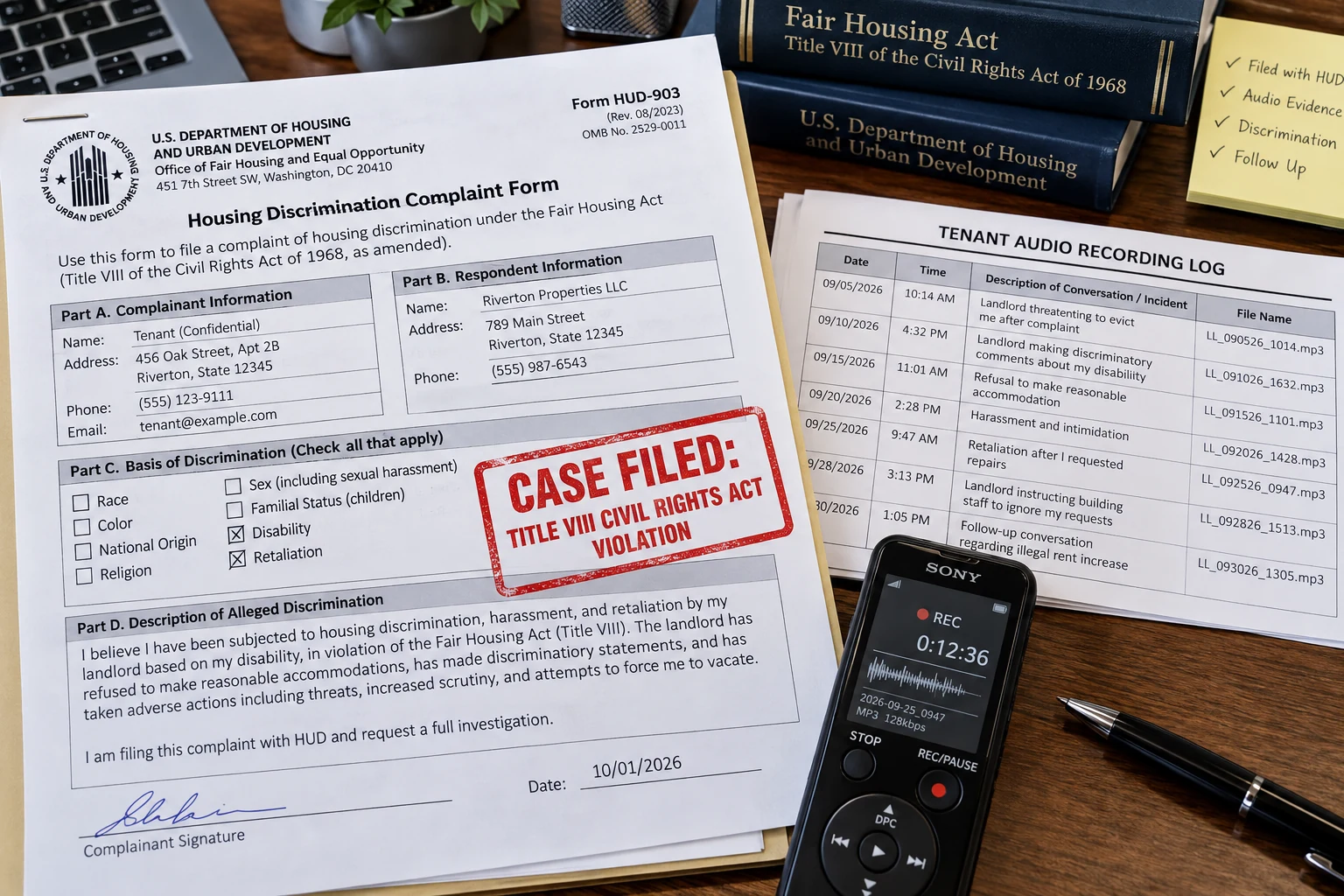
Review this complete statutory matrix to see whether your landlord's conduct violates federal or state civil rights laws:
| Protected Category | Protected Nationwide (Federal FHA)? | Illegal Landlord Examples That Win Lawsuits |
|---|---|---|
| 1. Race, Color & National Origin / Accent | YES — All 50 States Zero exemptions under 42 U.S.C. § 1982 |
Lying that an apartment was "just rented" after meeting you in person; steering minority applicants to specific rear buildings; requiring extra identification or background checks based on an accent or surname. |
| 2. Familial Status (Kids Under 18, Pregnancy & Adoption) | YES — All 50 States Exemption only for certified 55+/62+ senior housing |
Saying "This unit isn't safe for toddlers because of stairs or balconies," banning children from upper floors due to footstep noise, charging extra rent per child, or terminating a lease after learning a tenant is pregnant. |
| 3. Disability (Physical, Medical, Mental & Assistance Animals) | YES — All 50 States FHA § 3604(f) + Section 504 |
Refusing a Service Dog or Emotional Support Animal, charging pet rent, denying reserved ground-floor parking, or rejecting applicants receiving SSDI or SSI disability income. For specialized rules, review our comprehensive guides to suing for a reasonable accommodation refusal and suing for an assistance animal denial. |
| 4. Sex, Sexual Orientation, Gender Identity & Harassment | YES — All 50 States Enforced by HUD and DOJ under Bostock ruling |
A landlord or building superintendent demanding sexual favors in exchange for rent or repairs (quid pro quo); rejecting LGBTQ+ couples; or evicting a domestic violence survivor because emergency police were dispatched under the Violence Against Women Act (VAWA). |
| 5. Religion | YES — All 50 States | Advertising for "Christian tenants only," questioning an applicant about church attendance, or banning religious door adornments (such as a mezuzah) while permitting secular holiday wreaths. |
| 6. Section 8 Vouchers & "Source of Income" | YES in 22+ States & 100+ Cities CA, NY, NJ, WA, OR, IL, MA, CT, MD, VA, CO, MN, D.C. |
Posting "No Section 8 / No Housing Choice Vouchers," refusing to sign standard Housing Authority inspection forms, or requiring a voucher holder to earn 3x the full contract rent rather than 3x their out-of-pocket tenant share. |
| 7. Marital Status, Age, Immigration/ITIN & Criminal Record | Protected in Major States & Cities Plus HUD Disparate Impact Standards |
Refusing unmarried cohabitating couples (illegal in CA, NY, NJ, WA, IL); threatening to contact immigration enforcement (which triggers 6x to 12x rent statutory penalties in CA, NY, and IL); or enforcing blanket "no arrests ever" exclusion bans without individualized assessment. |
If you are evaluating whether your landlord's overall conduct supports multiple causes of action—such as constructive eviction or breach of contract—consult our comprehensive pillar guide on when you can sue your landlord.
How to Catch a Lying Landlord in 24 Hours (The Supreme Court-Approved "Tester" Check)
The single biggest challenge discriminated renters face is evidentiary: "I know the property manager rejected me because of my race, children, Section 8 voucher, or disability—but how do I prove it in court when they claimed someone else applied first?"
Landlords almost never write an email stating, "We do not rent to your group." Instead, they use pretext. They tell you the unit was leased an hour ago, that your credit score was two points below an unwritten benchmark, or that another application is pending. Fortunately, federal civil rights law provides a powerful, Supreme Court-sanctioned method to expose this deception.
The Landmark Supreme Court Rule: Fair Housing Testing
In the landmark civil rights ruling Havens Realty Corp. v. Coleman (455 U.S. 363), the United States Supreme Court confirmed that undercover "Fair Housing Testers" have full legal standing to test housing providers and that evidence gathered through paired testing is admissible in federal court. Testing is not entrapment; it is an established investigative tool used by HUD, the Department of Justice, and private civil rights organizations nationwide.
How to Execute a 24-Hour Paired Check Yourself
You can document blatant discrimination within hours of being turned away by following this three-step protocol:
Step 1: Timestamp the Active Ad
Immediately capture dated screenshots of the rental listing on Zillow, Apartments.com, Facebook Marketplace, or Craigslist. Confirm that the advertisement is still active and accepting inquiries after the landlord claimed the apartment was taken.
Step 2: Send a Paired Inquirer
Have a trusted friend, colleague, or family member who does not share your protected attribute (for example, applying without children, without a voucher, or of a different race) inquire about the exact same unit 2 to 24 hours later, presenting matching or slightly lower financial credentials.
Step 3: Document the Contradiction
If the landlord texts or emails your paired tester saying, "Yes, the apartment is vacant! Would you like a tour this afternoon?", you have captured undeniable written proof of pretext that establishes a prima facie Fair Housing violation worth tens of thousands of dollars.
Free Professional Testing Through Your Local Fair Housing Council
You do not have to perform testing alone. Nearly every major metropolitan area in the United States is served by a private, HUD-funded Fair Housing Center or Civil Rights Legal Aid organization. These non-profit agencies maintain trained, professional investigative testers who will conduct rigorous, paired audio-recorded or written testing of the landlord at zero cost to you. Their formal investigative reports carry immense weight during HUD conciliation and federal court proceedings.
The 2 Big Traps Landlords Use Against Families With Kids & Section 8 Voucher Holders
Two of the most prevalent forms of housing discrimination in America target families with young children and low-income renters utilizing government housing assistance. Landlords routinely attempt to disguise these illegal exclusions behind pseudo-legal corporate policies.
Trap #1: Fabricated Occupancy Caps & "No Kids Upstairs" Rules
Property owners know that posting "No Children Allowed" is an open federal violation. Instead, they engineer restrictive rules designed to make tenancy impossible for parents:
- The HUD "Keating Memo" Standard: Under official guidelines issued by the Department of Housing and Urban Development (the Keating Memo), an occupancy limitation of two persons per bedroom (plus an infant or young child) is presumed reasonable. When a landlord enforces a rule allowing only two people total in a spacious two-bedroom apartment, they are systematically excluding families with children. Courts treat overly restrictive occupancy caps as illegal familial status discrimination.
- Second-Floor Child Bans: Landlords frequently state, "We only place families on the ground floor because running footsteps disturb neighbors" or "Second-floor balconies are dangerous for small children." Steered placement based on familial status is strictly illegal. Parents have the sole legal right to determine whether an upper-floor apartment is safe for their children.
- Pre-1978 Lead Paint Excuses: Some property owners refuse to lease older properties to pregnant women or families with children under age six, claiming they want to avoid lead paint abatement liabilities. Under Title X and the Fair Housing Act, turning away an expectant mother or child because an apartment may contain lead hazards is illegal familial status discrimination.
Trap #2: The Section 8 "3x Full Contract Rent" Mathematical Trick
In the 22+ states and over 100 municipalities that prohibit source of income discrimination—including California, New York, New Jersey, Washington, Oregon, Illinois, Massachusetts, Maryland, and Colorado—landlords cannot flatly advertise "No Section 8." To circumvent the law, corporate management companies create a mathematical barrier:
The Unlawful Income Multiplier Scam
A landlord lists an apartment for $2,400 per month. A tenant applies with a Housing Choice Voucher that covers $2,000, leaving the tenant responsible for only $400 per month. The landlord rejects the applicant, claiming: "Our underwriting policy requires every tenant to prove monthly income equal to 3x the monthly rent ($7,200/month), and your paycheck is only $1,500/month."
Why this breaks the law: State statutes—such as California Government Code § 12955(o), Washington RCW 59.18.255, and New York Executive Law § 296(5)—explicitly mandate that when calculating income ratios for subsidized tenants, landlords are legally permitted to apply their income standard only to the tenant's individual out-of-pocket portion of the rent. In this example, 3x the tenant's $400 share is only $1,200 per month. Because the applicant earns $1,500, applying the test to the total $2,400 rent is an illegal pretext designed to bar voucher holders.
If your landlord responded to your voucher request or child occupancy by serving an eviction notice or refusing a renewal, review our specific resource on suing a landlord for refusing to renew a lease.
Calculate Your Housing Discrimination Lawsuit Payout
Estimate your potential recovery under the Federal Fair Housing Act and state civil rights laws including rent differentials, moving costs, humiliation damages, and punitive multipliers.
Why Small Landlords CANNOT Hide Behind the "Mrs. Murphy" Exemption (2 Legal Trump Cards)
When confronted with discrimination claims, small landlords and single-family rental owners frequently assert what real estate textbooks call the "Mrs. Murphy exemption." In practice, this defense fails in nearly every modern lawsuit due to two decisive statutory trump cards.
What Is the Federal "Mrs. Murphy" Exemption?
Under Section 3603(b)(2) of the 1968 Fair Housing Act, an owner-occupied building with four or fewer independent rental units—or a single-family home rented without a commercial broker—is narrowly exempt from certain administrative provisions of federal FHA enforcement. However, landlords routinely misunderstand the strict statutory boundaries of this carve-out.
Trump Card #1: The Civil Rights Act of 1866 (42 U.S.C. § 1982) Has ZERO Exemptions
If the discriminatory conduct involves race, color, ancestral heritage, or national origin, the 1968 Fair Housing Act is not your only weapon. The Civil Rights Act of 1866 (42 U.S.C. § 1982) guarantees all citizens the equal right to lease and hold real property.
The Supreme Court in Jones v. Alfred H. Mayer Co. (392 U.S. 409) ruled that Section 1982 bars all racial discrimination in housing, private as well as public. Section 1982 contains zero small-landlord exemptions, applies to every single-family house and duplex in the nation, has no statutory cap on punitive damages, and allows plaintiffs up to four years to file suit. A landlord renting a single bedroom in their personal residence who rejects an applicant because of their race can be sued directly in federal court under Section 1982.
Trump Card #2: Broker Usage, Public Ads & Strict State Civil Rights Statutes
Even outside of racial discrimination claims, small landlords routinely forfeit their federal exemption through basic commercial actions:
- Advertising Restrictions (42 U.S.C. § 3604(c)): Under federal law, the Mrs. Murphy exemption never applies to discriminatory advertising. An exempt owner who posts an online ad or sends a text message indicating a preference against kids, religion, or disability has committed a per se federal violation.
-
Using a Realtor or Property Management Software: The moment a small owner utilizes a licensed real estate broker, listing agent, or commercial screening platform, their federal exemption is instantly extinguished under
42 U.S.C. § 3603(b)(1). - State Laws That Abolish the Exemption: Progressive state civil rights laws entirely reject the federal Mrs. Murphy exemption. In California, the Fair Employment and Housing Act (FEHA) covers all rental housing with zero owner-occupancy exemptions for multi-unit properties. New York, New Jersey, Massachusetts, Washington, and Illinois maintain similarly broad protections that hold small property owners fully liable.
When a discriminatory landlord escalates into hostile text messages, surveillance, or personal threats, you may also have independent tort claims. See our detailed guide to suing your landlord for harassment.
How to File: Comparing HUD, State Agencies & Federal Court Lawsuits for $0
Victims of housing discrimination do not need tens of thousands of dollars in retainers to hold a landlord accountable. You have three primary legal pathways, each offering distinct advantages depending on your timing and financial objectives.
| Filing Track | Out-of-Pocket Cost | Statutory Deadline | What You Can Recover & How It Works |
|---|---|---|---|
| 1. Federal HUD Complaint (HUD.gov or 1-800-669-9777) | $0 (100% Free) | Within 1 Year (365 days) from the discriminatory act | HUD Fair Housing investigators interview witnesses, subpoena landlord emails and tenant files, and conduct formal conciliation. Straightforward settlements average $5,000 to $35,000. If conciliation fails, federal government lawyers prosecute the landlord before an Administrative Law Judge, seeking damages plus civil penalties up to $25,597 to $127,983. |
| 2. State Civil Rights Department (e.g., CA CRD, NY DHR, IL IDHR) | $0 (100% Free) | 1 to 3 Years (depending on jurisdiction) | Dual-filed with HUD under cooperative agreements. Essential if your claim involves Section 8 vouchers, source of income, marital status, or sexual orientation not covered by federal local offices. State agencies can enforce statutory multipliers, such as California's Unruh Civil Rights Act providing minimum $4,000 statutory damages or triple actual damages. |
| 3. Direct Federal or State Civil Lawsuit | Contingency Fee ($0 Upfront) | Within 2 Years under FHA § 3613 (Up to 4 years under § 1982) | A private civil rights attorney files a complaint in federal district court. This track allows for an Emergency Temporary Restraining Order (TRO) to immediately freeze the vacant apartment and prevent the landlord from leasing it to anyone else. Verdicts and settlements routinely range from $50,000 to $250,000+, and federal fee-shifting mandates that the landlord pay 100% of your attorney fees upon prevailing. |
If the discrimination involved abusive retaliation after you asserted your civil rights—such as a sudden eviction lawsuit or rent hike—learn how to counter-sue in our guide to landlord retaliation lawsuits. Furthermore, severe humiliation and sleeplessness support substantial non-economic compensation under our guide to suing for tenant emotional distress.
Ready-to-Send Fair Housing Preservation Notice & Discrimination Demand Letter
Serving a formal legal demand letter achieves two critical objectives: it puts the landlord on notice of statutory civil rights liabilities, and it places an enforceable Legal Spoliation Hold preventing them from deleting tenant screening records, text messages, and application logs.
Choose the appropriate tab below, click the button to copy the notice, replace the bracketed details, and deliver via certified mail and email.
FORMAL NOTICE OF FAIR HOUSING ACT VIOLATION
AND MANDATORY EVIDENCE PRESERVATION DEMAND

Date: [Current Date]
VIA CERTIFIED MAIL (RETURN RECEIPT REQUESTED) AND EMAIL

To:
[Landlord / Property Management Company Name]
[Property Management Address]
[Email Address]

Re: Unlawful Housing Discrimination and Evidence Spoliation Hold
Property Address: [Rental Property Address and Unit Number]
Prospective Tenant: [Your Full Legal Name]

Dear [Landlord / Property Manager Name]:

Please accept this letter as formal written notice that your actions concerning my rental application for the property located at [Rental Property Address, Unit #] constitute unlawful housing discrimination in direct violation of the Federal Fair Housing Act (42 U.S.C. § 3604), the Civil Rights Act of 1866 (42 U.S.C. § 1982), and applicable state civil rights statutes.

SPECIFIC UNLAWFUL CONDUCT:
On [Date of Incident / Application], I submitted an application and satisfied all published screening criteria. You engaged in discriminatory conduct by:
[Check and detail the applicable conduct below:]
[ ] Falsely stating the unit was no longer available after learning of my [race / national origin / disability / assistance animal / children];
[ ] Applying an unlawful income multiplier to my Section 8 voucher rather than calculating the ratio against my individual tenant portion;
[ ] Imposing an arbitrary, restrictive occupancy limit against my children that violates HUD Keating standards;
[ ] Refusing to engage in the interactive process regarding a reasonable accommodation request.

Subsequent investigation has established that this rental unit remained actively advertised and was offered to subsequent applicants lacking my protected characteristics, establishing clear evidence of disparate treatment and pretext.

MANDATORY EVIDENCE PRESERVATION DEMAND (LEGAL SPOLIATION HOLD):
You are hereby formally instructed to preserve, hold, and not destroy, overwrite, or alter any paper documents or electronically stored information (ESI) concerning the property located at [Address] from [Date of listing] to the present. This preservation hold specifically covers:
1. All rental applications, credit checks, background reports, and screening scores for Unit [#];
2. All guest cards, tour logs, phone logs, and inquiry records from Zillow, Apartments.com, and social media;
3. All email communications, SMS text messages, WhatsApp chats, and internal management notes between leasing agents, owners, and applicants regarding Unit [#];
4. Video surveillance footage of the leasing office and common areas for the relevant dates.
Failure to preserve these records will result in formal motions for adverse inference sanctions and spoliation penalties in federal court.

SETTLEMENT DEMAND & CURE PERIOD:
To resolve this matter amicably prior to the formal filing of a verified complaint with the U.S. Department of Housing and Urban Development (HUD), your state civil rights commission, and federal district court, I demand that you:
1. Offer the subject rental unit at the advertised rental rate of $[Monthly Rent];
2. Reimburse my documented out-of-pocket losses, application fees, temporary lodging expenses, and emotional distress damages in the amount of $[Settlement Amount].

Please respond in writing within five (5) business days of receipt of this notice. In the absence of a constructive response by [Date 5 business days out], formal administrative and judicial proceedings will commence immediately without further warning.

Sincerely,

_________________________________________
[Your Signature]

[Your Printed Name]
[Your Phone Number]
[Your Current Mailing Address]
[Your Email Address]
NOTICE OF DISCRIMINATORY HARASSMENT, UNLAWFUL RETALIATION,
AND DEMAND FOR IMMEDIATE CEASE AND DESIST

Date: [Current Date]
VIA CERTIFIED MAIL (RETURN RECEIPT REQUESTED) AND WRITTEN PORTAL

To:
[Landlord / Property Management Company Name]
[Property Management Office Address]
[Email Address]

Re: Formal Grievance Regarding Discriminatory Treatment & Retaliatory Actions
Tenant Name: [Your Full Legal Name]
Unit Number: [Your Apartment / Unit Number]
Premises: [Full Rental Property Address]

Dear [Landlord / Property Manager Name]:

I am writing to formally place you on notice that you and your on-site management staff are subjecting me and my household to ongoing discriminatory harassment and unlawful disparate treatment in violation of the Federal Fair Housing Act (42 U.S.C. §§ 3604(b) and 3617), state civil rights codes, and my contractual right to quiet enjoyment.

SUMMARY OF DISCRIMINATORY ACTS:
Commencing on or about [Date], management has engaged in a pattern of hostile and discriminatory practices targeting my tenancy based on [my race / national origin / familial status with children / pregnancy / disability / religion], including:
1. Selective enforcement of community rules, parking restrictions, and noise policies that are not enforced against other tenants;
2. Unreasonable delays and deliberate refusal to perform essential habitability maintenance in my unit while other units receive prompt service;
3. Verbal harassment, derogatory remarks, or threats to terminate my lease or report my household to public authorities;
4. The service of a retaliatory notice to vacate or rent increase following my assertion of tenant rights.

STATUTORY PROHIBITION AGAINST INTERFERENCE AND RETALIATION:
Under 42 U.S.C. § 3617, it is unlawful to coerce, intimidate, threaten, or interfere with any person in the exercise or enjoyment of their housing rights. Retaliating against a tenant for lodging a housing grievance or requesting accommodations subjects housing providers to substantial civil penalties, statutory emotional distress awards, and mandatory attorney fee-shifting.

FORMAL DEMAND FOR CORRECTIVE ACTION:
I hereby demand that management take the following remedial actions within seven (7) calendar days:
1. Immediately cease and desist all targeted harassment, selective inspections, and discriminatory communications;
2. Unconditionally withdraw and rescind the [Notice to Vacate / Lease Non-Renewal / Frivolous Fine] dated [Date];
3. Complete all pending habitability repairs requested in my maintenance ticket dated [Date].

Please confirm your written compliance with these demands by [Date 7 days out]. If this unlawful pattern continues, I will immediately submit formal complaints to HUD and our state civil rights agency and pursue injunctive relief and damages in court.

Sincerely,

_________________________________________
[Your Signature]

[Your Printed Name]
[Unit Number]
[Your Phone Number]
[Your Email Address]
How Much Can You Recover for Housing Discrimination?
When taking legal action in Small Claims Court or Housing Court, financial recovery is calculated using established statutory remedies, documented out-of-pocket expenses, and rent reduction standards:
| Recovery Category | Calculation Standard | Statutory Authority & Limits |
|---|---|---|
| 1. Fair Housing Act Actual & Emotional Damages | Compensation for humiliation, emotional trauma, and financial costs incurred finding alternative housing. | Fair Housing Act, 42 U.S.C. § 3604. |
| 2. Mandatory Attorney's Fees & Costs | Full statutory recovery of legal fees and expert witness costs for prevailing tenants in federal or state civil court. | 42 U.S.C. § 3613(c)(2). |
| 3. HUD Administrative Civil Penalties | Substantial administrative fines assessed by HUD administrative law judges against discriminating housing providers. | 24 C.F.R. § 180.671. |
Small Claims Filing Limits: Most tenants resolve these matters pro se (without a lawyer) in Small Claims Court. Maximum claim limits vary by state: for example, $12,500 in California (California Courts Self-Help), $10,000 in New York City (NY Courts Small Claims), and $20,000 in Texas (Texas Judicial Branch). If damages exceed local small claims thresholds, lawsuits proceed to standard Civil Court.
Frequently Asked Questions
SueLegal is an independent educational legal publisher, not a law firm or lawyer referral service. The information provided in this guide is for general informational and educational purposes only and does not constitute formal legal advice. Residential landlord-tenant laws, repair notice periods, and statutory remedies vary significantly across state and municipal jurisdictions. If you are facing eviction, severe uninhabitable conditions, or complex litigation, consult a licensed attorney in your jurisdiction or contact your local legal aid organization. For more details on our standards, read our Editorial Policy and Legal Research Methodology.