
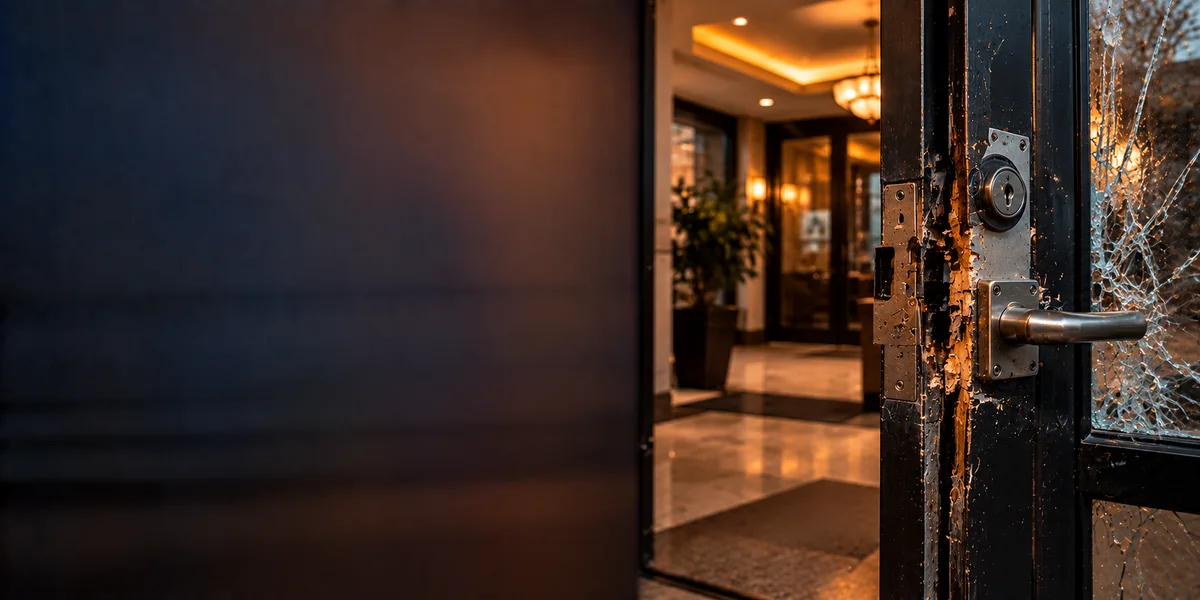
Yes, you can sue your landlord for inadequate security—even if your lease has a clause claiming the landlord "is not responsible for crime or theft."
Under Negligent Security (Premises Liability) and state housing laws, landlords have a strict legal duty to provide working door deadbolts, window locks, well-lit parking lots/stairwells, and secure building entrances—and to maintain any security gates, cameras, or guards they promised in your lease. Depending on what happened, you have three ways to take legal action:
- If You or a Guest Were Assaulted, Robbed, or Injured ($50,000 to $1,000,000+ Insurance Settlements): If an intruder attacked you because the landlord ignored a broken lobby door, propped-open security gate, dark stairwell, or prior crime warnings, a personal injury lawyer can sue your landlord's commercial liability insurance policy at $0 upfront cost for medical bills, PTSD/trauma therapy, lost income, and pain and suffering.
- If Your Apartment Was Burglarized or Your Car Was Broken Into ($1,500 to $15,000 in Small Claims Court): If a thief entered through a broken window latch, an un-rekeyed apartment lock, a broken "gated garage" door, or with a maintenance master key, you can sue for stolen belongings, car repair/insurance deductibles, moving costs, and a 15%–35% rent refund.
- If No Crime Has Happened Yet, But Broken Doors/Gates Leave You Unsafe: You can call 311 Code Enforcement, sue for a monthly rent reduction for lost security amenities, or break your lease penalty-free under Constructive Eviction.
Important Steps to Take
- A "We Aren't Responsible for Crime" Clause in Your Lease Is Not a Free Pass: Landlords always point to lease disclaimers when a car or apartment is broken into. In nearly all 50 states, lease waivers cannot shield a landlord who violated state lock laws (
CA Civ. Code § 1941.3,TX Prop. Code § 92.153,NY MDL § 50-a) or left a promised security gate broken after repeated warnings! - Pull the Free Police "911 Calls-for-Service Log" for Your Building's Address: The #1 way to win a negligent security lawsuit is proving the landlord knew crime was happening on the property. File a free public records request with your local police department for all 911 dispatches to your complex over the last 24 months—that printout is courtroom gold.
- Paying for a "Gated Community" Where the Gate Is Always Broken? Sue for a Rent Refund: If your complex advertised "Controlled-Access Gated Parking" or "24/7 Courtesy Patrol" and left the gate stuck wide open for months, they are breaching your lease every single month—even before a break-in happens!
- No Forced Entry? Check Who Had the Master Key (Or the Old Tenant's Key): If your apartment was burglarized with zero damage to the lock, check if your landlord failed to re-key the deadbolt after the prior tenant left (mandatory in Texas and other states!) or let unvetted contractors/staff access the master key box.
- Save Evidence of the Broken Gate or Dark Light IMMEDIATELY: Just like broken stairs, landlords rush out the morning after a robbery or assault to fix the broken lobby latch or screw in new floodlights. Film the broken lock, open gate, or pitch-black walkway the same day!
The 5 Types of Inadequate Security Lawsuits Against Landlords (And What Each Pays)
When criminal activity occurs on rental property, landlords instinctively argue that they are not responsible for the independent criminal acts of third parties. While a landlord does not guarantee personal safety against random street crime, they are legally liable when their own negligent maintenance failures invite or facilitate the crime.
Under American premises liability jurisprudence, landlords owe tenants and lawful visitors a duty to maintain reasonably secure premises. This duty encompasses physical hardware—such as operational exterior deadbolts, functional window latches, automatic door closers, and working security gates—as well as adequate illumination in parking areas and corridors.
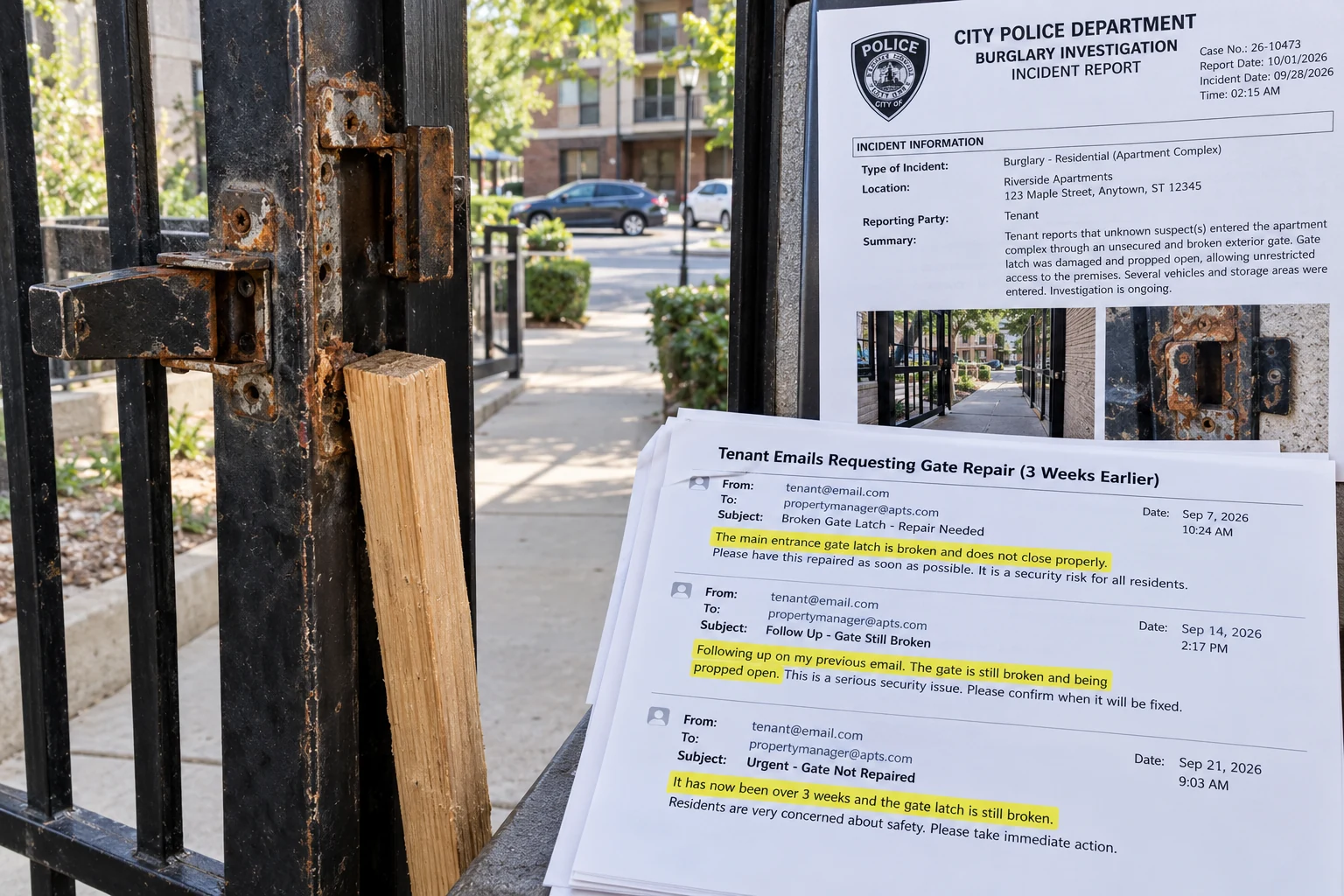
Depending on how the security failure occurred and the resulting harm, tenant claims fall into five established categories:
| Security Failure | Why the Landlord Is Legally Liable | Typical Court or Insurance Payout | Best Legal Venue |
|---|---|---|---|
| 1. Violent Assault, Robbery, or Attack on Property | Management ignored a broken lobby door latch, dark parking lot floodlights, or non-functioning vehicle gates despite prior reports or high area crime. | $50,000 to $1,000,000+ Paid via landlord commercial general liability (CGL) policy |
Civil Court with a Personal Injury Lawyer ($0 upfront contingency fee). |
| 2. Apartment Burglary via Defective Deadbolt or Window Latch | Direct breach of mandatory state lock laws and implied warranty of habitability; failure to provide secure physical barriers triggers negligence per se. | 100% Stolen Property + $2,000–$10,000 emotional trauma + moving costs. | Small Claims Court (or Civil Court if stolen property exceeds statutory limits). |
| 3. Burglary With NO Forced Entry (Un-Rekeyed or Master Key) | Landlord failed to re-key locks between tenancies (mandatory in Texas under Prop. Code § 92.156) or allowed unvetted maintenance staff unmonitored master key access. | Full Property Loss + punitive damages + statutory fines (1 month rent + $500 in Texas). | Small Claims or Civil Court alongside police report. |
| 4. Car Theft / Smashed Windows in "Gated" Garage | Landlord induced tenants to lease by charging for "controlled-access gated parking," then left the electronic gate stuck open for weeks or months. | Auto Deductible + stolen contents + 15%–25% rent refund for every month gate was broken. | Small Claims Court (Breach of Contract & Negligent Misrepresentation). |
| 5. Broken Lobby Door / Trespassers (No Crime Yet) | Breaches the warranty of habitability and local building codes (IPMC § 304.18); tenants do not have to wait for an assault to take decisive legal action. | 15%–35% Monthly Rent Abatement + $0 Penalty Lease Break + 100% deposit return. | 311 Code Enforcement + Small Claims Court. |
If your security dispute stems from broader landlord defaults—such as unanswered repair tickets or habitability failures—see our core pillar guide on when you can sue your landlord.
Why the Lease "Landlord Is Not Responsible for Crime" Clause Does NOT Stop Your Lawsuit
When a tenant reports a stolen vehicle, an apartment break-in, or a frightening encounter with a trespasser, management almost universally points to a boilerplate exculpatory clause buried in the lease.
Typically, these clauses state: "Resident acknowledges that Owner does not provide security, does not guarantee protection against crime, and is not liable for theft, vandalism, or criminal acts of third parties." Property managers rely on this language hoping tenants will immediately abandon legal claims. In civil court, however, these sweeping disclaimers routinely collapse under judicial scrutiny.
1. Mandatory State Lock & Safety Statutes Cannot Be Waived
State legislatures have enacted explicit statutory protections declaring security disclaimers null and void. In California under Civil Code § 1953, any lease provision that waives or modifies a landlord's duty of care or liability for negligence is contrary to public policy and completely void. New York enforces an identical prohibition under General Obligations Law § 5-321, while Texas strictly forbids waiving residential security device mandates under Property Code § 92.006.
2. You Are Suing for the Landlord's Own Negligence, Not the Burglar's Conduct
An exculpatory clause cannot shield a party from its own active negligence. When a tenant brings a negligent security lawsuit, the cause of action does not claim the landlord committed the burglary or assault. Rather, the lawsuit establishes that the landlord breached its independent common-law duty to maintain exterior doors, security gates, and perimeter illumination, thereby creating the physical vulnerability that allowed the intruder entry.
3. The "Assumed Duty" Doctrine for Advertised Amenities
Under contract law and the Restatement (Second) of Torts § 323, when a landlord advertises a property as a "luxury gated community," promises "24/7 courtesy patrol," or installs an electronic access-control system, they have voluntarily assumed a legal duty to maintain that security feature in working order. If the landlord permits the gate to stand wide open for months while continuing to collect premium rents, they have breached both an express contractual covenant and an assumed safety duty.
When security promises in your lease are breached, review our detailed guide to suing for breach of lease.
How to Prove the Crime Was "Foreseeable" in 10 Minutes (The Police Call-Log Secret)
The central pillar of every negligent security lawsuit is foreseeability. Under landmark legal authority such as Kline v. 1500 Massachusetts Ave. Apartment Corp. (439 F.2d 477), a landlord is only liable for third-party criminal attacks if the landlord had notice of conditions or prior incidents making the crime foreseeable.
Demonstrating foreseeability does not require showing that the exact same crime happened previously in your specific apartment. It requires proving that management knew the property was vulnerable to criminal intrusion and failed to take reasonable security countermeasures.
1. Maintenance Portal Tickets & Online Reviews
Preserve every work order submitted by you or your neighbors regarding broken gate motors, malfunctioning door strikes, or unlit stairwells. Check Google Maps and Yelp for public 1-star reviews from other tenants complaining about building break-ins months before your incident occurred.
2. Free Police "911 Calls-for-Service" CAD Logs
Submit an open records request to your local municipal police department for the Computer-Aided Dispatch (CAD) call log for your apartment complex's address over the preceding 24 to 36 months. A police printout showing dozens of prior burglary, assault, or prowler dispatches demolishes any landlord claim that crime was unexpected.
3. Immediate Photographic & Video Documentation
Within hours of an incident, record video showing how exterior security gates swing open freely or how lobby doors fail to latch automatically. Capture nighttime footage of unlit walkways and parking bays without camera flash to establish the actual visual darkness encountered by occupants.
If the landlord's security failures stem from broader property indifference, review our comprehensive analysis on proving landlord negligence.
State-by-State Mandatory Lock, Peephole & Building Security Laws
When a landlord violates a specific statutory security standard, the plaintiff does not need to debate general negligence principles. The statutory violation establishes negligence per se, where liability is presumed as a matter of law.
| Jurisdiction | Mandatory Security Hardware Required by Law | Automatic Statutory Remedies |
|---|---|---|
| Texas (Tex. Prop. Code §§ 92.153–92.165) | Must provide on all exterior doors: (1) keyless bolting device (inside deadbolt); (2) door viewer (peephole); (3) exterior deadbolt; (4) sliding glass door pin locks and security bars; and mandatory re-keying within 7 days of every tenant turnover. | If landlord fails to cure within 7 days of written notice: tenant can repair-and-deduct, break lease for $0, and recover 1 month rent + $500 civil penalty + actual damages + 100% attorney fees. |
| California (Cal. Civ. Code § 1941.3) | Deadbolt locks with minimum 13/16-inch throw on swinging exterior doors; working window locks on ground-floor and accessible windows; locking common-area entry doors in multi-unit buildings. | Repair-and-deduct, habitability rent abatement, statutory tort liability, and automatic negligence per se if an un-repaired lock results in a burglary or attack. |
| New York (NY Multiple Dwelling Law §§ 50-a, 51-c) | Automatic self-closing and self-locking entrance doors in buildings with 8+ units; two-way voice intercom system; door peepholes; and an absolute right under § 51-c for tenants to install an additional deadbolt. | NYC 311 / HPD Class B & C violations, immediate rent abatement in Housing Court, and full premises liability under the Burgos v. Aqueduct Realty Corp. doctrine for unlocked entrances. |
| Virginia, Washington, Florida & IPMC Municipalities | International Property Maintenance Code (§ 304.18) mandates 1-inch throw deadbolts on all unit entry doors, secure window sash locks, and continuously illuminated interior stairwells and public access points. | 311 municipal building code citations, Small Claims property recovery, and constructive eviction lease cancellations. |
| 45+ States: Emergency Domestic Violence Lock-Out Laws | Landlords must change exterior entry locks within 24 to 72 hours upon receiving written notice or a court protection order involving domestic violence, sexual assault, or stalking (e.g., CA Civ. Code § 1941.5). | Tenant may change locks independently and deduct expenses if landlord misses deadline; full civil liability attaches if landlord fails to comply and harm occurs. |
If the core failure involves broken entry hardware that management ignored, consult our dedicated guide on suing for broken apartment locks.
How to Break Your Lease for $0 If Your Building Is Unsafe (Before You Become a Victim!)
You are not legally obligated to remain in an apartment and wait to become the victim of a violent crime or burglary when management refuses to secure the premises.
Under the doctrine of Constructive Eviction and the implied warranty of habitability, a landlord's persistent failure to maintain functional entrance locks, security gates, or perimeter lighting renders the premises legally uninhabitable. By adhering to a strict three-step protocol, tenants can vacate without early termination penalties and recover their full security deposit.
The 3-Step Safe Exit Protocol
- Step 1: Deliver Formal Written Notice to Cure (7 to 14 Days): Send written notice via certified mail and the online tenant portal detailing the security defect (such as broken lobby door locks, open garage gates, or burned-out floodlights). Explicitly state that the security failure breaches the implied warranty of habitability and state lock codes, giving the landlord statutory cure time (typically 7 days in Texas and Florida, or 14 to 30 days in other jurisdictions).
- Step 2: Request a 311 Municipal Housing Code Inspection: Contact city building code enforcement or the fire marshal to inspect common-area entrances, broken exterior gates, and unlit hallways. A formal notice of violation issued by a municipal inspector under IPMC § 304.18 provides objective evidence that the building was legally unsafe.
- Step 3: Vacate and Declare Constructive Eviction: If the cure period expires and management has failed to restore security hardware, deliver a final notice of lease termination for constructive eviction. Surrender keys, document the vacant unit condition with date-stamped video, and demand the immediate return of your security deposit and moving expenses.
For step-by-step legal procedures regarding lease cancellations, review our authoritative guides on constructive eviction lawsuits and landlords entering without permission. If management installed fake or unauthorized surveillance, examine suing a landlord for security camera issues.
Ready-to-Send Inadequate Security Repair, Refund & Insurance Claim Demand Letter
Serving a formal written demand is essential whether you are seeking immediate security hardware repairs or pursuing financial recovery after an intrusion. Choose the appropriate notice below, click the button to copy, customize the bracketed information, and send via certified mail and email.
URGENT NOTICE OF INADEQUATE SECURITY, HABITABILITY VIOLATION,
AND FORMAL DEMAND FOR REPAIR AND RENT ABATEMENT

Date: [Current Date]
VIA CERTIFIED MAIL (RETURN RECEIPT REQUESTED) AND RESIDENT PORTAL

To:
[Landlord / Property Management Company Name]
[Property Management Office Address]
[Management Email Address]

Premises: [Apartment Complex Name, Your Unit Number, Full Street Address]
Tenant Name: [Your Full Legal Name]

Dear [Landlord / Property Manager Name]:

Please accept this letter as formal written notice that the property located at [Address] suffers from severe, ongoing security defects that violate the implied warranty of habitability, municipal property maintenance codes, state residential lock statutes, and express covenants of my lease agreement.

SPECIFIC SECURITY DEFECTS:
Commencing on or about [Date condition began], the following security hardware has remained broken, inoperable, or unmaintained:
[ ] Main building entrance / lobby door lock fails to latch or close automatically;
[ ] Vehicle security gate to gated parking garage is broken and permanently stuck open;
[ ] Parking lot / common stairwell exterior floodlights are burned out, creating darkness;
[ ] Apartment unit deadbolt / window latch is defective or improperly installed.

Management has received prior notice of these defects via maintenance tickets dated [List previous ticket dates], yet the hazards remain uncorrected. As a direct consequence, unauthorized non-residents and trespassers have gained unimpeded access to the premises, creating a severe and foreseeable risk of burglary, theft, and physical assault.

FORMAL DEMAND FOR IMMEDIATE ACTION:
Pursuant to governing statutory safety codes, I hereby demand that management:
1. Complete permanent professional repairs to the defective [lock / security gate / lighting] within seventy-two (72) hours of receipt of this notice;
2. Issue a retroactive rent credit in the amount of $[Amount] reflecting the diminished rental value of the premises during the period of security failure; and
3. Reimburse $[Amount] in documented out-of-pocket losses resulting from the security failure.

Be advised that boilerplate lease clauses disclaiming liability for criminal acts cannot waive statutory lock mandates or active management negligence under governing state law. If complete repairs are not verified within the statutory cure window, I will exercise my statutory remedies, including municipal code enforcement reports, repair-and-deduct procedures, and formal lease cancellation under constructive eviction.

Sincerely,

_________________________________________
[Your Signature]

[Your Printed Name]
[Apartment / Unit Number]
[Your Phone Number]
[Your Email Address]
NOTICE OF NEGLIGENT SECURITY INJURY / PROPERTY LOSS,
DEMAND FOR CGL INSURANCE CARRIER, AND EVIDENCE SPOLIATION HOLD

Date: [Current Date]
VIA CERTIFIED MAIL (RETURN RECEIPT REQUESTED) AND EMAIL

To:
[Landlord / Property Management Company Name]
[Property Management Office Address]
[Management Email Address]

Re: Incident Date: [Date of Assault / Burglary / Vehicle Theft]
Police Incident Report Number: [Police Incident / Case Report #]
Premises: [Property Name, Unit Number, and Full Address]
Claimant: [Your Full Legal Name]

Dear [Landlord / Property Manager Name]:

This letter provides formal notice of a serious criminal incident occurring at [Apartment Complex Name / Address] directly resulting from management's negligent security failures, and establishes a strict legal hold regarding all relevant electronic and physical evidence.

INCIDENT SUMMARY:
On [Date] at approximately [Time], Claimant was subjected to a [physical assault / robbery / apartment burglary / vehicle theft inside the gated garage] at [Exact location on property]. The intruder gained access due to defective security conditions, specifically [broken lobby door latch / permanently open parking gate / unlit parking lot / un-rekeyed apartment lock], which management knew or should have known presented an unreasonable risk of foreseeable criminal intrusion.

As a direct result of this security failure, Claimant suffered [physical injuries requiring medical treatment / substantial stolen property / vehicular damage and trauma], resulting in damages totaling $[Amount].

LEGAL SPOLIATION HOLD (EVIDENCE PRESERVATION MANDATE):
You are hereby formally directed to preserve and maintain in an un-altered condition all physical, digital, and electronically stored information (ESI) concerning the subject property for the period from [Date 60 days before incident] to the present, including but not limited to:
1. Video surveillance footage from all on-site cameras (internal lobbies, entry gates, parking lots, and elevators);
2. Electronic key-fob access logs, gate transponder records, and master key sign-out sheets;
3. All tenant maintenance tickets, service requests, and emails referencing broken locks, gates, or lighting;
4. Contractor repair invoices and quotes regarding security gates and exterior doors; and
5. Security incident logs and courtesy patrol reports.
Destruction, deletion, or overwriting of this footage or data will be treated as intentional spoliation of evidence in subsequent litigation.

DEMAND FOR INSURANCE DISCLOSURE:
Pursuant to governing civil disclosure rules, please forward the name, claims office address, and policy number of your Commercial General Liability (CGL) insurance carrier within five (5) business days so this matter may be submitted directly to your insurer.

Sincerely,

_________________________________________
[Your Signature]

[Your Printed Name]
[Apartment / Unit Number]
[Your Phone Number]
[Your Email Address]
How Much Compensation Can You Recover for Negligent Security?
When taking your landlord to Small Claims Court or Housing Court, financial recovery is determined by statutory damages categories, proven out-of-pocket losses, and rent reduction formulas:
| Recovery Category | Calculation Standard | Statutory Authority & Limits |
|---|---|---|
| 1. Stolen or Vandalized Property Value | Fair market value compensation for personal property stolen during break-ins resulting from broken entry gates or window latches. | Premises liability tort damages (Kline v. 1500 Mass. Ave., 439 F.2d 477). |
| 2. Physical Injury & Trauma Outlays | Medical treatment, psychological counseling, and lost income if tenant was assaulted due to foreseeable negligent security. | Compensatory personal injury damages. |
| 3. Immediate Lease Rescission | Right to terminate lease immediately without fees under statutory safe-home provisions or constructive eviction. | Constructive eviction doctrine. |
Small Claims Filing Limits: Most tenants resolve these disputes without hiring an attorney in Small Claims Court. Maximum claim limits vary by state: for example, $12,500 in California (California Courts Self-Help), $10,000 in New York City (NY Courts Small Claims), and $20,000 in Texas (Texas Judicial Branch). If your total damages exceed small claims thresholds, you may file in standard civil district court.
Frequently Asked Questions
Calculate Your Inadequate Security Lawsuit Payout
Estimate your potential compensation for broken gate car thefts, apartment burglaries, physical assaults, or ongoing security failures under state premises liability and lock statutes.
SueLegal is an independent educational legal publisher, not a law firm or lawyer referral service. The information provided in this guide is for general informational and educational purposes only and does not constitute formal legal advice. Residential landlord-tenant laws, repair notice periods, and statutory remedies vary significantly across state and municipal jurisdictions. If you are facing eviction, severe uninhabitable conditions, or complex litigation, consult a licensed attorney in your jurisdiction or contact your local legal aid organization. For more details on our standards, read our Editorial Policy and Legal Research Methodology.